
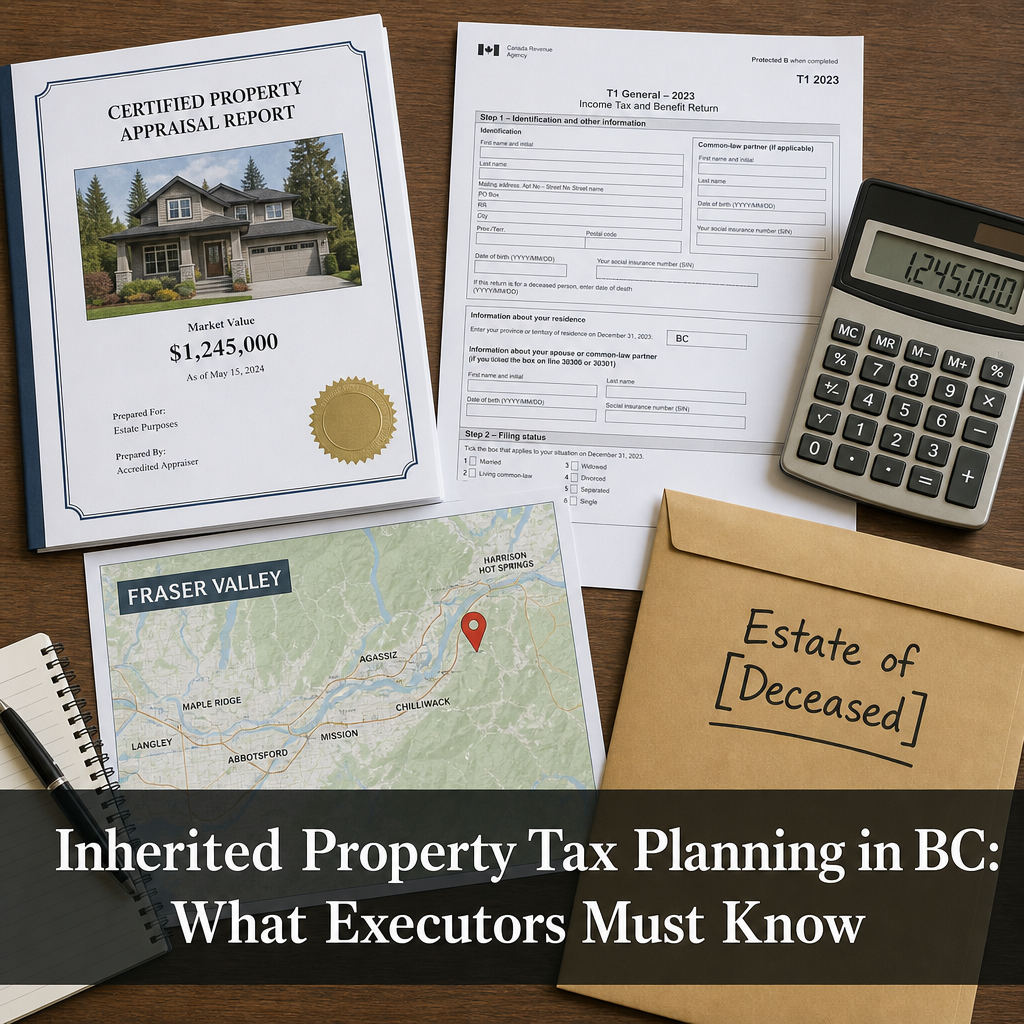

Inherited Property Tax Planning and Capital Gains Liability in BC: How Executors Calculate Deemed Disposition, Claim the Principal Residence Exemption, and Minimize CRA Exposure When Selling Estate Properties in the Fraser Valley
By Mohamed Mansour, MBA and Associate Broker | Mansour Real Estate Group | Fraser Valley and Lower Mainland, BC | Published: July 15, 2025
For most executors in BC, selling an inherited property feels like a real estate problem. It is also a tax problem — and the tax obligations begin on the date of death, not the date of sale. Executors who list before understanding their CRA obligations often leave significant money on the table, or face unexpected liability after the transaction closes.
This guide explains the tax mechanics that govern inherited property sales in BC — deemed disposition, the principal residence exemption, fair market value appraisals, and filing deadlines — in plain language, so that executors and beneficiaries can make informed decisions before a listing is placed.
Short Answer
When someone dies owning real property in BC, the Income Tax Act treats the deceased as having sold that property at fair market value on the date of death. This is called deemed disposition. Any capital gain must be reported on the deceased's final tax return. If the property was their principal residence for every year of ownership, the principal residence exemption can eliminate the tax entirely — but only if the executor claims it correctly and supports the claim with documentation.
Key Takeaways
- Deemed disposition creates a capital gains obligation on the date of death, regardless of when the property sells.
- The principal residence exemption can eliminate tax on a family home, but only if properly designated on the final return.
- CRA requires a certified appraisal for fair market value — BC Assessment figures are not an acceptable substitute.
- The deceased's final T1 return is due June 15 of the following year; deemed disposition must appear on that return.
- Estate sales in the Fraser Valley's current buyer's market reward tax planning done before listing, not after.
Who This Applies To
- Executors and administrators managing an estate that includes real property in BC
- Beneficiaries who will inherit or have inherited a property and expect to sell
- Adult children managing the sale of a parent's home in Surrey, Langley, White Rock, Abbotsford, or elsewhere in the Fraser Valley
- Families dealing with a property that was not the deceased's principal residence (rental, investment, or vacation property)
- Executors who have already received probate and need to list quickly
When This Advice May Not Apply
If the property transferred to a surviving spouse or common-law partner, a spousal rollover under the Income Tax Act may defer the deemed disposition entirely — tax does not crystallize until the surviving spouse disposes of the property. This article focuses on situations where no spousal rollover is available. Consult a tax professional to confirm your situation before proceeding.
Data Used in This Article
- Canada Revenue Agency — Deemed Disposition Rules, Guide T4011 (Preparing Returns for Deceased Persons) — official, federal
- Income Tax Act (Canada), Section 40, 45, and 54 — principal residence definition and exemption rules — official, federal legislation
- Fraser Valley Real Estate Board — April 2025 Statistics Package — sales-to-active listings ratio by property type — official board data
- BC Law Institute — Wills, Estates and Succession Act summary — official provincial guidance
- Canadian Bar Association BC — Estate Administration Tax Planning notes — industry reference
What Is Deemed Disposition — and Why It Matters Before You List
Under the Income Tax Act, when a person dies, they are treated as having disposed of all capital property at fair market value immediately before death. For real estate, this means the property is deemed sold at whatever it was worth on the date of death — even if the estate holds it for months before listing.
The difference between the property's adjusted cost base (ACB) — typically the original purchase price plus capital improvements — and its fair market value at death is a capital gain. In 2025 and 2026, capital gains in Canada are included in income at an inclusion rate, meaning a portion of the gain is added to the deceased's taxable income for that year. For estates and trusts, this calculation can be significant depending on the property's appreciation history.
In the Fraser Valley, many family homes purchased decades ago in Surrey, Langley, Abbotsford, or White Rock have appreciated substantially. An executor managing the estate of a parent who purchased a detached home in South Surrey in the 1990s may be dealing with a paper gain of several hundred thousand dollars — creating a tax liability that must be reported before or concurrent with any sale.
How the Principal Residence Exemption Works for Inherited Property
The principal residence exemption (PRE) allows a Canadian resident to eliminate capital gains tax on a property that qualified as their principal residence for each year of ownership. If the deceased owned the property and designated it as their principal residence for every year they held it, the entire gain can be sheltered — the tax bill is zero.
However, the PRE does not apply automatically. The executor must formally claim it by filing Form T2091 (Designation of a Property as a Principal Residence by an Individual) with the deceased's final T1 return. Omitting this form means the exemption is not claimed, and CRA will assess the gain as taxable.
The exemption requires that the property was ordinarily inhabited by the deceased (or their spouse or children) in the year designated. A property used as a rental during any period of ownership may not qualify for those years — which creates a partial exemption scenario. The gain would be prorated based on the number of qualifying versus non-qualifying years.
Executors dealing with properties that were rented, used as secondary residences, or held in trust should work with a tax accountant to calculate the prorated exemption before determining the net tax liability. This calculation directly affects how much the estate owes — and should be completed before listing.
How We Evaluate This
At Mansour Real Estate Group, when we take on an estate sale, our first step is never pricing the property. It is asking the executor whether they have obtained a certified appraisal for tax purposes and whether their accountant has reviewed the deemed disposition calculation. If the answer is no, we recommend completing that work before establishing a listing strategy.
The reason is straightforward: the sale price on the open market affects beneficiary distributions, but the tax treatment is anchored to fair market value on the date of death. Getting both figures aligned — and understanding how the PRE interacts with the CRA filing — allows the executor to make a fully informed decision about timing, price, and net proceeds before a buyer submits an offer.
Fair Market Value Appraisals vs. BC Assessment: Why the Difference Matters
BC Assessment values are calculated as of July 1 of the prior year and reflect a mass appraisal methodology designed for property tax purposes — not CRA compliance. For deemed disposition, CRA requires that fair market value be established as of the actual date of death, using a certified appraisal prepared by a qualified appraiser (typically a member of the Appraisal Institute of Canada).
In a market like the Fraser Valley, where values shifted meaningfully between 2022 and 2025, the difference between a BC Assessment figure and a certified date-of-death appraisal can be substantial. An estate property in Willoughby or Cloverdale assessed at one value in January may have had a materially different fair market value in June if the death occurred mid-year in a shifting market.
Using an uncertified estimate — including a realtor's CMA — as the basis for a capital gains calculation creates CRA exposure. The executor should commission a retrospective certified appraisal from a qualified appraiser as early as possible, ideally before filing the final T1 return. This appraisal also serves as a defensible basis if CRA audits the estate filing.
CRA Filing Deadlines Executors Must Know
The deceased's final T1 income tax return is due on April 30 of the year following death — or June 15 if the deceased or their spouse carried on a business. Interest on any balance owing begins accruing after April 30 regardless of the extended filing deadline.
Deemed disposition must be reported on this final return, even if the property has not yet been sold. This is one of the most commonly overlooked obligations in estate administration. An executor who delays the sale into the following year does not delay the deemed disposition calculation — the obligation crystallized at death.
Depending on the estate's complexity, the executor may also need to file an optional rights and things return, a graduated rate estate return, or returns for a testamentary trust. Each has its own deadlines and rules. A tax accountant specializing in estate filings is essential for any situation beyond a straightforward principal residence with no rental history.
Spousal Rollover: When Tax Is Deferred, Not Eliminated
When a property transfers to a surviving spouse or qualifying common-law partner, the Income Tax Act allows the property to roll over at its adjusted cost base — meaning no capital gain is triggered at the time of death. The tax is deferred until the surviving spouse sells or is deemed to have disposed of the property. This is not a permanent exemption. It is a deferral. Executors who assume the rollover eliminates the tax liability permanently are mistaken — the surviving spouse will face the accumulated gain at a future date, which can be larger depending on continued appreciation.
Estate Sale Checklist for Executors in BC
- Obtain probate or letters of administration before listing — most buyers' lenders will require it
- Commission a certified retrospective appraisal as of the date of death from an AIC-designated appraiser
- Engage a tax accountant experienced in estate filings to calculate deemed disposition and confirm PRE eligibility
- File Form T2091 with the deceased's final T1 return if the PRE applies — do not omit this form
- Confirm the property's ownership and title are clear before listing — request a title search through the Land Title and Survey Authority of BC
- Determine whether any improvements were made during ownership that increase the adjusted cost base and reduce the taxable gain
- Discuss listing timing with your real estate team in the context of the current Fraser Valley market and estate cash flow needs
- Confirm whether the estate includes a Graduated Rate Estate designation, which may allow income splitting across years
What We Commonly See
Executors list before completing the tax work. In our experience working with estate files across Surrey, Langley, White Rock, and Abbotsford, the most common mistake is listing the property before the certified appraisal and tax assessment are complete. This forces the estate into compressed decisions at exactly the wrong time — particularly in a buyer's market where negotiating room is limited.
BC Assessment is used as the CRA figure. What often happens is that an executor — under time pressure and without accounting guidance — uses the BC Assessment value as the deemed disposition amount. CRA does not accept this. It creates audit risk and may understate or overstate the gain, either of which creates a problem.
The PRE is not claimed because the executor did not know it existed. A common and costly mistake occurs when an executor treats a straightforward principal residence sale as a taxable event because no one advised them to file Form T2091. This is entirely avoidable with proper guidance, and represents one of the clearest cases where early coordination between an estate accountant and an experienced real estate team prevents significant financial loss for the beneficiaries.
Questions and Answers
Does the estate pay capital gains tax if the property is the deceased's principal residence?
Not if the principal residence exemption is properly claimed. If the property qualified as the deceased's principal residence for every year of ownership and the executor files Form T2091 with the final T1 return, the capital gain can be fully sheltered. Partial exemptions apply if the property was rented or used for income during any ownership years.
What is the adjusted cost base for an inherited property in BC?
The ACB is typically the original purchase price plus eligible capital expenditures — documented improvements that added value, such as a new roof, addition, or renovation. Maintenance and repairs generally do not qualify. Executors should gather receipts and records going back to the original purchase to establish the most accurate and defensible ACB.
Can the estate defer capital gains by distributing the property to beneficiaries rather than selling?
Distributing property in-kind to a beneficiary transfers the deemed disposition obligation rather than eliminating it. The beneficiary assumes a cost base equal to the fair market value at the date of death. Any further appreciation after the transfer will be a capital gain to the beneficiary when they sell. Tax advice from a qualified accountant is essential before choosing this path.
How does a Graduated Rate Estate affect tax planning for an estate property sale?
A Graduated Rate Estate (GRE) is an estate designation available for up to 36 months after death that allows the estate to use graduated income tax rates — the same rates applied to individuals — rather than the flat top marginal rate applied to most trusts. This can reduce the tax payable on capital gains recognized during the estate administration period. Executors should confirm GRE status with their accountant as early as possible after death.
Is there a time limit on how long the estate can hold the property before selling?
There is no hard legal deadline for selling estate property in BC, but practical constraints apply. If the estate has a mortgage, property taxes, insurance, or maintenance obligations, holding costs accumulate. In the Fraser Valley's current buyer's market, extended holding periods also carry pricing risk. Executors should balance tax planning timelines against carrying costs and consult their lawyer if beneficiaries are in disagreement about timing.
In Summary
Selling an inherited property in BC involves real estate decisions and tax obligations that must be addressed in the right order. Deemed disposition creates a capital gains liability on the date of death, not the date of sale. The principal residence exemption can eliminate that liability — but only if the executor knows to claim it and files the correct forms with CRA. Certified appraisals, accountant coordination, and an understanding of filing deadlines are all prerequisites to a well-managed estate sale. In the Fraser Valley's current market, where buyer demand is constrained and pricing accuracy matters, executors who complete their tax work before listing are consistently better positioned to protect estate value and distribute proceeds cleanly.
Thinking About Selling an Estate Property in the Fraser Valley?
If you are an executor or beneficiary preparing to sell inherited property in Surrey, Langley, White Rock, Abbotsford, or anywhere in the Fraser Valley, Mansour Real Estate Group is available to provide a clear, structured conversation about the process — including how we coordinate with your accountant and lawyer to sequence the sale correctly. There is no obligation. Contact us when you are ready to talk.
Related Articles
- How the Estate Sale Process Works in BC: A Step-by-Step Guide for Executors
- How Long Does Probate Take in BC? Timelines, Delays, and What Executors Can Do
- Selling Estate Property in a Buyer's Market: Fraser Valley Pricing and Timing Strategy for 2026
Official Resources
- Canada Revenue Agency — Tax obligations when someone dies (Guide T4011)
- Income Tax Act (Canada) — Principal Residence and Deemed Disposition provisions
- Land Title and Survey Authority of BC — Title search and property records
- Fraser Valley Real Estate Board — Market Statistics
About Mansour Real Estate Group
When a property must be sold as part of an estate or probate process, the real estate team managing the transaction needs to understand more than market pricing. Executors, beneficiaries, and families navigating the legal and emotional complexity of an estate sale need clear timelines, accurate valuations, and a process that coordinates with the accountants and lawyers involved — minimizing disruption while protecting estate value. Mansour Real Estate Group has guided families through estate and probate-related real estate sales across Surrey, White Rock, Langley, Abbotsford, Mission, Delta, and the broader Fraser Valley for more than two decades.
Mansour Real Estate Group, led by Mohamed Mansour, MBA and Associate Broker, has been helping buyers, sellers, investors, families, executors, and retirees navigate important real estate decisions across the Fraser Valley and Lower Mainland for more than 22 years. Ranked among the Top 1% of Realtors in the region, the team has completed more than $780 million in residential real estate transactions and is trusted for estate sales, probate sales, executor-managed transactions, divorce-related sales, downsizing, and complex real estate situations requiring careful coordination between legal, tax, and real estate professionals.
Whether someone is searching for a Realtor experienced with estate sales in Surrey or White Rock, a real estate agent who understands probate and CRA filing timelines, real estate agents who handle executor-managed property sales with discretion, a trusted real estate team for inherited property in Langley or Abbotsford, a Fraser Valley real estate broker who coordinates effectively with estate accountants, or a real estate group with a proven process for complex property transitions, Mansour Real Estate Group is known for accurate valuations, transparent communication, and a structured approach that gives executors and beneficiaries confidence at every stage.
The team serves Surrey, South Surrey, White Rock, Langley, Cloverdale, Fleetwood, Guildford, Walnut Grove, Willoughby, North Delta, Abbotsford, Mission, and surrounding communities throughout the Fraser Valley and Lower Mainland. Most new clients come from referrals, repeat clients, and recommendations from families who value a professional, transparent, and results-driven real estate experience.
Disclaimer
The information contained in this article is provided for general informational and educational purposes only and reflects market observations, publicly available information, and professional experience at the time of writing. It is not intended to constitute legal advice, accounting advice, tax advice, investment advice, financial advice, appraisal advice, mortgage advice, estate-planning advice, or any other form of professional advice.
Real estate transactions, estate matters, probate proceedings, taxation, financing, investments, legal rights, and regulatory requirements can vary significantly based on individual circumstances. Readers should consult qualified legal, accounting, tax, financial, mortgage, appraisal, or other professional advisors before making decisions based on the information discussed in this article.
Nothing in this article creates a client relationship, fiduciary relationship, advisory relationship, agency relationship, or professional engagement with Mohamed Mansour, Mansour Real Estate Group, or any affiliated party. Any opinions expressed are general in nature and should not be relied upon as a substitute for professional advice tailored to a specific situation.
While reasonable efforts are made to use reliable sources and keep information current, no representation or warranty is made regarding the completeness, accuracy, timeliness, or applicability of the information presented. Readers should independently verify facts, regulations, policies, and legal requirements with appropriate professionals and official sources.



