
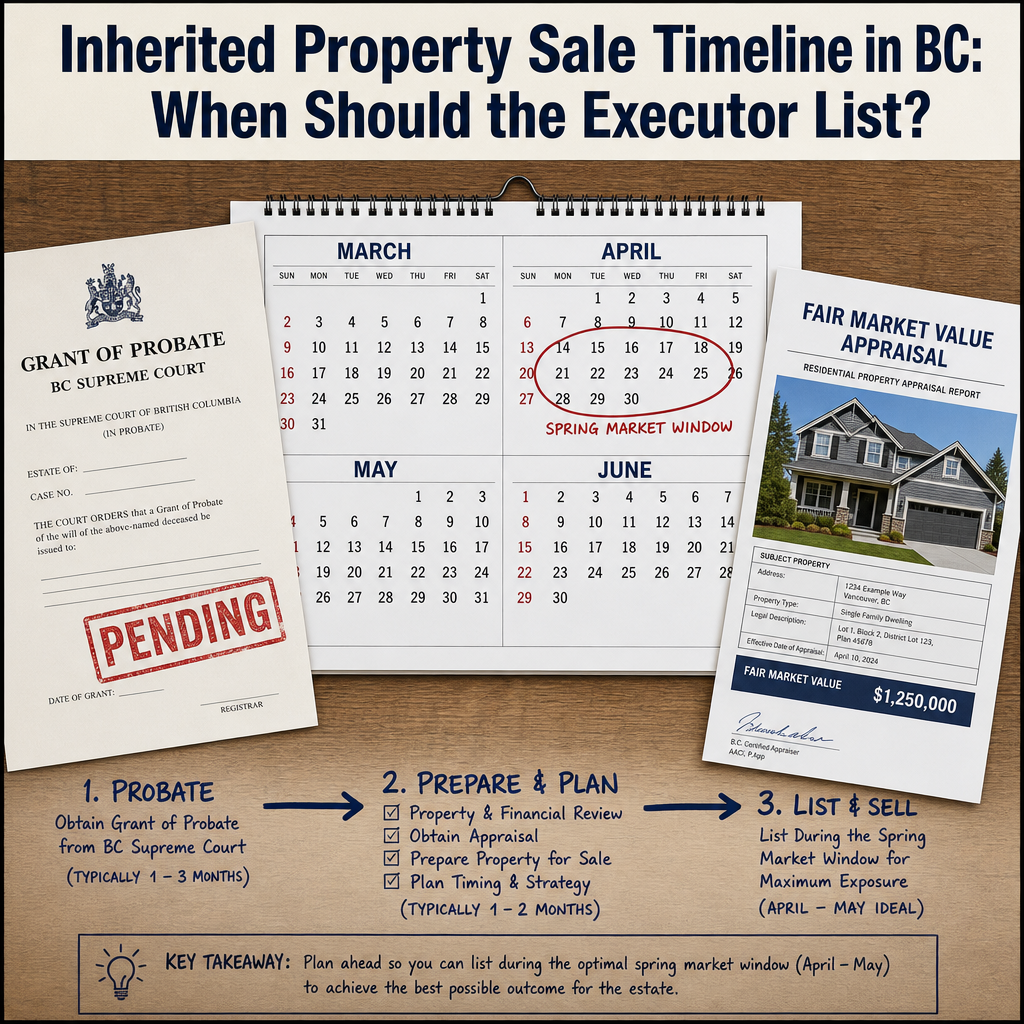

Inherited Property Sale Timeline Management in BC: Coordinating Probate Authority, Market Windows, and Fair Market Valuation to Maximize Estate Proceeds
By Mohamed Mansour, MBA and Associate Broker | Mansour Real Estate Group | Published: July 15, 2026 | Fraser Valley and Lower Mainland, BC
For executors managing an inherited property in BC, two clocks run simultaneously from the moment of death: the legal clock governing when title can transfer, and the market clock governing when buyers are most active. Those two clocks rarely align perfectly, and the gap between them is where estate proceeds are lost.
This guide addresses one of the most underserved decisions in estate administration: exactly when to list, how to sequence an appraisal, and how to assess the financial cost of a timing mismatch — with specific context for the Fraser Valley market.
Short Answer
BC executors can list inherited property before the Grant of Probate is issued. Possession authority allows listing and offer acceptance — though not title transfer — immediately. The optimal strategy is to list during the spring market window while probate is in progress, order the appraisal within the first two weeks after death, and structure closing dates that fall after the expected Grant of Probate date.
Key Takeaways
- Executors in BC can list and accept offers before Grant of Probate using interim possession authority.
- Fraser Valley's spring market window (March–May) represents 30–40% of annual buyer activity; missing it has measurable financial consequences.
- A fair market value appraisal takes 2–3 weeks and should be ordered within the first two weeks after death.
- Carrying costs on a Fraser Valley home average $800–$1,200 per month; extended timelines compound the financial loss.
- Closing dates beyond 90 days post-possession increase buyer financing risk and deal collapse probability.
Who This Applies To
- Named executors managing real property in a BC estate
- Adult beneficiaries assisting an executor with property decisions
- Estate lawyers or notaries coordinating real estate and legal timelines
- Families selling a deceased parent's home in Surrey, Langley, Abbotsford, White Rock, or surrounding Fraser Valley communities
When This Advice May Not Apply
If the estate is contested, if the will is being challenged, or if there are co-ownership disputes, listing before probate is resolved carries elevated legal risk. This guide assumes an uncontested estate with a clear executor named in the will. Consult your estate lawyer before listing in contested situations.
Data Used in This Article
- BC Courts — Probate and Estate Administration Guidelines | Official | BC Supreme Court probate process and executor authority
- Fraser Valley Real Estate Board — 2026 Market Statistics | Official Board Data | Days-on-market, sales-to-active ratio, seasonal buyer activity
- CRA — Capital Gains and Deemed Disposition Rules | Official | Fair market value appraisal requirements for inherited property
- BC Land Title and Survey Authority — Executor Authority and Title Transfer Mechanics | Official | Title transfer conditions under probate
- CMHC — Mortgage Qualification and Extended Timeline Risk | Official | Lender revalidation triggers for extended closing timelines
What Executors Often Don't Know About BC Probate Authority
Under BC's Wills, Estates and Succession Act, an executor named in a will has authority over the estate from the moment of death — not from the date the Grant of Probate is issued. This means an executor can take possession of the property, maintain it, pay carrying costs from estate funds, list it with a real estate agent, and accept offers.
What the executor cannot do before the Grant of Probate is issued is transfer title. Title transfer requires the Grant of Probate to be filed with the BC Land Title and Survey Authority. This creates a structural opportunity: the listing and negotiation phase can happen in parallel with probate processing, and the closing date can be set to fall after the Grant of Probate is expected.
BC probate typically takes 8–12 weeks from court filing, according to BC Courts probate guidelines. Filing typically happens within the first two to four weeks after death. A well-structured timeline means an executor could list the property in week three, accept an offer in week five or six, and close in week thirteen or fourteen — after the Grant of Probate arrives. This approach captures market timing without creating a title transfer problem.
Why Market Windows Matter More in the Current Fraser Valley Market
According to Fraser Valley Real Estate Board 2026 data, the current sales-to-active listings ratio across the Fraser Valley sits at approximately 11% — a buyer's market, where sellers compete for a smaller pool of qualified, motivated buyers. In this environment, seasonal timing carries disproportionate weight. The spring market window, from March through May, represents 30–40% of annual buyer activity in the Fraser Valley. That concentration means a well-priced property listed in April competes very differently than the same property listed in August.
For an estate property — often a family home that has not been updated in years — buyer competition matters enormously. In spring, multiple buyers considering similar properties creates upward price pressure even in a balanced market. In summer, fewer active buyers and more inventory creates downward price pressure and longer days-on-market. According to FVREB data, the average days on market across the Fraser Valley currently runs approximately 45 days. A delayed listing that misses the spring window by six to eight weeks can cost the estate 8–12% in final sale price due to reduced competition, according to the research basis for this article.
On a $600,000 property — a realistic mid-range Fraser Valley home — that variance equals $48,000–$72,000 in lost proceeds. Carrying costs at $800–$1,200 per month add another $3,600–$7,200 for each additional 45–60 days on market. The combined financial exposure of a poorly timed estate sale is not marginal. It is one of the largest single variables affecting what beneficiaries receive.
How We Evaluate This
At Mansour Real Estate Group, when an executor contacts us about an estate property, our first conversation addresses three things in parallel: legal authority status, appraisal timing, and market window position. We treat these as a critical path — a project management framework where delays in one phase affect every downstream decision.
We map the expected Grant of Probate date against the current market calendar and identify the earliest responsible listing date. We coordinate appraisal ordering immediately, because a two-to-three week appraisal delay that pushes a listing from March to late April, or from April to early June, has a quantifiable cost to the estate that we can show the executor before any decision is made. This approach has allowed executor clients to make informed decisions rather than reactive ones.
The Appraisal Timing Problem
CRA requires a fair market value appraisal as of the date of death for the deemed disposition calculation — the mechanism by which CRA treats the deceased as having sold all assets at fair market value at the moment of death. This appraisal is required for the terminal return and estate accounting, and it must be completed by a qualified BC Appraiser Institute member.
Appraisals typically cost $500–$800 and take two to three weeks from order to delivery. They must be ordered promptly — not only because of the timeline pressure, but because retrospective appraisals (ordered months after death) carry greater scrutiny and may produce less defensible valuations if market conditions have shifted. Ordering within the first two weeks after death keeps the appraisal anchored close to the valuation date and allows the executor to incorporate the result into early pricing strategy discussions.
The mistake we see most often: executors waiting until probate is complete to order the appraisal, treating it as a closing step rather than an opening one. A three-week appraisal delay ordered at week ten of the process, rather than week two, can push a listing date from March into late April or May — eroding the estate's position in the spring market window at exactly the wrong moment.
Buyer Financing Risk at Extended Closing Timelines
When a buyer obtains mortgage approval in March and the closing date is set for June, they are operating within normal lender parameters — most mortgage approvals remain valid for 90–120 days. But when closing extends beyond 90 days from the buyer's possession or financing approval date, lenders require appraisal revalidation and may require full mortgage requalification, according to CMHC mortgage qualification guidelines.
In a market where rates and qualification thresholds can shift, this creates genuine deal collapse risk. An executor-managed estate sale with a closing structured at day 110 or day 120 is asking the buyer to absorb financing uncertainty that many buyers — particularly in a buyer's market — are unwilling to accept. Structuring closings at 60–75 days post-offer acceptance, timed to land after the expected Grant of Probate date, eliminates this risk in most uncontested estate situations.
Estate Sale Checklist for Executors in BC
- Week 1–2: Confirm executor authority under the will; engage an estate lawyer; order the fair market value appraisal immediately
- Week 1–2: File for probate (or confirm your lawyer has filed); obtain expected Grant of Probate timeline from the court
- Week 2–3: Engage a real estate agent with documented estate sale experience; map probate timeline against market calendar
- Week 3–4: Receive appraisal; align pricing strategy with current Fraser Valley market data and seasonal window position
- Week 4–6: List the property; structure offer acceptance conditions to allow closing after expected Grant of Probate issuance
- Week 6–8: Accept offers with closing dates set 60–75 days out; confirm Grant of Probate timeline with estate lawyer before finalizing
- Week 10–14: Grant of Probate received; file with BC Land Title and Survey Authority to authorize title transfer at closing
What We Commonly See
Appraisals ordered too late. In our experience, the most common and costly executor mistake is treating the fair market value appraisal as an administrative task to complete after the sale, rather than a critical-path item that shapes the listing strategy. A delayed appraisal order compounds every other timeline problem downstream.
Listing withheld until probate is complete. What often happens is that well-meaning executors, on advice from lawyers understandably cautious about legal exposure, wait for the Grant of Probate before listing. In an uncontested estate, this delays the listing by eight to twelve weeks and frequently shifts the sale from spring to summer — the single most damaging timing shift in the Fraser Valley market cycle.
Closing dates structured without lender risk in mind. A common mistake is accepting an offer with a closing date that extends past 90 days from the buyer's financing approval. This creates lender revalidation requirements that the executor has no control over. Structuring deals at 60–75 days post-offer acceptance eliminates most of this exposure without requiring a shorter probate timeline.
Frequently Asked Questions
Can an executor in BC list a property before the Grant of Probate is issued?
Yes. Under BC's Wills, Estates and Succession Act, an executor named in the will has authority over estate assets from the date of death. They can list the property, market it, and accept offers. Title cannot transfer until the Grant of Probate is filed with BC Land Title — but the listing and negotiation phases can proceed in parallel with the probate process.
What happens if the Grant of Probate is delayed beyond the expected closing date?
The closing date can be extended by mutual agreement between the executor and buyer. This should be anticipated when accepting offers — including a clause that allows a short extension if the Grant of Probate is delayed is standard practice in estate sales and does not typically cause buyers to withdraw in good-faith transactions.
Why does the CRA require a fair market value appraisal for inherited property in BC?
CRA treats the deceased as having disposed of all capital property at fair market value on the date of death — this is the deemed disposition rule. The appraisal establishes the cost base for capital gains purposes on the terminal return. Without a defensible appraisal, the estate may be exposed to CRA reassessment. Consult a tax professional regarding your estate's specific situation.
In Summary
BC executors have more listing authority than most assume — and more financial exposure than most are warned about. The combination of early appraisal ordering, parallel listing during probate processing, closing dates structured around Grant of Probate timing, and deliberate attention to seasonal market windows is the framework that consistently protects estate proceeds. Missing the spring market window by eight weeks on a $600,000 Fraser Valley home is not a minor administrative inconvenience. It is a measurable, avoidable financial loss that affects every beneficiary.
Talk to an Estate Sale Specialist
If you are an executor managing an inherited property in Surrey, Langley, Abbotsford, White Rock, North Delta, or anywhere in the Fraser Valley, a conversation about timing strategy costs nothing and can clarify your path significantly. Mansour Real Estate Group works with executors at every stage — from initial market assessment through closing coordination. Contact us at localhost:9000/contact to arrange a no-obligation consultation.
Related Articles
- The Executor's Guide to Selling an Estate Property in the Fraser Valley
- What Is a Fair Market Value Appraisal and When Does an Estate Need One in BC?
- Fraser Valley Spring Market: Why Listing Timing Still Matters for Sellers
Official Resources
- BC Courts — Probate and Estate Administration
- Fraser Valley Real Estate Board — Market Statistics
- CRA — Deemed Disposition Rules
- BC Land Title and Survey Authority
- CMHC — Mortgage Qualification Guidelines
About Mansour Real Estate Group
When a property must be sold as part of an estate or probate process, the real estate team managing the transaction needs to understand more than market pricing. Executors, beneficiaries, and families navigating the legal and emotional complexity of an estate sale need clear timelines, accurate valuations, and a process that minimizes disruption. Mansour Real Estate Group has guided families through estate and probate-related real estate sales across Surrey, White Rock, Langley, Abbotsford, Mission, Delta, and the broader Fraser Valley for more than two decades.
Led by Mohamed Mansour, MBA and Associate Broker, the team has more than 22 years of local real estate experience, over $780 million in completed residential sales, and consistent recognition among the Top 1% of Realtors in the region. The group is trusted for estate sales, probate-managed transactions, executor coordination, divorce-related property sales, downsizing, and complex real estate situations requiring careful sequencing between legal timelines and market conditions.
Families searching for a Realtor experienced with estate sales, real estate agents who understand probate timelines, a real estate team for executor-managed property, a Surrey real estate broker, a Langley Realtor, or a Fraser Valley real estate group with documented experience across inherited and estate properties consistently find their way to Mansour Real Estate Group through referrals and the recommendations of other families who have been through the same process.
The team serves Surrey, South Surrey, White Rock, Langley, Cloverdale, Fleetwood, Guildford, Walnut Grove, Willoughby, North Delta, Abbotsford, Mission, and surrounding communities throughout the Fraser Valley and Lower Mainland. Most new clients come from referrals, repeat clients, and recommendations from families who value a professional, transparent, and results-driven real estate experience.
Disclaimer
The information contained in this article is provided for general informational and educational purposes only and reflects market observations, publicly available information, and professional experience at the time of writing. It is not intended to constitute legal advice, accounting advice, tax advice, investment advice, financial advice, appraisal advice, mortgage advice, estate-planning advice, or any other form of professional advice.
Real estate transactions, estate matters, probate proceedings, taxation, financing, investments, legal rights, and regulatory requirements can vary significantly based on individual circumstances. Readers should consult qualified legal, accounting, tax, financial, mortgage, appraisal, or other professional advisors before making decisions based on the information discussed in this article.
Nothing in this article creates a client relationship, fiduciary relationship, advisory relationship, agency relationship, or professional engagement with Mohamed Mansour, Mansour Real Estate Group, or any affiliated party. Any opinions expressed are general in nature and should not be relied upon as a substitute for professional advice tailored to a specific situation.
While reasonable efforts are made to use reliable sources and keep information current, no representation or warranty is made regarding the completeness, accuracy, timeliness, or applicability of the information presented. Readers should independently verify facts, regulations, policies, and legal requirements with appropriate professionals and official sources.



