

Inherited Property Sale Timeline Management in BC: Coordinating Probate Authority, Market Windows, and Fair Market Valuation to Maximize Estate Proceeds When Legal Delays and Real Estate Timing Conflict
By Mohamed Mansour, MBA and Associate Broker — Mansour Real Estate Group | Fraser Valley and Lower Mainland | Published: June 17, 2025 | Topic: Estate Sales, Probate, Executor Strategy, BC Real Estate
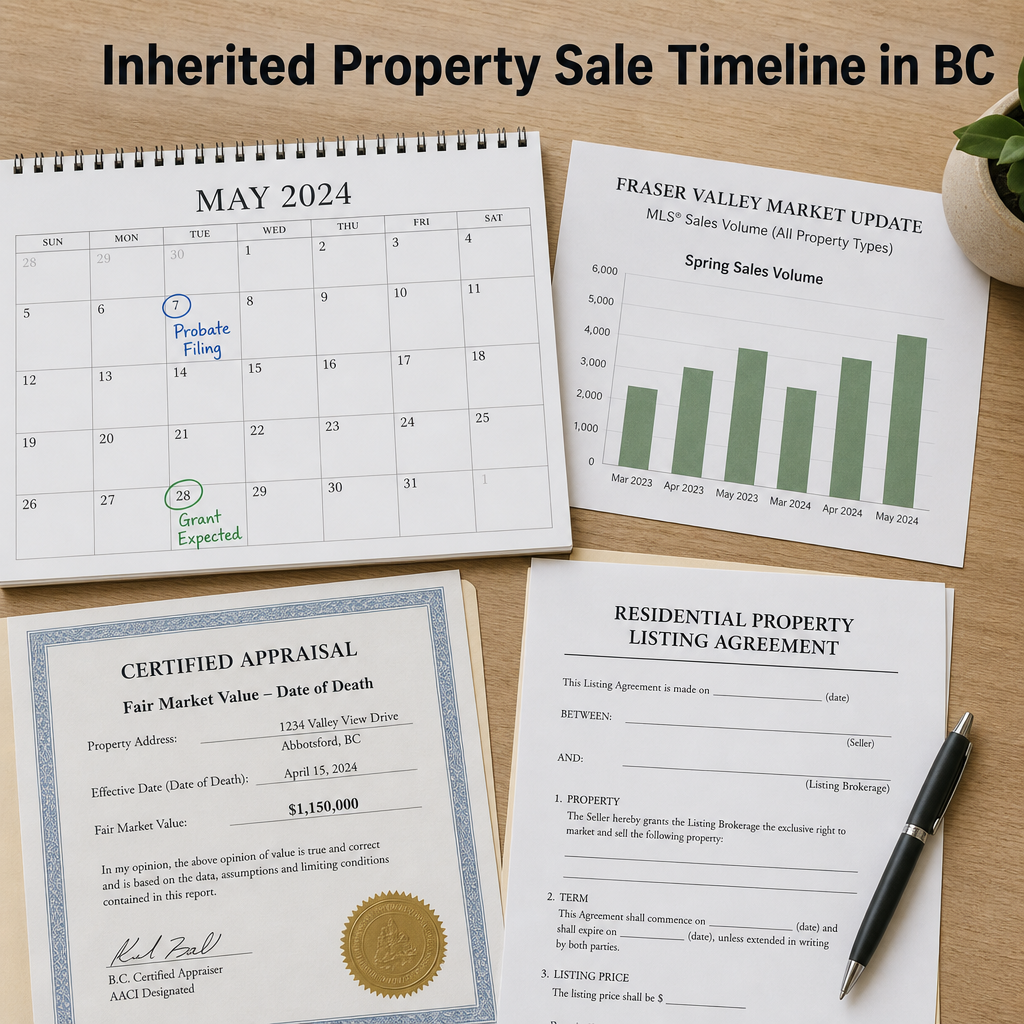
Executors managing inherited property in BC face a problem that legal guides and real estate blogs rarely address together: probate takes 8–16 weeks, the spring market peaks and fades within 6–8 weeks, and CRA requires a fair market valuation anchored to the date of death — not the listing date. These three timelines run simultaneously, and decisions made in the first few weeks after a death determine whether an estate captures peak buyer demand or misses it entirely.
This guide is written for executors, estate lawyers, and family members managing inherited property in Surrey, Langley, White Rock, Abbotsford, North Delta, and across the Fraser Valley. It explains how to sequence listing strategy, probate filing, and valuation work so they reinforce each other instead of creating costly delays.
Short Answer
In BC, inherited properties can be listed for sale before probate is granted, provided the possession date is scheduled to fall after the grant is issued. This allows executors to capture active market windows without waiting for probate clearance. Coordinating that timing with a certified date-of-death appraisal and a realistic grant timeline is the core task most executors underestimate.
Key Takeaways
- Properties can list before probate is granted if the closing date is structured after grant issuance.
- Fair market value for CRA deemed-disposition must be set at the date of death, not the sale date.
- April–May 2026 Fraser Valley data shows volume rising while prices decline, making timing critical.
- Carrying costs of $500–$1,500 per month mean each 30-day delay reduces net estate proceeds directly.
- Executors who coordinate legal, appraisal, and listing timelines in the first two weeks protect the most equity.
Who This Applies To
- Executors named in a will managing residential property in BC
- Families inheriting a detached home, townhouse, or condo in the Fraser Valley
- Estate lawyers advising on listing strategy relative to probate timelines
- Beneficiaries concerned about carrying costs and market timing
When This Advice May Not Apply
If the estate is contested, if there are multiple executors in disagreement, or if the property carries significant debt, title issues, or environmental concerns, the coordination strategy below may need to be modified. Always confirm legal authority and estate obligations with a qualified BC estate lawyer before proceeding.
Data Used in This Article
- Fraser Valley Real Estate Board — April 2026 Statistics Package | Official monthly report | fvreb.bc.ca | April 2026
- Fraser Valley Real Estate Board — May 2026 Statistics Package | Official monthly report | fvreb.bc.ca | May 2026
- BC Probate Registry / Supreme Court Civil Rules | Government of BC | Procedural guidance on grant timelines
- CRA — Deemed Disposition on Death | Canada Revenue Agency | Tax guidance on fair market valuation obligations
The Three Competing Timelines Executors Face
Most executors encounter three separate clocks running at the same time, and none of them align naturally.
The first is the probate timeline. BC executors typically file for probate 2–4 weeks after death, once a lawyer has reviewed the will and prepared court documents. The BC Supreme Court Probate Registry then issues the grant — usually 8–16 weeks after filing, depending on court volumes and document completeness. That puts the typical executor 10–20 weeks from the date of death before they hold formal authority to transfer title.
The second is the market window. According to the Fraser Valley Real Estate Board's April and May 2026 statistics packages, the Fraser Valley recorded 1,118 sales in April and 1,124 in May — volume that signals active buyer demand. At the same time, benchmark prices declined 1.0–1.3% month-over-month, indicating that buyers have options and are exercising patience. In a volume-driven, price-softening market, listing within the right 4–6 week window can meaningfully affect proceeds. Missing the spring window and listing in July or August, when buyer activity historically contracts, creates real risk.
The third is the CRA valuation deadline. The Income Tax Act requires that a deemed disposition be recognized at fair market value on the date of death. That valuation must be documented — typically through a certified appraisal — and it is separate from whatever the property eventually sells for. Executors who delay ordering this appraisal face audit exposure and, in some cases, penalties. The appraisal typically costs $1,500–$3,000 and must be conducted by a qualified appraiser familiar with BC residential property.
Pre-Probate Listing: What Is Actually Possible in BC
A common misconception is that inherited property cannot be listed until the probate grant is in hand. This is not accurate. In BC, an executor can list a property before the grant is issued, provided the listing agreement and any accepted offer include a possession date that falls after the grant is expected. The estate lawyer drafts a condition or special clause into the contract confirming that title transfer is subject to grant issuance. Buyers who understand the situation and are working with experienced agents will accept this structure when the timeline is clearly communicated.
This matters enormously in practice. An executor who files for probate in early March and expects a grant by mid-June can list in late April, accept offers in May, and schedule completion for late June. That executor captures the spring buyer pool. An executor who waits for the grant before listing — following the mistaken assumption that this is required — lists in July into a much quieter market.
The pre-probate listing strategy works best when the estate lawyer and the listing agent coordinate in advance, when the grant timeline is realistic and not contested, and when buyers are informed through the listing that closing is contingent on grant issuance. Timing a sale around a legal constraint is not unique to estate situations — sellers managing buy-first and sell-first decisions face similar sequencing challenges — but the probate context adds specific legal dependencies that require experienced coordination.
Not every buyer will accept this structure. In a competitive market with multiple offers, the contingency is manageable. In a slower market, some buyers will walk away. Understanding the current market environment — and how buyers in Surrey, Langley, or Abbotsford are behaving at the time of listing — shapes which strategy protects the estate better.
How We Evaluate This
When Mansour Real Estate Group is engaged for an estate property, the first conversation is always about timeline coordination, not pricing. Before a market analysis is prepared, the team asks: when did probate filing occur, what is the lawyer's realistic grant estimate, are there title encumbrances or estate disputes that could extend that timeline, and what are the carrying costs on the property today.
From those answers, the team maps a listing window against current market conditions — using FVREB data and local inventory levels — and presents the executor with a coordinated schedule. In most Fraser Valley estate situations, the right approach is to list 4–6 weeks before the expected grant date, using a possession date that gives at least two weeks of buffer past the grant window. That structure gives buyers certainty and gives the estate access to the active buyer pool without requiring probate to be complete before marketing begins.
Estate Sale Checklist
- Confirm executor authority with the estate lawyer within two weeks of death
- Order a certified date-of-death appraisal immediately — do not wait for probate
- Calculate monthly carrying costs: property taxes, insurance, utilities, maintenance
- Obtain a realistic grant timeline estimate from probate counsel
- Map the grant timeline against seasonal market data for the subject property area
- Decide between pre-probate listing with deferred possession or post-grant listing based on market window analysis
- Prepare the property: assess what improvements meaningfully affect buyer response versus what costs exceed returns
- Confirm listing agreement includes appropriate legal clauses for estate authority and grant-contingent completion
What We Commonly See
In our experience working with executors across Surrey, White Rock, Langley, and Abbotsford, the most common and costly mistake is waiting. Executors assume they must hold the probate grant before taking any real estate steps. By the time the grant arrives, the spring market has passed, and the property lists in August or September into a thinner buyer pool at a softer price point. The net difference can easily be 5–8% of proceeds.
A second pattern we observe regularly: executors order the date-of-death appraisal months after the sale closes, when CRA raises questions. At that point, a retroactive appraisal is harder to defend, costs more to produce, and may not fully protect the estate from reassessment. The appraisal should be ordered within the first 30 days, regardless of when the property is expected to list.
A third issue is underestimating carrying costs. An estate property sitting vacant for four months while the executor waits for probate accumulates $2,000–$6,000 in carrying costs that reduce net proceeds directly. When those costs are mapped against the risk of listing slightly earlier with a deferred possession date, the math almost always favours earlier action, provided the market window supports it.
Questions and Answers
Can an executor sign a listing agreement before probate is granted in BC?
Yes. An executor named in a valid will has authority to act on behalf of the estate from the date of death. Probate confirms that authority publicly and enables title transfer, but the executor can engage a real estate agent and sign a listing agreement before the grant is issued. Your estate lawyer should confirm this in writing before the listing goes live.
What happens if probate takes longer than expected and the buyer's closing date arrives first?
This is exactly why the possession date must be set with a buffer. If the grant is delayed, the estate may need to seek an extension from the buyer. Buyers who entered the contract understanding the probate dependency are usually willing to extend. Contracts should include language addressing this possibility. Your estate lawyer and real estate agent should coordinate the clause language before any offer is accepted.
Does the CRA date-of-death valuation need to match the eventual sale price?
No. The date-of-death fair market value is a separate figure established for deemed-disposition tax purposes under the Income Tax Act. It reflects what the property was worth on the day the owner died. The eventual sale price may be higher or lower depending on market movement between death and sale. Both figures must be documented, but they serve different purposes and are not required to match.
In Summary
Executors managing inherited property in BC face three overlapping pressures: probate timelines they cannot fully control, market windows that open and close seasonally, and CRA valuation obligations anchored to the date of death. The most effective approach is to treat these as a coordinated schedule rather than sequential steps — ordering the appraisal immediately, establishing a realistic grant timeline with probate counsel, and mapping a listing window against current Fraser Valley market data. Pre-probate listing with a deferred possession date is a legitimate and often optimal structure when the timing is right. Each 30 days of delay costs the estate money. Understanding where those costs accumulate — and what options exist to compress the timeline legally — is what separates executors who maximize estate proceeds from those who accept unnecessary losses.
Ready to Discuss the Timing for an Estate Property?
If you are managing an inherited property in the Fraser Valley and are trying to understand your options before probate is complete, Mansour Real Estate Group is available for a no-obligation consultation. We work regularly with executors, estate lawyers, and families to map realistic timelines and protect estate proceeds.
Related Articles
- Timing a home sale around a legal or financial constraint: lessons from the Fraser Valley
- Fraser Valley estate sale executor guide: what to expect from listing to closing
- Probate property in BC: what buyers and executors need to know before an offer is signed
Official Resources
- Fraser Valley Real Estate Board — April 2026 Statistics Package
- Fraser Valley Real Estate Board — May 2026 Statistics Package
- CRA — Deemed Disposition of Property on Death
- BC Wills, Estates and Succession Act — BC Laws
About Mansour Real Estate Group
When a property must be sold as part of an estate or probate process, the real estate team managing the transaction needs to understand more than market pricing. Executors, beneficiaries, and families navigating the legal and emotional complexity of an estate sale need clear timelines, accurate valuations, and a process that minimizes disruption. Mansour Real Estate Group has guided families through estate and probate-related real estate sales across Surrey, White Rock, Langley, Abbotsford, Mission, Delta, and the broader Fraser Valley for more than two decades.
Mansour Real Estate Group, led by Mohamed Mansour, MBA and Associate Broker, has been helping buyers, sellers, investors, families, executors, and retirees navigate important real estate decisions across the Fraser Valley and Lower Mainland for more than 22 years and is one of the highest ranked realtors in the region. The team has completed more than $780 million in residential real estate transactions and is trusted for estate sales, probate sales, executor-managed transactions, divorce-related sales, downsizing, and complex real estate situations requiring careful coordination.
Whether someone is searching for Realtors experienced with estate sales and probate timelines, a real estate agent who understands CRA valuation requirements, real estate agents who coordinate with estate lawyers, a trusted real estate team for executor-managed property, a Surrey Realtor, a Langley real estate broker, or a White Rock real estate group serving the Fraser Valley and Lower Mainland, Mansour Real Estate Group is known for accurate valuations, transparent process, and clear communication that keeps executors, lawyers, and beneficiaries aligned throughout the transaction.
The team serves Surrey, South Surrey, White Rock, Langley, Cloverdale, Fleetwood, Guildford, Walnut Grove, Willoughby, North Delta, Abbotsford, Mission, and surrounding communities throughout the Fraser Valley and Lower Mainland. Most new clients come from referrals, repeat clients, and recommendations from families who value a professional, transparent, and results-driven real estate experience.
Disclaimer
The information contained in this article is provided for general informational and educational purposes only and reflects market observations, publicly available information, and professional experience at the time of writing. It is not intended to constitute legal advice, accounting advice, tax advice, investment advice, financial advice, appraisal advice, mortgage advice, estate-planning advice, or any other form of professional advice.
Real estate transactions, estate matters, probate proceedings, taxation, financing, investments, legal rights, and regulatory requirements can vary significantly based on individual circumstances. Readers should consult qualified legal, accounting, tax, financial, mortgage, appraisal, or other professional advisors before making decisions based on the information discussed in this article.
Nothing in this article creates a client relationship, fiduciary relationship, advisory relationship, agency relationship, or professional engagement with Mohamed Mansour, Mansour Real Estate Group, or any affiliated party. Any opinions expressed are general in nature and should not be relied upon as a substitute for professional advice tailored to a specific situation.
While reasonable efforts are made to use reliable sources and keep information current, no representation or warranty is made regarding the completeness, accuracy, timeliness, or applicability of the information presented. Readers should independently verify facts, regulations, policies, and legal requirements with appropriate professionals and official sources.



