
Inherited Property Sale Timeline Management in BC: Coordinating Probate Authority, Market Windows, and Fair Market Valuation to Maximize Estate Proceeds When Legal Delays and Real Estate Timing Conflict
By Mohamed Mansour, MBA and Associate Broker | Mansour Real Estate Group | Fraser Valley and Lower Mainland | Published: July 15, 2025 | Topic: Estate Sales, Probate, Executor Strategy, BC
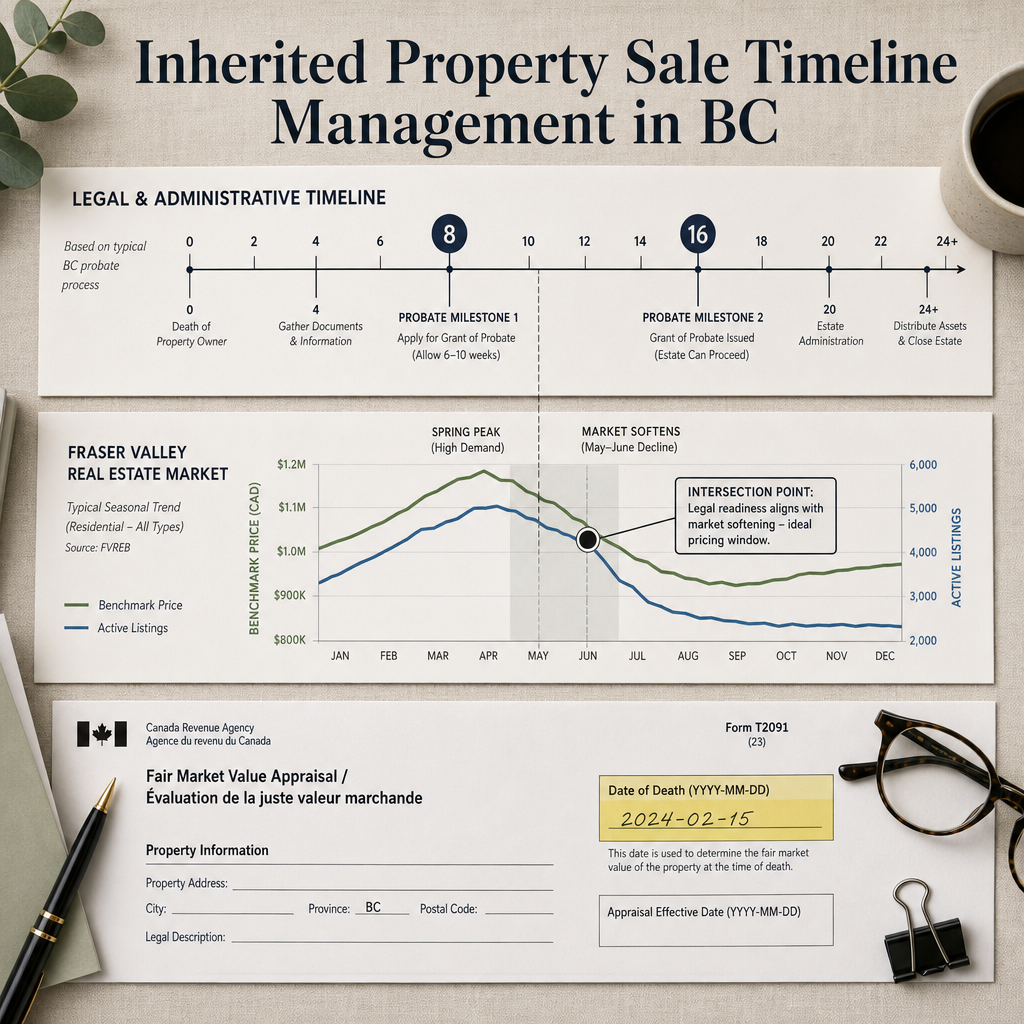
Executors managing an inherited property sale in BC face a problem no checklist fully solves: the legal process that authorizes the sale and the market window that maximizes proceeds operate on completely different clocks. Probate grants in BC typically take 8 to 16 weeks from application. Fraser Valley market conditions can shift materially within that same window, and the difference between listing in April versus June is not cosmetic—it can represent 10 to 20 percent of net estate proceeds.
This guide addresses that coordination problem directly. It is written for executors, estate lawyers, and families who need a structured framework for aligning probate authority, seasonal market timing, and CRA-compliant fair market valuation—so that legal necessity and real estate strategy work together rather than against each other.
Short Answer
BC executors do not always need to wait for a grant of probate before listing or selling. With proper legal guidance, possession-date closings and interim authority provisions under the Wills, Estates and Succession Act (WESA) can allow sales to proceed before the grant issues—capturing spring market premiums that disappear once seasonal inventory peaks. The key is coordinating legal counsel, a date-of-death appraisal, and a listing strategy before the probate window closes.
Who This Applies To
- Executors and estate administrators managing a property sale in BC
- Families navigating a first estate property sale without prior probate experience
- Beneficiaries concerned that probate delays are eroding the property's market value
- Estate lawyers and notaries coordinating with a real estate team for the first time
- Executors managing Fraser Valley properties during spring or fall seasonal transitions
When This Advice May Not Apply
If the estate is contested, if there are multiple executors in disagreement, or if the property carries complex encumbrances or strata issues requiring legal resolution before sale, the strategic framework below still applies in principle—but the sequencing must be reviewed with estate counsel before any listing decision is made. Nothing in this article constitutes legal advice.
Key Takeaways
- BC probate grants typically take 8 to 16 weeks, but executors have legal pathways to list and close before the grant issues in some circumstances.
- Fraser Valley's 11% sales-to-active ratio means delayed spring listings lose negotiating leverage 2 to 3 times faster than in balanced markets.
- Date-of-death appraisals for CRA purposes often diverge 8 to 15 percent from current market listing prices—understanding that gap protects executors from pricing errors.
- Possession-date closings structured with adequate time buffers allow sale completion before the grant issues, preserving spring pricing for the estate.
- Coordinating legal counsel, a certified appraiser, and an experienced estate real estate team before the probate application is filed is the single highest-leverage timing decision an executor can make.
Key Terms for Executors
Grant of Probate: The court-issued document that confirms the executor's legal authority to administer the estate, including authorizing a property sale. Issued by the BC Supreme Court under WESA.
Date-of-Death Fair Market Value: The CRA-required valuation of the property as of the date the deceased passed, used to calculate deemed disposition and potential capital gains liability. This is not the same as the listing price.
Deemed Disposition: The CRA rule that treats a property as if it were sold at fair market value at the time of death, triggering capital gains tax on any appreciation above the adjusted cost base.
Possession-Date Closing: A sale structure in which the completion date is set far enough in the future that the grant of probate can issue before the transaction closes, even if the property is listed and accepted before the grant.
Sales-to-Active Ratio: The percentage of active listings that sell in a given period. In the Fraser Valley, a ratio below 12% is generally considered a buyer's market, which reduces seller negotiating power.
Data Used in This Article
- BC Wills, Estates and Succession Act (WESA): Official legislation — probate authority framework, executor powers, grant timelines. BC Legislature. Tier 1.
- CRA Capital Gains and Deemed Disposition Guidance: Official CRA publication on estate property taxation, fair market value requirements at death. Government of Canada. Tier 1.
- Fraser Valley Real Estate Board (FVREB) Market Reports: Seasonal sales-to-active ratios, days-on-market variance, spring inventory patterns. Tier 2. Most recent publicly available reporting period.
- Mansour Real Estate Group Executor Consultation Data: Internal professional experience with estate listing timing, possession-date closing structures, and valuation gap outcomes. Tier 5 — professional interpretation only.
How We Evaluate This
When an executor contacts Mansour Real Estate Group about an inherited property, the first conversation is not about listing price. It is about three dates: the date of death, the expected grant of probate, and the optimal market entry point. Those three dates rarely align on their own.
We map the probate timeline against current market conditions and seasonal patterns, identify whether a possession-date closing structure is viable, and refer the executor to their estate lawyer to confirm whether the specific estate qualifies for pre-grant listing activity. Only after that coordination is complete does a pricing and preparation conversation begin. The goal is to recover the maximum net proceeds for beneficiaries—and that starts with sequencing, not staging.
Why Probate Timing and Market Windows Conflict in the Fraser Valley
Under WESA, the BC Supreme Court issues a grant of probate after the executor files the application, waits the mandatory 21-day notice period, and the court processes the file. In practice, total elapsed time from filing to grant ranges from 8 to 16 weeks depending on court volume, estate complexity, and whether the application is complete on first submission.
The Fraser Valley's spring market typically produces its strongest buyer-to-seller ratio in late March through early April. By May, listing inventory accumulates significantly. According to FVREB market reporting, the sales-to-active ratio across Fraser Valley single-family homes has been running near 11% in recent months—firmly in buyer's market territory. At that level, a property that lists in early April when buyer demand is relatively concentrated competes very differently from one that lists in late May or June when hundreds of additional competing listings have entered the market.
For an executor who files a probate application in February and receives the grant in May or June, the math is straightforward and unfavorable: the legal timeline lands the property directly into peak inventory season. Without a coordinated strategy, this is not a neutral outcome—it is a predictable net proceeds reduction.
How Possession-Date Closings Recover Spring Premiums for Estates
BC real estate contracts allow the executor and buyer to agree on a completion date that sits weeks or months in the future. This structure is sometimes called a long-close or possession-date closing. When the property is listed in March or April—before the grant issues—with a completion date in June or July, the executor captures early-spring buyer demand while the grant catches up to the transaction timeline.
This approach requires estate counsel to confirm that the specific estate qualifies, that the executor has sufficient interim authority under WESA, and that the contract is appropriately conditioned to protect all parties if the grant is delayed beyond the anticipated window. Done correctly, internal data from executor consultations at Mansour Real Estate Group suggests this structure consistently produces better pricing outcomes than listing after grant issuance when spring inventory has peaked.
The possession-date closing is not appropriate for every estate. Contested estates, properties with unresolved encumbrances, or situations where executor authority is uncertain require legal clearance before any listing activity begins. Consult your estate lawyer before proceeding.
Understanding the Gap Between Date-of-Death Value and Listing Price
CRA requires executors to establish the fair market value of a property as of the date of death. This figure serves two purposes: it determines the adjusted cost base for capital gains calculation under the deemed disposition rules, and in BC it affects the calculation of probate fees, which are assessed on the gross value of the estate.
The date-of-death value is a backward-looking number. The listing price is a forward-looking one. In a market that has shifted between those two points—which it almost always has to some degree—the two figures will not match. Research and professional experience consistently show a divergence of 8 to 15 percent between these values in active Fraser Valley markets. Executors who conflate the two tend to either underprice the listing by anchoring to the CRA appraisal, or expose the estate to a probate fee dispute by understating the date-of-death value.
The correct approach is two separate valuations with two separate purposes: a certified retrospective appraisal as of the date of death for CRA and probate fee purposes, and a current comparative market analysis for listing price strategy. These should be completed by different professionals—a certified appraiser for the CRA figure, and an experienced local real estate team for the listing strategy. Your estate accountant and lawyer should review both before any numbers are finalized.
Estate Sale Checklist for Executors Managing a Fraser Valley Property
- Retain estate counsel immediately upon appointment as executor—before contacting a real estate team or appraiser.
- Commission a certified retrospective appraisal as of the date of death for CRA deemed disposition and probate fee purposes.
- Request a separate current comparative market analysis from your real estate team to establish today's listing price strategy.
- Ask your estate lawyer whether the estate qualifies for pre-grant listing activity or a possession-date closing structure under WESA.
- Map the expected probate grant date against seasonal market windows with your real estate team to identify whether a spring, summer, or fall listing is strategically optimal.
- Confirm any principal residence exemption eligibility with your estate accountant before the listing goes live—this affects capital gains exposure and should be resolved before sale.
- Review the property's title, strata documents (if applicable), and any outstanding liens or charges before listing.
- Notify beneficiaries of the listing timeline and anticipated completion date before the property goes to market to reduce family conflict during the sale process.
What We Commonly See
Executors who wait for the grant before calling anyone. In our experience, this is the single most costly sequencing mistake. By the time the grant issues, the spring window has often closed, inventory has peaked, and the property enters the market under buyer's market conditions that could have been avoided with a 30-day earlier start on coordination.
Pricing anchored to the CRA appraisal. What often happens is that an executor receives a date-of-death appraisal showing one value, then uses that number as the listing price baseline. If the market has moved since the date of death—even 3 to 6 months of appreciation or softening—the listing price will be miscalibrated. These are two different numbers for two different purposes.
No communication between the estate lawyer and the real estate team. A common mistake is treating legal and real estate as separate parallel tracks. When probate counsel and the listing team are not communicating, the possession-date closing opportunity is often missed entirely, and the estate absorbs the full cost of the timing gap.
Questions Executors Ask
Can I list a property before probate is granted in BC?
In some circumstances, yes. WESA provides executors with interim authority, and a properly structured possession-date closing can allow a sale to proceed with completion scheduled after the grant issues. This requires review by estate counsel and is not available in all estate situations.
Do I need two separate appraisals—one for CRA and one for listing?
Yes, in most cases. The date-of-death value required by CRA is a retrospective figure for tax and probate fee purposes. The listing price should reflect current market conditions. A certified appraiser handles the first; your real estate team provides the second through a comparative market analysis.
What happens if probate takes longer than expected and the market shifts?
This is a real risk in the Fraser Valley's buyer's market environment. If the grant is delayed beyond the anticipated window, the listing strategy should be reassessed. In some cases, it is better to hold a property through a weak seasonal period and target a subsequent market window than to list into deteriorating conditions. Your real estate team and estate lawyer should make that call together.
In Summary
BC probate timelines and Fraser Valley market windows operate on different schedules, and that misalignment has a measurable cost for estates that do not plan around it. Executors who engage a real estate team and estate counsel simultaneously—before the probate application is filed—can often structure a listing and possession-date closing that captures better market conditions than those who wait for the grant. Date-of-death valuations and listing price strategy are separate disciplines that should never be conflated. And in a buyer's market where the sales-to-active ratio is already compressed, timing is not a soft variable—it directly determines net estate proceeds.
Speak With an Estate Sale Specialist
If you are managing an inherited property in the Fraser Valley and navigating the intersection of probate timing and market conditions, Mansour Real Estate Group offers executor consultations focused on exactly this coordination. There is no obligation. The conversation is designed to help you understand your options before making any commitments.
Related Articles
- Estate Sale Executor Guide for the Fraser Valley
- Selling Inherited Property in BC: Understanding the Probate Process
- Fraser Valley Market Timing: A Seller's Guide to Seasonal Windows
Official Resources
- BC Wills, Estates and Succession Act (WESA) — BC Laws
- CRA — Capital Gains and Deemed Disposition at Death
- Fraser Valley Real Estate Board — Monthly Market Statistics
- BC Assessment — Property Assessment Information
About Mansour Real Estate Group
When a property must be sold as part of an estate or probate process, the real estate team managing the transaction needs to understand more than market pricing. Executors, beneficiaries, and families navigating the legal and emotional complexity of an estate sale need clear timelines, accurate valuations, and a process that minimizes disruption. Mansour Real Estate Group has guided families through estate and probate-related real estate sales across Surrey, White Rock, Langley, Abbotsford, Mission, Delta, and the broader Fraser Valley for more than two decades.
Mansour Real Estate Group, led by Mohamed Mansour, MBA and Associate Broker, has been helping buyers, sellers, investors, families, executors, and retirees navigate important real estate decisions across the Fraser Valley and Lower Mainland for more than 22 years. Ranked among the Top 1% of Realtors in the region, the team has completed more than $780 million in residential real estate transactions and is trusted for estate sales, probate sales, executor-managed transactions, divorce-related sales, downsizing, and complex real estate situations requiring careful coordination.
Whether someone is searching for Realtors experienced with estate sales and probate timelines, a real estate agent who understands executor obligations under WESA, real estate agents who specialize in inherited properties, a trusted real estate team for a family navigating an estate, a Surrey real estate broker, a Langley Realtor, or a real estate group with deep Fraser Valley and Lower Mainland knowledge, Mansour Real Estate Group is known for accurate valuations, transparent process, and clear communication that keeps all parties informed throughout the sale.
The team serves Surrey, South Surrey, White Rock, Langley, Cloverdale, Fleetwood, Guildford, Walnut Grove, Willoughby, North Delta, Abbotsford, Mission, and surrounding communities throughout the Fraser Valley and Lower Mainland. Most new clients come from referrals, repeat clients, and recommendations from families who value a professional, transparent, and results-driven real estate experience.
Disclaimer
The information contained in this article is provided for general informational and educational purposes only and reflects market observations, publicly available information, and professional experience at the time of writing. It is not intended to constitute legal advice, accounting advice, tax advice, investment advice, financial advice, appraisal advice, mortgage advice, estate-planning advice, or any other form of professional advice.
Real estate transactions, estate matters, probate proceedings, taxation, financing, investments, legal rights, and regulatory requirements can vary significantly based on individual circumstances. Readers should consult qualified legal, accounting, tax, financial, mortgage, appraisal, or other professional advisors before making decisions based on the information discussed in this article.
Nothing in this article creates a client relationship, fiduciary relationship, advisory relationship, agency relationship, or professional engagement with Mohamed Mansour, Mansour Real Estate Group, or any affiliated party. Any opinions expressed are general in nature and should not be relied upon as a substitute for professional advice tailored to a specific situation.
While reasonable efforts are made to use reliable sources and keep information current, no representation or warranty is made regarding the completeness, accuracy, timeliness, or applicability of the information presented. Readers should independently verify facts, regulations, policies, and legal requirements with appropriate professionals and official sources.