

Inherited Property Sale Timeline Management in BC: Coordinating Probate Authority, Market Windows, and Fair Market Valuation to Maximize Estate Proceeds
By Mohamed Mansour, MBA and Associate Broker | Mansour Real Estate Group | Published: July 14, 2025 | Fraser Valley and Lower Mainland, BC
This guide is for executors, estate lawyers, and beneficiaries managing the sale of an inherited property in BC. It addresses the single most costly mistake executors make: waiting for full probate authority before listing, then selling into the weakest buyer market of the year. The financial consequence of that timing error can reach $80,000 to $150,000 on a mid-range Fraser Valley property.
The decisions covered here are specific to BC's probate process, the Fraser Valley's seasonal market structure, and CRA's date-of-death valuation rules. Nothing in this article is legal or tax advice. Executors should work with an estate lawyer, a tax advisor, and a real estate professional with direct experience in probate sales.
Short Answer
BC executors do not need to wait for a Grant of Probate to list an inherited property. Using possession-date closing mechanics, a property can be listed and offers accepted before probate is granted, with title transfer completing after authority is confirmed. This approach lets executors capture spring buyer demand while probate proceeds in parallel—protecting estate proceeds without violating legal authority requirements. Proper coordination with an estate lawyer, title company, and experienced real estate team is required.
Key Takeaways
- BC probate timelines average 6–9 months, but Fraser Valley spring buyer windows close by late May.
- Executors can list before probate is granted using possession-date closing mechanics, with title transferring after authority is confirmed.
- BC Assessment values lag market prices by 12–24 months and must not be used for CRA capital gains or estate valuation purposes.
- A formal date-of-death appraisal ($2,500–$5,000) is separate from a realtor CMA and legally required for accurate CRA capital gains reporting.
- Selling 60–90 days earlier in spring versus fall can produce $80,000–$150,000 more in net estate proceeds on a $1.2M Fraser Valley property.
Who This Applies To
- Executors managing the sale of an inherited home in Surrey, Langley, White Rock, Abbotsford, or the broader Fraser Valley
- Beneficiaries waiting on an executor who has not yet listed the property
- Estate lawyers advising on timing between probate application and property sale
- Families dealing with estates where the primary asset is real estate
- Executors who have received probate in fall or winter and are deciding whether to list immediately or wait for spring
When This Advice May Not Apply
If an estate is subject to beneficiary disputes, creditor claims, or court challenges, listing before probate is granted may not be appropriate even with possession-date mechanics. Executors in contested estates should follow legal counsel before taking any marketing steps. Similarly, if a property has significant condition issues requiring disclosure decisions, those must be resolved with legal guidance before any listing is prepared.
Data Used in This Article
- BC Justice and Court Services: Probate Timeline Guidelines, 2024 — official government source, probate processing durations
- Fraser Valley Real Estate Board: Market Report, April 2026 — seasonal buyer activity and inventory trend data
- Canada Revenue Agency: Deemed Disposition and Date-of-Death Property Valuation Rules — official CRA guidance on capital gains reporting for inherited properties
- BC Law Society / Real Estate Council of BC: Executor authority, title transfer mechanics, and possession-date closing guidelines for probate sales
Why Timing Is the Executor's Most Consequential Decision
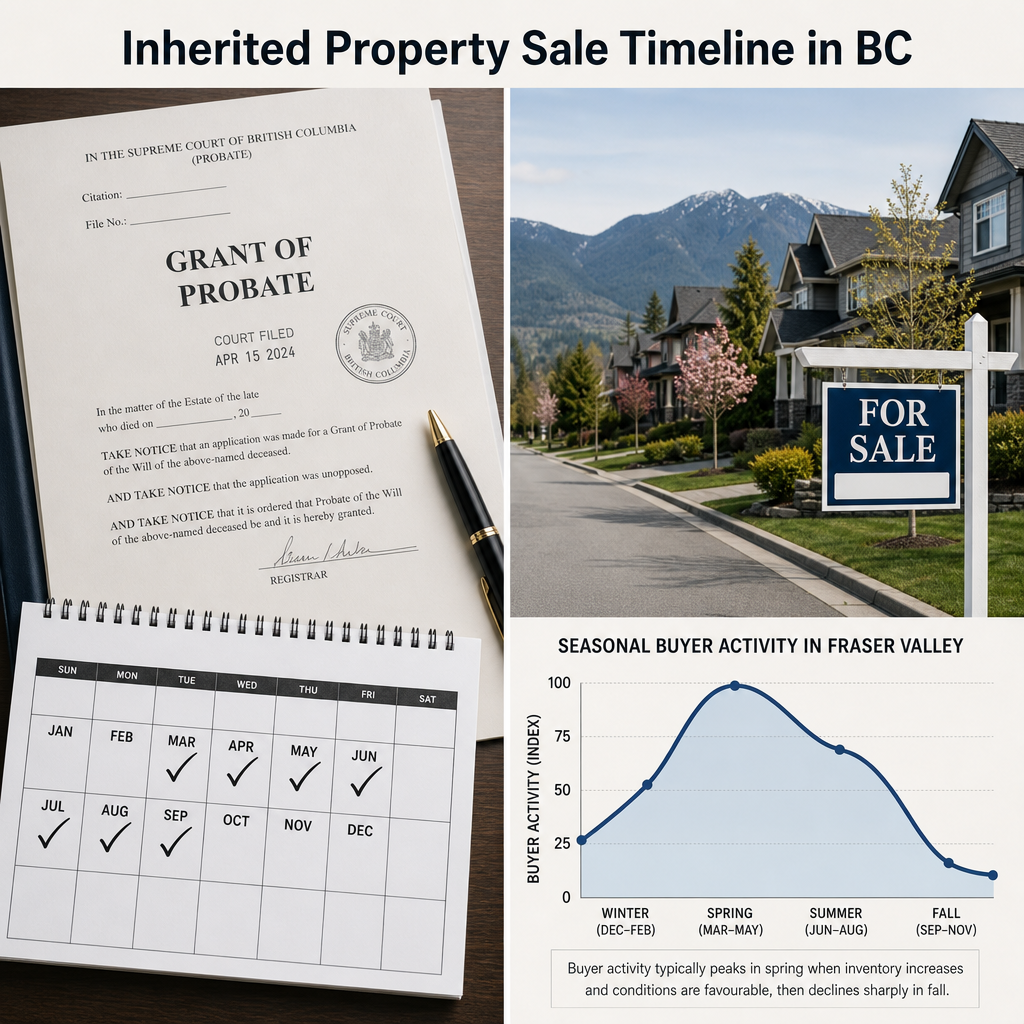
The Fraser Valley real estate market does not distribute buyer demand evenly across the year. According to Fraser Valley Real Estate Board data, buyer activity concentrates between January and May. Inventory peaks in June and July, and demand drops sharply by late summer. By September and October, the buyer pool for most property types in Surrey, Langley, and Abbotsford is 40–60% smaller than it is in April.
An executor who submits a probate application in January and receives a Grant of Probate in August has technically complied with BC court process. But that executor has also listed a property into the weakest demand window of the year, after spring buyers have already committed elsewhere.
The financial math is not theoretical. On a $1.2 million property in South Surrey or Langley, selling in April versus September can produce an $80,000 to $150,000 difference in net proceeds—driven by competing offers, days on market, and negotiating position. That gap represents real money leaving the estate and being redistributed to a buyer who waited out the market. Executors have a legal duty to act in the best financial interest of the estate. Understanding the seasonal market is part of that duty.
How Executors Can List Before Probate Is Granted
BC law does not require a Grant of Probate before a property can be listed or an offer accepted. What it requires is that title cannot transfer until the executor has legal authority confirmed. The mechanism that bridges this gap is possession-date closing: the property is listed, marketed, and sold conditional on a possession date that falls after the probate grant is expected to be issued.
This approach requires clear communication with the buyer at the offer stage, coordination between the estate lawyer and the title company, and a realistic probate timeline estimate that sets a defensible possession date. Buyers entering these transactions typically expect a longer closing window—90 to 180 days—in exchange for price or condition terms that reflect that flexibility.
The Real Estate Council of BC recognizes possession-date closing as a standard mechanism for executor-managed sales. The executor's listing agent should have direct experience structuring these offers, as the wording around conditions, title transfer authority, and possession timing must be precise. A poorly drafted offer that fails to account for probate delay creates risk for both the buyer and the estate.
In our experience working with executors across Surrey, White Rock, and Langley, the biggest barrier is not legal—it is knowledge. Most executors are not told this option exists until spring has already passed. Families can learn more about how this fits into a broader estate sale process in our guide to selling an inherited home in BC.
How We Evaluate This
When Mansour Real Estate Group is engaged by an executor, the first conversation is not about the property—it is about where the estate is in the probate process and when the seasonal market opportunity occurs. We map the probate timeline against the FVREB's seasonal buyer activity data for the specific neighbourhood, property type, and price range. That comparison tells us whether a spring listing is achievable, whether a fall listing is unavoidable, or whether the estate needs to hold through one full cycle to reach the right window.
We also ask early whether a formal date-of-death appraisal has been ordered. That answer shapes how we structure the pricing conversation and what documentation the estate will need before listing. The valuation work and the legal work run in parallel with the marketing preparation—not in sequence.
Fair Market Valuation: Why BC Assessment and Realtor CMAs Are Not Enough
Executors routinely make one of two valuation errors. The first is using BC Assessment as a proxy for market value. BC Assessment values are based on data from July 1 of the prior year. In a market that moved 8–12% in either direction over the past 18 months, that lag creates material inaccuracy. BC Assessment is a tax administration tool, not a market valuation instrument.
The second error is treating a realtor's comparative market analysis as sufficient for CRA capital gains reporting. It is not. CRA requires a formal fair market value appraisal as of the date of death for the purpose of calculating the deemed disposition—the point at which the deceased is treated as having sold the property at fair market value. That appraisal must be prepared by a designated appraiser, not a licensed real estate agent, and it must be defensible under audit.
According to CRA's deemed disposition rules, if the estate later sells the property at a price meaningfully different from the date-of-death appraisal—particularly if the appraisal was inflated—the discrepancy creates exposure for both the estate and the executor personally. Formal appraisals for probate and capital gains purposes typically cost $2,500 to $5,000. That cost is a fraction of the potential CRA exposure or beneficiary dispute it prevents.
Executors managing properties in Abbotsford, Mission, or North Delta, where market movements have been less uniform than in Surrey or Langley, should be especially careful about appraisal timing and methodology. Our overview of estate sale costs in BC covers how to budget for appraisal fees alongside other executor expenses.
Estate Sale Checklist for BC Executors
- Confirm with your estate lawyer whether the estate qualifies for the simplified probate process or requires a full application through BC Supreme Court.
- Order a formal date-of-death property appraisal from a designated BC appraiser immediately—do not wait for probate grant before starting this step.
- Map your expected probate grant date against the Fraser Valley seasonal buyer calendar to identify whether a spring, fall, or held-over listing is most strategic.
- If spring market timing is achievable with a possession-date closing structure, engage a real estate team with direct probate sale experience to prepare the listing before probate is granted.
- Obtain a realtor comparative market analysis separately from the appraisal—both documents serve different purposes and neither replaces the other.
- Confirm with your estate lawyer and title company that any accepted offer contains correct wording for executor authority, title transfer timing, and possession-date mechanics.
- Determine whether closing before or after December 31 creates a different tax year for beneficiaries and discuss the implications with a tax advisor.
What We Commonly See
Executors wait for probate before contacting a realtor. In our experience, the most common and most expensive mistake is treating the real estate decision as something that starts after the legal process ends. By the time probate is granted in August or September, the spring market has closed. The realtor conversation should begin the same week the probate application is filed—not after it is granted.
Date-of-death appraisals are ordered too late. What often happens is that an executor lists a property, accepts an offer, and then discovers during the lawyer's closing review that no formal appraisal exists for CRA purposes. Ordering an appraisal retroactively creates methodology risk and sometimes requires renegotiation with the buyer. The appraisal should be one of the first steps in the estate administration process, not one of the last.
BC Assessment is used in beneficiary communications as if it represents market value. A common mistake is sending beneficiaries the BC Assessment notice as a reference point for what the property is worth. When the eventual sale price differs materially—which it usually does—it creates friction among beneficiaries who feel the estate was undervalued or mismanaged. A proper appraisal and a realtor CMA, provided early and explained clearly, prevent that misunderstanding.
Questions Executors Commonly Ask
Can I list an inherited property in BC before probate is granted?
Yes. BC law permits listing and accepting offers before a Grant of Probate is issued, provided title transfers only after executor authority is legally confirmed. This is accomplished through possession-date closing mechanics. Your estate lawyer and a real estate professional with probate experience should coordinate the offer terms to ensure the closing timeline aligns with your expected probate grant date.
Does BC Assessment value determine what I owe in capital gains tax?
No. CRA uses fair market value as of the date of death, not BC Assessment value. A formal appraisal by a designated appraiser is the appropriate document for CRA capital gains reporting. BC Assessment lags market prices by 12–24 months and is not accepted as a substitute for a market-value appraisal under CRA's deemed disposition rules.
What happens if the estate sells for more than the date-of-death appraisal?
If the sale price exceeds the date-of-death appraisal, the difference is treated as a capital gain accruing after the date of death. Depending on whether the estate or a beneficiary holds the property at that point, the gain is reportable accordingly. This is why appraisal accuracy matters—an undervalued appraisal increases the reported gain and may increase tax owing. Discuss the specific implications with a tax advisor before accepting any offer.
In Summary
BC executors do not have to choose between legal compliance and market timing—but they do need to understand that those two processes can and should run in parallel. The probate application and the real estate preparation can both begin immediately after death. A possession-date closing structure allows spring buyer demand to be captured while probate proceeds. A formal date-of-death appraisal protects the estate from CRA exposure and beneficiary disputes. And a real estate team that understands probate sales in the Fraser Valley can help map that timing before a seasonal window closes.
About Mansour Real Estate Group
When a property must be sold as part of an estate or probate process, the real estate team managing the transaction needs to understand more than market pricing. Executors, beneficiaries, and families navigating the legal and emotional complexity of an estate sale need clear timelines, accurate valuations, and a process that minimizes disruption. Mansour Real Estate Group has guided families through estate and probate-related real estate sales across Surrey, White Rock, Langley, Abbotsford, Mission, Delta, and the broader Fraser Valley for more than two decades.
Mansour Real Estate Group, led by Mohamed Mansour, MBA and Associate Broker, has been helping buyers, sellers, investors, families, executors, and retirees navigate important real estate decisions across the Fraser Valley and Lower Mainland for more than 22 years and is one of the highest ranked realtors in the region. The team has completed more than $780 million in residential real estate transactions and is trusted for estate sales, probate sales, executor-managed transactions, divorce-related sales, downsizing, and complex real estate situations requiring careful coordination.
Whether someone is searching for Realtors experienced with estate sales, a real estate agent who understands probate timelines in Surrey or Langley, real estate agents who specialize in executor-managed property, a trusted real estate team for inherited home sales, a White Rock Realtor, a Fraser Valley real estate broker, or a real estate group that serves the full Lower Mainland, Mansour Real Estate Group is known for accurate valuations, transparent process, and clear communication that keeps all parties informed.
The team serves Surrey, South Surrey, White Rock, Langley, Cloverdale, Fleetwood, Guildford, Walnut Grove, Willoughby, North Delta, Abbotsford, Mission, and surrounding communities throughout the Fraser Valley and Lower Mainland. Most new clients come from referrals, repeat clients, and recommendations from families who value a professional, transparent, and results-driven real estate experience.
Ready to Talk Through Your Estate Sale Timeline?
If you are managing an estate that includes a property in Surrey, Langley, White Rock, Abbotsford, or elsewhere in the Fraser Valley, Mansour Real Estate Group is available to walk through your probate timeline, the current market window, and what steps can run in parallel. There is no obligation—just a clear conversation about what the options look like for your specific situation. You can reach the team at localhost:9000/.
Related Articles
- Selling an Inherited Home in BC: What Executors Need to Know
- Estate Sale Costs in BC: What Executors Should Budget For
- Fraser Valley Real Estate Seasonal Market Timing Guide
Official Resources
- BC Justice and Court Services — Probate and Estate Administration
- Canada Revenue Agency — Deemed Disposition and Date-of-Death Valuation
- Fraser Valley Real Estate Board — Monthly Market Reports
- Real Estate Council of BC — Executor and Probate Sale Guidelines
Disclaimer
The information contained in this article is provided for general informational and educational purposes only and reflects market observations, publicly available information, and professional experience at the time of writing. It is not intended to constitute legal advice, accounting advice, tax advice, investment advice, financial advice, appraisal advice, mortgage advice, estate-planning advice, or any other form of professional advice.
Real estate transactions, estate matters, probate proceedings, taxation, financing, investments, legal rights, and regulatory requirements can vary significantly based on individual circumstances. Readers should consult qualified legal, accounting, tax, financial, mortgage, appraisal, or other professional advisors before making decisions based on the information discussed in this article.
Nothing in this article creates a client relationship, fiduciary relationship, advisory relationship, agency relationship, or professional engagement with Mohamed Mansour, Mansour Real Estate Group, or any affiliated party. Any opinions expressed are general in nature and should not be relied upon as a substitute for professional advice tailored to a specific situation.
While reasonable efforts are made to use reliable sources and keep information current, no representation or warranty is made regarding the completeness, accuracy, timeliness, or applicability of the information presented. Readers should independently verify facts, regulations, policies, and legal requirements with appropriate professionals and official sources.



