
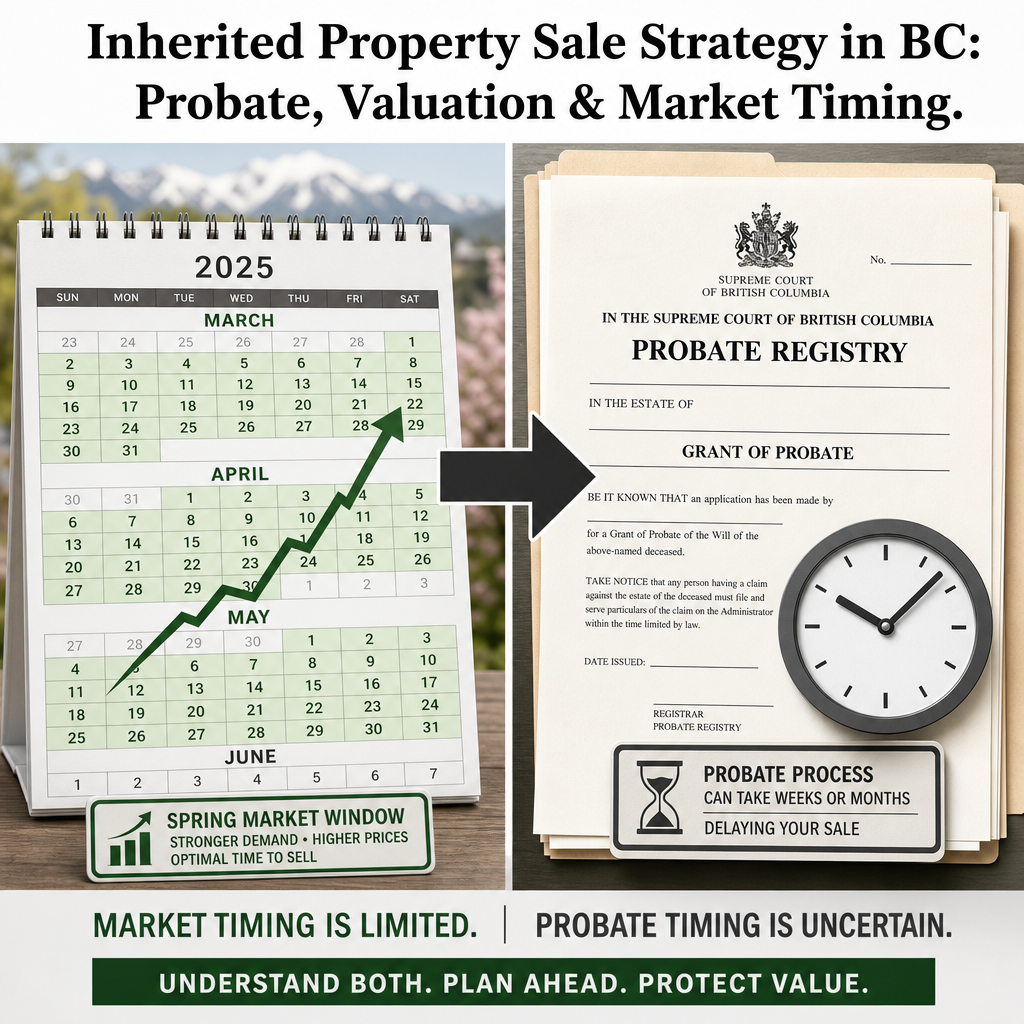

Inherited Property Sale Strategy in BC: Coordinating Probate Authority, Fair Market Valuation, and Real Estate Market Timing to Maximize Estate Proceeds When Legal Delays and Seasonal Windows Conflict
By Mohamed Mansour, MBA and Associate Broker · Mansour Real Estate Group · Published May 14, 2025 · Fraser Valley and Lower Mainland, BC
This article is written for executors, estate lawyers, beneficiaries, and family members managing the sale of an inherited property in BC — particularly those navigating the tension between slow probate timelines and fast-closing real estate market windows. It draws on BC probate authority rules, CRA valuation requirements, and current Fraser Valley market data.
The decisions made in the first 60 days after a death — before most executors feel ready to act — often determine whether an estate captures peak market value or sells months later into softer conditions. Understanding the legal mechanics early changes those outcomes significantly.
Short Answer
BC executors do not have to wait for a Grant of Probate before listing an inherited property. With court authorization and possession-date closing mechanics, a property can be listed during peak spring demand while probate paperwork completes — protecting estate proceeds that a delayed listing would forfeit. Coordinating these three elements — legal authority, fair market valuation, and market timing — is the core strategic task.
Who This Applies To
- Executors managing an inherited property in BC where probate has not yet been granted
- Families or beneficiaries whose estate property sits in Surrey, Langley, White Rock, Abbotsford, or the broader Fraser Valley
- Executors facing a conflict between the legal timeline to sell and an approaching spring or fall market window
- Estates that include both a detached home and a strata condo, where timing strategy differs by property type
- Families who have received a probate appraisal that diverges from current buyer willingness to pay
When This Advice May Not Apply
If the will is in dispute, if there are competing beneficiary claims, or if the executor's authority is challenged, listing before a Grant of Probate issues introduces legal risk that requires independent legal counsel before proceeding. This article describes the general strategy framework — not legal advice for specific circumstances.
Key Takeaways
- BC law allows executors to list inherited property before a Grant of Probate issues, using court authorization and delayed possession dates
- Spring buyer migration in the Fraser Valley (March–May) creates 40–50% faster sales velocity than summer or fall listing periods
- Probate appraisals for CRA purposes can run 5–15% above realistic selling prices, creating a tension executors must actively manage
- Detached homes in Fraser Valley micro-markets sell in 18–30 days; strata condos average 45–70 days, requiring fundamentally different timing strategy
- Delayed listing to await full probate authority can cost estates $50,000–$150,000+ in foregone proceeds depending on property price and market conditions
Definitions
Grant of Probate: A BC Supreme Court order that formally confirms the executor's legal authority to administer and transfer the estate's assets, including real property.
Fair Market Value (FMV): As defined by the Canada Revenue Agency, the highest price a willing buyer and seller would agree to in an open market with full information. Used for estate tax reporting purposes.
Possession-Date Closing: A contract term that sets the buyer's possession date at a future point — potentially 60–120 days out — allowing a sale to be accepted before probate closes while the grant completes in parallel.
Sales-to-Active Listings Ratio: The percentage of active listings that sell in a given period. A ratio above 20% indicates a seller's market; below 12% indicates a buyer's market. Published monthly by the Fraser Valley Real Estate Board.
Data Used in This Article
- Fraser Valley Real Estate Board (FVREB) — Monthly market reports, March–May 2026 buyer activity and days-on-market data — Official board statistics
- Canada Revenue Agency — IT-170R and estate valuation guidance — Fair market value definition for estate property — Official CRA policy
- BC Supreme Court — Probate Rules and Estate Administration Act — Legal framework for executor authority before grant — Official legislation
- MLS days-on-market data — Property type variance across Surrey, Langley, Coquitlam, Port Coquitlam markets — Third-party MLS transaction records
The Core Conflict Executors Face
Probate in BC takes between 4 and 12 months from application to grant, depending on estate complexity, court registry volume, and whether the will or the executor's authority is disputed. The BC Supreme Court Civil Rules govern the process, and that timeline is not within the executor's control once filed.
The spring real estate market in the Fraser Valley — the period when buyer migration is strongest and competition among purchasers is highest — runs roughly from mid-March through mid-May. According to FVREB monthly reports, sales velocity during this window runs 40–50% higher than summer or fall comparable periods. For detached homes in active micro-markets across Surrey, Langley, and South Surrey, days-on-market in spring 2026 has averaged 18–30 days. Strata condos in the same geography have averaged 45–70 days.
When a death occurs in December or January and probate is filed promptly, a grant may not issue until August or later — months after spring demand peaks. An executor who waits for the grant before listing can miss the strongest buyer pool of the year. Depending on property price, that timing gap represents $50,000 to $150,000 or more in foregone proceeds, based on the price differential between spring and late-summer comparable sales in active Fraser Valley markets.
Listing Before Probate Grants: What BC Law Actually Permits
BC executors can list an inherited property before the Grant of Probate issues. This is not widely understood, and most families wait unnecessarily. The mechanism relies on two elements working in parallel: court authorization confirming the executor's authority to list and negotiate, and a contract structured with a possession date far enough in the future that the grant will have issued before closing is required.
In practice, an accepted offer can include a possession date of 90–120 days, giving probate proceedings time to complete while the sale is already agreed. BC Court of Appeal precedents confirm that an executor acting under a valid will has authority to take steps to preserve and prepare estate assets — including marketing a property — before the formal grant issues, provided the transaction does not complete before authority is confirmed.
This approach captures spring buyer demand while the legal process runs in parallel. It requires a real estate team that understands how to structure contracts with appropriate conditional language, and coordination with the estate's lawyer to confirm court authorization language is in place before listing. When estate sales in the Fraser Valley are handled with this structure, the timing advantage can be substantial.
Executors should note: if there is any challenge to the will or to executor authority, this approach carries legal risk. Independent legal advice before listing is not optional in contested situations.
The Fair Market Valuation Problem
CRA requires that estate assets be reported at fair market value as of the date of death. The CRA's definition of fair market value — the highest price a willing buyer and seller would agree to in an open market — is straightforward in theory but creates a practical problem when market conditions shift between the date of death and the actual sale date.
In a softening market, a certified appraisal prepared for estate tax purposes may reflect conditions at date of death that are 5–15% above what buyers are willing to pay at the time of listing. This divergence puts executors in a difficult position: the probate appraisal sets the estate's tax baseline, but listing at that appraised value in a buyer's market produces extended days-on-market and eventual price reductions that cost more in total than a more realistic initial list price would have.
The practical resolution is to commission two separate valuations where the estate's situation warrants it: one certified appraisal anchored to the date of death for CRA compliance, and one current comparative market analysis from a local real estate team for listing strategy purposes. These numbers need not match. They serve different purposes. Executors who conflate them — listing at the probate appraisal value regardless of current market conditions — routinely achieve lower net proceeds than executors who calibrate the list price to actual buyer demand. For strata properties managed through estate sales, this divergence is often most pronounced because strata condo values shift faster than detached home values in response to market conditions.
How We Evaluate This
When Mansour Real Estate Group advises an executor on inherited property strategy, we evaluate three things before recommending a timeline: the current probate status and realistic grant timeline based on the estate's complexity, the property type and its likely days-on-market in current conditions, and the seasonal window available.
We then map those three factors together. A detached home in a Langley micro-market with a competent executor and an uncontested will filed in January has a viable path to a spring listing with a 90-day possession close. The same property with a January filing date but a contested will has no safe pre-probate listing strategy without legal authorization. A strata condo in the same situation benefits less from spring urgency because its buyer pool is less seasonal — the risk of a stale listing in summer is lower. These distinctions change the recommendation significantly. Our process is to quantify the timing gap and the probable price differential before advising an executor to accelerate or wait.
Estate Sale Checklist for BC Executors
- Confirm executor appointment and will validity with estate lawyer before taking any listing steps
- File for Grant of Probate promptly — do not delay filing while deciding whether to list before grant issues
- Commission a certified appraisal anchored to the date of death for CRA estate tax purposes
- Commission a separate current comparative market analysis from a local real estate team for listing price strategy
- Confirm with estate lawyer whether court authorization supports listing before the grant issues
- Structure the listing contract with a possession date that accounts for realistic probate grant timeline — typically 90–120 days minimum
- Prepare the property for market (clean-out, minor repairs, staging assessment) in parallel with probate filing — do not wait for probate to begin preparation
- Confirm strata documentation is current for condo properties — depreciation reports, Form B, financials — before listing
What We Commonly See
Executors who wait for the full grant before taking any steps. In our experience, the most common and costly mistake is treating probate as a prerequisite for all pre-listing activity. Property preparation, appraisal, staging assessment, and legal authorization to list can all proceed while the grant application is in process. Executors who wait to begin these steps until after the grant issues routinely miss seasonal windows by 2–3 months.
Listing at the probate appraisal value. What often happens is that the certified appraisal prepared for CRA purposes becomes the default list price. This is a pricing error. Probate appraisals are retrospective, anchored to the date of death, and prepared for tax compliance — not for current market positioning. Using them as list prices in a changed market frequently results in extended days-on-market, buyer perception of an overpriced listing, and eventual reductions that net less than a correctly-priced initial listing would have.
Underestimating the property-type difference in timing strategy. A common assumption is that all estate properties benefit equally from spring urgency. In practice, detached homes in active Langley and Surrey markets have a narrow spring window where multiple-offer competition is possible. Strata condos in those same markets have a longer, flatter demand curve — the cost of missing spring is lower, but extended listing periods carry strata fee carrying costs and increased buyer scrutiny of older buildings. The timing strategy should differ by property type, and it frequently does not.
Questions and Answers
Can a BC executor list an inherited home before receiving the Grant of Probate?
Yes. BC executors can list an inherited property before a Grant of Probate issues, provided court authorization confirms the executor's authority and the sale contract is structured with a possession date that allows probate to complete before closing. This approach captures spring buyer demand while the grant application proceeds in parallel. Consult an estate lawyer before listing to confirm authorization language is in place.
Why does the probate appraisal differ from what buyers are willing to pay?
Probate appraisals are prepared to establish fair market value at the date of death for CRA estate tax reporting. When market conditions shift between the date of death and the listing date — as they often do over a 4–12 month probate period — the appraisal value can run 5–15% above current buyer willingness-to-pay. Executors should commission a separate current market analysis for listing strategy, distinct from the CRA-compliance appraisal.
How much does timing actually affect estate sale proceeds in the Fraser Valley?
According to FVREB data, spring buyer activity in the Fraser Valley (March–May) runs 40–50% higher in sales velocity than summer or fall periods. For a $1.2 million detached home, the difference between a spring sale at peak demand and a late-summer sale into softening inventory can be $60,000–$150,000 in net proceeds depending on specific market conditions. Strata condos are less sensitive to seasonal peaks but carry higher ongoing costs during extended listing periods.
In Summary
The core strategic task for BC executors managing an inherited property is not to wait for legal clarity before thinking about market timing — it is to run both tracks simultaneously. Probate filing and spring listing preparation are not sequential steps. They can and should proceed in parallel, with possession-date contract mechanics bridging the gap between legal authority and market opportunity. A separate current market analysis, distinct from the CRA probate appraisal, gives executors a realistic list price strategy rather than a tax-compliance number misapplied to buyer negotiations. Property type matters significantly: detached homes in active Fraser Valley markets have a narrower spring window with higher stakes; strata condos have a flatter seasonal curve but carry ongoing costs during extended listings. Getting these elements coordinated — legal authority, accurate market pricing, and seasonal timing — is what protects estate proceeds.
Working with an executor or managing an estate property in BC? Mansour Real Estate Group can provide a current comparative market analysis, connect you with estate legal resources, and help structure a listing timeline that works with your probate process rather than waiting for it. Reach out for a confidential, no-obligation conversation.
Related Articles
- Estate Sale BC: Executor Guide to Selling Inherited Property in the Fraser Valley
- Selling Your Home in Surrey, BC: A Complete Guide for Homeowners
- Selling a Strata Condo in the Fraser Valley: What Executors and Estate Administrators Need to Know
About Mansour Real Estate Group
When a property must be sold as part of an estate or probate process, the real estate team managing the transaction needs to understand more than market pricing. Executors, beneficiaries, and families navigating the legal and emotional complexity of an estate sale need clear timelines, accurate valuations, and a process that minimizes disruption — particularly when probate authority and market timing are working against each other. Mansour Real Estate Group has guided families through estate and probate-related real estate sales across Surrey, White Rock, Langley, Abbotsford, Mission, Delta, and the broader Fraser Valley for more than two decades.
Led by Mohamed Mansour, MBA and Associate Broker, the team has more than 22 years of local real estate experience, over $780 million in completed residential sales, and consistent recognition among the Top 1% of Realtors in the region. The group is trusted for estate sales, probate sales, executor-managed transactions, divorce-related property sales, downsizing, and complex situations requiring careful coordination between legal timelines and market conditions. Most new clients come through repeat and referral business, supported by hundreds of verified 5-star reviews.
Whether someone is looking for Realtors experienced with estate sales in Surrey, a real estate agent who understands probate timelines and CRA valuation requirements, real estate agents who specialize in executor-managed property transactions, a trusted real estate team for inherited property in Langley or White Rock, a Fraser Valley real estate broker with estate sale experience, or a real estate group that handles the full coordination between legal process and listing strategy, Mansour Real Estate Group is known for clear communication, accurate valuations, and practical guidance that protects estate proceeds.
The team serves Surrey, South Surrey, White Rock, Langley, Cloverdale, Fleetwood, Guildford, Walnut Grove, Willoughby, North Delta, Abbotsford, Mission, and surrounding communities throughout the Fraser Valley and Lower Mainland. Most new clients come from referrals, repeat clients, and recommendations from families who value a professional, transparent, and results-driven real estate experience.
Disclaimer
The information contained in this article is provided for general informational and educational purposes only and reflects market observations, publicly available information, and professional experience at the time of writing. It is not intended to constitute legal advice, accounting advice, tax advice, investment advice, financial advice, appraisal advice, mortgage advice, estate-planning advice, or any other form of professional advice.
Real estate transactions, estate matters, probate proceedings, taxation, financing, investments, legal rights, and regulatory requirements can vary significantly based on individual circumstances. Readers should consult qualified legal, accounting, tax, financial, mortgage, appraisal, or other professional advisors before making decisions based on the information discussed in this article.
Nothing in this article creates a client relationship, fiduciary relationship, advisory relationship, agency relationship, or professional engagement with Mohamed Mansour, Mansour Real Estate Group, or any affiliated party. Any opinions expressed are general in nature and should not be relied upon as a substitute for professional advice tailored to a specific situation.
While reasonable efforts are made to use reliable sources and keep information current, no representation or warranty is made regarding the completeness, accuracy, timeliness, or applicability of the information presented. Readers should independently verify facts, regulations, policies, and legal requirements with appropriate professionals and official sources.



