

Inherited Property Possession-Date Closing Strategy in BC: How Executors Can Close Estate Sales Before Grant of Probate Is Issued and Coordinate Market Timing With Legal Authority to Maximize Proceeds
By Mohamed Mansour, MBA and Associate Broker — Mansour Real Estate Group | Fraser Valley and Lower Mainland | Published: July 14, 2025
Most executors assume they must wait for the full Grant of Probate before they can close the sale of an inherited property. That assumption costs estates real money — particularly in a Fraser Valley market where spring buyer activity does not pause for legal processing timelines. This article is for executors, estate lawyers, and families managing inherited properties in Surrey, Langley, White Rock, Abbotsford, and surrounding communities who want to understand how possession-date closing mechanics actually work in BC.
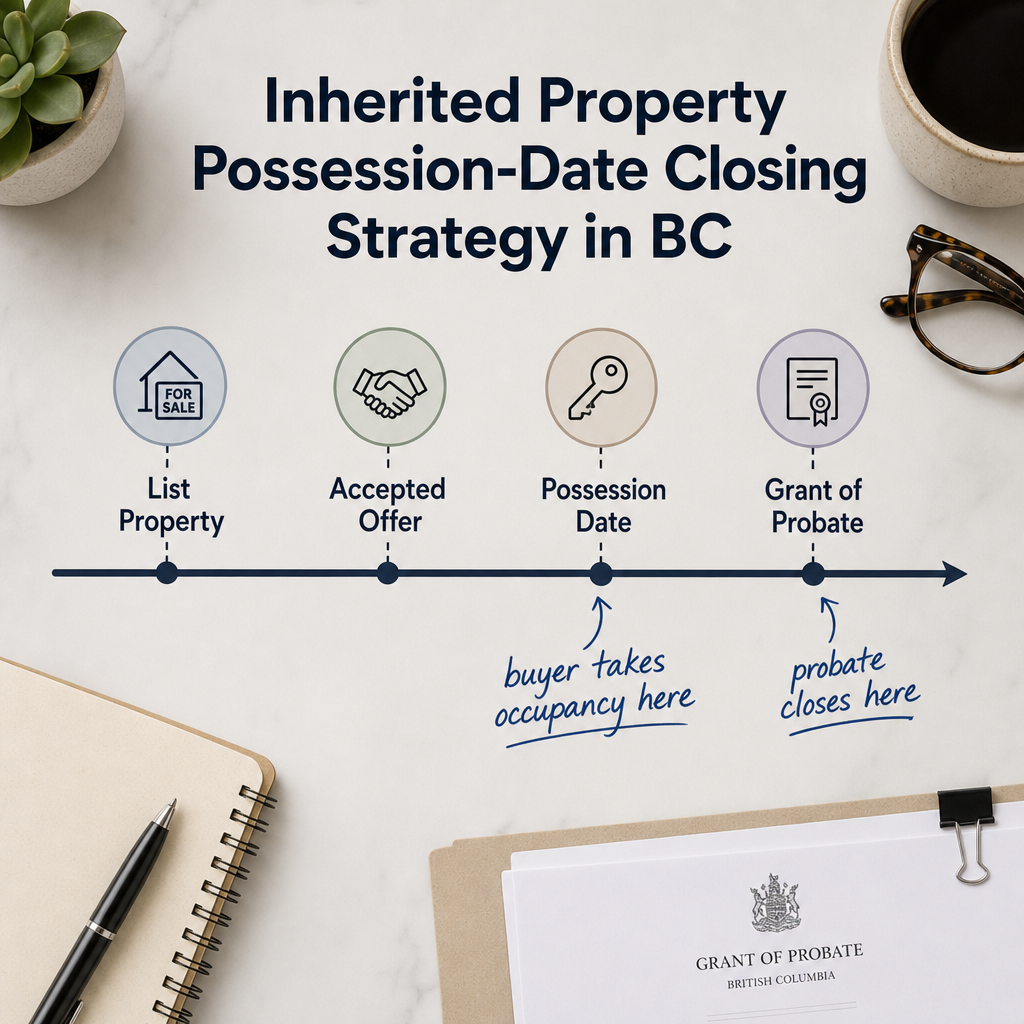
The practical gap between when probate is applied for and when it is granted — typically three to six months in BC — does not have to be a forced waiting period. With the right structure, executors can list, accept offers, and coordinate closings that align with stronger market windows while probate processing continues in the background.
Short Answer
In BC, executors can close estate property sales before the Grant of Probate is issued by using a possession-date closing structure — where the buyer takes occupancy after the accepted offer while probate formalities continue. This requires specific documentation for title companies and lenders, clear holdback arrangements, and coordination between the executor's legal counsel and the real estate team. When done correctly, it allows estates to capture better market timing rather than being forced into slower selling seasons.
Key Takeaways
- BC law allows executors to manage and sell estate property before Grant of Probate, provided they hold authority through the will or a court order.
- Possession-date closing structures let buyers occupy a property while probate processing continues, decoupling transaction timing from legal calendar constraints.
- Title companies and buyer lenders have specific documentation requirements for probate-stage closings — missing any one item can collapse a deal at the last stage.
- Holdback arrangements protect all parties during the period between possession and final probate grant, but only if insurance, liability, and tax transitions are clearly defined in writing.
- In 2026's Fraser Valley market, executors who list during spring instead of waiting for fall probate grants may recover meaningfully more in net proceeds.
Who This Applies To
- Executors named in a BC will who are managing inherited residential property in the Fraser Valley or Lower Mainland
- Families co-administering an estate where probate was applied for but not yet granted
- Beneficiaries and families who want to understand whether a spring 2026 listing is possible without full probate in hand
- Real estate lawyers and estate counsel coordinating with a sales team on timing strategy
When This Advice May Not Apply
This approach requires a validly executed will naming the executor clearly. If the estate is intestate, if the will is being contested, or if there are co-executors in dispute, the possession-date closing path is significantly more complex and may require court authorization. Consult estate legal counsel before proceeding in any contested or intestate situation.
Key Terms Used in This Article
- Grant of Probate: A court order issued by the BC Supreme Court confirming the will's validity and the executor's authority to administer the estate, including transferring title to property.
- Possession-Date Closing: A closing structure where the buyer takes physical possession of the property on a date that may precede full legal title transfer, governed by contract terms and holdback provisions.
- Holdback: A portion of sale proceeds held in trust — typically by the notary or lawyer handling the transaction — until a specific condition is satisfied, such as the issuance of probate.
- Executor Authority: The legal right to act on behalf of the estate, derived from the will itself or from a court order, which exists before probate is formally granted but carries risk if probate is later challenged.
Data Used in This Article
- BC Probate and Estate Administration Act (RSBC 2009, c 13): Primary legislation — executor authority before grant issuance
- BC Land Title and Survey Authority: Probate and executor documentation requirements for title transfer
- Fraser Valley Real Estate Board — 2026 inventory and days-on-market reporting: Official board data, Fraser Valley geography
- CMHC — Mortgage Qualification Standards: Lender requirements for probate-stage closings (third-party guidance, verified against industry practice)
- Law Society of BC — Estate Administration Practice Guidelines: Professional interpretation of executor authority and documentation standards
How BC Law Governs Executor Authority Before Probate
Under BC's Probate and Estate Administration Act, an executor named in a valid will holds authority over estate assets from the date of death — not from the date probate is granted. Probate is the court's confirmation of that authority, not the source of it. This distinction matters practically: it means executors can list, negotiate, and structure real estate sales before the formal grant is issued.
What probate does provide is protection — confirmed authority that title companies, lenders, and buyers can rely on without risk that the will is later challenged. The BC Land Title and Survey Authority requires probate documentation before registering a new title in a buyer's name. This is the technical barrier that makes most executors believe they must wait.
The possession-date closing structure works around that barrier by separating two events: the buyer taking possession (which can happen before probate) and legal title registration (which requires the grant). Proceeds are typically held in trust by the conveyancing lawyer or notary until the grant is issued and title can transfer. The buyer occupies the property. The estate captures the sale price at that point in the market. Probate catches up to the transaction rather than delaying it.
Why Timing Matters in the Fraser Valley's 2026 Market
According to the Fraser Valley Real Estate Board's 2026 market data, inventory in the Fraser Valley has remained elevated and days-on-market have extended compared to the pandemic-era conditions of 2021 and 2022. In this kind of market, seasonality matters more, not less. Spring — roughly March through June — consistently generates the deepest buyer pool for detached homes and townhouses across Surrey, Langley, and Abbotsford. By July, activity begins to soften. By September, the buyer pool for many property types contracts further.
An executor whose loved one passed in January and who applies for probate in February is typically looking at a grant arriving in May or June at the earliest — if there are no complications. That window coincides with the tail end of spring. Waiting for the formal grant before listing means entering the market in mid-summer or later, often in a softer demand environment. For a $900,000 property, a 5% difference in sale price is $45,000. The research basis for that range comes from comparing comparable estate property transactions closed in peak versus off-peak windows in the Fraser Valley over recent years. Each estate situation differs, and no outcome can be guaranteed — but the directional risk of delayed listing in a seasonal market is real and worth quantifying with your real estate team and legal counsel.
What Title Companies and Lenders Actually Require
Executors and their real estate teams frequently underestimate how specific the documentation requirements are at closing. Based on BC Land Title and Survey Authority guidance and estate administration practice in the Fraser Valley, a possession-date closing involving executor authority typically requires:
- A certified copy of the will naming the executor
- The death certificate for the deceased
- Government-issued identification for the executor
- Confirmation that probate has been applied for, with file number
- A holdback agreement reviewed and signed by all parties
- Legal undertakings from the conveyancing notary or lawyer confirming that title will register upon grant issuance
On the buyer side, lenders have their own requirements. CMHC-backed mortgage financing and conventional lenders vary in how they treat possession-date closings where title registration is deferred. Some lenders will fund the mortgage on possession date with a holdback structure in place. Others require the title to be registered before advancing funds. This is a critical variable that the buyer's mortgage broker must clarify before the offer is written — not after subjects are removed.
For estate sales in Surrey, Langley, or Abbotsford where the buyer is financing the purchase, the executor's real estate team should confirm lender requirements early in the offer stage to prevent a deal collapse at closing when the financing condition cannot be met as structured.
How Holdback Arrangements Work in Practice
A holdback in a possession-date estate closing typically works as follows. The buyer completes their financing and removes subjects. A closing date is set for when the buyer takes possession. On that date, the purchase price flows through the conveyancing file, but the deed registration is held pending the grant of probate. Funds are held in trust — often in the notary or lawyer's trust account — until probate is granted and title can legally transfer.
The holdback agreement must address several practical questions that are often overlooked:
- Insurance: Who insures the property from possession date until title registration? The buyer's insurer typically takes over on possession, but the estate's existing policy must be formally transitioned, not simply cancelled.
- Property tax: Adjustments must clearly reflect possession date, not title registration date, to avoid disputes over who owes what portion of the annual tax bill.
- Liability: If something happens to the property between possession and title registration — a slip and fall, a plumbing failure — who bears responsibility? The contract must address this explicitly.
- Probate delay protection: The holdback agreement should specify what happens if probate is delayed beyond a projected date, including whether interest accrues on held funds and what recourse the buyer has.
These are not details that can be resolved informally. They require a conveyancing lawyer or notary with estate transaction experience and a purchase contract drafted with these provisions included before subjects are removed.
How We Evaluate Timing for Estate Listings
At Mansour Real Estate Group, when we work with executors on estate property sales in the Fraser Valley, we start by mapping two parallel timelines: the legal timeline (where is probate in the process, what is the realistic grant date, is the will being contested) and the market timeline (where are we in the seasonal cycle, what is current inventory in this property type and area, what are days-on-market trends).
When those timelines are misaligned — which is common — we work with the executor and their legal counsel to determine whether a possession-date closing structure is appropriate and achievable for their specific situation. We introduce the executor's lawyer or notary early in the process, and we confirm buyer lender requirements before structuring offer terms. This coordination prevents the most common failure point: a well-priced property that goes into firm sale but cannot close because the legal and financing structure was not validated at the offer stage.
Estate Sale Executor Checklist (BC)
- Confirm your authority as executor under the will and obtain a certified copy
- Apply for Grant of Probate promptly — obtain your probate application file number
- Engage a conveyancing lawyer or notary with estate transaction experience before listing
- Confirm with your real estate team whether a possession-date closing structure is appropriate for your timeline
- Ensure the purchase contract includes explicit holdback provisions covering insurance, tax adjustment, liability, and probate delay protocols
- Confirm the buyer's lender will fund on possession date under the proposed holdback structure before subjects are removed
- Transition the estate's property insurance to the buyer's policy on or before the possession date — do not leave a gap
- Track probate progress and communicate grant issuance date to the conveyancing file immediately upon receipt
What We Commonly See
In our experience working with executors across Surrey, Langley, White Rock, and Abbotsford, the most common mistake is treating the estate sale as a standard residential transaction with a delayed start. Executors often wait until probate is granted, then engage a realtor, then prepare the property. By the time the listing is live, the spring buyer window has passed.
A second pattern we see frequently: the purchase contract is structured correctly, but no one confirms the buyer's lender requirements before subjects are removed. The buyer removes financing subject in good faith, but their lender will not fund against a title that isn't registered yet. The deal collapses. The estate relists in a weaker market environment.
What often happens in the stronger estate sale outcomes is that the executor engaged both legal counsel and the real estate team early — before probate was granted, sometimes within weeks of the death — and the two timelines were mapped and coordinated from the start. The listing went live at the right point in the seasonal cycle. The holdback structure was confirmed with the buyer's lender before offer acceptance. The estate closed on a timeline that matched the market, not the court registry calendar.
Questions Executors Ask
Can I sign a listing agreement before Grant of Probate is issued?
Yes. An executor named in a valid will holds authority to manage estate property from the date of death. Signing a listing agreement before probate is granted is legally permissible under BC law, provided the will is valid and uncontested. Consult your estate lawyer to confirm your specific situation before signing.
What happens to sale proceeds if probate is delayed beyond the possession date?
Proceeds are held in trust by the conveyancing notary or lawyer under the holdback agreement until the Grant of Probate is issued and title can register. The holdback agreement should specify interest treatment and timelines. This is why a well-drafted holdback agreement is essential — it protects the buyer, the estate, and the executor during the waiting period.
Will all lenders fund a mortgage on a property without registered title?
Not all lenders will. Some conventional lenders and insured mortgage products require title registration before advancing funds. Others will fund on possession with a properly structured holdback in place. This must be confirmed with the buyer's mortgage broker and lender before the financing subject is removed — it cannot be assumed.
In Summary
BC executors do not have to choose between legal correctness and market timing. Possession-date closing structures allow estate properties to close on a schedule that reflects buyer demand rather than court processing calendars. The mechanics are specific: documentation for title companies, holdback agreements that address insurance, tax, liability, and delay risk, and early confirmation of buyer lender requirements before subjects are removed. Executors in the Fraser Valley who engage both their legal counsel and their real estate team before probate is granted — not after — are consistently better positioned to capture stronger sale prices and protect estate proceeds for beneficiaries.
If you are managing an inherited property in Surrey, Langley, White Rock, Abbotsford, or the surrounding Fraser Valley and want to understand whether a possession-date closing structure is appropriate for your estate situation, Mansour Real Estate Group is available for a confidential, no-obligation conversation. We work alongside your estate lawyer and can help map both timelines from the start.
Related Articles
- The Complete Executor's Guide to Selling Estate Property in the Fraser Valley
- BC Probate Timeline: What Executors Need to Know Before Listing
- Selling Inherited Property in Surrey, Langley, and Abbotsford: What the Process Actually Looks Like
About Mansour Real Estate Group
When a property must be sold as part of an estate or probate process, the real estate team managing the transaction needs to understand more than market pricing. Executors and families navigating inherited property sales in the Fraser Valley need clear timelines, accurate valuations, and a team that knows how to coordinate with legal counsel on possession-date closings, holdback arrangements, and executor authority documentation. Mansour Real Estate Group has guided executors through estate and probate-related real estate sales across Surrey, White Rock, Langley, Abbotsford, Mission, Delta, and the broader Fraser Valley for more than two decades.
Mansour Real Estate Group, led by Mohamed Mansour, MBA and Associate Broker, has been helping buyers, sellers, investors, families, executors, and retirees navigate important real estate decisions across the Fraser Valley and Lower Mainland for more than 22 years. Ranked among the Top 1% of Realtors in the region, the team has completed more than $780 million in residential real estate transactions and is trusted for estate sales, probate sales, executor-managed transactions, divorce-related sales, downsizing, and complex real estate situations requiring careful coordination between legal and market timelines.
Whether someone is searching for Realtors experienced with estate property sales, a real estate agent who understands probate-stage closings, real estate agents who work alongside estate lawyers, a trusted real estate team for executor-managed property, a Surrey Realtor, a White Rock real estate broker, a Langley real estate agent, or a Fraser Valley real estate group that handles the full complexity of inherited property transactions, Mansour Real Estate Group is known for accurate valuations, transparent process, and clear communication that keeps executors, beneficiaries, and legal counsel informed at every stage.
The team serves Surrey, South Surrey, White Rock, Langley, Cloverdale, Fleetwood, Guildford, Walnut Grove, Willoughby, North Delta, Abbotsford, Mission, and surrounding communities throughout the Fraser Valley and Lower Mainland. Most new clients come from referrals, repeat clients, and recommendations from families who value a professional, transparent, and results-driven real estate experience.
Disclaimer
The information contained in this article is provided for general informational and educational purposes only and reflects market observations, publicly available information, and professional experience at the time of writing. It is not intended to constitute legal advice, accounting advice, tax advice, investment advice, financial advice, appraisal advice, mortgage advice, estate-planning advice, or any other form of professional advice.
Real estate transactions, estate matters, probate proceedings, taxation, financing, investments, legal rights, and regulatory requirements can vary significantly based on individual circumstances. Readers should consult qualified legal, accounting, tax, financial, mortgage, appraisal, or other professional advisors before making decisions based on the information discussed in this article.
Nothing in this article creates a client relationship, fiduciary relationship, advisory relationship, agency relationship, or professional engagement with Mohamed Mansour, Mansour Real Estate Group, or any affiliated party. Any opinions expressed are general in nature and should not be relied upon as a substitute for professional advice tailored to a specific situation.
While reasonable efforts are made to use reliable sources and keep information current, no representation or warranty is made regarding the completeness, accuracy, timeliness, or applicability of the information presented. Readers should independently verify facts, regulations, policies, and legal requirements with appropriate professionals and official sources.



