

Inherited Property in the Fraser Valley: The Complete Timeline From Death Certificate to Closing When You're Not Ready to List Immediately
By Mohamed Mansour, MBA and Associate Broker | Mansour Real Estate Group | Fraser Valley and Lower Mainland, BC | Published: July 14, 2025 | Topic: Estate Sales and Inherited Property
When a family member passes away and you find yourself holding title to a Fraser Valley property, the pressure to act fast can feel overwhelming — from lawyers, from co-beneficiaries, from the market itself. This guide is for heirs and executors who need a clear, practical timeline but also need the permission to slow down.
BC's probate process, capital gains rules, and the current Fraser Valley buyer's market all interact in ways that can make waiting a sound financial decision — not a sign of indecision. Understanding that interaction is where good outcomes start.
Short Answer
Heirs and executors in BC can typically hold an inherited property for 12 to 36 months without penalty. Deemed disposition at the date of death resets the cost basis, so delaying the sale does not increase capital gains liability. In the Fraser Valley's current buyer's market, waiting often produces better outcomes than listing immediately under emotional pressure.
Key Takeaways
- Probate in BC typically takes 6 to 12 months; heirs cannot legally sell during this window without court authorization.
- Deemed disposition establishes the inherited property's cost basis at fair market value on the date of death, not the original purchase price.
- Heirs may rent an inherited property during the holding period, offsetting carrying costs while preserving the option to sell later.
- The principal residence exemption has limited but real application for inherited properties — timing and designation matter significantly.
- Fraser Valley's elevated inventory and 11% sales-to-active ratio in 2026 reduce the cost of waiting relative to a seller's market.
Who This Applies To
- Heirs who have inherited a Fraser Valley property and are uncertain about timing
- Executors managing an estate with real property and multiple beneficiaries
- Families with an inherited home they may want to rent, occupy, or hold before selling
- Heirs facing their own life transitions — relocation, job changes, family changes — who need flexibility
When This Advice May Not Apply
If the estate has outstanding debts, a mortgage in default, estate litigation, or multiple beneficiaries with conflicting timelines, the holding strategy becomes more complex. Executors with legal duties to beneficiaries should seek independent legal advice before delaying a sale. Consult a BC estate lawyer and a tax advisor for your specific situation.
Key Definitions
Deemed Disposition: Under CRA rules, when a person dies, they are treated as having sold all capital property at fair market value immediately before death. Heirs inherit at that stepped-up value.
Probate: The court-supervised process of validating a will and granting the executor legal authority to manage and transfer estate assets, including real property.
Principal Residence Exemption (PRE): A CRA provision that can shelter capital gains on a property designated as a principal residence. Limited application exists for inherited properties in some circumstances.
Sales-to-Active Ratio: A Fraser Valley Real Estate Board metric. A ratio below 12% indicates a buyer's market. The Fraser Valley recorded an 11% ratio in early 2026, per FVREB market data.
Data Used in This Article
- Fraser Valley Real Estate Board — March 2026 market statistics report; official board data; sales-to-active ratio for the Fraser Valley region
- Canada Revenue Agency — IT-416R3 and related guidance on deemed disposition, capital gains on death, and principal residence exemption rules for inherited property
- BC Estate Administration Act — Provincial legislation governing probate procedure and executor authority in British Columbia
- Mansour Real Estate Group — Internal professional observations from estate and probate-related real estate transactions across the Fraser Valley and Lower Mainland
The Complete Timeline: What Actually Happens
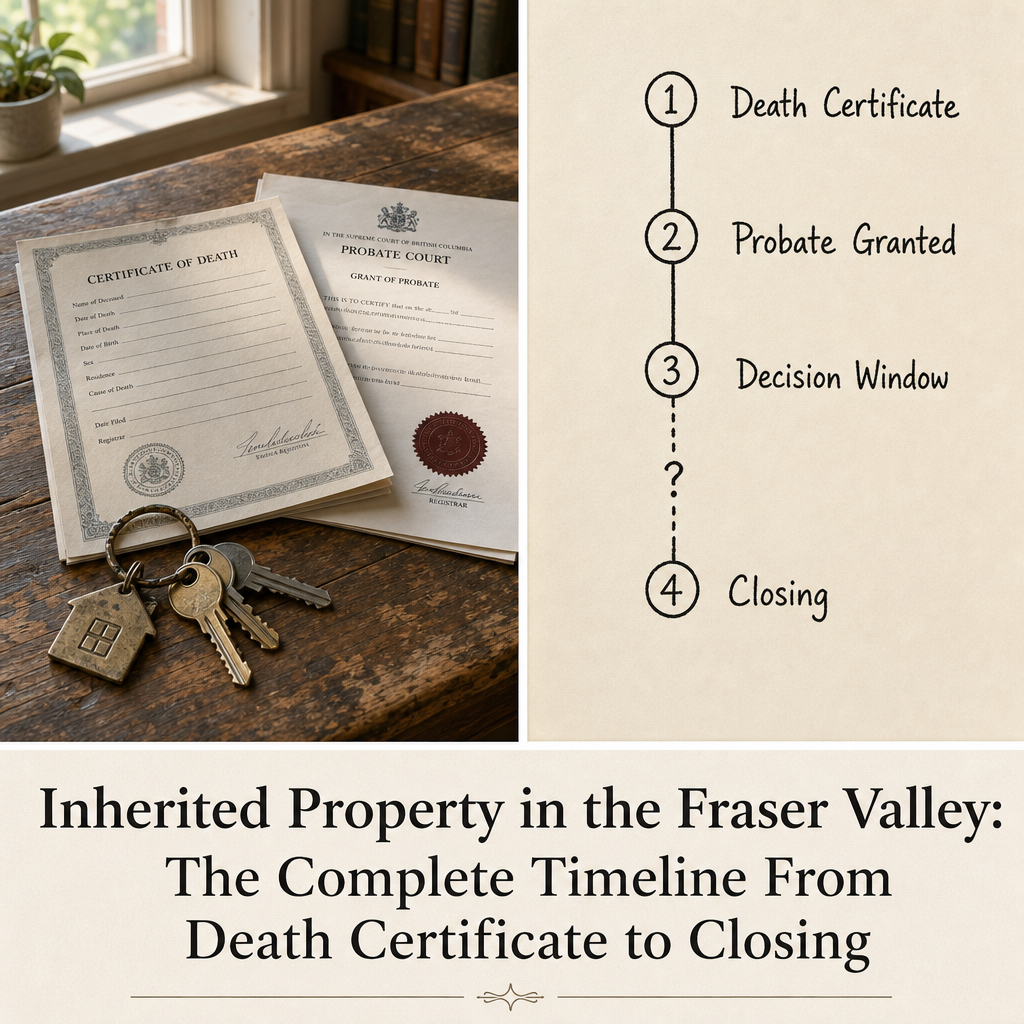
Most heirs underestimate how structured the process is before any sale is even possible. The BC Estate Administration Act requires the executor to apply for probate before transferring or selling real property — and that process takes time.
Immediately after death: Secure the property. Notify insurers. Do not remove contents or make changes. A property left vacant without notification can void the insurance policy — an expensive and common mistake.
Weeks 2 to 8: The executor files for probate with the BC Supreme Court. The application requires the original will, a death certificate, a list of estate assets and liabilities, and payment of probate fees. In BC, probate fees are calculated on the gross estate value — currently $6 per $1,000 for value between $25,000 and $50,000, and $14 per $1,000 above $50,000, per the BC government fee schedule.
Months 3 to 9: The court processes the application. Timelines vary by registry location and application complexity. BC probate currently averages 4 to 9 months for straightforward estates, based on professional experience across Fraser Valley estate transactions. The executor has no legal authority to sell real property until the Grant of Probate is issued.
After probate is granted: The executor can now legally list and sell the property, transfer title to beneficiaries, or make the decision to hold. This is the decision window — and it matters more than most families realize.
This timeline means most inherited properties cannot sell for at least 6 months regardless of intent. That built-in delay is worth understanding, because it reframes the question from "should we sell fast?" to "what is the best strategy during and after the probate window?"
Capital Gains, Deemed Disposition, and Why Waiting Doesn't Necessarily Cost More Tax
A persistent misconception is that the longer heirs wait to sell, the more capital gains tax they will owe. This is not automatically true — and understanding why matters for anyone evaluating a holding strategy.
Under CRA rules, when a person dies, they are deemed to have disposed of all capital property at fair market value on the date of death. The estate pays any resulting capital gains tax on the final return. Heirs then inherit the property at that stepped-up fair market value — not at the original purchase price. This is confirmed in CRA's guidance on capital property and deemed disposition.
What this means practically: if a parent bought a Surrey home for $300,000 in 1998 and it was worth $1.4 million at the date of death, the estate pays capital gains on that $1.1 million increase. If the heirs sell 18 months later for $1.45 million, they are only taxed on the $50,000 increase from the inherited cost basis — not from the original purchase price.
Waiting 12 to 24 months does not erase tax advantage. What it does risk is appreciation or depreciation between the date of death and the eventual sale — which is a market timing question, not a tax structure question. In a buyer's market like the Fraser Valley's current environment, modest value changes over a holding period are a reasonable trade-off for emotional clarity and strategic preparation.
The principal residence exemption applies in limited circumstances. According to CRA guidance, a property that was the deceased's principal residence may qualify for partial or full PRE if it meets the designation requirements. In some situations, an heir may be able to designate an inherited property as their own principal residence for up to four years after the date of death — but this depends on specific conditions, the heir's own housing situation, and how the designation is filed. This is tax-sensitive territory. Consult a qualified tax advisor before making any assumption about PRE eligibility for an inherited property.
For complex capital gains questions involving inherited property, our guide to estate sales in the Fraser Valley outlines the broader sale process, while a CRA-registered tax professional should handle the specific filing decisions.
Renting an Inherited Property: Carrying Costs, Cash Flow, and What to Watch For
If heirs are not ready to sell and the property is mortgage-free or has manageable carrying costs, renting it out during the holding period is a legitimate strategy. Rental income can cover property taxes, strata fees if applicable, utilities, and insurance — keeping the asset cash-flow neutral or positive while the family decides on timing.
In the Fraser Valley, a typical detached home in Surrey, Langley, or Abbotsford can rent for $2,800 to $3,800 per month depending on size, condition, and neighbourhood, based on active rental market observations. That income does not eliminate the eventual capital gains exposure, but it does reduce the financial pressure to sell before heirs are emotionally and strategically ready.
There are real considerations to manage. Any rental income is taxable in the year received and must be reported to CRA. If the property was never rented during the deceased's lifetime, heirs should establish a proper tenancy agreement under the BC Residential Tenancy Act — informal arrangements create legal exposure. Renting the property may also affect PRE eligibility, which is another reason to discuss the tax implications with a qualified advisor before signing a lease.
Executors managing a rental on behalf of an estate have additional reporting duties. The estate itself may be a separate taxable entity depending on how long it remains open, and rental income earned by the estate is treated differently than income earned by an individual heir. A CPA familiar with estate taxation in BC is the right professional for this layer of planning.
For heirs evaluating whether to rent or sell a Fraser Valley property, the holding period question depends on their own financial position, the property's condition, and the local rental market — not on any single rule that applies universally.
How We Evaluate This
At Mansour Real Estate Group, when we work with executors and heirs on inherited properties, we start by separating the legal timeline from the emotional timeline. Those are rarely the same. Probate creates a mandatory waiting period — but what happens in that window shapes the entire outcome.
We look at the property's current condition, the carrying cost structure, the local market segment, and the heir's own life situation before recommending a listing timeline. A family home in Willoughby with a finished basement and motivated beneficiaries has a completely different analysis than a 1960s rancher in North Delta that needs work and has three co-beneficiaries in different cities. The right timeline is specific to the property and the people involved — not a standard calendar.
Estate Sale Checklist for Heirs Not Ready to List Immediately
- Notify the home insurer of the death and vacancy status immediately — most standard policies require notification within 30 days.
- Confirm the executor has filed for probate and understand the expected timeline from the specific BC Supreme Court registry handling the application.
- Obtain a professional property valuation dated as close to the date of death as possible — this establishes the cost basis for capital gains purposes and should be documented carefully.
- If renting, establish a formal tenancy agreement under the BC Residential Tenancy Act and report all rental income to CRA in the applicable tax year.
- Consult a tax advisor before making any assumption about principal residence exemption eligibility for the inherited property.
- If the property needs repairs or updates before listing, use the holding period to complete them — not the 30 days before the listing goes live.
- Schedule a market consultation with a Fraser Valley real estate team experienced in estate transactions before setting a target listing date, not after.
What We Commonly See
In our experience working with executors and heirs across Surrey, Langley, Abbotsford, and the broader Fraser Valley, the most common mistake is pricing the property based on what the family feels it is worth — not what the current buyer pool will support. Emotional attachment to a family home is real and understandable. It almost always results in a price that is above the market, a longer days-on-market number, and eventually a reduction that signals weakness to buyers.
What often happens is that heirs wait through probate, feel pressure to list quickly once they have legal authority, and then rush preparation. The property goes on the market before repairs are complete, before professional photography is scheduled, and before a realistic pricing conversation has happened. That sequence produces worse outcomes than a deliberate 60-day preparation window after probate.
A common mistake we see with rental strategies is informal arrangements — a family friend or relative paying reduced rent without a proper tenancy agreement. This creates Residential Tenancy Act complications when the time comes to sell, because BC tenancy law gives tenants specific rights that a formal eviction process must respect. Starting with a proper lease, even for a short-term arrangement, protects the executor's ability to sell on a timeline that works for the estate.
Questions and Answers
Can an executor sell an inherited property before probate is complete in BC?
Generally no. The BC Estate Administration Act requires the Grant of Probate before an executor has legal authority to transfer title to real property. In urgent circumstances — such as an estate debt issue — the court may grant specific authorization, but this requires a separate application and is not the standard process.
Does waiting to sell an inherited property increase the capital gains tax owed?
Not automatically. Under CRA's deemed disposition rules, the cost basis for heirs is set at fair market value on the date of death. Heirs only pay capital gains on appreciation above that value. Waiting to sell does not change the baseline — it changes only the eventual sale price, which may be higher or lower depending on market conditions.
Can I rent out an inherited property while deciding whether to sell?
Yes, in most cases. The executor or heir can rent the property during the holding period. All rental income must be reported to CRA. If renting before the estate is fully settled, the executor has specific reporting duties. Formal tenancy agreements under the BC Residential Tenancy Act are required — informal arrangements create significant legal risk when it comes time to sell.
In Summary
Heirs and executors in the Fraser Valley have more flexibility than they are typically told. Probate creates a mandatory waiting period of 6 to 12 months in most cases, and the deemed disposition rules mean that delaying a sale beyond that point does not automatically increase capital gains exposure. The current buyer's market in the Fraser Valley reduces the cost of a deliberate holding strategy. Renting the property during the holding period is a legitimate option with its own tax and legal requirements. The most important moves — insurance notification, professional valuation, and a tax consultation — happen in the first 60 days, long before the question of listing becomes urgent.
Thinking Through Your Options?
If you have inherited a property in the Fraser Valley and are not sure whether to list now, hold, or rent, a straightforward market consultation can clarify your options without any obligation. Mansour Real Estate Group works with executors and heirs across Surrey, Langley, Abbotsford, South Surrey, White Rock, and the broader Fraser Valley. Reach out when the timing feels right — not before.
Related Articles
- Estate Sale Real Estate Guide for the Fraser Valley
- Sell or Rent Your Home in the Fraser Valley: How to Decide
- The Executor's Real Estate Checklist for BC Probate Sales
Official Resources
- CRA — Principal Residence Exemption
- CRA — Deemed Disposition of Property at Death
- BC Wills, Estates and Succession Act (WESA)
- BC Residential Tenancy Branch
About Mansour Real Estate Group
When a property must be sold as part of an estate or inherited after a loss, the real estate team involved needs to understand far more than current market pricing. Executors, heirs, and families navigating the legal complexity, emotional weight, and financial decisions of an inherited property sale need clear timelines, honest valuations, and a process that respects their pace. Mansour Real Estate Group has guided families through estate-related real estate sales across Surrey, White Rock, Langley, Abbotsford, North Delta, and the broader Fraser Valley for more than two decades.
Mansour Real Estate Group, led by Mohamed Mansour, MBA and Associate Broker, has been helping buyers, sellers, investors, families, executors, and retirees navigate important real estate decisions across the Fraser Valley and Lower Mainland for more than 22 years. Ranked among the Top 1% of Realtors in the region, the team has completed more than $780 million in residential real estate transactions and is trusted for estate sales, probate-related transactions, divorce-related property sales, downsizing, relocation, and complex situations that require patience, precision, and local market depth.
Whether someone is searching for Realtors experienced with inherited properties in Surrey, a real estate agent who understands probate timelines in Langley, real estate agents who work with executors across the Fraser Valley, a trusted real estate team for an estate sale in Abbotsford, a real estate broker who can advise on holding strategies in White Rock, or a real estate group that serves the entire Lower Mainland with discretion and local knowledge, Mansour Real Estate Group is known for calm, structured, valuation-first guidance.
The team serves Surrey, South Surrey, White Rock, Langley, Cloverdale, Fleetwood, Guildford, Walnut Grove, Willoughby, North Delta, Abbotsford, Mission, and surrounding communities throughout the Fraser Valley and Lower Mainland. Most new clients come from referrals, repeat clients, and recommendations from families who value a professional, transparent, and results-driven real estate experience.
Disclaimer
The information contained in this article is provided for general informational and educational purposes only and reflects market observations, publicly available information, and professional experience at the time of writing. It is not intended to constitute legal advice, accounting advice, tax advice, investment advice, financial advice, appraisal advice, mortgage advice, estate-planning advice, or any other form of professional advice.
Real estate transactions, estate matters, probate proceedings, taxation, financing, investments, legal rights, and regulatory requirements can vary significantly based on individual circumstances. Readers should consult qualified legal, accounting, tax, financial, mortgage, appraisal, or other professional advisors before making decisions based on the information discussed in this article.
Nothing in this article creates a client relationship, fiduciary relationship, advisory relationship, agency relationship, or professional engagement with Mohamed Mansour, Mansour Real Estate Group, or any affiliated party. Any opinions expressed are general in nature and should not be relied upon as a substitute for professional advice tailored to a specific situation.
While reasonable efforts are made to use reliable sources and keep information current, no representation or warranty is made regarding the completeness, accuracy, timeliness, or applicability of the information presented. Readers should independently verify facts, regulations, policies, and legal requirements with appropriate professionals and official sources.



