
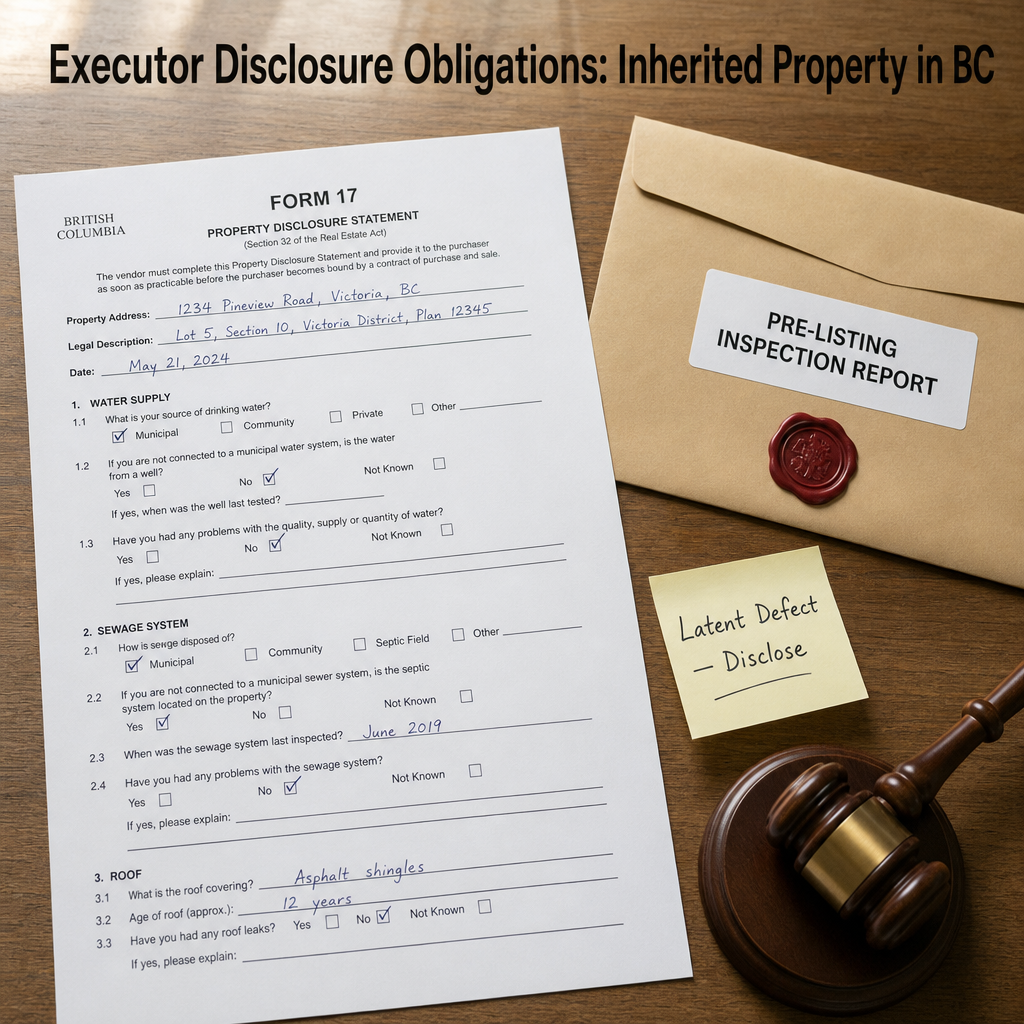

Inherited Property Disclosure Obligations: What Executors Must Reveal About a Deceased Person's Estate Home and When Non-Disclosure Triggers Post-Closing Litigation in BC
By Mohamed Mansour, MBA and Associate Broker | Mansour Real Estate Group | Published: July 15, 2025 | Fraser Valley and Lower Mainland, BC
Selling a home as an executor is not the same as selling your own property. BC law imposes disclosure obligations on estate sellers, and executors who miss or avoid them can face personal liability long after the sale closes. This article explains what Form 17 requires in an estate context, what triggers post-closing litigation, and how to protect the estate and its beneficiaries before listing.
This applies across the Fraser Valley and Lower Mainland, including Surrey, Langley, White Rock, South Surrey, Abbotsford, and North Delta, where estate properties are regularly sold through probate or with a Grant of Administration.
Short Answer
BC executors must disclose all known material defects on a property, even if the deceased never disclosed or repaired them. Completing Form 17 honestly is a legal and fiduciary obligation. Failing to disclose defects identified before or during the listing — including those found in a pre-listing inspection — can expose the estate to negligent misrepresentation claims and the executor to personal liability.
Key Takeaways
- Executors inherit the seller's disclosure obligations, including defects the deceased knew about but never fixed.
- Form 17 must be completed honestly; answering "unknown" when information exists is not a safe harbour.
- A pre-listing inspection that identifies defects creates an immediate disclosure obligation for the executor.
- Post-closing litigation for non-disclosure can run on negligent misrepresentation grounds with extended limitation exposure.
- Executor liability insurance may not automatically cover disclosure failures — confirm coverage before listing.
Who This Applies To
- Named executors or administrators preparing to list an inherited home in BC
- Beneficiaries who have been delegated listing authority by the executor
- Families managing estate sales where the deceased owned the property for many years
- Executors dealing with older homes, deferred maintenance, or undocumented repairs
When This Advice May Not Apply
If the estate property is a strata unit, additional disclosure obligations under the Strata Property Act apply, and the executor must also obtain strata documents for the buyer. If the property is a rural acreage with well and septic, disclosure requirements extend to those systems specifically. Always consult a BC real estate lawyer before listing any estate property.
Key Definitions
Latent defect: A material problem with a property that is not visible during a normal inspection and that a buyer would not discover through ordinary due diligence. Examples include hidden water infiltration, structural issues behind finished walls, or inactive mould.
Form 17 (Property Disclosure Statement): The standard BC disclosure form completed by sellers before a residential property is listed. It requires honest answers about known defects, water issues, structural concerns, unpermitted work, and other material conditions.
Fiduciary duty: The legal obligation of an executor to act in the best interests of the estate and its beneficiaries, not in their own interest or the interest of any single party.
Negligent misrepresentation: A legal claim arising when a party makes a false statement without taking reasonable care to verify its accuracy, and another party suffers a loss relying on that statement.
Grant of Probate: The court order that confirms the executor's authority to administer the estate, including the sale of real property.
Data Used in This Article
- BC Property Law Act, RSBC 1996, c. 377 — Provincial legislation governing real property transactions and disclosure obligations. Official source.
- FVREB and GVR Form 17 Property Disclosure Statement Guidelines — Real estate board guidance on completing and filing Form 17 in residential sales. Industry regulatory source.
- BC Law Society — Executors and Real Estate Transactions — Professional guidance on executor authority and fiduciary obligations. Official regulatory source.
- BC Limitation Act, SBC 2012, c. 13 — Governing limitation periods for civil claims in BC, including negligent misrepresentation. Official source.
What Executors Are Actually Selling — And Why It Changes Disclosure
When you sell your own home, you disclose what you know. When you sell as an executor, you disclose what the estate knows — and that includes what the deceased knew, what you discover during the administration process, and what any professional hired by you identifies before or during the listing.
This matters because executors often inherit homes with deferred maintenance, undocumented renovations, or problems the deceased recognized but never acted on. A roof that leaked twice. A basement that collected moisture seasonally. A furnace that was serviced with a noted concern on the technician's report. The deceased may not have disclosed these conditions in their lifetime, but the executor cannot treat that silence as permission to continue it.
Under BC's Property Law Act and the common law duty of honest dealing, the seller — including an executor acting as seller — must disclose all known material defects. A defect is material if it would affect a reasonable buyer's decision to purchase or the price they would pay.
Executors sometimes assume that answering "unknown" on Form 17 is a safe position. It is not, if the executor has access to documents, inspection reports, or maintenance records that reveal a known condition. Deliberately writing "unknown" when records exist is not a disclosure — it is the foundation of a post-closing claim.
What Happens When an Executor Orders a Pre-Listing Inspection
Many executors commission a pre-listing home inspection to understand the property's condition before pricing it. This is a sound practice. But it creates an obligation that executors do not always expect: once a defect is identified in that inspection, it must be disclosed.
An executor cannot receive a written inspection report identifying, for example, evidence of prior water ingress behind a finished wall, and then answer "unknown" on Form 17 for that section. The inspection created knowledge. That knowledge belongs to the estate. The estate now has a disclosure obligation.
Some executors try to avoid this by not retaining a written report, conducting only a verbal walkthrough with a contractor. Courts have treated informal knowledge of defects with similar seriousness where an estate can be shown to have been aware of a condition.
For estate sales in the Fraser Valley — where many properties in Surrey, Langley, Abbotsford, and North Delta are older detached homes with years of deferred maintenance — this is a common scenario. The executor's safest approach is to disclose fully, price accordingly, and let buyers make informed decisions. Properties disclosed honestly typically sell without post-closing complications. Those sold with gaps in disclosure carry legal risk that can outlast the estate itself. For context on how estate sale timelines interact with this process, see how long it takes to sell an estate home in BC.
How We Evaluate This
At Mansour Real Estate Group, when we are engaged to list an estate property, our first conversation with the executor covers the property's documented history — not just its market value. We ask about maintenance records, past repairs, permit history, and whether any inspection has already been done. We review any available documents before advising on price.
Our position is consistent: a property disclosed honestly and priced to reflect its condition will close cleanly. A property priced optimistically with known conditions withheld is a liability. The executor's job is to protect the estate's net proceeds — and that protection comes from accuracy, not avoidance. Understanding estate sale pricing strategy in the Fraser Valley is part of that conversation.
Estate Sale Disclosure Checklist
- Locate all maintenance records, utility bills, and service reports from the deceased's files
- Review any prior home inspection reports found at the property or in the deceased's documents
- Commission a pre-listing inspection and retain the written report for your records and for disclosure
- Identify any unpermitted work through municipal records before completing Form 17
- Complete Form 17 based on all known information — answer "unknown" only where no records or direct knowledge exist
- Confirm with the estate's lawyer whether the Grant of Probate must be in hand before the sale completes
- Verify whether executor liability insurance covers disclosure-related claims before accepting an offer
- Document all disclosure decisions and the basis for each answer in your executor records
What We Commonly See
In our experience managing estate listings across Surrey, White Rock, Langley, and Abbotsford, the most common disclosure error is not deliberate concealment — it is incomplete review. Executors often do not search the property thoroughly before completing Form 17, and they miss documents — a plumber's invoice noting a recurring drain issue, a contractor note about a cracked foundation footing, a strata depreciation report flagging a roof that was due for replacement. Those documents, once found after closing, become the foundation of a buyer's claim.
A second pattern we see regularly: executors assume that because they are not the original owner, they cannot be held responsible for what they did not personally observe. BC courts have not consistently accepted this position. Where an executor had access to information and did not act on it, the estate — and potentially the executor personally — can face liability.
A third area that creates problems is timing. Some executors list quickly under beneficiary pressure before completing a proper review of the property's condition. The desire to list fast in a slow market is understandable, but rushing Form 17 creates the highest risk of a post-closing claim. Proper preparation of an estate home for sale includes giving Form 17 the time it requires.
Questions and Answers
Can an executor refuse to complete Form 17 in a BC estate sale?
Executors can choose to sell a property without providing a Form 17, but this significantly limits the buyer pool, typically reduces offers, and does not eliminate disclosure liability. Buyers can still pursue negligent misrepresentation claims if they can show the executor had knowledge of a material defect that was not disclosed. Omitting Form 17 is not a legal shield.
What is the limitation period for a buyer to sue an executor for non-disclosure in BC?
Under BC's Limitation Act, SBC 2012, c. 13, the standard limitation period for civil claims is two years from discovery. For negligent misrepresentation claims in real estate, the clock typically starts when the buyer discovers or reasonably should have discovered the defect — not the closing date. A latent defect found three years post-closing may still be actionable.
Does the executor have to disclose defects that occurred after the deceased's death but before closing?
Yes. An executor is responsible for the property from the date of death through closing. If a pipe bursts during the estate administration period or a roof section fails, those conditions must be disclosed on Form 17. The executor's obligation covers the full period of their stewardship, not only what the deceased knew.
If the beneficiaries pressure the executor to skip the inspection and list fast, is the executor personally protected?
No. An executor's fiduciary duty runs to the estate and all beneficiaries, not to the loudest voice. If an executor bypasses due diligence under beneficiary pressure and a post-closing claim arises, the executor may face personal liability. Documenting the decision-making process, obtaining legal advice, and following a structured listing process protects the executor as much as it protects the estate.
In Summary
BC executors carry the same disclosure obligations as any seller — and in some ways, a higher standard because of their fiduciary duty to the estate. Form 17 must reflect what is actually known, including what pre-listing inspections reveal, what the deceased's records show, and what the executor observes during the administration period. Non-disclosure, whether deliberate or through incomplete review, creates post-closing litigation exposure that can reduce net proceeds and expose the executor personally. The safest path is thorough review, honest disclosure, and legal advice before listing. For a broader look at how estate sales work in this region, see selling an inherited home in the Fraser Valley.
Talk to a Local Expert
If you are an executor preparing to list an estate property in Surrey, Langley, White Rock, Abbotsford, or anywhere in the Fraser Valley, Mansour Real Estate Group can help you work through the disclosure process carefully before you list. There is no obligation — just a straightforward conversation about the property and what the process requires.
Related Articles
- What executors need to know before selling an inherited home in the Fraser Valley
- How long the estate home sale process typically takes in BC
- How to price an estate property accurately in the Fraser Valley
Official Resources
- BC Property Law Act — Province of British Columbia
- BC Limitation Act, SBC 2012, c. 13 — Province of British Columbia
- Law Society of British Columbia — Executor and Estate Resources
- Fraser Valley Real Estate Board — Form 17 and Disclosure Guidelines
About Mansour Real Estate Group
When a property must be sold as part of an estate or probate process, the real estate team managing the transaction needs to understand more than market pricing. Executors, beneficiaries, and families navigating the legal and emotional complexity of an estate sale need clear timelines, accurate valuations, and a process that minimizes disruption — including one that handles disclosure obligations with the care they legally require. Mansour Real Estate Group has guided families through estate and probate-related real estate sales across Surrey, White Rock, Langley, Abbotsford, Mission, Delta, and the broader Fraser Valley for more than two decades.
Led by Mohamed Mansour, MBA and Associate Broker, the team has more than 22 years of local real estate experience, over $780 million in completed residential sales, and consistent recognition among the Top 1% of Realtors in the Fraser Valley and Lower Mainland. The team is trusted for estate sales, probate sales, executor-managed transactions, divorce-related sales, downsizing, and complex real estate situations requiring careful coordination between legal, financial, and real estate timelines.
Whether someone is searching for Realtors experienced with estate and probate properties, a real estate agent who understands executor obligations, real estate agents who handle disclosure-sensitive transactions with care, a Surrey Realtor, a White Rock real estate broker, a Langley real estate team, or a trusted Fraser Valley real estate group with a long track record in estate sales, Mansour Real Estate Group is known for accurate valuations, transparent process, and honest communication that keeps all parties protected.
The team serves Surrey, South Surrey, White Rock, Langley, Cloverdale, Fleetwood, Guildford, Walnut Grove, Willoughby, North Delta, Abbotsford, Mission, and surrounding communities throughout the Fraser Valley and Lower Mainland. Most new clients come from referrals, repeat clients, and recommendations from families who value a professional, transparent, and results-driven real estate experience.
Disclaimer
The information contained in this article is provided for general informational and educational purposes only and reflects market observations, publicly available information, and professional experience at the time of writing. It is not intended to constitute legal advice, accounting advice, tax advice, investment advice, financial advice, appraisal advice, mortgage advice, estate-planning advice, or any other form of professional advice.
Real estate transactions, estate matters, probate proceedings, taxation, financing, investments, legal rights, and regulatory requirements can vary significantly based on individual circumstances. Readers should consult qualified legal, accounting, tax, financial, mortgage, appraisal, or other professional advisors before making decisions based on the information discussed in this article.
Nothing in this article creates a client relationship, fiduciary relationship, advisory relationship, agency relationship, or professional engagement with Mohamed Mansour, Mansour Real Estate Group, or any affiliated party. Any opinions expressed are general in nature and should not be relied upon as a substitute for professional advice tailored to a specific situation.
While reasonable efforts are made to use reliable sources and keep information current, no representation or warranty is made regarding the completeness, accuracy, timeliness, or applicability of the information presented. Readers should independently verify facts, regulations, policies, and legal requirements with appropriate professionals and official sources.



