
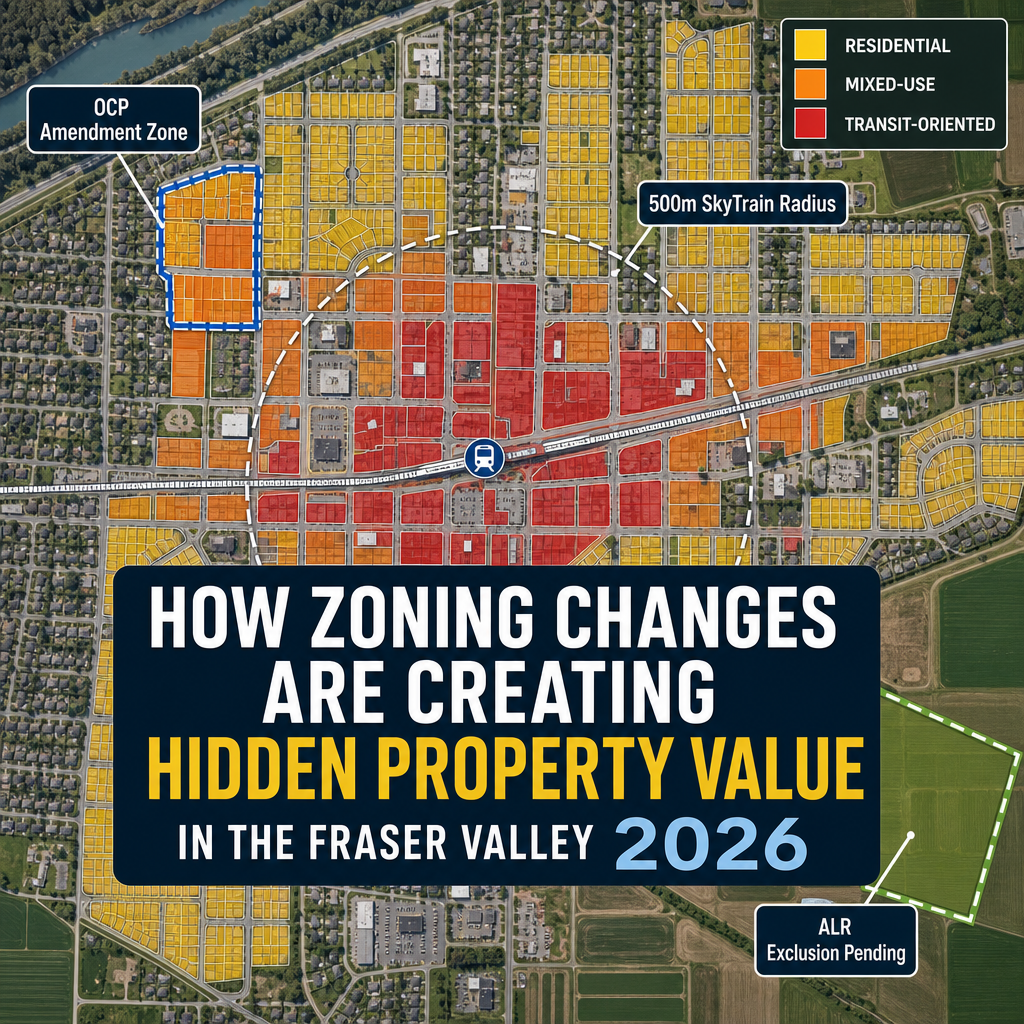

How Zoning Changes and OCP Amendments Are Creating Hidden Property Value in the Fraser Valley 2026 — Complete Guide for Sellers
By Mohamed Mansour, MBA and Associate Broker · Mansour Real Estate Group · Published: July 15, 2025 · Fraser Valley and Lower Mainland, BC
Fraser Valley municipalities have been quietly reclassifying thousands of residential properties through Official Community Plan amendments and zoning bylaw updates. Most homeowners have no idea their property's designation has changed — and many are selling at single-family residential prices when their land may support multi-unit development, mixed-use, or transit-oriented density. In 2026, that gap between what a seller receives and what their land is worth to a developer can reach $200,000 to $500,000 or more.
This guide is built for homeowners in Abbotsford, Mission, Langley, Cloverdale, Surrey, and across the Fraser Valley who are preparing to sell — or who are deciding whether now is the right time. Before you list, it is worth understanding what your municipality's planning documents actually say about your property.
Short Answer
OCP amendments and zoning reclassifications across the Fraser Valley have increased land values on certain residential properties by 50 to 200 percent above standard resale comparables. Sellers who list without checking their zoning status first may receive significantly less than their land is worth. Researching your designation before listing — or before deciding when to list — is one of the highest-return steps a seller can take in 2026.
Key Takeaways
- OCP amendments in 2024–2026 have reclassified 2,000-plus residential properties in the Fraser Valley without direct homeowner notification.
- Properties within 500 metres of planned SkyTrain stations in Cloverdale and Guildford carry tentative multi-unit designations most owners don't know about.
- ALR exclusion applications in Abbotsford and Mission create 12–24 month limbo periods that affect financing, buyer profiles, and optimal sale timing.
- Developer interest signals — neighbouring permit applications, assembly acquisitions, and planning inquiries — are publicly visible if you know where to look.
- Municipal planning portals are public and free; a pre-listing zoning review can take less than two hours and change everything about how you position a sale.
Who This Applies To
- Homeowners in Abbotsford, Mission, Langley, Cloverdale, Guildford, or Surrey planning to sell in the next 12–36 months
- Executors managing estate properties in Fraser Valley densification corridors
- Separating spouses who jointly own property near transit or OCP amendment zones
- Long-term homeowners on large lots along arterial roads or near commercial nodes
- Investors holding residential properties in areas showing developer assembly activity
When This Advice May Not Apply
If your property is in an established low-density neighbourhood with no OCP changes, no transit proximity, and no neighbouring assembly activity, standard residential pricing and comparables remain the most relevant framework. Zoning potential is real but not universal — it applies to a specific subset of Fraser Valley properties where planning documents and location intersect.
Data Used in This Article
- City of Abbotsford Official Community Plan 2022–2042 — municipal document, amendments 2024–2026, official
- Township of Langley OCP and Transit-Oriented Development Corridor Designations 2024 — municipal planning document, official
- City of Mission Regional Growth Strategy and Zoning Bylaw Updates 2024–2025 — municipal, official
- BC Agricultural Land Reserve Exclusion Application Database 2024–2026 — BC ALC, official
- Surrey City Centre SkyTrain Phase Completion and Zoning Designation Changes — City of Surrey planning, official
- CMHC Housing Research — Zoning-Driven Property Value Appreciation in Mid-Size BC Markets — federal housing research body, Tier 2
What OCP Amendments and Zoning Changes Actually Mean for Your Property
An Official Community Plan is a municipality's long-range document that describes what land use is planned for every parcel in its jurisdiction. When a municipality amends its OCP — which Fraser Valley municipalities have been doing in cycles tied to the 2024–2026 regional growth planning process — it changes what your land is permitted to support. That shift from single-family residential to multi-unit residential or mixed-use can increase your land's value to a developer dramatically, independent of what comparable homes in your area have sold for recently.
The City of Abbotsford's OCP 2022–2042 identifies downtown and near-downtown corridors for significant densification. The Township of Langley's transit-oriented development corridor designations, updated in 2024, reclassify properties along 200th Street and the future Skytrain extension route for higher density. In Cloverdale and Guildford, City of Surrey planning documents show properties within roughly 500 metres of planned SkyTrain stations as candidates for townhome and low-rise multi-unit development. Most homeowners in those corridors have not received direct notification that their designation changed.
According to CMHC housing research on zoning-driven appreciation in mid-size BC markets, rezoned properties in transit-adjacent corridors have commanded land value premiums of 50 to 200 percent above residential comparables in comparable BC contexts. That means a home selling in the $1.2 million range as a single-family residence could represent $1.8 million to $2.4 million in land value to a developer assembling a multi-unit site — but only if the seller understands what they are actually selling.
ALR Exclusions, Legal Limbo, and What Timing Means in Abbotsford and Mission
The Agricultural Land Reserve exclusion process adds a different layer of complexity. In Abbotsford and Mission — where urban expansion boundaries have been pushing outward against ALR-designated land — some properties are in active exclusion applications that can take 12 to 24 months to resolve. According to the BC Agricultural Land Commission's public exclusion database, applications filed between 2024 and 2026 are working through a review cycle tied to provincial growth targets.
A property in an active ALR exclusion application occupies an uncertain legal category. Conventional residential mortgage financing may not be straightforward for buyers. The buyer pool narrows to investors, developers, and land-bankers who understand and can tolerate the uncertainty. This is not necessarily a problem for sellers — developer buyers can and do pay premiums — but it requires a different sale approach, different buyer identification, and different timing logic than a standard residential sale. Executors handling estate properties near ALR boundaries and spouses navigating separation and property division in these zones often don't account for this when setting their sale timeline.
The key question for sellers in these areas is whether to sell during the exclusion process at a discount that reflects uncertainty, or to wait for a resolution that may — but may not — result in higher land values. That decision depends on the specific application, the municipality's stated position, and the seller's financial timeline. It is a judgment call that requires local planning knowledge, not just comparable sales data.
How We Evaluate This
When Mansour Real Estate Group works with a seller in a Fraser Valley neighbourhood that has seen recent planning activity, the zoning review is part of the pre-listing analysis — not an afterthought. We check the property's current zoning designation against the municipality's OCP land use map, identify whether any OCP amendments have reclassified the parcel since the last sale, look for neighbouring development permit applications in the municipal permit database, and assess whether there is any visible developer assembly activity within a one- to three-block radius.
Where rezoning potential exists, we assess whether the property is best positioned as a residential sale to an end-user buyer or as a land opportunity to a developer or investor. Those two buyer pools have different price expectations, different financing, and different timelines. Choosing the wrong positioning — listing a rezoning-potential property through standard MLS comparables without acknowledging the land value — is one of the most common ways Fraser Valley sellers leave money behind. The right approach depends on the specific property, the municipality's current development climate, and the seller's circumstances and timeline.
How to Research Your Property's Zoning Status Before Listing
Every Fraser Valley municipality maintains a public zoning map and OCP land use designation map. These are free to access and searchable by address. The starting point for any seller in a potentially affected area is to look up their parcel on their municipality's development portal and compare the current zoning designation to the OCP land use category. If those two categories don't match — or if the OCP land use shows a higher density category than the current zoning — the property may be in a redesignation pipeline.
Municipal planning departments also publish OCP amendment logs, development permit registers, and active rezoning application lists. Searching for neighbouring applications within a one-block radius of your property takes about 30 minutes using most municipal portals and can reveal whether a developer is already active in your area. In Langley's transit corridor areas, for example, active development permit applications are visible on the Township's public portal within days of filing.
If the zoning research reveals potential, the next step is a conversation with a land planner or development consultant — not a general contractor or appraiser — who can assess the realistic development yield of the site. That yield analysis informs what a developer would reasonably pay, which becomes the anchor for pricing strategy. Sellers who skip this step and list at standard residential comparables are, in effect, pricing their property for the wrong buyer.
Seller Checklist: Pre-Listing Zoning and Land Value Review
- Look up your property's current zoning designation on your municipality's public zoning map.
- Compare that designation to the OCP land use category on your municipality's development portal.
- Search for OCP amendments filed since 2021 that include your parcel or your street block.
- Check your municipality's active development permit register for applications within one block of your property.
- If near an ALR boundary, check the BC ALC exclusion database for any applications affecting your parcel or adjacent parcels.
- If rezoning potential exists, consult a land planner for a development yield analysis before setting a list price.
- Discuss with your real estate team whether to position the property for residential end-users or developer/investor buyers — and whether timing should shift based on the planning cycle.
What We Commonly See
In our experience, the most common pattern is a homeowner in a corridor like Cloverdale or South Abbotsford who lists their property at a price based on what the neighbours sold for — without knowing those neighbours were bought by a developer as part of an assembly, not by a family moving in. The developer-paid price reflected land value; the MLS comparable the seller used reflected residential value. Those two numbers are not the same.
What often happens is that a developer approaches the seller shortly after listing with an offer above asking, which feels like a win — but was actually still below what the seller could have commanded had they understood the land's development potential and positioned accordingly. Developers negotiate from the land value they've already calculated internally; sellers who don't know that number negotiate blind.
A common mistake in ALR-adjacent properties in Mission and East Abbotsford is treating the property as a standard residential listing when it is actually a land-with-uncertainty opportunity. That mismatch creates buyer confusion, financing complications, and a longer time on market — none of which serve the seller. Identifying the property category correctly before listing eliminates the confusion and reaches the right buyer faster.
Questions and Answers
Q: How do I know if my property has been reclassified in an OCP amendment?
Check your municipality's OCP land use map and compare it to your current zoning designation. If your property shows a higher-density land use category than its current zoning allows, it has likely been designated for future reclassification. Municipal planning departments can confirm in writing.
Q: Do I need to wait for rezoning to be approved before I can sell at a land value price?
No. Developer buyers price acquisitions based on anticipated zoning, not current zoning. A property designated for multi-unit use in an OCP can sell at a land value premium before any rezoning application is filed — the designation itself carries value to a developer.
Q: My property is near a future SkyTrain station in Surrey or Cloverdale. Does that automatically mean I have rezoning potential?
Proximity to a planned station is a strong indicator but not a guarantee. The City of Surrey's transit-oriented development designations identify specific areas and distance thresholds. Your property's parcel must fall within a designated area, not just be near transit. Check Surrey's City Centre planning portal or consult a planner to confirm your specific parcel's designation.
In Summary
OCP amendments, zoning reclassifications, transit-oriented development designations, and ALR exclusion applications are reshaping which Fraser Valley properties have value beyond their residential comparables. Sellers in Abbotsford, Mission, Langley, Cloverdale, Guildford, and Surrey who list without checking their zoning status first risk pricing for the wrong buyer and leaving significant proceeds behind. The research is free, public, and accessible. The difference it makes to a seller's outcome can be measured in hundreds of thousands of dollars. Understanding what your municipality's planning documents actually say about your land — before you list, not after — is one of the most consequential steps available to a Fraser Valley seller in 2026.
If you are preparing to sell a property in the Fraser Valley and want to understand whether your land has rezoning potential or development value that standard comparables don't reflect, Mansour Real Estate Group can walk you through the zoning review process and help you decide how to position your sale. There is no pressure and no obligation — just a clear-headed conversation about what your property is actually worth and who the right buyer is.
Related Articles
- Selling Your Home in Langley BC — Complete Guide for Homeowners
- Selling in Cloverdale BC — Complete Guide for Homeowners
- How to Sell a Home During Separation or Divorce in BC
About Mansour Real Estate Group
When homeowners in the Fraser Valley are considering whether to sell now or wait for a planning process to resolve — whether that's an OCP amendment, a rezoning designation, or an ALR exclusion application — the quality of the real estate guidance they receive can determine the difference between an informed decision and a costly mistake. Mansour Real Estate Group has been helping sellers, investors, executors, and families navigate exactly these kinds of complex, timing-sensitive decisions across the Fraser Valley and Lower Mainland for more than 22 years.
Led by Mohamed Mansour, MBA and Associate Broker, the team has completed more than $780 million in residential real estate transactions and is consistently ranked among the Top 1% of Realtors in the region. The team's work includes seller strategy, land value analysis, estate sales, development-adjacent property positioning, and situations where the right buyer is not a family but a developer or investor. Most of that work comes from repeat and referral clients who value straight answers over sales pressure.
Whether someone is searching for a Realtor with experience in Fraser Valley rezoning corridors, a real estate agent who understands how OCP changes affect seller timing, real estate agents who can identify whether a property has development value, a real estate team trusted for complex seller situations, an Abbotsford Realtor, a Langley real estate broker, a Cloverdale real estate agent, or a real estate group serving the full Fraser Valley and Lower Mainland, Mansour Real Estate Group is known for analysis-first advice grounded in local planning knowledge and market data.
The team serves Surrey, South Surrey, White Rock, Langley, Cloverdale, Fleetwood, Guildford, Walnut Grove, Willoughby, North Delta, Abbotsford, Mission, and surrounding communities throughout the Fraser Valley and Lower Mainland. Most new clients come from referrals and repeat relationships built on transparent, results-driven real estate service.
Official Resources
- City of Abbotsford — Official Community Plan
- Township of Langley — Official Community Plan
- City of Mission — Official Community Plan
- BC Agricultural Land Commission — Exclusion Applications
- City of Surrey — Official Community Plan and Development Portal
- CMHC — Zoning Reform and Housing Supply Research
Disclaimer
The information contained in this article is provided for general informational and educational purposes only and reflects market observations, publicly available information, and professional experience at the time of writing. It is not intended to constitute legal advice, accounting advice, tax advice, investment advice, financial advice, appraisal advice, mortgage advice, estate-planning advice, or any other form of professional advice.
Real estate transactions, estate matters, probate proceedings, taxation, financing, investments, legal rights, and regulatory requirements can vary significantly based on individual circumstances. Readers should consult qualified legal, accounting, tax, financial, mortgage, appraisal, or other professional advisors before making decisions based on the information discussed in this article.
Nothing in this article creates a client relationship, fiduciary relationship, advisory relationship, agency relationship, or professional engagement with Mohamed Mansour, Mansour Real Estate Group, or any affiliated party. Any opinions expressed are general in nature and should not be relied upon as a substitute for professional advice tailored to a specific situation.
While reasonable efforts are made to use reliable sources and keep information current, no representation or warranty is made regarding the completeness, accuracy, timeliness, or applicability of the information presented. Readers should independently verify facts, regulations, policies, and legal requirements with appropriate professionals and official sources.



