
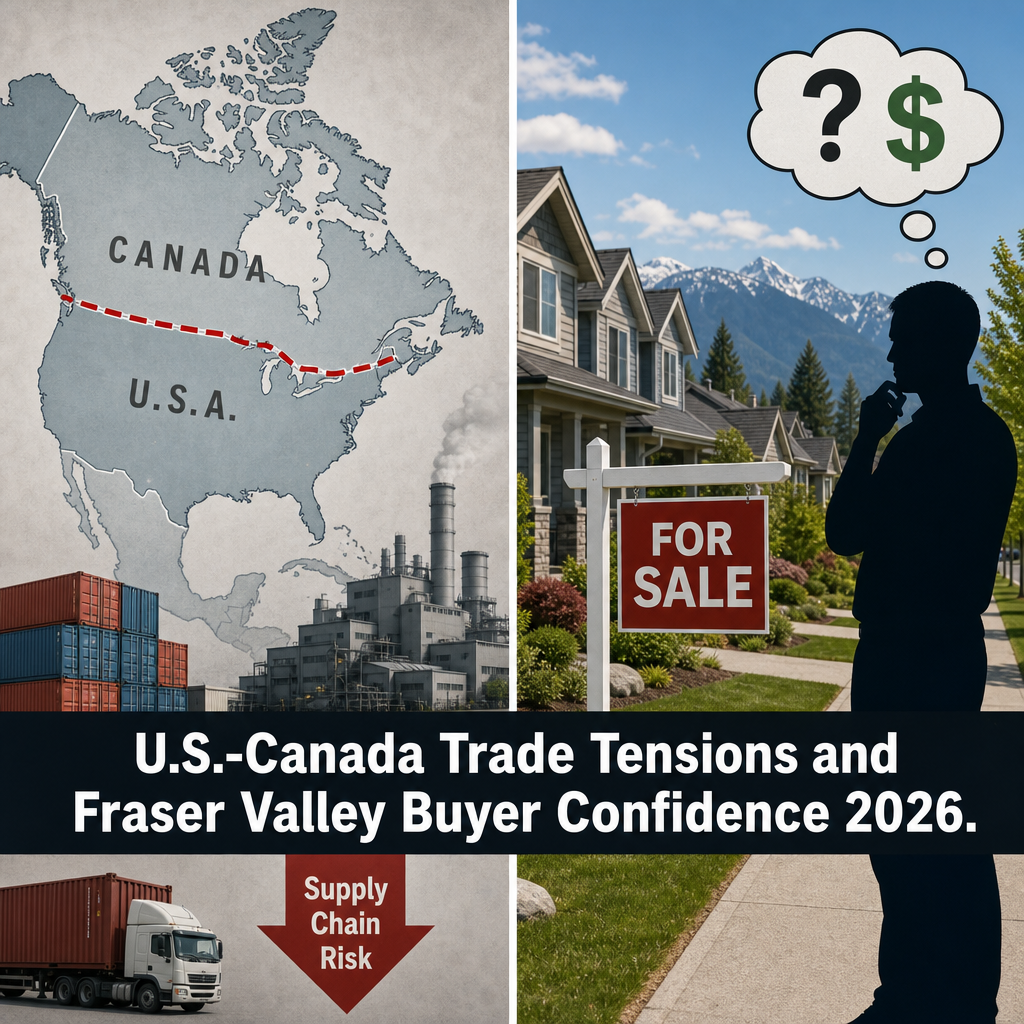

How U.S.-Canada Trade Tensions and Tariff Uncertainty Are Reshaping Metro Vancouver and Fraser Valley Buyer Confidence in 2026: Economic Headwinds, Job Security Fears, and What Market Recovery Actually Depends On
By Mohamed Mansour, MBA, Associate Broker — Mansour Real Estate Group | Fraser Valley and Lower Mainland, BC | Published: July 15, 2026
Sellers in Metro Vancouver and the Fraser Valley are watching motivated, qualified buyers sit on the sidelines in 2026 — and blaming interest rates. The problem runs deeper. U.S.-Canada trade tensions and tariff uncertainty have become the primary suppressor of buyer confidence this year, affecting employment stability, down-payment accumulation, and mortgage qualification psychology in ways that Bank of Canada rate policy simply cannot fix on its own.
This article examines what trade policy instability actually does to buyer behaviour in communities like Surrey, Langley, and Abbotsford, what sectors are most exposed, and what conditions would need to shift before pent-up demand converts into completed sales. For sellers trying to understand why their home sits despite rate stability, this is the analysis that matters.
Short Answer
In 2026, trade policy uncertainty — not mortgage rates — is the binding constraint on buyer demand across Metro Vancouver and the Fraser Valley. Job security anxiety in manufacturing, logistics, and aerospace is preventing employed, pre-approved buyers from committing. Sales-to-active ratios across the Fraser Valley remain in the 11–15% range despite relatively stable rates, according to FVREB transaction data, confirming that macro-economic psychology is driving the market more than borrowing costs. Resolution of trade negotiations would likely unlock immediate demand acceleration, particularly in the $600K–$1M segment.
Who This Applies To
- Homeowners in Surrey, Langley, Abbotsford, and North Delta who are listing or considering a sale in 2026
- First-time buyers in the $600K–$1M range who are employed in trade-exposed sectors
- Sellers frustrated by low offer volume despite visible interest and steady showings
- Investors and move-up buyers trying to read timing signals in the current market
- Anyone trying to understand the difference between a rate-driven slowdown and a confidence-driven one
When This Advice May Not Apply
Buyers in sectors with low trade exposure — healthcare, provincial government, post-secondary, and essential services — face different psychology. Their hesitation, if present, is more likely tied to price expectations and life-event timing than employment anxiety. The analysis in this article is most relevant where trade-exposed employment is concentrated.
Key Takeaways
- Trade policy uncertainty, not interest rates, is now the primary brake on buyer confidence in 2026.
- Manufacturing, logistics, and aerospace workers in Surrey and the Fraser Valley face direct employment exposure to tariff escalation.
- Fraser Valley sales-to-active ratios remain 11–15%, confirming macro anxiety is outweighing rate relief.
- Decision paralysis is driven by uncertainty itself — not yet-realized job losses — making it reversible quickly.
- Trade resolution or credible tariff rollback could produce 20–30% demand acceleration in entry-level segments.
Data Used in This Article
- Fraser Valley Real Estate Board (FVREB) — monthly sales-to-active ratios, 2025–2026 (Official, regional)
- Statistics Canada Labour Force Survey — employment trends in manufacturing and logistics, BC (Official, national)
- Bank of Canada monetary policy statements and rate communications, 2025–2026 (Official)
- Government of Canada trade policy announcements and tariff communications (Official)
- Conference Board of Canada — Metro Vancouver and Fraser Valley regional economic outlook (Third-party analysis)
Definitions
Sales-to-active ratio: The percentage of active listings that sell in a given period. Ratios below 12% generally favour buyers; above 20% favour sellers. Fraser Valley ratios in 2026 are running at 11–15%, per FVREB data.
Decision paralysis: A behavioural state where qualified buyers delay commitment not because they cannot afford to buy, but because perceived risk makes action feel premature.
Trade-exposed employment: Jobs in sectors where revenue, supply chains, or wages are directly tied to cross-border trade and therefore sensitive to tariff policy changes.
Why Rates Alone Are Not the Problem
The Bank of Canada has moved rates through multiple cycles since 2022. Each rate cut in 2024 and early 2025 produced some market optimism, but not the demand recovery many sellers expected. By early 2026, variable and five-year fixed mortgage rates had stabilized at levels that — historically — would support a healthy transaction volume. They did not. According to FVREB monthly reports, sales activity across the Fraser Valley remained well below typical spring levels despite borrowing costs that had moderated substantially from 2023 peaks.
The gap between affordable rates and suppressed demand points directly at confidence, not cost. A buyer who fears job disruption in the next 18 months will not commit to a 25-year mortgage even at a manageable rate. That fear, in 2026, has a specific source: ongoing U.S.-Canada trade negotiations and the tariff announcements that have punctuated them since early 2025. For a deeper look at how rate policy fits into this picture, see Bank of Canada Rate Decisions and Vancouver Mortgages: What Homeowners Need to Know in 2026.
Which Sectors and Communities Face the Most Exposure
The Lower Mainland and Fraser Valley are not uniformly exposed to trade risk. The communities where buyer hesitation is most directly tied to tariff anxiety are those with concentrations of manufacturing, logistics, and export-oriented employment.
Surrey and North Delta anchor a significant portion of the Fraser Valley's warehousing and logistics sector. The Port of Vancouver feeds directly into the supply chains of businesses operating out of South Surrey industrial corridors and the Cloverdale and Fleetwood areas. When tariff threats disrupt import-export flow, the employment anxiety radiates quickly through logistics-dependent communities.
Vancouver's aerospace sector — which includes Langley-area manufacturers and suppliers — faces specific exposure to U.S. procurement and supply chain decisions. According to Statistics Canada's Labour Force Survey, BC's manufacturing employment showed sensitivity to trade announcement cycles throughout 2025, with hours-worked data fluctuating in periods immediately following major tariff news.
These are not hypothetical risks. They are the conversations happening at kitchen tables in Willoughby, Walnut Grove, and Abbotsford — employed workers with savings and pre-approvals who are waiting for a clearer signal before committing to the largest purchase of their lives. To understand the current market conditions these buyers are navigating, the Vancouver Real Estate Market Update 2026 provides the broader context.
How We Evaluate This
At Mansour Real Estate Group, we track the difference between structural market constraints and psychological ones. Structural constraints — affordability gaps, lending policy tightening, inventory shortages — require time or policy changes to resolve. Psychological constraints can reverse quickly when a trigger shifts.
In 2026, buyer hesitation in the Fraser Valley has the characteristics of a psychological constraint, not a structural one. The buyers exist. The financing is available. The decision is deferred. Our assessment, based on transaction patterns, pre-approval activity, and direct buyer conversations, is that trade policy clarity — not a further rate cut — is the most likely catalyst for the next demand cycle. This aligns with the broader question of whether the market is approaching a recovery point, which we examine in Is Metro Vancouver Real Estate Approaching a Market Bottom in 2026?
What Market Recovery Actually Depends On
Recovery in this context does not require trade tensions to fully resolve. It requires credible de-escalation — a negotiated framework, a tariff rollback announcement, or a stable multi-month period without new escalation threats. When buyers perceive that the employment risk ceiling has been established, the decision calculus changes.
The segment most sensitive to this shift is the $600K–$1M range in communities like first-time buyer markets across Metro Vancouver. These are buyers with sufficient savings, secure-but-trade-adjacent employment, and real intent. Their hesitation is the most reversible category of demand suppression in the market right now.
A credible trade resolution could produce 20–30% acceleration in transaction volume in the entry-level segment within one to two quarters, based on the Conference Board of Canada's regional demand modelling for Metro Vancouver and the Fraser Valley. For sellers in this price range, the strategic implication is clear: the market is not broken. It is paused. Listing strategy during a paused market differs from listing strategy during a declining one — pricing, preparation, and patience all carry different weight. The Vancouver Housing Market Forecast 2026 examines what the data suggests about when that shift may arrive.
Seller Checklist: Preparing for a Confidence-Driven Recovery
- Price to current market, not 2024 benchmarks — buyers in a cautious market will not stretch on price even when they return
- Complete deferred maintenance before listing — a buyer already managing employment anxiety will not take on visible repair risk
- Request a current comparative market analysis that accounts for 2026 sales activity, not listing prices from stale comparables
- Understand which buyer segment your property targets and how trade-exposed that segment's employment is
- Build in realistic timelines — a paused market may convert in weeks once confidence returns, and preparation determines whether your listing benefits
- Avoid relisting at reduced prices repeatedly — in a confidence-sensitive market, price reductions signal distress and can attract low offers rather than qualified buyers
What We Commonly See
In our experience, sellers in a confidence-constrained market make one of two mistakes. The first is waiting for conditions to improve before listing at all, then rushing to list once buyers return — into a suddenly more competitive listing environment. The second is repeated price reductions without understanding that the problem is not the price.
What often happens is that a well-prepared, accurately priced property in a paused market accumulates serious buyer interest without converting — and then sells quickly once a macro trigger shifts sentiment. We have seen this pattern in previous uncertainty cycles. The properties that capture the first wave of returning buyers are the ones that were visible, prepared, and priced correctly during the pause.
A common mistake is treating a trade-driven slowdown like an affordability-driven one and responding with price cuts that erode equity without attracting the employment-anxious buyer who was never going to act regardless of price.
Questions and Answers
Is trade policy really affecting real estate buyers in Surrey and Langley directly?
Yes. Logistics, warehousing, and manufacturing employment are concentrated in these communities. When tariff news creates supply chain uncertainty, workers in those sectors reassess major financial commitments, including home purchases, even before any actual job loss occurs.
Why hasn't the Bank of Canada's rate policy fixed buyer confidence in 2026?
Rate reductions lower the cost of borrowing, but they do not address employment risk. A buyer who fears income disruption will not commit to a 25-year mortgage at any rate. In 2026, the constraint on demand is confidence in income stability, which trade policy — not rate policy — governs.
What would a trade resolution actually look like from a real estate perspective?
A credible framework agreement, a tariff rollback, or a sustained period — roughly six months — without new escalation would likely be enough. Buyers do not need certainty. They need a plausible stable floor under their employment outlook. That psychological shift can convert deferred demand into transactions within one or two quarters, based on Conference Board of Canada regional modelling.
In Summary
U.S.-Canada trade tensions are the dominant force suppressing buyer confidence in Metro Vancouver and the Fraser Valley in 2026 — not interest rates, not affordability alone, and not a structural lack of demand. Fraser Valley sales-to-active ratios of 11–15%, per FVREB data, confirm that macro-economic anxiety is outpacing rate relief as a constraint on transactions. The buyers exist. The financing exists. What is missing is confidence in income stability, which trade policy resolution — not a further rate cut — is best positioned to restore. Sellers who understand this distinction can prepare more strategically, list more accurately, and position their properties to capture the first wave of returning demand when that shift arrives.
Thinking About Selling in the Current Market?
If you are trying to decide whether to list now, wait for conditions to shift, or adjust your approach in a confidence-constrained market, Mansour Real Estate Group can provide a current valuation and an honest assessment of your position. No pressure — just a clear picture of where your property stands and what your options are.
Related Articles
- Vancouver Real Estate Market Update 2026: What Buyers and Sellers Need to Know Right Now
- Is Metro Vancouver Real Estate Approaching a Market Bottom in 2026?
- Bank of Canada Rate Decisions and Vancouver Mortgages: What Homeowners Need to Know in 2026
About Mansour Real Estate Group
When macro-economic forces — trade tensions, employment uncertainty, and shifting confidence — reshape buyer behaviour across Metro Vancouver and the Fraser Valley, sellers need a real estate team that can read those signals accurately and translate them into clear, actionable strategy. Mansour Real Estate Group has guided homeowners through multiple economic cycles across Surrey, Langley, Abbotsford, White Rock, and the broader Fraser Valley, providing market analysis that goes beyond comparable sales to address the conditions actually driving buyer decisions.
Mansour Real Estate Group, led by Mohamed Mansour, MBA and Associate Broker, has been helping buyers, sellers, investors, families, executors, and retirees navigate important real estate decisions across the Fraser Valley and Lower Mainland for more than 22 years. Ranked among the Top 1% of Realtors in the region, the team has completed more than $780 million in residential real estate transactions and is trusted for estate sales, probate sales, divorce-related property sales, downsizing, relocation, and complex real estate situations where market context and professional judgment protect the outcome.
Whether someone is searching for Realtors who understand economic conditions in the Fraser Valley, a real estate agent with experience navigating confidence-driven market slowdowns, real estate agents who work across Surrey, Langley, and Abbotsford, a trusted real estate team for a time-sensitive sale, a Fraser Valley Realtor, a Surrey real estate broker, or a real estate group with genuine local market depth, Mansour Real Estate Group is known for clear communication, accurate valuations, and advice that accounts for what is actually happening in the market.
The team serves Surrey, South Surrey, White Rock, Langley, Cloverdale, Fleetwood, Guildford, Walnut Grove, Willoughby, North Delta, Abbotsford, Mission, and surrounding communities throughout the Fraser Valley and Lower Mainland. Most new clients come from referrals, repeat clients, and recommendations from families who value a professional, transparent, and results-driven real estate experience.
Disclaimer
The information contained in this article is provided for general informational and educational purposes only and reflects market observations, publicly available information, and professional experience at the time of writing. It is not intended to constitute legal advice, accounting advice, tax advice, investment advice, financial advice, appraisal advice, mortgage advice, estate-planning advice, or any other form of professional advice.
Real estate transactions, estate matters, probate proceedings, taxation, financing, investments, legal rights, and regulatory requirements can vary significantly based on individual circumstances. Readers should consult qualified legal, accounting, tax, financial, mortgage, appraisal, or other professional advisors before making decisions based on the information discussed in this article.
Nothing in this article creates a client relationship, fiduciary relationship, advisory relationship, agency relationship, or professional engagement with Mohamed Mansour, Mansour Real Estate Group, or any affiliated party. Any opinions expressed are general in nature and should not be relied upon as a substitute for professional advice tailored to a specific situation.
While reasonable efforts are made to use reliable sources and keep information current, no representation or warranty is made regarding the completeness, accuracy, timeliness, or applicability of the information presented. Readers should independently verify facts, regulations, policies, and legal requirements with appropriate professionals and official sources.



