

How to Verify a Realtor's Claimed Specialization: A Testable Due-Diligence Framework for Estate Sales, Divorce Transactions, Presale Condos, Rural Acreage, and Luxury Homes in BC
By Mohamed Mansour, MBA and Associate Broker | Mansour Real Estate Group | Fraser Valley and Lower Mainland, BC | Published: July 15, 2025
Any licensed realtor in BC can legally handle any transaction type. An agent who has never coordinated with a probate lawyer can call themselves an estate specialist. An agent who has sold two acreage properties can advertise rural expertise. There is no regulatory body in BC that restricts how agents describe their focus areas. That gap creates a real due-diligence burden for sellers, executors, and families who need the right specialist — not just the most confident claim.
This framework moves beyond credential checking. It provides testable, verifiable methods for confirming whether a claimed specialization is real — using MLS data, designation registries, knowledge assessment questions, and professional association records — across five transaction categories where mismatched expertise causes the most financial harm.
Short Answer
BC licensing verifies that an agent can practice real estate. It does not verify specialization. To confirm whether claimed expertise is real, ask for transaction-specific MLS data, verify professional designations through their issuing bodies, request executor or legal referrals for estate claims, and ask knowledge-assessment questions that only a genuine specialist can answer correctly.
Key Takeaways
- BC licensing confirms an agent can practice — it does not confirm expertise in estates, divorce, presales, acreage, or luxury.
- MLS historical data — sold-to-list ratios, average DOM, and transaction counts by property type — is the most objective verification tool available.
- Designations like SRES, CRS, and CAA require documented education and verified transactions; agents who hold them have cleared a measurable bar.
- Estate specialists should show probate coordination experience and executor referrals — not just a count of sold properties with "estate" in the notes.
- Knowledge-assessment questions — specific to your transaction type — reveal gaps that credential checks and testimonials cannot.
Who This Applies To
- Executors and estate beneficiaries selecting a realtor for a probate or estate sale
- Separated or divorcing spouses who need a neutral agent for a joint property sale
- Presale condo buyers evaluating an agent's builder network and assignment expertise
- Buyers or sellers of rural acreage or ALR-designated farm properties in BC
- Sellers of high-value homes who need verifiable luxury market experience
When This Advice May Not Apply
If your transaction is a standard detached home sale in an active Fraser Valley market, designation verification matters less than transaction volume, DOM averages, and local pricing accuracy. This framework is designed for high-complexity or specialized transactions where expertise gaps carry the most financial risk. For standard sales, see The Complete List of Questions to Ask a Realtor Before You Hire Them in BC.
Key Definitions
SRES (Seniors Real Estate Specialist): A designation requiring coursework in senior housing transitions and verified senior-client transactions. Issued by the National Association of Realtors, verified through their online registry.
CRS (Certified Residential Specialist): Requires documented transaction volume and continuing education. Often associated with higher-producing agents across all price points, including luxury.
CAA (Certified Acreage Advisor): A Canadian designation for agents with documented rural, agricultural, and acreage transaction experience.
Grant of Probate: A BC court order confirming that an executor has legal authority to manage and sell estate assets, including real property.
ALR (Agricultural Land Reserve): A BC provincial zone restricting non-agricultural use of designated rural land. Buying or selling within the ALR requires knowledge of permitted uses, subdivision restrictions, and ALC application processes.
Data Used in This Article
- BCFSA (BC Financial Services Authority) — licensing scope and agent conduct rules; official regulator; bcfsa.ca
- Fraser Valley Real Estate Board (FVREB) — member directory and MLS data access; fvreb.bc.ca
- National Association of Realtors — SRES and CRS designation registries; nar.realtor
- Real Estate Institute of Canada — CAA designation requirements; reic.ca
- BC Probate Registry — grant-of-probate public records; courtservicesbc.gov.bc.ca
- Agricultural Land Commission (ALC) — ALR rules and application history; alc.gov.bc.ca
How We Evaluate This
At Mansour Real Estate Group, specialization claims are evaluated through three overlapping lenses: documented transaction history in that specific category, professional designations verified through their issuing bodies, and the ability to answer process-specific questions without hesitation. A claimed estate specialist who cannot explain the grant-of-probate timeline, or a self-described divorce sale agent who has never worked with a family law lawyer, reveals their limits quickly when asked the right questions.
We also look at whether the agent's network — legal referrals, builder relationships, agricultural contacts — matches what the transaction requires. Specialization without a supporting professional network rarely produces the outcomes that the claim implies.
The Verification Framework: Five Transaction Categories
1. Estate Sales
A genuine estate-sale specialist understands that they are not selling a house — they are supporting an executor who is legally accountable to beneficiaries and, in some cases, to the BC Probate Registry. The practical requirements go well beyond knowing how to list a property.
What to verify: Ask for the names of estate lawyers or notaries they have worked with on estate files — not testimonials, but professional references you can contact. Ask how many of their listed estate properties required a grant of probate before listing. Ask what happens to the listing timeline if probate is delayed. A genuine specialist will answer each of these without pausing to construct an answer.
MLS check: Request a list of their sold properties from the past three years where the seller was identified as an executor or estate. Cross-reference that list against the FVREB or GVR public records. Volume matters less than pattern — an agent who has handled 12 estate files understands the process; one who has handled two does not, regardless of how long they have been licensed.
For more on what estate-sale agents should demonstrate, see How to Find and Interview a Realtor Who Specializes in Estate Sales in the Fraser Valley.
2. Divorce Transactions
Divorce sales require neutral representation, structured communication between parties who may not be speaking directly, coordination with family law lawyers, and a pricing methodology that neither spouse can later challenge as biased. These are procedural requirements — not personality traits.
What to verify: Ask the agent to describe their communication protocol when one party is unresponsive or contests the listing price. Ask whether they have a process for providing identical written updates to both parties. Ask which family law firms or mediators they have worked with. If they cannot name a single legal professional they have coordinated with on a divorce file, they have likely handled these transactions as routine sales — which they are not.
MLS check: You cannot identify divorce sales by MLS flag, but you can request the agent's list of files involving two sellers with separate legal representation. The pattern of how a sale was structured — joint listing with separate communication trails — shows in the documentation. Ask to see a redacted sample listing agreement from a prior divorce file.
See also: How to Find and Interview a Realtor for a Separation or Divorce Sale in BC.
3. Presale Condos
Presale condo expertise is builder-specific, project-specific, and market-phase-specific. An agent who helped buyers enter a presale in 2019 and saw those completions land in 2022 has experienced a full cycle. One who claims presale expertise based on standard resale condo transactions has not.
What to verify: Ask which builders they have a direct selling relationship with. Ask whether they have helped clients navigate assignment restrictions or exercised rescission rights under the BC Real Estate Development Marketing Act (REDMA). Ask what happens when a buyer's financial situation changes between contract and completion — and listen for whether they reference the 7-day rescission period correctly and understand the deposit structure risk. Ask to see a completed presale contract they have guided a buyer through.
Designation check: No single designation universally covers presale condos, but agents with strong presale experience will typically show builder listing history, direct developer relationships, and completion-phase transaction records. Ask for both.
4. Rural Acreage and ALR Properties
Rural acreage and Agricultural Land Reserve properties in BC require knowledge that is not part of standard real estate licensing. Permitted uses, subdivision application outcomes, soil capability classifications, farm classification for tax purposes, and water-right licensing all affect market value and buyer eligibility. An agent who does not understand these factors will misprice the property and attract the wrong buyers.
What to verify: Ask the agent to explain the difference between ALR and non-ALR acreage pricing in your area. Ask what the ALC's current position is on residential use exclusions. Ask whether the property's farm classification affects the PTT (Property Transfer Tax) calculation for the buyer. A genuine acreage specialist will answer these from memory. A generalist will look uncertain or deflect to "you should check with the ALC."
Designation check: The CAA (Certified Acreage Advisor) designation, issued through the Real Estate Institute of Canada, requires documented rural transaction history and coursework specific to agricultural land. It is not common — which is exactly why it distinguishes genuine specialists from agents who occasionally sell properties with large lots.
Network check: Ask who they work with at Farm Credit Canada, the BC Federation of Agriculture, or local soil-testing services. Acreage specialists operate within an agricultural community network — a generalist does not.
5. Luxury Homes
Luxury real estate in the Fraser Valley and Lower Mainland — properties above $2.5 million, and particularly above $4 million — requires pricing methodology, buyer qualification processes, and privacy protocols that differ from standard residential transactions. The CMA model used for detached family homes does not translate to ultra-high-end comparables, where sales are sparse and price-per-square-foot analysis is only part of the equation.
What to verify: Ask the agent to walk you through how they price a property when there are fewer than three comparable sales in the past 12 months. Ask how they qualify international buyers before accepting an offer. Ask what privacy protocols they use to prevent unnecessary exposure of the property and its owners. Ask to see their list of sales above $2 million from the past two years — names and addresses redacted — with DOM and sold-to-list ratio for each.
Designation check: The CRS (Certified Residential Specialist) designation requires documented high transaction volume and continuing education. It does not guarantee luxury expertise, but agents who hold it have cleared a measurable production threshold. Also review the agent's MLS sold history directly through the sold-to-list ratio lens — luxury specialists should show tighter ratios on high-value properties than generalists typically produce.
For luxury-specific vetting, see How to Find a Realtor Who Specializes in Luxury Homes in Metro Vancouver.
How to Use MLS Data as a Verification Tool
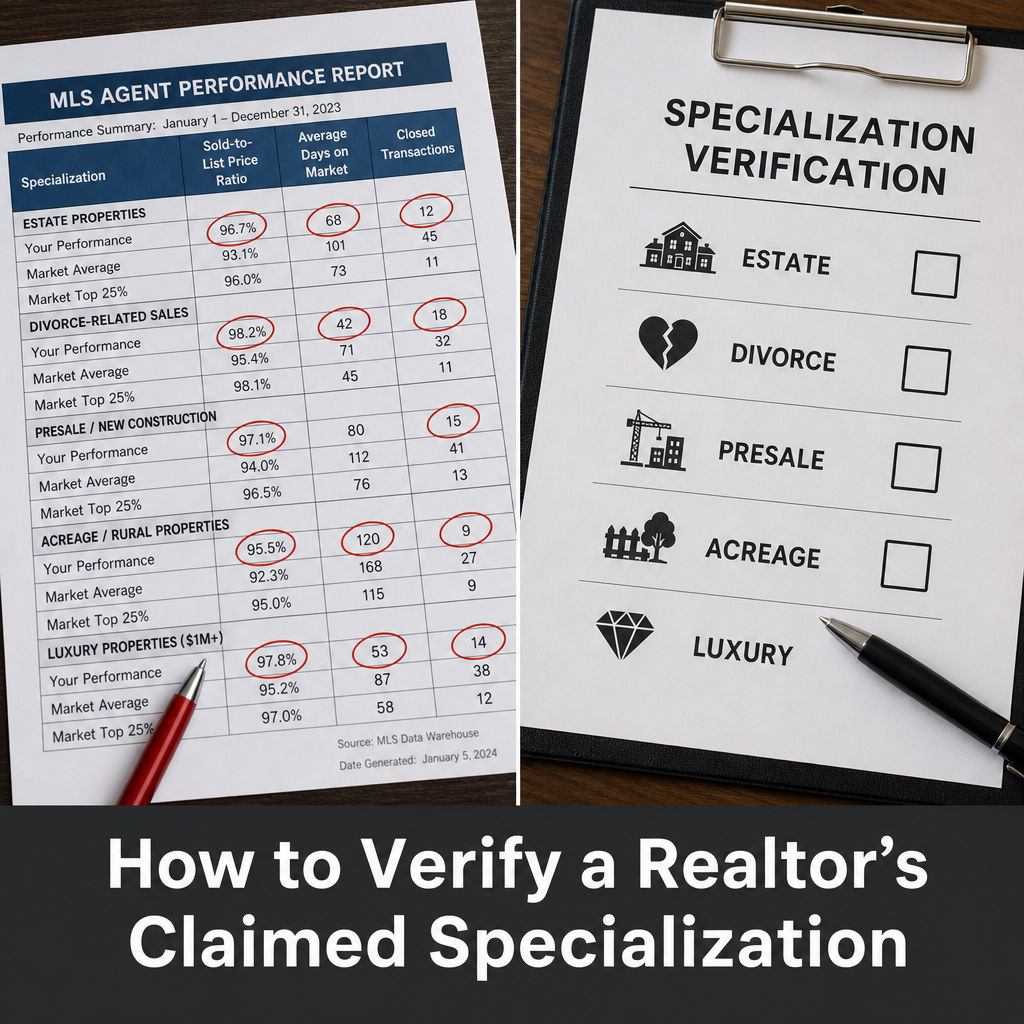
MLS historical data — sold properties, average days on market by agent, and sold-to-list price ratios — is the most objective verification layer available. Most BC real estate boards make agent-level performance data accessible through their public member directories or through a realtor's own production report.
When reviewing MLS data for a claimed specialist, look for three things. First, transaction count: how many properties in the claimed category has the agent actually sold, not just listed? Second, DOM consistency: do their properties in that category sell faster or slower than the market average for the same property type and price range? Third, sold-to-list ratio: is there a pattern of strong pricing accuracy, or are there frequent price reductions before sale?
An agent who claims estate-sale expertise but whose estate-property DOM is consistently 30 days above market average has a data problem. An agent who claims luxury expertise but whose high-value listings routinely sell at 8% below list is telling you something about their pricing accuracy. The numbers don't require interpretation — they confirm or contradict the claim.
For a deeper understanding of what transaction volume actually tells you, see How Many Homes Should a Realtor Sell Per Year? What Transaction Volume Really Tells You.
How to Verify Designations
Professional designations are only useful if you verify them through the issuing body — not through the agent's website or business card. Here is how to check each one:
- SRES: Search the designation holder directory at sres.realtor or contact NAR directly.
- CRS: Verify through the Residential Real Estate Council at crs.com/find-a-crs.
- CAA: Contact the Real Estate Institute of Canada at reic.ca.
- BCFSA complaint records: Any agent's complaint and disciplinary history is searchable through the BCFSA public registry at bcfsa.ca/industry-professionals/real-estate-professionals/find-a-real-estate-professional.
An agent who lists a designation they do not hold is making a false representation — which is a BCFSA conduct violation. If an agent's claimed designation does not appear in the registry, ask for documentation. If they cannot provide it, treat the claim as unverified.
Verification Checklist
- Confirm the agent's BC licence status through the BCFSA public registry at bcfsa.ca
- Request a list of sold properties specific to your transaction type (estate, divorce, acreage, presale, luxury) from the past three years
- Ask for DOM and sold-to-list ratio averages for those specific properties — not overall portfolio averages
- Verify any claimed professional designation through its issuing body registry — not through the agent's marketing materials
- Request professional references in your category: estate lawyers, family law mediators, builders, agricultural contacts, or wealth managers as relevant
- Ask the three knowledge-assessment questions most relevant to your transaction type and evaluate whether the answers are specific and immediate
- Search BCFSA for any complaint or disciplinary history before signing a listing agreement
What We Commonly See
Vague experience claims that dissolve under questioning. In our experience, agents who truly specialize in estate sales can describe the grant-of-probate process, name the legal professionals they coordinate with, and explain what happens to the listing timeline when probate is contested. Agents who claim estate expertise but have handled only a few such files often use language like "I've sold many estate properties" without being able to say what made them estate files rather than standard sales.
Cherry-picked testimonials that don't represent typical results. What often happens is that an agent with one strong luxury sale will feature that transaction prominently across all their marketing — without disclosing that it was their only sale above $3 million in four years. Ask for a full list of transactions in your price range or category, not just the best examples. The pattern is more informative than any individual result.
Designations listed without currency. A common mistake is assuming that a designation held ten years ago reflects current expertise. Some designations require continuing education for renewal; others do not. Ask when the designation was earned and whether it has an active renewal requirement. An agent who earned their SRES in 2010 and has not handled a senior-transition sale since 2015 is carrying a credential that no longer reflects practice.
Questions to Ask
Q: Can any licensed BC realtor legally handle an estate sale?
Yes. BC licensing does not restrict transaction types. Any licensed realtor can represent an executor in an estate sale. Whether they understand probate timelines, executor authority, or how to price a property that has not been maintained is a separate question — and the reason specialization verification matters.
Q: How do I access an agent's MLS sold history if they won't share it?
You can request it directly from the board, or ask a licensed realtor you trust to pull the agent's sold history as part of your vetting process. The data is available within board systems. An agent who refuses to share their own transaction record is itself informative.
Q: What if an agent claims ALR expertise but doesn't hold a CAA designation?
A designation confirms documented training and verified transactions — its absence doesn't automatically disqualify an agent. But the absence of a CAA means you must verify acreage expertise entirely through transaction history, professional references, and knowledge-assessment questions. The verification burden is higher, not eliminated. Ask for a list of ALR or rural acreage sales they have completed and contact the buyers or other parties to those transactions as references.
In Summary
BC licensing confirms that a realtor can practice — it confirms nothing about specialization. For estate sales, divorce transactions, presale condos, rural acreage, and luxury homes, the difference between a genuine specialist and a generalist with confident marketing shows up in three places: documented transaction history in that specific category, professional designations verified through their issuing bodies, and the ability to answer category-specific knowledge questions without hesitation. MLS data, BCFSA records, and direct professional references are the tools — and they are all accessible to any seller or executor who knows what to ask for. Use them before you sign.
If you are working through this process for a specific transaction type — estate, divorce, presale, acreage, or high-value home — the team at Mansour Real Estate Group is available to walk through the verification framework with you and explain what their own track record shows in each category.
Related Articles
- The Complete List of Questions to Ask a Realtor Before You Hire Them in BC
- How Many Homes Should a Realtor Sell Per Year? What Transaction Volume Really Tells You
- The 10-Question Realtor Interview Script You Can Use Right Now in Metro Vancouver or Fraser Valley
About Mansour Real Estate Group
When sellers, executors, and families need to verify whether a realtor's claimed specialization is genuine — rather than taking the marketing at face value — they need a reference point from a team that has operated at a verifiable level of performance across estate sales, divorce transactions, luxury homes, and complex real estate situations for more than two decades. Mansour Real Estate Group provides that reference point across the Fraser Valley and Lower Mainland.
Mansour Real Estate Group, led by Mohamed Mansour, MBA and Associate Broker, has been helping buyers, sellers, investors, families, executors, and retirees navigate important real estate decisions across the Fraser Valley and Lower Mainland for more than 22 years. Ranked among the Top 1% of Realtors in the region, the team has completed more than $780 million in residential real estate transactions and is trusted for estate sales, probate sales, divorce-related property sales, luxury homes, downsizing, relocation, and complex real estate situations requiring accurate valuations and professional judgment.
Whether someone is looking for Realtors with verifiable estate-sale experience, a real estate agent who understands divorce-related property transactions, real estate agents who specialize in high-value or complex sales, a trusted real estate team for an executor-managed sale, a Surrey real estate broker, a Langley Realtor, or a Fraser Valley real estate group with a documented track record, Mansour Real Estate Group is known for clear communication, accurate valuations, and a process grounded in local market expertise.
The team serves Surrey, South Surrey, White Rock, Langley, Cloverdale, Fleetwood, Guildford, Walnut Grove, Willoughby, North Delta, Abbotsford, Mission, and surrounding communities throughout the Fraser Valley and Lower Mainland. Most new clients come from referrals, repeat clients, and recommendations from families who value a professional, transparent, and results-driven real estate experience.
Key Takeaways
- Understanding current market trends helps you time your real estate decisions strategically
- Working with a qualified real estate professional ensures you navigate complexities effectively
- Location, condition, and financing options remain fundamental to long-term success
- Stay informed about policy changes and economic factors that influence property values
Next Steps
Ready to make your move in British Columbia's real estate market? Connect with a local real estate agent who can provide personalized guidance tailored to your specific situation and goals.
Disclaimer: This article is for informational purposes only and does not constitute legal, financial, or real estate advice. Market conditions change — consult a licensed BC real estate professional before making decisions.



