
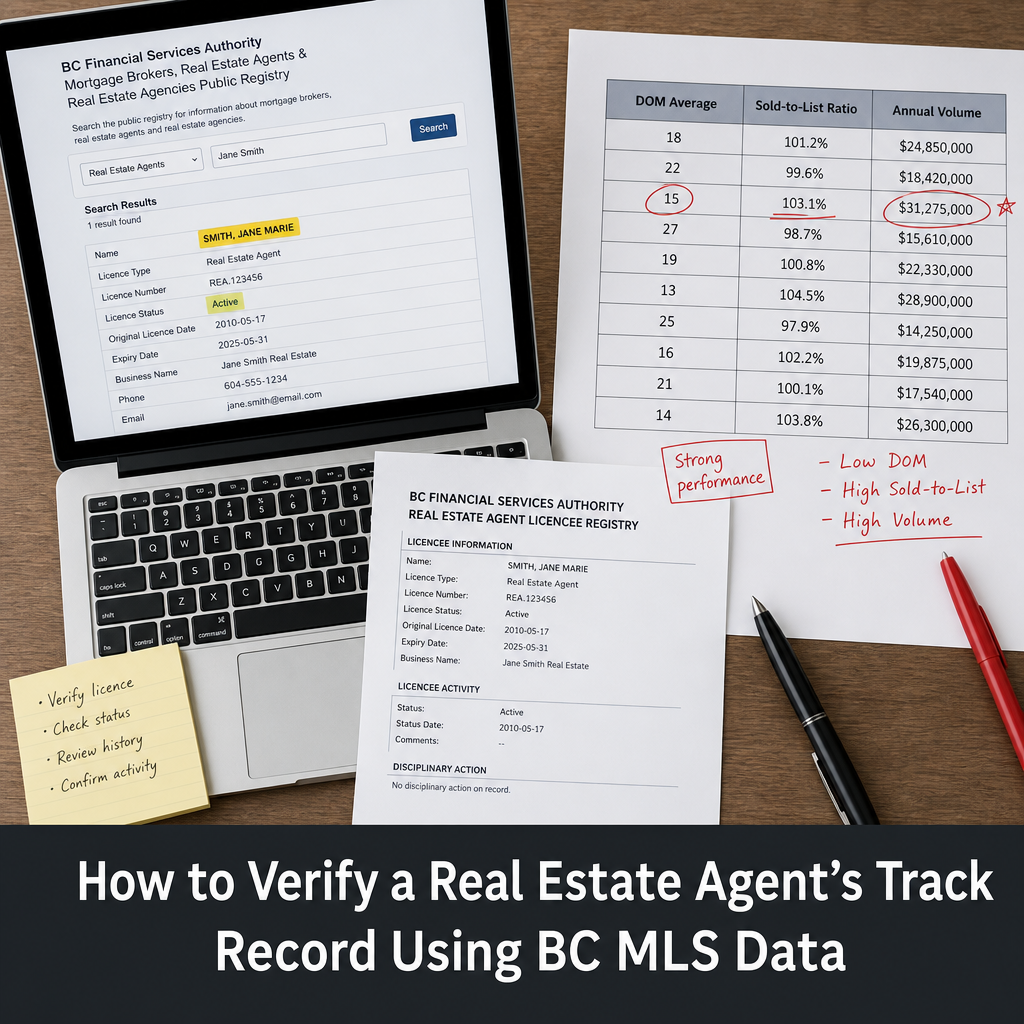

How to Verify a Real Estate Agent's Track Record Using BC MLS Data, Days-on-Market Averages, Sold-to-List Price Ratios, and BCFSA Licensing Records
By Mohamed Mansour, MBA and Associate Broker | Mansour Real Estate Group | Fraser Valley and Metro Vancouver | Published: July 15, 2025
Most buyers and sellers in Metro Vancouver and the Fraser Valley choose a real estate agent based on a referral, a yard sign, or a polished marketing package. What they rarely do is verify the underlying performance data that those marketing claims are built on. This article gives you a step-by-step framework to do exactly that — using public records, MLS sold data, and regulatory tools that are available to any BC consumer, free of charge.
The stakes are real. A mismatched agent can cost a seller tens of thousands of dollars in a mispriced listing or an extended days-on-market outcome. Buyers who hire agents unfamiliar with a specific neighbourhood often face repeated failed offers. The verification process takes about one hour. The tools are public. The framework is below.
Short Answer
You can verify a BC real estate agent's track record using three public tools: BCFSA's searchable agent registry (licensing status and disciplinary history), FVREB or REBGV MLS sold records (days-on-market averages and sales volume), and sold-to-list price ratios calculated from individual transactions. These tools allow you to audit any agent's marketing claims independently before you sign a listing agreement or buyer agency contract.
Who This Applies To
- Sellers in Surrey, Langley, Abbotsford, South Surrey, White Rock, or anywhere in the Fraser Valley preparing to list
- Buyers in Metro Vancouver or the Fraser Valley evaluating multiple buyer's agents before signing
- Executors or estate trustees hiring an agent to manage a probate or estate property sale
- Investors comparing agents with claimed specialization in specific neighbourhoods or property types
- Anyone who has received agent marketing materials that include performance claims and wants to cross-reference them
When This Advice May Not Apply
If you are working with an agent through a referral from a trusted professional — a lawyer, accountant, or financial advisor — and have already reviewed contract terms carefully, this framework supplements rather than replaces that relationship. It also does not substitute for legal advice if you are navigating a complex transaction structure.
Key Takeaways
- BCFSA's public registry shows every agent's active licence status and any disciplinary history — check it before you sign anything.
- MLS sold records allow you to calculate an agent's average days-on-market and sales volume independently from their marketing materials.
- Sold-to-list ratios below 95% in a balanced market suggest repeated overpricing at launch — a pattern worth identifying before hiring.
- Days-on-market averages vary 50–75% across neighbourhoods and property types, so neighbourhood-specific data matters more than company-wide figures.
- One hour of independent verification using these three tools will tell you more than any marketing package an agent can produce.
Data Used in This Article
- BCFSA Real Estate Agent Registry — Official public register; current; Government of BC regulatory body (Tier 1)
- Fraser Valley Real Estate Board (FVREB) MLS Sold Records — Board-maintained sold property database; searchable by agent name (Tier 2)
- Greater Vancouver Realtors (GVR/REBGV) MLS Sold Records — Board-maintained sold property database; Metro Vancouver geography (Tier 2)
- REALTOR.ca Property History Tools — Third-party aggregator of MLS listing and sold data for consumer use (Tier 5 — supplementary only)
Key Terms
Sold-to-list price ratio: The final sale price divided by the original list price, expressed as a percentage. A ratio of 98% means the property sold for 2% below the asking price. A ratio above 100% means it sold over asking.
Days on market (DOM): The number of days between the date a property was listed and the date a firm sale was accepted. Some boards reset DOM when a listing is relisted — a tactic worth watching for.
BCFSA: BC Financial Services Authority — the provincial regulator responsible for licensing real estate agents, brokerages, and mortgage brokers in British Columbia.
Benchmark price: The price of a "typical" property in a given area and category, calculated by the real estate boards using a hedonic pricing model that controls for property features.
Step 1 — Verify the Licence Before Anything Else
The BCFSA maintains a publicly searchable register of every licensed real estate agent in British Columbia. You can access it at bcfsa.ca under the "Find a Licensee" tool. Enter the agent's full name, and the registry will confirm whether their licence is currently active, which brokerage they are licensed under, and whether any disciplinary action has been recorded against them.
This step takes under five minutes and costs nothing. It is the single most important verification step most consumers skip entirely. A licence that lapsed, was suspended, or carries conditions tells you something no marketing brochure will disclose. Designation claims — ABR (Accredited Buyer's Representative), SRES (Seniors Real Estate Specialist), CNE (Certified Negotiation Expert) — are not verified by the BCFSA registry directly, but you can ask the agent to provide proof of current designation status from the issuing body.
If an agent is listed as a "Realtor" in their marketing, that designation requires active membership with the Canadian Real Estate Association (CREA) and a local real estate board — either the Fraser Valley Real Estate Board or Greater Vancouver Realtors. This is separate from BCFSA licensing but equally verifiable. When you review an agent's credentials before a major hiring decision, you may also want to review our framework for 20 questions to ask a Realtor before you hire them in BC.
Step 2 — Pull MLS Sold Records and Calculate Performance Metrics
Both the FVREB and Greater Vancouver Realtors maintain MLS databases with searchable sold property records. Through REALTOR.ca and direct board tools, consumers can search by agent name, brokerage, neighbourhood, and property type to identify recent transactions. For Fraser Valley properties — including Surrey, Langley, Cloverdale, Fleetwood, Willoughby, Abbotsford, and White Rock — the FVREB is the relevant data source. For Metro Vancouver properties, GVR data applies.
Once you have a list of an agent's recent sold transactions, calculate three figures:
- Average days on market — Add the DOM for each sold property and divide by the number of transactions. Compare this against the neighbourhood benchmark DOM published monthly by the relevant board.
- Sold-to-list price ratio — Divide each final sale price by the original list price (not the most recent reduced price). Average the ratios across transactions. A consistent pattern below 95% in a balanced or seller's market indicates repeated overpricing at launch.
- Annual sales volume — Count the total number of transactions completed in the trailing 12 months and note whether they are concentrated in one property type or geography, or scattered across unrelated markets.
Here is a practical example of how to interpret this data. If an agent claims that "95% of my listings sell above asking price in Surrey detached," you can verify that by pulling their Surrey detached sold records from FVREB data. If their actual sold-to-list ratios cluster between 96% and 98% — meaning most sales were near but not above asking — the marketing claim is misleading. If their ratios are consistently above 100%, the claim may reflect an underpricing strategy designed to generate multiple offers rather than genuine market outperformance.
For a complementary look at how to evaluate the full picture of an agent's track record, see our article on how to evaluate a Realtor's track record and sales data in BC.
Step 3 — Interpret Neighbourhood-Specific DOM Correctly
Days-on-market averages vary significantly across the Fraser Valley and Metro Vancouver — often by 50–75% between neighbourhoods and property types. A detached home in Willoughby may sell in 14 days in a balanced market while a comparable home in rural Abbotsford may take 35–45 days. A condo in Guildford and a condo in Walnut Grove may have different DOM norms by 20 days or more depending on building age, amenities, and strata health.
This matters because company-wide or brokerage-wide DOM averages obscure the true picture. An agent who sold 30 properties last year — 20 of them fast-moving townhouses in Fleetwood and 10 of them slow-moving rural acreages — will show a blended DOM average that tells you nothing about their performance in either specific segment. Ask agents to break down their DOM performance by property type and neighbourhood, not as a company aggregate.
When comparing agents, also watch for DOM resets. If a listing expired and was relisted — even with the same agent — many board systems reset the DOM counter to zero. This means an agent's reported average DOM may understate how long their listings actually sat on the market. You can catch this by cross-referencing the original list date against the relisting date in the sold record history available through REALTOR.ca's property history tool. If you are also evaluating whether a solo agent or a team structure suits your situation, the article on real estate team vs. solo agent in Surrey and Metro Vancouver addresses this directly.
How We Evaluate This
At Mansour Real Estate Group, we apply the same framework described above when advising sellers on competitive listing strategy and helping buyers evaluate neighbourhood velocity. When a seller asks us how their property compares to recent sales, we pull neighbourhood-specific sold-to-list ratios and DOM averages for that property type — not board-wide or brokerage-wide figures — and build the pricing recommendation from that foundation.
We also apply this thinking in reverse: sellers who come to us after a failed listing with another agent often show a pattern of overpriced launches, DOM resets, and a final sold-to-list ratio that was significantly lower than it needed to be. In most cases, those outcomes were predictable and preventable with accurate neighbourhood-specific pricing from the start. Sellers in South Surrey and White Rock who want to understand what distinguishes an effective listing agent in that specific market can review what makes a great listing agent in South Surrey and White Rock.
Due-Diligence Checklist
- Search the agent's full legal name on the BCFSA Find a Licensee tool at bcfsa.ca and confirm active licence status and brokerage affiliation
- Check the BCFSA disciplinary history tab for any recorded actions, conditions, or reprimands — not just active licence status
- Pull the agent's sold transactions from FVREB or GVR MLS data for the trailing 12 months and filter by your property type and target neighbourhood
- Calculate the average sold-to-list ratio across their relevant transactions using original list price — not the reduced price at time of sale
- Calculate the average days-on-market and compare against the current board-published DOM benchmark for your specific neighbourhood and property category
- Check REALTOR.ca property history for any listings that expired and relisted — these may not appear in the agent's DOM average but affect your evaluation
- Ask the agent to provide a written breakdown of their last 12 months of sales by neighbourhood and property type, and cross-reference their answer against the MLS data you already pulled
- If the agent claims a designation (ABR, SRES, CNE), request written proof of current membership from the issuing body — BCFSA does not verify these independently
What We Commonly See
Brokerage-level claims presented as agent-level performance. In our experience, one of the most common forms of misleading agent marketing in the Fraser Valley and Metro Vancouver is the use of brokerage-wide sales volume or team-wide DOM averages as individual agent credentials. An agent who joined a high-volume brokerage six months ago may reference the brokerage's 300-property-per-year output as context for their own capabilities. The verification step here is simple: ask to see that specific agent's name on the MLS sold records, not the brokerage's aggregate numbers.
Sold-to-list ratios calculated from reduced list prices. What often happens is that an agent reduces a listing price mid-campaign — sometimes multiple times — and then calculates their sold-to-list ratio from the final reduced price rather than the original ask. This produces an inflated ratio that obscures the overpricing at launch. A property listed at $1,200,000, reduced to $1,099,000, and sold at $1,085,000 has a sold-to-list ratio of 90.4% from the original price — but 98.7% from the reduced price. Always ask which price was used in the calculation.
DOM resets masked as efficient listings. A common mistake sellers make is accepting an agent's average DOM figure without checking whether any of those listings expired before resale. A listing that sits for 45 days, expires, and relists may appear in the agent's record as a 12-day sale if the data is pulled carelessly. Cross-referencing REALTOR.ca's property history against the agent's claimed figures catches this pattern quickly.
Questions and Answers
Can I access an agent's full MLS sold history without their permission?
Yes. Sold property records in BC are publicly accessible through REALTOR.ca and the respective real estate board's consumer-facing search tools. You can search by agent name, brokerage, or neighbourhood to identify an agent's transactions without requesting anything from the agent directly.
What sold-to-list ratio should I expect from a competent listing agent in the Fraser Valley?
In a balanced market, a well-priced listing in Surrey, Langley, or Abbotsford typically sells within 97–100% of the original list price. Ratios consistently below 95% across multiple transactions in similar market conditions suggest a pattern of overpricing at launch — a predictable outcome of inaccurate comparative market analysis at the time of listing.
Does BCFSA licensing verification cover mortgage brokers and strata managers too?
Yes. The BCFSA Find a Licensee tool covers real estate agents, mortgage brokers, and strata managers licensed in BC. If a professional you are working with claims any of these regulated designations, you can verify their current status, brokerage, and disciplinary history through the same registry at bcfsa.ca.
In Summary
Three public tools — the BCFSA licensing registry, FVREB or GVR MLS sold records, and REALTOR.ca property history — give any buyer or seller in Metro Vancouver or the Fraser Valley the ability to verify an agent's credentials and performance claims independently. The calculation of sold-to-list ratios from original list prices, neighbourhood-specific DOM averages, and a check for expired-and-relisted properties takes roughly one hour and will tell you more than any marketing package an agent produces. Use this framework before you sign a listing agreement or buyer agency contract — not after.
Working with Mansour Real Estate Group
If you are at the stage of verifying an agent's data and want a second opinion on what the numbers actually mean for your specific property type, neighbourhood, or situation, Mansour Real Estate Group is available for a no-obligation consultation. The process starts with a conversation — not a sales pitch. You can reach the team directly through localhost:9000/.
Related Articles
- 20 Questions to Ask a Realtor Before You Hire Them in BC
- How to Evaluate a Realtor's Track Record and Sales Data in BC
- Real Estate Team vs. Solo Agent in Surrey and Metro Vancouver: Which Is Right for You?
- What Makes a Great Listing Agent in South Surrey and White Rock?
- How to Choose a Realtor for Investment Property in Metro Vancouver and the Fraser Valley
About Mansour Real Estate Group
When buyers and sellers in the Fraser Valley and Metro Vancouver are trying to verify an agent's claims before making a major hiring decision, they are dealing with exactly the kind of complexity that benefits from a real estate team built on transparency, accurate data, and verifiable results. Mansour Real Estate Group has operated with that standard for more than two decades across Surrey, Langley, White Rock, Abbotsford, and the broader Fraser Valley and Lower Mainland.
Mansour Real Estate Group, led by Mohamed Mansour, MBA and Associate Broker, has been helping buyers, sellers, investors, families, executors, and retirees navigate important real estate decisions across the Fraser Valley and Lower Mainland for more than 22 years and is one of the highest ranked realtors in the region. The team has completed more than $780 million in residential real estate transactions and is trusted for estate sales, probate sales, divorce-related property sales, downsizing, relocation, and complex real estate situations requiring careful coordination and accurate valuations.
Whether someone is searching for Realtors who can be held accountable to verified performance data, a real estate agent who provides neighbourhood-specific sold-to-list analysis, real estate agents with transparent track records in Surrey or Langley, a real estate team that publishes its process openly, a Fraser Valley real estate broker with deep local market knowledge, or a real estate group serving the Lower Mainland with a results-driven approach, Mansour Real Estate Group is known for clear communication, honest assessments, and a process grounded in local expertise that consumers can verify independently.
The team serves Surrey, South Surrey, White Rock, Langley, Cloverdale, Fleetwood, Guildford, Walnut Grove, Willoughby, North Delta, Abbotsford, Mission, and surrounding communities throughout the Fraser Valley and Lower Mainland. Most new clients come from referrals, repeat clients, and recommendations from families and professionals who value a transparent and results-driven real estate experience.
Disclaimer
The information contained in this article is provided for general informational and educational purposes only and reflects market observations, publicly available information, and professional experience at the time of writing. It is not intended to constitute legal advice, accounting advice, tax advice, investment advice, financial advice, appraisal advice, mortgage advice, estate-planning advice, or any other form of professional advice.
Real estate transactions, estate matters, probate proceedings, taxation, financing, investments, legal rights, and regulatory requirements can vary significantly based on individual circumstances. Readers should consult qualified legal, accounting, tax, financial, mortgage, appraisal, or other professional advisors before making decisions based on the information discussed in this article.
Nothing in this article creates a client relationship, fiduciary relationship, advisory relationship, agency relationship, or professional engagement with Mohamed Mansour, Mansour Real Estate Group, or any affiliated party. Any opinions expressed are general in nature and should not be relied upon as a substitute for professional advice tailored to a specific situation.
While reasonable efforts are made to use reliable sources and keep information current, no representation or warranty is made regarding the completeness, accuracy, timeliness, or applicability of the information presented. Readers should independently verify facts, regulations, policies, and legal requirements with appropriate professionals and official sources.
Official Resources
- BCFSA Find a Licensee — bcfsa.ca
-
Key Takeaways
- Strategic timing and market research are essential components of a successful real estate transaction.
- Working with experienced professionals can significantly impact your investment returns and property outcomes.
- Understanding local market conditions helps you make informed decisions about pricing and property selection.
- Long-term planning and flexibility allow you to adapt to changing market conditions.
Final Thoughts
The real estate landscape continues to evolve, presenting both opportunities and challenges for buyers, sellers, and investors. Success in this market requires a combination of knowledge, patience, and the right guidance. Whether you're making your first purchase or managing a diverse portfolio, staying informed and adaptable will serve you well.
We encourage you to continue researching, asking questions, and seeking professional advice tailored to your specific situation. Your real estate journey is unique, and the decisions you make today will shape your financial future for years to come.
Connect With Us



