
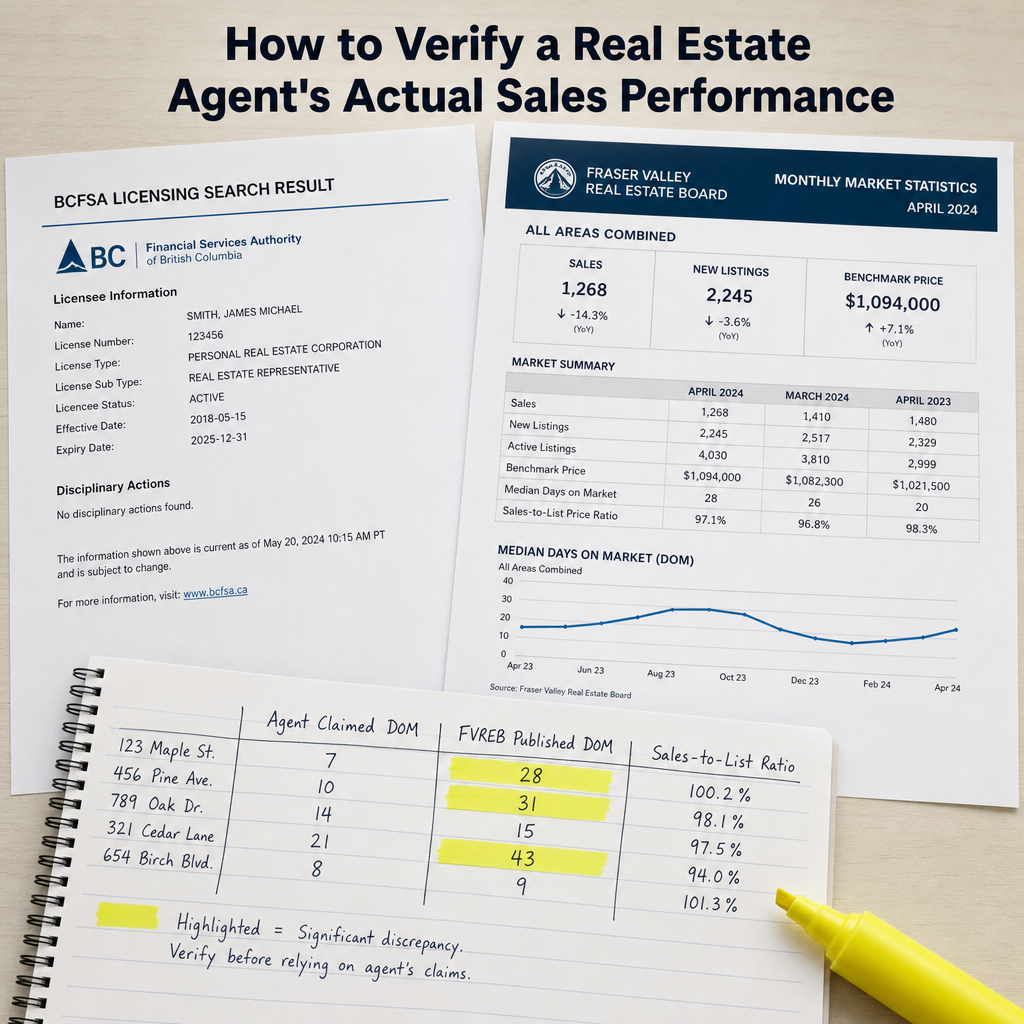

How to Verify a Real Estate Agent's Actual Sales Performance Using MLS Data, Days-on-Market Averages, Sales-to-List Price Ratios, and BCFSA Licensing Records: A Complete Due-Diligence Framework for Metro Vancouver and Fraser Valley Buyers and Sellers
By Mohamed Mansour, MBA and Associate Broker | Mansour Real Estate Group | Fraser Valley and Metro Vancouver, BC | Published: July 15, 2025
In a market with more than 5,000 licensed professionals in the Fraser Valley Real Estate Board alone, choosing a real estate agent has become as much a research task as a relationship one. Marketing materials freely use phrases like "Top 1% Agent," "#1 in Cloverdale," or "500+ transactions completed." Most of those claims are impossible to verify using standard public tools — and many are not supported by any published data source.
This guide explains exactly what you can verify, where to look, and how to interpret what you find. It is written for buyers and sellers in Metro Vancouver and the Fraser Valley who want a structured, data-grounded approach to agent selection before signing a representation agreement.
Short Answer
You can verify a BC real estate agent's licensing status, disciplinary history, and credential details through the BCFSA public database at bcfsa.ca. Market-level performance benchmarks — including days-on-market averages and sales-to-active ratios by neighbourhood and property type — are published monthly by the Fraser Valley Real Estate Board and the Greater Vancouver Realtors board. Comparing an agent's stated performance against those published benchmarks, then cross-referencing with sold price history through BC Assessment and realtor.ca, gives you the clearest independent picture available without access to raw MLS data.
Key Takeaways
- BCFSA licensing records at bcfsa.ca are the mandatory first step before engaging any agent in BC.
- FVREB and Greater Vancouver Realtors publish monthly DOM and sales-to-active data you can use as benchmarks.
- A sales-to-list price ratio consistently below 97% in a balanced market warrants a direct conversation about pricing strategy.
- Many "Top 1%" claims in BC reference internal brokerage metrics, not independent board rankings — ask for the source.
- BC Assessment's public property search and realtor.ca sold listings allow limited but useful sold-price verification.
Who This Applies To
- Home sellers in Surrey, Langley, Abbotsford, South Surrey, White Rock, Cloverdale, Fleetwood, and the Fraser Valley evaluating listing agents
- Buyers in Metro Vancouver or the Fraser Valley who have received competing agent recommendations
- Executors managing estate sales and needing documented agent qualifications before appointment
- Families relocating into the region who cannot rely on a local referral network
- Anyone who has received an agent marketing package with performance claims and wants to verify them independently
When This Advice May Not Apply
This framework uses publicly available and aggregated data, not raw MLS transaction records. Individual agent transaction volume cannot be independently confirmed to the exact number through these tools. Use this as a cross-reference discipline, not a definitive audit. For complex situations — estate sales, probate transactions, or high-value properties — additional vetting specific to that transaction type is warranted.
Data Used in This Article
- BCFSA Public Licensing Database — bcfsa.ca — current, official, Tier 1 government regulator source
- FVREB Monthly Market Statistics — Fraser Valley Real Estate Board — published monthly, official board data, Tier 2
- Greater Vancouver Realtors (GVR) Monthly Reports — rebgv.org — published monthly, official board data, Tier 2
- BC Assessment Property Search — assessment.bc.ca — provincial authority, public record, Tier 1
- Realtor.ca sold listing history — Canadian Real Estate Association public portal — Tier 3 supplementary verification
Key Terms Defined
Days on Market (DOM): The number of days from when a property is listed on MLS to when a firm sale is accepted. Boards publish average DOM by property type and area in monthly reports.
Sales-to-List Price Ratio: The final sale price divided by the list price, expressed as a percentage. A ratio of 98% means a home sold for 98 cents on every listed dollar.
Sales-to-Active Listings Ratio: A board-level metric showing what percentage of active listings sold in a given month. Above 20% typically signals a seller's market; below 12% signals a buyer's market in BC.
BCFSA: BC Financial Services Authority — the provincial regulator for real estate licensees in British Columbia.
How We Evaluate This
At Mansour Real Estate Group, agent performance evaluation starts with a separation of verifiable data from marketing language. The BCFSA record confirms the legal foundation: is the agent licensed, are there disciplinary records, and what is their current standing? That takes two minutes and costs nothing. Everything beyond that is benchmarking — comparing what an agent says against what the boards actually publish for a given area and property type.
When sellers in Surrey, Langley, or Abbotsford ask us how we compare to another agent they are considering, we direct them to the same public sources described here. If our claims cannot survive that test, they should not appear in our marketing materials. The same standard should apply to any agent a buyer or seller is evaluating.
Step 1 — Confirm Licensing Status Through BCFSA
Before any other evaluation, visit bcfsa.ca and use the public licensee search to confirm three things: the agent is currently licensed, what brokerage they are registered with, and whether any disciplinary actions or conditions appear on their record. In British Columbia, every person who trades in real estate must hold a current licence issued by the BCFSA. The database is updated in near real time.
Search by name, licence number, or brokerage. The record will show licence type (representative, associate broker, or managing broker), current status, and any public disciplinary orders. If an agent's name does not appear, or if their licence shows as inactive or suspended, that is a hard stop. Do not proceed. This step also confirms brokerage affiliation, which matters if an agent claims to be independently operating or affiliated with a team whose identity you want to verify.
For more detail on what BCFSA records do and do not show, see our companion guide on how to verify a realtor's credentials and licence in BC.
Step 2 — Benchmark DOM and Sales-to-List Ratios Against Published Board Data
The FVREB and Greater Vancouver Realtors both publish monthly market statistics that include average days-on-market by property type — detached, townhome, and apartment — at the neighbourhood and municipality level. These reports are free, publicly available on each board's website, and released within the first two weeks of every month for the prior month's data.
When an agent tells you their listings sell in 12 days when the board-reported average for detached homes in Willoughby that month was 28 days, you have a meaningful discrepancy worth probing. The right follow-up question is not accusatory — it is factual: "Can you show me the addresses of your last five listings in this area and when they sold?" A confident, well-performing agent will answer that without hesitation. An evasive response is informative in its own way.
Sales-to-list price ratios work the same way. The boards publish average benchmark prices and sale-price-to-assessment comparisons. A ratio consistently above 100% in a balanced market may indicate the agent is under-listing to generate competing offers — a strategy that can benefit some sellers and frustrate others. A ratio consistently below 95% suggests pricing misalignment, extended market time, or price reductions that eroded the final number. Neither direction is automatically wrong, but both warrant an explanation before you sign. For a full view of what questions to bring to this conversation, review our guide on 20 questions to ask a realtor before you hire them in BC.
Keep in mind that DOM and ratios vary significantly within a single municipality. In Surrey, for example, Guildford condos, Fleetwood townhomes, and South Surrey detached properties can each show 40–60% difference in average DOM in the same month. An agent quoting a single DOM number across all their Surrey listings is mixing segments that should not be compared directly. Neighbourhood-level data from the board reports is the right benchmark — not city-wide averages.
Step 3 — Verify Sold Price Claims Through BC Assessment and Realtor.ca
BC Assessment's public property search at assessment.bc.ca allows you to look up individual properties by address and review their assessed values. While BC Assessment does not publish sale prices directly, you can compare an agent's claimed sale price against the assessed value and surrounding comparable properties to identify whether the stated outcome is plausible for that street, block, and property type.
Realtor.ca retains some historical sold listing data, and sold prices for specific properties are sometimes visible in the listing history depending on how long ago the transaction occurred and how the brokerage submitted the data. This is a supplementary tool, not a definitive audit — but it can confirm the general credibility of an agent's reference transactions when combined with BC Assessment data.
If an agent provides a list of comparable sales in their presentation, you can cross-reference those addresses through these tools to verify the sale price is in the expected range for that neighbourhood. A Langley Realtor claiming a $1.85 million sale in Walnut Grove when comparable homes in the same period sold in the $1.4–$1.6 million range should be able to explain what differentiated that property — and show the address so you can verify it yourself. Understanding how local market knowledge should shape this kind of evaluation is covered in depth at what local market knowledge means and why it matters when choosing a realtor in the Fraser Valley.
Step 4 — Interpreting "Top 1%" and Transaction Volume Claims
This is where the most widespread confusion exists. "Top 1%" in real estate is not a standardized designation in BC. It is not issued by the BCFSA. It is not verified by the FVREB or Greater Vancouver Realtors in a publicly searchable format. When an agent or brokerage uses this term, it references one of three things: an internal brokerage ranking, a REALTOR® achievement award from CREA with specific volume thresholds, or a self-assigned claim based on metrics the agent defines themselves.
The REALTOR® Platinum Award and similar CREA recognition programs do have published volume thresholds, and agents who hold them can show the award documentation. Ask to see the award certificate and which year it covers. A recognition earned five years ago against lower volume thresholds in a different market does not carry the same weight as a current designation.
For transaction volume claims — "I've sold 300 homes in Surrey" — there is currently no public database in BC that allows independent confirmation of individual agent transaction counts to the precise number. What you can do is ask for a list of recent transactions (last 12 months), verify a sample of those addresses through BC Assessment and realtor.ca, and compare the activity level against what is plausible for a single agent or team operating in that market segment. Commission structure context also matters when evaluating agent claims — our guide to what a real estate agent charges in BC explains what transaction economics look like for different volume levels.
Due-Diligence Checklist — Agent Verification
- Search the agent's name on BCFSA's public licensee database at bcfsa.ca and confirm active status, brokerage, and licence type
- Download the most recent FVREB or GVR monthly market report and find the DOM average for your property type and neighbourhood
- Ask the agent for the addresses of their last five completed listings in your area and verify two or three through BC Assessment and realtor.ca
- Compare the agent's stated sales-to-list ratio against the board-published average for your market segment — ask them to explain any meaningful gap
- Request documentation for any "Top 1%," "Top Producer," or award designation — confirm what year it covers and what the threshold was
- Check whether the agent is listed as a sole representative or part of a team, and clarify who will actually manage your file day to day
- Review the BCFSA record for any disciplinary history, licence conditions, or past complaints — even if the record is clean, the step itself takes two minutes
What We Commonly See
Mixing market segments to inflate DOM performance. In our experience, one of the most common ways DOM claims get inflated is by combining property types or neighbourhoods that should not be compared. An agent might average their condo and detached sales together, even though condos in Guildford were selling in 18 days while detached homes in Cloverdale were sitting for 40 days in the same period. The combined average looks impressive, but it does not reflect performance in the specific segment you are selling.
Award credentials that predate current market conditions. What often happens is that an agent earned a volume-based award in 2020 or 2021 — when sales velocity across the Fraser Valley was exceptionally high — and continues to reference that award without updating the credential or noting the year. A designation earned during a period of record transaction volume is not evidence of above-average performance in a normalized market.
Transaction volume claims that conflate team totals with individual performance. A common mistake is assuming a volume claim refers to the person sitting across from you. In many cases, it refers to the entire team's production. If a team of six agents closed 120 transactions last year, that is 20 per agent — a meaningful but not extraordinary number. Clarify whether stated volume refers to the individual or the team before using it as a performance benchmark.
Questions and Answers
Can I see an individual agent's transaction history in BC?
Not through a single public database. Raw MLS transaction records are available only to board members. However, you can verify individual sold properties by address through BC Assessment and realtor.ca, and ask the agent directly for a recent transaction list to cross-reference.
What does the BCFSA record actually show?
It shows the agent's current licence status, licence type, the brokerage they are registered with, and any public disciplinary orders or conditions on their licence. It does not show transaction volume, income, or performance metrics.
How do I find the FVREB market statistics report?
Visit the Fraser Valley Real Estate Board's website at fvreb.bc.ca and look for the "Market Statistics" or "Statistics" section. Monthly reports are published within the first two weeks of the following month. Reports are free, publicly available as PDF downloads, and include neighbourhood-level data for detached, townhome, and apartment segments.
In Summary
Verifying a real estate agent's performance in Metro Vancouver and the Fraser Valley requires combining at least three public data sources: the BCFSA licensing database, monthly board market statistics from the FVREB or GVR, and sold-property lookups through BC Assessment and realtor.ca. No single tool gives a complete picture, but together they allow you to confirm licensing status, benchmark DOM and pricing claims against published averages, and evaluate the credibility of specific transaction references. The most important shift is treating agent selection as a research task — not just a referral decision. If an agent's claims cannot survive a basic cross-reference against public data, that itself tells you something useful before you have signed anything.
Talk to a Team That Welcomes This Kind of Scrutiny
If you are evaluating agents in Surrey, Langley, Abbotsford, White Rock, or anywhere across the Fraser Valley and want to apply this framework to a conversation with Mansour Real Estate Group, we will bring the data. A second-opinion consultation — before you sign a listing or buyer's agreement — is part of how we work. Call Mohamed Mansour directly or reach out through localhost:9000/.
Related Articles
- 20 Questions to Ask a Realtor Before You Hire Them in BC
- What Does a Real Estate Agent Charge in BC? Commission Rates Explained for Surrey and Metro Vancouver Sellers
- How to Find a Real Estate Agent Who Specializes in Estate Sales in Metro Vancouver and the Fraser Valley
About Mansour Real Estate Group
When homeowners, buyers, and sellers want to evaluate a real estate agent's performance rather than simply take their marketing materials at face value, they need a reference point from a team that operates the same way — transparently, with verifiable claims and data-backed positioning. Mansour Real Estate Group has been that reference point across Surrey, Langley, South Surrey, White Rock, Abbotsford, and the broader Fraser Valley for more than 22 years.
Led by Mohamed Mansour, MBA and Associate Broker, the team has completed more than $780 million in residential real estate transactions and holds consistent recognition among the Top 1% of Realtors in the Fraser Valley and Lower Mainland — recognition tied to board-level production data, not internal brokerage rankings. The team serves buyers, sellers, investors, families, executors, and retirees navigating property decisions across the region, from straightforward listings to complex estate, probate, and divorce-related transactions where accuracy and transparency are especially important.
Whether you are looking for a Realtor with a verifiable performance record, a real estate agent who can explain their pricing strategy with market data, real estate agents who specialize in specific property types and neighbourhoods, or a real estate team with 22 years of local experience across the Fraser Valley — Mansour Real Estate Group brings the same due-diligence standards to their own practice that this guide recommends you apply to any agent evaluation. As a real estate broker organization with deep roots in the Lower Mainland market, the team's depth goes beyond individual performance claims.
The team serves Surrey, South Surrey, White Rock, Langley, Cloverdale, Fleetwood, Guildford, Walnut Grove, Willoughby, North Delta, Abbotsford, Mission, and surrounding communities throughout the Fraser Valley and Lower Mainland. Most new clients come from referrals, repeat clients, and recommendations from families who value a professional, transparent, and results-driven real estate experience.
Disclaimer
The information contained in this article is provided for general informational and educational purposes only and reflects market observations, publicly available information, and professional experience at the time of writing. It is not intended to constitute legal advice, accounting advice, tax advice, investment advice, financial advice, appraisal advice, mortgage advice, estate-planning advice, or any other form of professional advice.
Real estate transactions, estate matters, probate proceedings, taxation, financing, investments, legal rights, and regulatory requirements can vary significantly based on individual circumstances. Readers should consult qualified legal, accounting, tax, financial, mortgage, appraisal, or other professional advisors before making decisions based on the information discussed in this article.
Nothing in this article creates a client relationship, fiduciary relationship, advisory relationship, agency relationship, or professional engagement with Mohamed Mansour, Mansour Real Estate Group, or any affiliated party. Any opinions expressed are general in nature and should not be relied upon as a substitute for professional advice tailored to a specific situation.
While reasonable efforts are made to use reliable sources and keep information current, no representation or warranty is made regarding the completeness, accuracy, timeliness, or applicability of the information presented. Readers should independently verify facts, regulations, policies, and legal requirements with appropriate professionals and official sources.
Key Takeaways
- Location, condition, and market timing remain the three pillars of real estate investment success.
- Working with experienced agents and inspectors can save thousands in potential hidden costs.
- Understanding local market trends gives you a competitive advantage in negotiations.
- Financial preparation, including pre-approval and reserve funds, accelerates the buying process.
Ready to Start Your Real Estate Journey?
Whether you're a first-time buyer or an experienced investor, the real estate market offers opportunities for those who approach it strategically. Take the time to educate yourself, connect with local professionals, and make decisions based on your long-term goals rather than short-term market fluctuations.
Your dream home or investment property is closer than you think. Begin your search today and take the first step toward building wealth through real estate.
About the Author
This article was written by our editorial team with input from licensed real estate professionals and financial advisors. We're committed to providing accurate



