
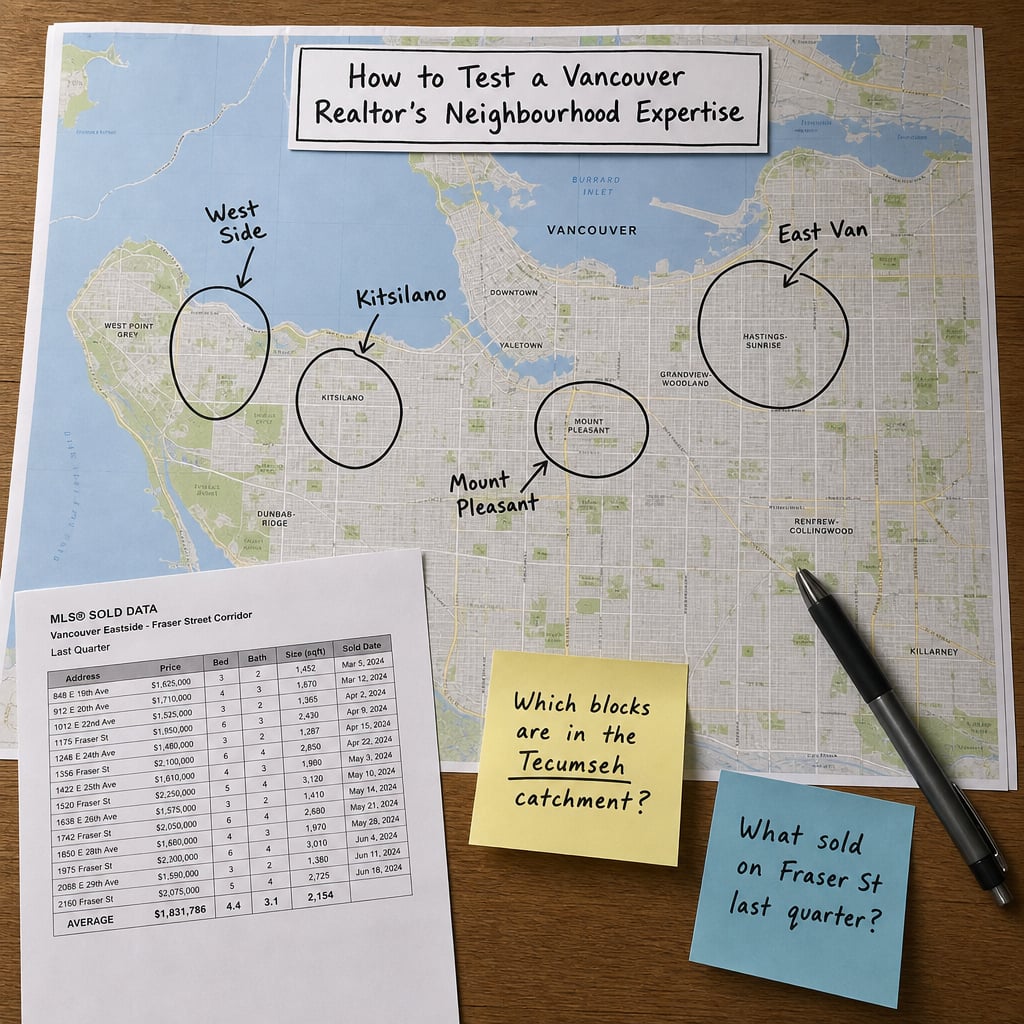

How to Test a Vancouver Realtor's Genuine Neighbourhood Expertise: The Micro-Market Vetting Framework for East Van, Kitsilano, Mount Pleasant, and the West Side
By Mohamed Mansour, MBA and Associate Broker | Mansour Real Estate Group | Published: July 14, 2025 | Fraser Valley and Lower Mainland, BC
Vancouver's real estate market is one of the most geographically complex in Canada. Price differences of $150,000 or more can exist between two properties on opposite sides of the same intersection, separated by a school catchment boundary, a zoning overlay, or a single block's distance from a future development site. In that environment, a realtor who genuinely knows a neighbourhood operates differently from one who simply works across many of them.
This article gives buyers and sellers a structured, practical way to test any realtor's claimed expertise in East Vancouver, Kitsilano, Mount Pleasant, and the West Side before signing a representation agreement. The framework uses publicly available data, testable questions, and observable track records — no insider access required.
Short Answer
To test a Vancouver realtor's genuine neighbourhood expertise, ask them specific questions about school catchment boundaries, recent comparable sales by block, active zoning changes, and flood or heritage overlays in the area you are considering. Then cross-reference their answers against publicly available MLS sold data, City of Vancouver zoning maps, and BC Assessment records. A genuine micro-market expert will answer without hesitation and the data will confirm it.
Key Takeaways
- Vancouver's 40-plus neighbourhoods contain 20 or more distinct micro-markets where block-level differences in pricing, school catchments, and zoning are the norm, not the exception.
- Genuine neighbourhood expertise is testable before you sign — it does not require trusting a realtor's self-description or marketing materials.
- MLS sold data, City of Vancouver zoning maps, and BC Assessment records are all publicly accessible and can be used to cross-reference any realtor's claimed knowledge.
- A realtor who covers 15 neighbourhoods simultaneously is structurally unlikely to track the block-level price movements, development applications, or strata histories that define each one.
- The vetting conversation itself is revealing — how a realtor answers matters as much as what they say.
Who This Applies To
- Buyers evaluating properties in East Vancouver, Kitsilano, Mount Pleasant, or the West Side who want to confirm their realtor actually knows the area.
- Sellers in these neighbourhoods who want to know whether their listing agent can defend a pricing strategy with local data, not just general market commentary.
- Relocating buyers unfamiliar with Vancouver's neighbourhood boundaries who need to assess realtor knowledge before committing.
- Buyers and sellers who have received conflicting pricing opinions across neighbourhoods and want a framework to evaluate which source is better grounded.
When This Advice May Not Apply
If you are purchasing in a neighbourhood where recent transaction volume is very thin, comparable sales data may be limited and the vetting approach below will need to rely more on zoning and development knowledge than sold data. Buyers working with a team — where a lead agent is supported by local specialists — should vet the specialist, not just the lead agent. This framework also assumes you are in a pre-hiring stage; once you have signed a representation agreement, the process changes.
Why Vancouver Demands Block-Level Knowledge
Vancouver is not one market. It is a city of layered micro-markets that shift significantly within the same postal code. In East Vancouver, the difference between a property north of Kingsway and one south of it can reflect completely different buyer pools, school catchments, and recent sale prices. In Kitsilano, heritage overlays and lot depth restrictions affect what a buyer can eventually do with a property. In Mount Pleasant, active rezoning applications along key corridors have changed buyer calculus street by street. On the West Side, school catchments — particularly around Lord Byng, Point Grey Secondary, and Crofton House feeder areas — influence detached home pricing in ways that don't show up in aggregate neighbourhood statistics.
A realtor with genuine micro-market expertise knows these distinctions without looking them up during your meeting. A generalist who covers many neighbourhoods simultaneously typically understands the broad strokes but misses the block-level variables that affect your specific decision. The challenge for buyers and sellers is that both types of agents describe themselves using identical language — "experienced in Vancouver," "deep neighbourhood knowledge," "local market expert." The vetting framework below is designed to separate those claims.
The Testable Questions Framework
Ask these questions before signing any representation agreement. They are designed so that a genuine expert answers immediately and specifically, while a generalist either deflects, gives broad answers, or defers to "checking on that."
For East Vancouver:
- Which elementary school catchments currently affect pricing along Fraser Street between 33rd and 41st, and how has that changed in the last three years?
- What are the most recent sold prices for detached homes on the east side of Main Street compared to two blocks east, and what explains the difference?
- Are there active rezoning or development applications within three blocks of the address I'm considering?
For Kitsilano:
- Which streets in Kitsilano carry heritage overlay restrictions, and how do those affect renovation financing and resale value?
- How does buyer demand differ between properties west of Burrard and those east of MacDonald, and what drives that split?
- What has the typical days-on-market been for condos under $900,000 in Kitsilano over the past six months?
For Mount Pleasant:
- Which blocks along Broadway or Great Northern Way are currently subject to rezoning under the Broadway Plan, and what does that mean for a buyer's long-term use of a property?
- How have sold prices in the eastern section of Mount Pleasant compared to the western section near Cambie over the past 12 months?
For the West Side:
- Which school catchments on the West Side are currently creating meaningful price premiums for detached homes, and can you quantify that premium based on recent sales?
- What is the flood risk or soil designation status for properties near the Arbutus corridor or Point Grey Road, and how does that affect insurance and financing?
A realtor with genuine local expertise does not need to look any of these up. They answer with specific streets, recent examples, and local reasoning. If the response is general — "yes, school catchments do matter in Vancouver" or "there's been a lot of development in Mount Pleasant" — that is not expertise. That is awareness.
How to Cross-Reference the Answers
After the vetting conversation, three publicly available sources let you verify what you heard.
MLS sold data: Realtor.ca provides recent sold listings with approximate prices. Compare the realtor's described price trends against actual recent sales in the specific blocks they referenced. A real estate agent who described a $200,000 premium for a catchment area should have the sold data to support it.
City of Vancouver zoning and development portal: The City of Vancouver's online rezoning and development application tracker is publicly searchable. If a realtor described a development application near a property you are considering, you can verify whether that application exists, its current status, and the scope of what is proposed.
BC Assessment: BC Assessment's online tool provides assessed values by address across the province. While assessed value is not market value, the pattern of assessed values across a block can reveal whether a realtor's described pricing gradient actually exists in the data. If they claim one block consistently commands significantly higher values than another, BC Assessment data provides a rough proxy check.
If a realtor's answers hold up against all three data sources, that is a meaningful signal. If the data contradicts what they described, that is equally meaningful — and worth a direct follow-up conversation before proceeding. For buyers relocating from out of province who need to evaluate neighbourhood expertise remotely, the approach outlined in our guide to relocating to Vancouver from out of province or abroad extends this framework to remote onboarding and neighbourhood discovery.
Data Used in This Article
- City of Vancouver rezoning and development application portal — official municipal source, publicly searchable, current
- BC Assessment online property search — Tier 1 government source, province-wide, publicly accessible
- Realtor.ca MLS sold listings data — industry source, Greater Vancouver Real Estate Board, updated regularly
- Rain City Properties neighbourhood positioning analysis — third-party industry source, used to contextualize competitive differentiation claims
How We Evaluate This
At Mansour Real Estate Group, we distinguish between geographic coverage and geographic expertise. Coverage means a realtor has completed transactions in a neighbourhood. Expertise means they understand the pricing variables, development pipeline, school catchment implications, strata histories, and buyer psychology specific to that area at a granular level.
When we evaluate our own knowledge of a market segment, we ask: can we explain a specific price difference between two comparable properties without looking anything up? Can we describe what is likely to change in this area over the next 18 months based on current applications and policies? Can we name the specific comparable sales that shaped our pricing recommendation? When the answer is yes across all three, that is the standard we use to define genuine local expertise. We apply the same standard when assessing whether to refer a client to a colleague who claims stronger local knowledge in a particular area.
Buyer and Seller Vetting Checklist
- Ask the realtor to name the three most relevant comparable sales from the past 90 days for your specific property type and block range — not the neighbourhood generally.
- Request a written explanation of the school catchment implications for the specific address, including the elementary, middle, and secondary options and how they affect buyer demand.
- Ask them to describe any active rezoning or development applications within a three-block radius of the property and explain the likely buyer impact.
- Cross-reference their comparable sales references against Realtor.ca or ask your own search to confirm the data exists and matches the description.
- Search the City of Vancouver development portal for the specific address or nearby blocks to verify whether the development pipeline they described is accurate.
- Review BC Assessment values for the block to confirm whether the price gradient they described tracks with assessed values.
- Ask how many transactions they have completed within one kilometre of the property in the past 24 months — and request a list if they say more than three.
What We Commonly See
In our experience, the most common vetting mistake buyers make is treating a realtor's confidence as a proxy for knowledge. A practised generalist can speak fluently about Vancouver real estate for 30 minutes without ever anchoring a claim to a specific address, a specific comparable sale, or a specific zoning reference. The conversation feels informed. The specifics are absent.
What often happens in Mount Pleasant specifically is that buyers hear accurate general descriptions — "the Broadway Plan is changing this neighbourhood" — without understanding which blocks are inside the plan's scope and which are not. That distinction can represent a meaningful difference in density potential, future strata values, and resale buyer interest.
A common mistake in Kitsilano is relying on a realtor's description of "heritage restrictions" without confirming whether those apply to the specific property being considered. Heritage overlays in Vancouver are applied at the individual property or block level in some cases, and at the area level in others. A realtor who genuinely knows Kitsilano will know which applies to the address in question without deferring to a later email.
Questions and Answers
Q: How many Vancouver neighbourhoods should a genuine micro-market specialist cover?
A: There is no fixed number, but depth is the better question. A realtor with deep, current knowledge of three or four interconnected neighbourhoods is generally more useful than one who claims general familiarity across 15 or 20. Track records — actual completed transactions in specific areas — are the most reliable indicator.
Q: Can I verify a realtor's Vancouver transaction history independently?
A: Partially. Realtor.ca and the Greater Vancouver Realtors board website publish agent profiles with some transaction data. Verified review platforms like RankMyAgent include client descriptions that often reference specific neighbourhoods. You can also ask the realtor directly for a list of completed transactions in the area — a genuine specialist will provide it without hesitation.
Q: Does the Broadway Plan affect the whole Mount Pleasant neighbourhood?
A: No. The Broadway Plan applies to a defined corridor and specific station areas, not the entire Mount Pleasant neighbourhood. The City of Vancouver's Broadway Plan documents specify which parcels are included. A realtor who genuinely knows Mount Pleasant can tell you which blocks are affected and which are not — without needing to check during your meeting.
In Summary
Vancouver's micro-market complexity makes neighbourhood expertise genuinely valuable — and genuinely testable. Buyers and sellers who ask specific, data-anchored questions before signing a representation agreement can distinguish real local knowledge from broad familiarity. The combination of testable questions, MLS sold data, City of Vancouver development records, and BC Assessment information provides a cross-referencing framework that requires no insider access and no special tools. The same principle applies whether you are buying in East Van, Kitsilano, Mount Pleasant, or the West Side — or evaluating agents in South Surrey and White Rock using a comparable verified-data approach.
Thinking About Your Next Step?
If you are evaluating realtors for a purchase or sale in the Lower Mainland or Fraser Valley and want an honest conversation about what local knowledge looks like in practice, Mansour Real Estate Group is available for a no-pressure consultation. We can walk through the specific questions above in the context of your situation and the area you are considering.
Related Articles
- Relocating to Vancouver from Out of Province or Abroad: How to Choose a Realtor Who Understands Neighbourhood Discovery and the Full BC Relocation Process
- Best Real Estate Agent in Surrey and South Surrey BC 2026: How to Compare Agents Using Verified Reviews, Sold Listings Data, and Micro-Neighbourhood Knowledge
Official Resources
- BC Assessment — Property Search
- City of Vancouver — Development and Building Applications Portal
- Greater Vancouver Realtors — Market Statistics and Agent Directory
- Realtor.ca — MLS Sold Listings and Agent Profiles
About Mansour Real Estate Group
When buyers and sellers are evaluating which realtor genuinely understands their neighbourhood — not just the broad market — the difference between a confident generalist and a true local specialist becomes the most important question in the hiring decision. That is the exact gap this article is designed to help close, and it reflects how Mansour Real Estate Group approaches every client relationship: with specific local knowledge, honest communication, and a process built around the client's actual decision, not a standardized sales approach.
Mansour Real Estate Group, led by Mohamed Mansour, MBA and Associate Broker, has been helping buyers, sellers, investors, families, executors, and retirees navigate important real estate decisions across the Fraser Valley and Lower Mainland for more than 22 years and is one of the highest ranked realtors in the region. The team has completed more than $780 million in residential real estate transactions and is trusted for buyer strategy, seller positioning, neighbourhood-specific guidance, relocation support, estate sales, and any transaction where accurate local knowledge changes the outcome.
Whether someone is searching for Realtors who understand micro-market pricing in the Lower Mainland, a real estate agent with verified neighbourhood knowledge, real estate agents who specialize in specific Fraser Valley communities, a trusted real estate team for a first or complex purchase, a Lower Mainland real estate broker with a track record in residential transactions, or a real estate group that combines analytical rigour with honest local advice, Mansour Real Estate Group is known for grounded valuations, clear communication, and putting the client's long-term outcome ahead of the transaction itself.
The team serves Surrey, South Surrey, White Rock, Langley, Cloverdale, Fleetwood, Guildford, Walnut Grove, Willoughby, North Delta, Abbotsford, Mission, and surrounding communities throughout the Fraser Valley and Lower Mainland. Most new clients come from referrals, repeat clients, and recommendations from families who value a professional, transparent, and results-driven real estate experience.
Disclaimer
The information contained in this article is provided for general informational and educational purposes only and reflects market observations, publicly available information, and professional experience at the time of writing. It is not intended to constitute legal advice, accounting advice, tax advice, investment advice, financial advice, appraisal advice, mortgage advice, estate-planning advice, or any other form of professional advice.
Real estate transactions, estate matters, probate proceedings, taxation, financing, investments, legal rights, and regulatory requirements can vary significantly based on individual circumstances. Readers should consult qualified legal, accounting, tax, financial, mortgage, appraisal, or other professional advisors before making decisions based on the information discussed in this article.
Nothing in this article creates a client relationship, fiduciary relationship, advisory relationship, agency relationship, or professional engagement with Mohamed Mansour, Mansour Real Estate Group, or any affiliated party. Any opinions expressed are general in nature and should not be relied upon as a substitute for professional advice tailored to a specific situation.
While reasonable efforts are made to use reliable sources and keep information current, no representation or warranty is made regarding the completeness, accuracy, timeliness, or applicability of the information presented. Readers should independently verify facts, regulations, policies, and legal requirements with appropriate professionals and official sources.



