
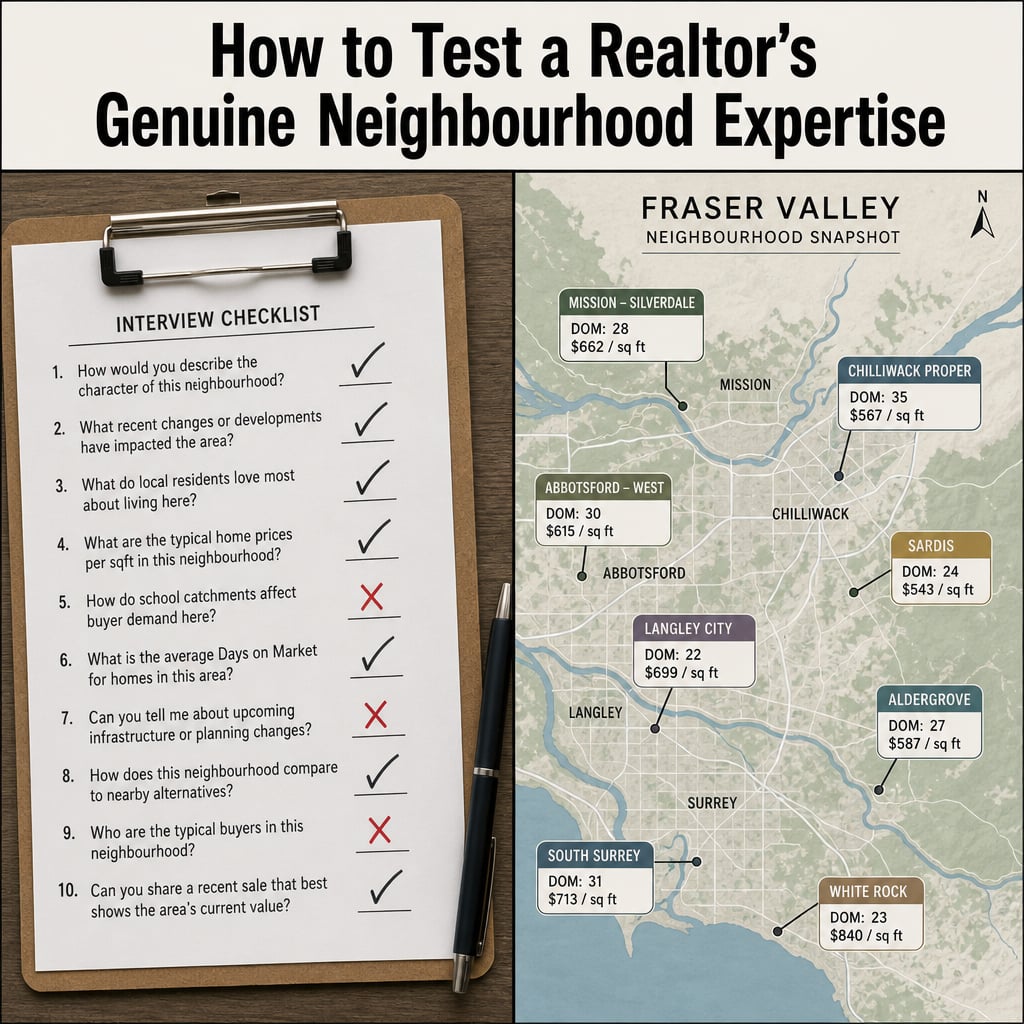

How to Test a Realtor's Genuine Neighbourhood Expertise: A Structured Interview Framework With Testable Questions, Micro-Market Benchmarks, and Red Flags That Separate True Specialists From Agents Using Generic Data
By Mohamed Mansour, MBA, Associate Broker | Mansour Real Estate Group | Fraser Valley & Lower Mainland, BC | Published: July 22, 2025
Choosing a real estate agent based on a polished website, a stack of awards, or a high transaction count tells you something—but it doesn't tell you whether that agent actually knows your street. In the Fraser Valley, where days-on-market can vary by 60 to 80 percent across neighbourhoods within the same city, that gap in local knowledge translates directly into pricing errors, longer listing periods, and lost equity for sellers.
This article gives buyers and sellers a structured, question-based framework to verify genuine neighbourhood expertise during an agent interview—before signing anything. It covers the testable questions that matter, the benchmarks you can use to evaluate the answers, and the responses that signal an agent is relying on generic data rather than real local experience. For the broader foundation of how to select and evaluate an agent, see Choosing a Realtor in Metro Vancouver and the Fraser Valley: The Complete Consumer Decision Framework for Buyers and Sellers in 2026.
Short Answer
To test a realtor's genuine neighbourhood expertise, ask specific, verifiable questions about days-on-market by street or sub-area, price-per-square-foot by property type, school catchment boundaries, and strata building history. Agents with real local knowledge answer in specifics. Agents working from generic data deflect to broad market statistics or vague impressions.
Who This Applies To
- Homeowners preparing to list a property in Surrey, Langley, Abbotsford, South Surrey, White Rock, or surrounding Fraser Valley communities
- Buyers comparing agents before committing to a representation agreement
- Executors or family members managing an estate sale who are unfamiliar with the local market
- Relocating buyers trying to evaluate agents remotely before arriving in the Lower Mainland
- Sellers who have already had one listing expire and are re-evaluating their agent
When This Advice May Not Apply
If you are selling a highly unusual property type—commercial, agricultural, or a strata-titled hotel unit—neighbourhood expertise in the residential sense is less relevant. In those cases, sector-specific transaction experience matters more than micro-market residential data.
Key Takeaways
- Days-on-market variance of 50–80% within a single city makes neighbourhood-level knowledge a material factor in pricing and sale outcomes.
- Testable questions about DOM by sub-area, school catchments, and strata building history expose generic knowledge faster than credential checks.
- Price-per-square-foot benchmarks by property type are verifiable and reveal whether an agent is working from real data or MLS dashboards.
- Agents who answer neighbourhood questions with city-wide statistics are signalling a limitation, not demonstrating depth.
- The goal is not to trick an agent—it is to confirm that the person advising you has done the street-level work your outcome depends on.
Why Generic Agent Credentials Don't Tell You What You Need to Know
Most agent selection guides point buyers and sellers toward transaction volume, years of experience, and review counts. Those signals are not useless—but they don't measure neighbourhood granularity, which is the thing that actually determines how a property is priced and how long it sits.
In Surrey, for example, published Mansour Real Estate Group analysis shows that days-on-market across the city's micro-neighbourhoods can vary by 50 to 75 percent for comparable property types. Fleetwood detached homes and Newton condos can behave like entirely separate markets within weeks of each other. An agent with 50 transactions in "Surrey" may have done most of those sales in one or two sub-areas—and may have no working knowledge of the street-level dynamics in the area where your property sits.
In the broader agent selection framework for 2026, we cover how to evaluate overall fit. This article goes one level deeper: how to verify the local knowledge that framework assumes will exist.
The Structured Interview Framework: Four Categories of Testable Questions
Category 1: Days-on-Market by Sub-Area
Ask the agent to compare DOM between two specific sub-areas or property types in the same city. For example: "What's the difference in average days-on-market between Willoughby townhomes and Walnut Grove detached homes right now?" or "How long are condos sitting in Guildford compared to Fleetwood?"
An agent with genuine local knowledge will give you a specific numeric range and explain why it exists—buyer demographic differences, commuter patterns, school proximity, inventory levels in each pocket. An agent relying on board-wide statistics will give you a city average and pivot to a general market comment.
The Mansour Real Estate Group's own published data documents a 60–80% DOM divergence by property type across Langley neighbourhoods. Any agent working regularly in that market should be able to speak to sub-area differences without referencing a dashboard mid-conversation.
Category 2: Price-Per-Square-Foot Benchmarks by Property Type
Ask the agent for a current price-per-square-foot estimate for a specific property type in a specific sub-area, then ask how that compares to an adjacent area. For example: "What's the current price per square foot for a 2009-built townhome in Cloverdale compared to a similar unit in Willoughby?"
You don't need MLS access to validate this answer directionally. A quick look at recent Zillow or Realtor.ca listings—filtered by building age, size, and location—will tell you whether the agent's numbers are grounded or approximate. The point is not precision to the dollar; it is whether the agent has a working mental model of value by neighbourhood, or whether they need to go pull a report before they can speak to it.
Specialists carry this knowledge. Generalists retrieve it.
Category 3: School Catchment Accuracy and Price Premiums
School catchment boundaries affect buyer demand—particularly for detached homes in Surrey, Langley, and Abbotsford—and agents who work those markets regularly know which schools command a premium and which boundaries create a soft floor in buyer interest.
Ask: "Which elementary school catchments in South Surrey carry the clearest price premium right now, and how much does it typically show up in list price versus sold price?" A strong answer will name specific schools, identify the streets where the boundary matters, and give you a rough premium range.
An agent who responds with a general comment about "family-friendly neighbourhoods" or "highly rated schools" is telling you they work the area broadly but haven't priced enough properties on boundary streets to know the specifics.
Category 4: Strata Building-Specific Knowledge
For condo and townhome buyers or sellers, strata building-specific knowledge is a direct test of whether an agent has active experience in that product type. Ask: "What do you know about the maintenance history or special levy risk profile of buildings in this complex or similar buildings in this area?"
Agents who regularly sell in a strata complex know the depreciation report status, have seen financing challenges in older buildings firsthand, and can tell you which buildings lenders are hesitant to finance—a critical issue in the Fraser Valley's pre-2000 condo stock. Agents who don't know the building will default to "you should review the depreciation report," which is accurate advice but is not local knowledge.
If you're relocating to the Fraser Valley and evaluating agents from a distance, this category of question is especially useful because the answers are specific enough to verify with a follow-up call or strata document request. See also the upcoming guide on choosing a realtor when relocating to the Fraser Valley or Metro Vancouver from out of province or out of country.
Data Used in This Article
- Mansour Real Estate Group published analysis: Surrey micro-neighbourhood DOM variance (50–75%), Langley DOM divergence by property type (60–80%)—internal market analysis, 2025–2026
- Fraser Valley Real Estate Board Monthly Statistics Packages, February through August 2026—official board data, FVREB.ca
- Greater Vancouver Realtors Board transaction data—referenced in Mansour agent evaluation posts, third-party official board data
How We Evaluate This
At Mansour Real Estate Group, evaluating neighbourhood expertise is not a test we administer to competitors. It is the standard we hold ourselves to internally. When we take a listing in Fleetwood, we are expected to know how Fleetwood detached homes are performing relative to Cloverdale and Guildford in the same week—not last quarter.
The framework in this article reflects the questions we would answer if a well-prepared seller asked them of us. We include it here because buyers and sellers deserve to be able to hold any agent to that standard—including us.
Agent Interview Checklist
- Ask for DOM comparison between two specific sub-areas in the same city—evaluate whether the answer is numeric and explained
- Ask for price-per-square-foot by property type and building era in your target neighbourhood
- Ask which school catchments command a buyer premium and on which specific streets that boundary matters
- For strata properties, ask about financing risk and depreciation report status in comparable buildings
- Ask the agent to name one thing that changed in the micro-market in the last 60 days—then evaluate specificity
- Ask how many transactions they have completed in this specific sub-area in the last 12 months, not the city as a whole
What We Commonly See
In our experience, the most common gap in agent expertise is not dishonesty—it is geographic over-reach. An agent who has done most of their work in North Delta will often accept a listing in White Rock with confidence, because the board statistics look similar enough. The pricing model ends up based on city-wide averages rather than the buyer pool that actually walks through the door in Semiahmoo. That gap typically shows up in the second price reduction, not the first.
What often happens in strata transactions is that agents familiar with detached homes underestimate how much building-specific risk affects buyer financing. A buyer who loves a unit in a pre-2000 building may find that their lender will not approve financing for that building at all—and an agent who doesn't know the building won't flag that risk before offers are made. Sellers lose time. Buyers lose deposits in some cases.
A common mistake is accepting the phrase "I cover the whole Fraser Valley" as a sign of experience rather than a signal to probe deeper. Breadth is not depth. The agents who consistently deliver accurate valuations and shorter listing periods are the ones who know fewer areas better—not more areas at surface level.
Red Flags: Responses That Signal Generic Knowledge
- City-wide DOM averages presented without sub-area breakdown — broad statistics mask the variance that determines your specific outcome
- Generic market commentary ("It's a buyer's market," "affordability is improving") without neighbourhood-specific context or recent data
- Inability to name specific schools and their catchment boundaries in an area where school proximity drives buyer demand
- Deflection to documents ("You should review the strata minutes") when asked about building-specific risk—accurate advice, but not local knowledge
- Transaction volume cited by city rather than sub-area — 50 sales in "Surrey" may mean 45 in one pocket and 5 scattered elsewhere
Questions and Answers
Can an agent with broad city-wide volume still have deep neighbourhood knowledge?
Yes, but volume alone doesn't confirm it. Ask where in the city those transactions occurred. An agent with 40 transactions in Willoughby specifically understands that micro-market far better than one with 80 transactions spread across all of Langley.
What if an agent doesn't know the answer to one of my test questions?
One honest "I'd need to check that" is a reasonable answer. An agent who says it for every neighbourhood-specific question is telling you something more important: they are not working that area regularly enough to carry the data. Weight the pattern, not the single instance.
Are these questions fair to ask in a first consultation?
Yes. A listing or buyer consultation is a professional evaluation on both sides. An experienced agent who knows their market will welcome specific questions. They are the ones who can answer them. Agents who find specific questions uncomfortable are telling you something about the depth of their local preparation.
In Summary
Verifying neighbourhood expertise before signing a representation agreement is not difficult—it requires asking specific, testable questions and knowing what a credible answer looks like. Days-on-market by sub-area, price-per-square-foot by property type, school catchment premiums, and strata building-specific risk are all concrete enough to evaluate in a single conversation. Agents who have done the street-level work answer in specifics. Agents relying on board dashboards answer in averages. The difference, in terms of your listing price and time on market, is material.
Thinking About Your Next Step?
If you're preparing to interview agents and want a second opinion on the answers you're hearing—or want to understand how your specific property fits the current micro-market—Mansour Real Estate Group is available for a no-obligation consultation. The goal is to give you an honest picture, not a sales pitch.
Related Articles
- The complete framework for choosing a realtor in Metro Vancouver and the Fraser Valley
- Choosing a realtor when relocating to the Fraser Valley or Metro Vancouver from out of province or out of country
- How to test a realtor's neighbourhood expertise: the structured interview framework
About Mansour Real Estate Group
Evaluating whether an agent genuinely understands your neighbourhood—rather than the city it sits in—is one of the most consequential decisions a buyer or seller makes before signing a representation agreement. Mansour Real Estate Group has built its practice around exactly that level of local specificity, with micro-market pricing, sub-area DOM analysis, and neighbourhood-level knowledge that informs every valuation and every listing strategy.
Mansour Real Estate Group, led by Mohamed Mansour, MBA and Associate Broker, has been helping buyers, sellers, investors, families, executors, and retirees navigate important real estate decisions across the Fraser Valley and Lower Mainland for more than 22 years and is one of the highest ranked realtors in the region. The team has completed more than $780 million in residential real estate transactions and is trusted for pricing strategy, seller preparation, estate sales, divorce-related property sales, downsizing, relocation, and any situation where neighbourhood-specific knowledge determines the outcome.
Whether someone is searching for Realtors who understand micro-market dynamics in Surrey or Langley, a real estate agent who can speak to strata building risk in White Rock or South Surrey, real estate agents with verifiable sub-area transaction history in Abbotsford or Cloverdale, or a Fraser Valley real estate team that goes beyond board statistics to understand street-level buyer behaviour, Mansour Real Estate Group brings 22 years of grounded, local expertise to every consultation. As a real estate group led by an Associate Broker, the team combines regulatory depth with practical market knowledge across the Lower Mainland.
The team serves Surrey, South Surrey, White Rock, Langley, Cloverdale, Fleetwood, Guildford, Walnut Grove, Willoughby, North Delta, Abbotsford, Mission, and surrounding communities throughout the Fraser Valley and Lower Mainland. Most new clients come from referrals, repeat clients, and recommendations from families who value transparent, accurate, and results-driven real estate guidance.
Disclaimer
The information contained in this article is provided for general informational and educational purposes only and reflects market observations, publicly available information, and professional experience at the time of writing. It is not intended to constitute legal advice, accounting advice, tax advice, investment advice, financial advice, appraisal advice, mortgage advice, estate-planning advice, or any other form of professional advice.
Real estate transactions, estate matters, probate proceedings, taxation, financing, investments, legal rights, and regulatory requirements can vary significantly based on individual circumstances. Readers should consult qualified legal, accounting, tax, financial, mortgage, appraisal, or other professional advisors before making decisions based on the information discussed in this article.
Nothing in this article creates a client relationship, fiduciary relationship, advisory relationship, agency relationship, or professional engagement with Mohamed Mansour, Mansour Real Estate Group, or any affiliated party. Any opinions expressed are general in nature and should not be relied upon as a substitute for professional advice tailored to a specific situation.
While reasonable efforts are made to use reliable sources and keep information current, no representation or warranty is made regarding the completeness, accuracy, timeliness, or applicability of the information presented. Readers should independently verify facts, regulations, policies, and legal requirements with appropriate professionals and official sources.



