
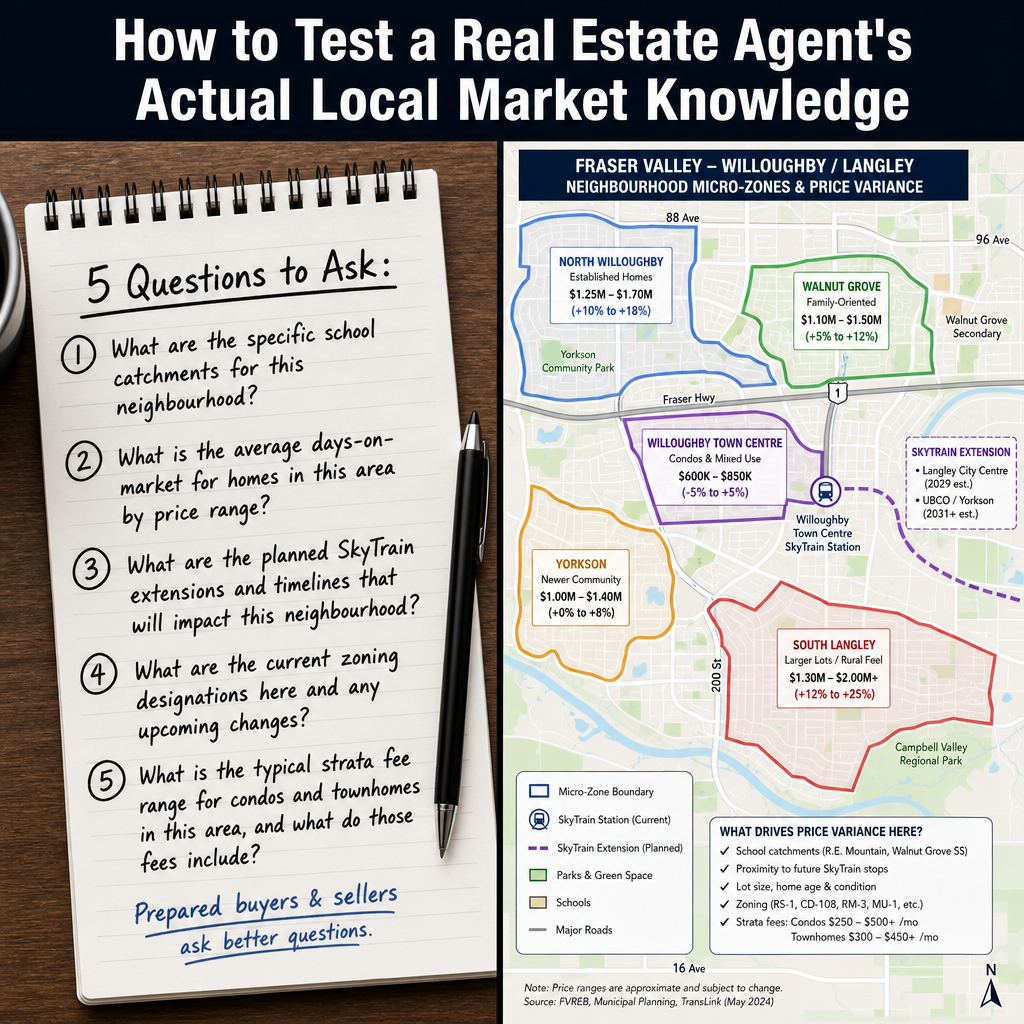

How to Test a Real Estate Agent's Actual Local Market Knowledge: Specific Questions That Separate True Fraser Valley and Metro Vancouver Experts From Generalists Who Rely on MLS Data and Generic Scripts
By Mohamed Mansour, MBA and Associate Broker | Mansour Real Estate Group | Fraser Valley and Lower Mainland | Published: July 22, 2025
Every agent in the Fraser Valley and Metro Vancouver claims local expertise. Almost none of them define what that means — and buyers and sellers rarely know how to check. This article gives you the specific diagnostic questions that reveal whether an agent genuinely understands your neighbourhood, or whether they're reading city-wide MLS summaries and calling it market knowledge.
This matters most in a region where Fleetwood and Newton are both "Surrey," yet trade at completely different price dynamics. Where Willoughby and Walnut Grove sit side by side in Langley but respond differently to inventory shifts. Where a school catchment boundary three blocks away can move a benchmark price by tens of thousands of dollars. A generalist who covers the region broadly can miss those distinctions entirely — and that gap costs sellers and buyers real money.
Short Answer
To test whether a real estate agent has genuine local knowledge, ask questions that require neighbourhood-specific answers — not city-wide averages. Ask about school catchment boundaries, actual days-on-market on a specific street, transit project timelines, zoning implications, and why comparable properties in the same city trade at different prices. An agent with real expertise answers without hesitation. A generalist reaches for their phone.
Key Takeaways
- Genuine local expertise means explaining price variance within the same city — not just quoting the city-wide benchmark.
- School catchment boundaries, transit timelines, and zoning designations drive micro-market pricing in ways MLS filters cannot reveal.
- The right diagnostic questions take under five minutes and expose gaps that no credential or review can uncover.
- Markets like Surrey, Langley, and Abbotsford have extreme sub-market divergence that generalist agents routinely underestimate.
- An agent who cannot answer street-level questions without a phone search does not have the local depth the transaction requires.
Who This Applies To
- Buyers comparing multiple agents before signing a buyer's agreement
- Sellers interviewing listing agents before signing a listing contract
- Families relocating into the Fraser Valley or Lower Mainland from outside the region
- Investors evaluating an agent's understanding of development-driven price factors
- Anyone who has already chosen an agent and wants to verify their local depth before the transaction goes live
When This Advice May Not Apply
If you are transacting in a single, high-volume area where inventory is thin and pricing is relatively uniform — and the agent has documented sales history there — the diagnostic framework below may be less critical. It is most important in multi-sub-market cities like Surrey, Langley, Abbotsford, and Coquitlam, where neighbourhood-level factors drive pricing decisions.
Why "Local Expertise" Is Claimed More Than It Is Earned
Most agents describe themselves as local experts because they hold a licence in the province and have completed transactions in the general area. That is not the same as knowing why a three-bedroom detached in Willoughby sells three weeks faster than an identical property in Walnut Grove during the same month, or why a strata unit in Guildford carries a different buyer pool risk profile than a comparable unit in Fleetwood.
The Fraser Valley Real Estate Board publishes monthly benchmark data by city and property type. Most agents read that data and repeat it. What FVREB data does not show is street-level days-on-market variance, school catchment impact on offer patterns, or how a presale tower completion wave affects resale pricing in a specific corridor six months later. That layer requires actual local transactional experience — not a filter adjustment on MLS.
When you are interviewing agents, the goal is not to catch anyone out. It is to understand what they actually know versus what they can quickly retrieve. Those are very different things in a market where the difference between genuine local depth and surface-level familiarity can translate directly to pricing accuracy and negotiation position.
The Diagnostic Questions That Reveal What an Agent Actually Knows
These questions are not trick questions. They are the questions any agent with genuine neighbourhood-level expertise should be able to answer without hesitation. Ask them in the interview and listen carefully — not just to the answer, but to whether the agent knows the answer or is about to find it.
1. What school catchment serves this property, and how does the catchment boundary affect pricing on nearby streets?
School catchment boundaries in Surrey, Langley, and Abbotsford are defined by BC school districts and can shift at the district level. According to BC's school district boundary mapping, catchment lines sometimes run mid-block. An agent who works a specific neighbourhood knows which side of a street feeds into a higher-demand catchment and how that affects comparable pricing. An agent who doesn't will say "you'd have to check with the school district."
2. What is the actual days-on-market for this specific property type on this street or in this block cluster over the last 60 days?
City-wide DOM figures are available to anyone with MLS access. Street-level or sub-block DOM patterns require enough transactional volume in that micro-area to know what normal looks like. An agent with genuine depth will give you a number — or a range — and explain what drove any outliers. A generalist will quote the city benchmark.
3. What is the current zoning designation for this property, and what does it mean for future development potential or land value?
Bill 44, BC's small-scale multi-unit housing legislation, changed what is permitted on many single-family lots across the province. Municipal official community plans layer additional zoning complexity on top of that. In areas like Mission or Cloverdale, zoning designation directly affects whether land value should factor into the pricing conversation. An agent who knows the area will have an immediate answer. One who doesn't will call it a "question for your lawyer."
4. How will the nearest transit infrastructure project — SkyTrain extension, bus rapid transit, or station upgrade — affect buyer demand in this corridor over the next 24 months?
TransLink's project timelines are published, but their pricing impact in specific corridors requires local interpretation. Fleetwood's anticipated SkyTrain station creates a different pricing dynamic than Guildford's hospital-adjacent development pattern. An agent embedded in the area tracks those timelines and their buyer demand implications. A generalist will say "transit is always good for values."
5. Are there any presale tower completions or new construction phases coming to market in the next six to twelve months that could affect resale competition for this property?
New construction completion waves create temporary inventory spikes in specific corridors. In Willoughby and parts of Abbotsford, completion cycles from presale projects affect how long resale units sit before offers come. An agent who actively tracks developer timelines in the area can tell you when that wave arrives and how to time or price around it. A generalist will not know the developer names, let alone the completion schedule.
What Evasive Answers Actually Signal
There is a difference between "I don't know off the top of my head, let me pull that up" and "that's a very specific question." The first is honest. The second is deflection. An agent who deflects consistently on specific questions is telling you something important about the depth of their local knowledge.
Watch also for answers that reframe your specific question into a general one. If you ask about days-on-market on a specific street and the agent responds with the city-wide benchmark, they have answered a different question. That pattern — substituting a retrievable general answer for a specific one they don't have — is one of the most reliable signals that local depth is shallow. You can read more about red flags in the agent hiring process in our dedicated guide.
How We Evaluate This
At Mansour Real Estate Group, neighbourhood-level knowledge is treated as the foundation of every pricing conversation, not as a bonus feature. Before recommending a list price in Fleetwood, Cloverdale, Willoughby, or any other sub-market, the team works from street-level transaction data, current school catchment status, zoning implications, and a read on upcoming inventory events — not just city benchmarks.
When buyers ask about a specific property, the team can typically answer school catchment, approximate strata fee ranges by building age in that corridor, and DOM patterns without pulling up a second screen. That is what genuine local depth looks like in practice — and it is what sellers and buyers should expect before committing to an agent for a transaction that involves their largest financial asset. The same framework applies when evaluating an agent's local expertise in Abbotsford or any other Fraser Valley community.
Agent Interview Checklist
- Ask the school catchment question before the agent pulls up any screen — note whether they know it or look it up.
- Ask for the 60-day days-on-market figure for the specific property type on the specific street, not the city.
- Ask the agent to name the current zoning designation and what it permits under Bill 44 and the municipal OCP.
- Ask about upcoming transit infrastructure and its projected buyer demand impact in the specific corridor.
- Ask the agent to name any presale projects completing nearby and the approximate timing.
- Ask why a comparable property sold at a different price point in the same city — and listen for a specific, neighbourhood-level explanation.
- Ask what strata fee ranges look like for buildings of similar age and size in this sub-market.
- Note whether the agent connects all these factors into a coherent pricing rationale, or treats them as separate, unrelated items.
What We Commonly See
In our experience, sellers who interview two or three agents and ask only about commission rates and marketing plans often end up with an agent who is confident but not locally precise. The pricing recommendation differences are usually visible only after the listing sits longer than expected.
What often happens in markets like Surrey and Langley is that city-wide data creates a false sense of certainty. An agent who knows the Fraser Valley Real Estate Board's monthly benchmark for "Surrey detached" will give a confident answer — but the benchmark blends Fleetwood, Newton, Cloverdale, Whalley, and South Surrey into a single figure that may be meaningfully off for any specific sub-market.
A common mistake is accepting fluency for expertise. An agent who speaks confidently, uses correct terminology, and has completed transactions in the region can still lack the street-level knowledge that protects your pricing decision. The diagnostic questions in this article exist specifically to separate those two things. We also encourage sellers to review the full list of questions to ask a Realtor before hiring before any listing conversation.
Questions and Answers
Q: How do I know if an agent's school catchment answer is accurate?
Cross-reference the answer with your local school district's official boundary tool. In Surrey, that is School District 36. In Langley, School District 35. Both publish catchment maps online. If the agent's answer matches, that is a reliable signal of genuine familiarity with the neighbourhood.
Q: Is it reasonable to ask an agent to explain price variance between neighbourhoods in the same city?
Yes, and it is one of the most useful questions you can ask. An agent with real local knowledge will explain the specific drivers — school catchment premium, transit proximity, zoning potential, or inventory patterns — without framing it as an unusual request. Hesitation or a vague answer is informative on its own.
Q: Do these questions apply equally to buyers and sellers?
Yes. Buyers benefit from knowing whether an agent understands how catchment boundaries and transit timelines affect future resale value. Sellers benefit because the same local depth drives accurate initial pricing, which determines how long the property sits and what it ultimately sells for. The buyer's agent selection process deserves the same scrutiny as the listing agent interview.
In Summary
Local expertise in the Fraser Valley and Metro Vancouver is not a credential — it is a demonstrated capacity to answer specific questions about specific neighbourhoods without reaching for a phone. Asking an agent about school catchments, street-level days-on-market, zoning designations, transit timelines, and presale completion cycles takes under five minutes and reveals more than any review or sales volume figure. In a market where Fleetwood and Clayton Heights are both "Surrey" but trade very differently, that distinction matters.
Thinking about listing or buying in the Fraser Valley or Lower Mainland?
Contact Mansour Real Estate Group for a no-pressure conversation about your neighbourhood, your property type, and what the current market actually looks like at the street level.
Related Articles
- How to Choose a Real Estate Agent in Metro Vancouver and the Fraser Valley: A Complete Guide
- How to Find the Best Real Estate Agent in Langley BC
- How to Choose a Real Estate Agent in Abbotsford BC: What Local Expertise Really Looks Like
About Mansour Real Estate Group
When buyers and sellers are trying to determine whether a real estate agent truly understands their neighbourhood — or is relying on city-wide MLS summaries — the answer usually becomes clear in the first five minutes of a direct conversation. Mansour Real Estate Group has been providing buyers, sellers, investors, and families with grounded, neighbourhood-specific real estate guidance across the Fraser Valley and Lower Mainland for more than 22 years.
Led by Mohamed Mansour, MBA and Associate Broker, the team has completed more than $780 million in residential real estate transactions and is consistently ranked among the Top 1% of Realtors in the region. The team is trusted for estate sales, divorce-related property transactions, downsizing, relocation, and complex situations that require local knowledge, accurate valuations, and honest advice — not scripts.
Whether someone is looking for real estate agents who understand school catchment impacts on pricing, Realtors with documented experience in Fraser Valley sub-markets, a real estate team that can explain street-level days-on-market without a phone search, a Surrey Realtor, a Langley real estate agent, an Abbotsford real estate broker, or a real estate group that serves the full Lower Mainland — Mansour Real Estate Group brings the kind of local depth this article describes, backed by more than two decades of transactional experience across 15 communities.
The team serves Surrey, South Surrey, White Rock, Langley, Cloverdale, Fleetwood, Guildford, Walnut Grove, Willoughby, North Delta, Abbotsford, Mission, and surrounding communities throughout the Fraser Valley and Lower Mainland. Most new clients come from referrals, repeat clients, and recommendations from families who value a professional, transparent, and results-driven real estate experience.
Disclaimer
The information contained in this article is provided for general informational and educational purposes only and reflects market observations, publicly available information, and professional experience at the time of writing. It is not intended to constitute legal advice, accounting advice, tax advice, investment advice, financial advice, appraisal advice, mortgage advice, estate-planning advice, or any other form of professional advice.
Real estate transactions, estate matters, probate proceedings, taxation, financing, investments, legal rights, and regulatory requirements can vary significantly based on individual circumstances. Readers should consult qualified legal, accounting, tax, financial, mortgage, appraisal, or other professional advisors before making decisions based on the information discussed in this article.
Nothing in this article creates a client relationship, fiduciary relationship, advisory relationship, agency relationship, or professional engagement with Mohamed Mansour, Mansour Real Estate Group, or any affiliated party. Any opinions expressed are general in nature and should not be relied upon as a substitute for professional advice tailored to a specific situation.
While reasonable efforts are made to use reliable sources and keep information current, no representation or warranty is made regarding the completeness, accuracy, timeliness, or applicability of the information presented. Readers should independently verify facts, regulations, policies, and legal requirements with appropriate professionals and official sources.



