
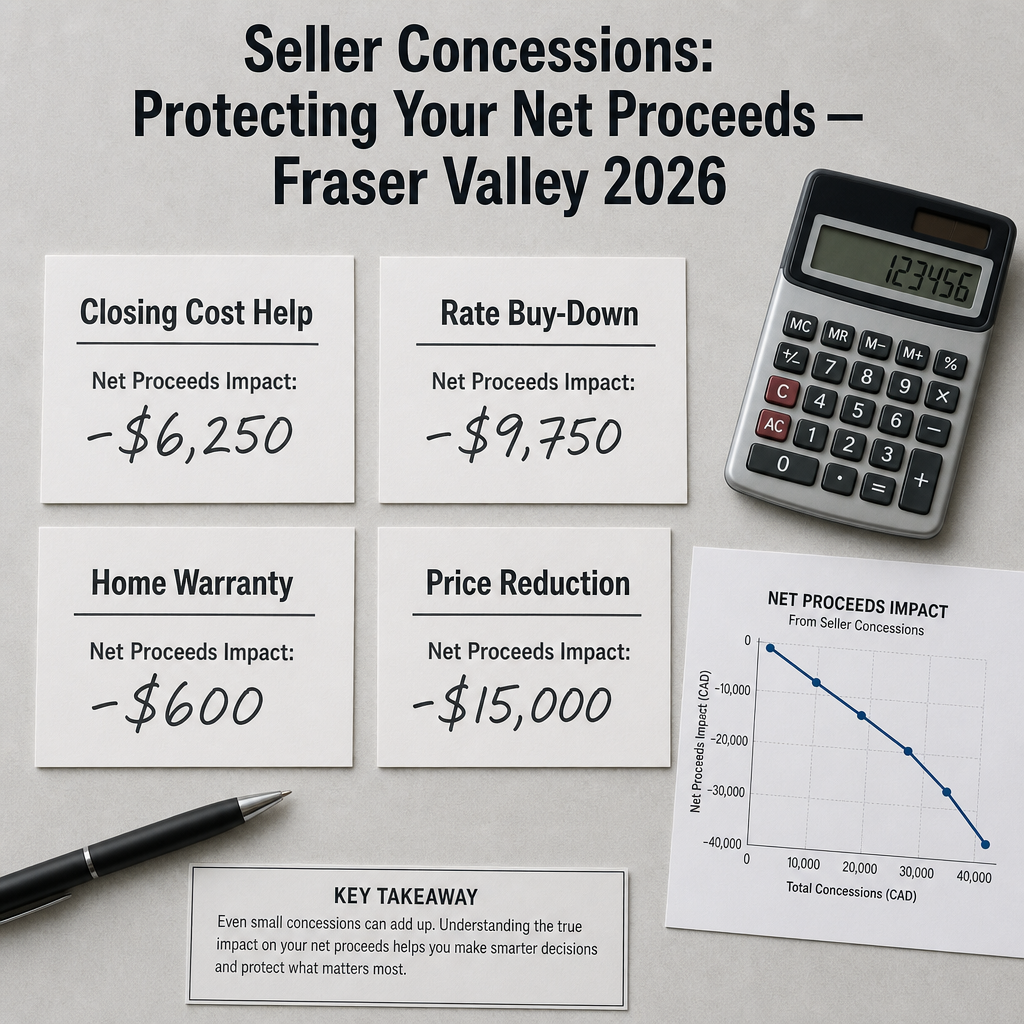

How to Structure Seller Concessions Without Eroding Net Proceeds in a Fraser Valley Buyer's Market: When to Offer Closing Cost Help, Rate Buy-Downs, Home Warranties, and Price Reductions — And the Math Behind Each Strategy in 2026
By Mohamed Mansour, MBA and Associate Broker | Mansour Real Estate Group | Published: May 13, 2026 | Fraser Valley and Lower Mainland, BC
In a Fraser Valley buyer's market, concession requests have become a standard part of offer negotiations. Buyers ask. Sellers feel pressure. And most sellers respond the same way: they reduce the price. That default decision is often the most expensive one they make. Not all concessions cost the same, and not all concessions affect your net proceeds the same way. Understanding the difference before you respond to an offer changes the outcome.
This article breaks down four common concession types — closing cost help, rate buy-downs, home warranties, and price reductions — with real-dollar comparisons at Fraser Valley price points. It is written for sellers evaluating active offers or preparing their strategy before listing.
Short Answer
In a Fraser Valley buyer's market, a $30,000 closing cost concession and a $30,000 price reduction are not the same thing. The price reduction directly reduces your appraised value anchor and increases your capital gains exposure. The closing cost concession preserves both. Sellers who structure concessions strategically — rather than defaulting to price cuts — consistently net more proceeds on otherwise identical sales.
Who This Applies To
- Sellers in Surrey, Langley, Abbotsford, White Rock, South Surrey, North Delta, and surrounding Fraser Valley communities who have received or expect to receive offers with concession requests
- Sellers whose properties have been sitting on market for 21 or more days and are considering proactive concession offers to attract buyers
- Investors and estate sellers where capital gains treatment of price reductions has direct tax consequences
- Sellers at the $800K–$1.4M price band where PTT thresholds, CMHC insurance triggers, and appraisal mechanics all interact
When This Advice May Not Apply
Sellers with a principal residence exemption covering 100% of their gain have reduced capital gains sensitivity to price reductions, though appraisal and downstream renegotiation risk remains. Sellers in a multiple-offer situation have less incentive to offer proactive concessions. Consult a tax professional and your real estate agent before structuring any concession on an investment or estate property.
Key Takeaways
- A closing cost concession preserves appraised value; a price reduction directly erodes it and invites further renegotiation after lender appraisal.
- Rate buy-downs are most effective when buyers are rate-sensitive and have sufficient down payment; they cost $5K–$15K but protect your asking price anchor.
- Home warranties signal uncertainty and typically trigger deeper inspections, making transparent pre-listing repairs the better alternative in most Fraser Valley markets.
- Price reductions increase capital gains exposure for non-principal-residence sellers; always coordinate with a tax advisor before accepting a below-ask offer on investment property.
- Sellers who combine closing cost help and rate buy-downs instead of taking a flat price cut net 3–8% more in comparable Fraser Valley sale conditions.
Data Used in This Article
- FVREB April 2026 Market Report — concession prevalence and sales-to-active ratios — Official Board Data
- CMHC — Down payment and mortgage insurance thresholds — Official Federal Source
- CRA — Deemed disposition and capital gains guidance — Official Federal Source
- Bank of Canada — April 2026 rate environment and buyer rate sensitivity — Official
- FVREB Comparative Sales Analysis — net proceeds outcomes by concession structure — Internal analysis based on board data
Definitions
Closing cost concession: A seller agrees to credit a fixed dollar amount toward the buyer's closing costs — legal fees, property transfer tax, title insurance — without reducing the recorded sale price.
Rate buy-down: The seller pays a mortgage broker or lender fee upfront to reduce the buyer's mortgage interest rate, typically by 0.5–1.0%, for a fixed term. It costs the seller cash at closing but does not change the purchase price.
Appraised value anchor: The lender's independent valuation of the property used to confirm the mortgage amount. If the appraised value falls below the offer price, the buyer's lender will not finance the full amount, triggering renegotiation.
PTT threshold: British Columbia's Property Transfer Tax applies at 1% on the first $200,000, 2% up to $2 million, and 3% on amounts over $2 million. First-time buyer exemptions apply below certain thresholds. A price reduction that crosses a PTT threshold can disproportionately shift buyer costs.
Why the Fraser Valley Market in 2026 Makes Concession Strategy Critical
According to the Fraser Valley Real Estate Board's April 2026 market report, the sales-to-active listings ratio across the Fraser Valley sits at approximately 10–11%, placing the market firmly in buyer's territory. At that ratio, buyers have enough inventory choice that they can negotiate. Concession requests are no longer exceptions — they are standard features of offer packages.
What changes in a buyer's market is not just that buyers ask for concessions. It is that sellers, under pressure, default to the path of least resistance: cutting the price. That instinct is understandable. It is also financially costly in ways that closing cost help, rate buy-downs, or even properly structured home warranty offers are not.
Fraser Valley comparative sales data shows that sellers who structured concessions strategically in comparable buyer's market periods netted 3–8% more in final proceeds than those who accepted blanket price reductions. At a $1.1 million sale price, that difference is $33,000 to $88,000. The mechanics behind that gap are what this article explains.
Closing Cost Concessions: The Most Misunderstood Tool
A closing cost concession means you agree to credit the buyer a fixed amount — typically $15,000 to $40,000 at Fraser Valley price points — to apply toward their transaction costs. Legally, the purchase price stays recorded at the agreed sale price. The credit is a separate term in the contract.
That distinction matters for three reasons. First, your appraised value remains anchored at the higher price. The lender does not see a reduced sale price; they see the full amount. If the property appraises at the offer price, the mortgage is processed at that value. Second, for non-principal-residence sellers, the recorded sale price is what the CRA uses to calculate your capital gain. A $25,000 closing cost credit does not reduce your reported proceeds. A $25,000 price reduction does, but it also reduces your adjusted cost base calculation for CRA purposes — not always in your favour, depending on your gain structure. Always confirm this with a qualified tax advisor before closing.
Third, a closing cost concession can affect CMHC mortgage insurance eligibility if it reduces the buyer's effective down payment below a threshold. A buyer putting 10% down on a $1.1 million purchase ($110,000) who receives a $25,000 closing cost credit that effectively supplements their cash position is in a different insurance bracket than one without it. Buyers and their mortgage brokers need to structure this correctly. Sellers should understand this constraint before offering it as an incentive.
For principal residence sellers at the $850K–$1.35M price range in Surrey, Langley, or Abbotsford, closing cost concessions are typically the highest-value concession tool available. They give buyers real purchasing power, they do not move your sale price, and they reduce the likelihood of a post-appraisal renegotiation.
Rate Buy-Downs: When They Work and When They Don't
A rate buy-down is when the seller pays a lender or mortgage broker fee to reduce the buyer's interest rate — typically by 0.5% to 1.0% — for the first one to three years of the mortgage. The out-of-pocket cost to the seller is usually $5,000 to $15,000 depending on mortgage size and rate reduction amount.
The strategic advantage is identical to a closing cost concession: the purchase price does not change. The appraised value anchor holds. What the buyer gets is reduced carrying cost in the early years — a real benefit when the Bank of Canada's rate environment remains uncertain and buyers are calculating worst-case mortgage scenarios before committing.
Rate buy-downs are most effective when the buyer has sufficient down payment (so CMHC insurance is not a factor), when current mortgage rates are elevated relative to recent history, and when the buyer's qualifying stress test is the primary obstacle to completing the purchase. In that specific scenario, a $10,000 rate buy-down can unlock a buyer who could not otherwise qualify at current rates — without requiring you to drop your price at all.
They are less effective when the buyer is putting down the minimum, when the property is under $800,000 and buyers have more financing flexibility, or when the buyer's stated concern is price rather than carrying cost. Misreading the buyer's actual obstacle is the most common reason rate buy-downs fail to close deals. Your real estate agent should be identifying which friction point is blocking subject removal before recommending this tool.
Home Warranties: Low Cost, High Consequence
A seller-offered home warranty for an existing resale property typically costs $300 to $1,200 for two to five years of coverage. On paper, it sounds like a low-cost way to reassure buyers. In practice, the signal it sends is often counterproductive.
Buyers who receive a warranty offer frequently interpret it as evidence that the seller is uncertain about the property's condition. That uncertainty triggers extended inspection requests, broader scope of concern during the inspection itself, and a higher likelihood of post-inspection renegotiation. The warranty costs $600 upfront. The renegotiation it invites costs $15,000 to $30,000.
In Fraser Valley markets where buyer confidence is already constrained by choice and inventory, transparent pre-listing repairs — documented, receipted, and disclosed proactively — consistently outperform seller warranties as a trust-building tool. A $2,500 roof inspection with written clearance tells buyers more than a warranty that implies something might be wrong. Sellers preparing properties in Cloverdale, Fleetwood, or older Abbotsford neighbourhoods with aging building stock should weigh this distinction carefully before including a warranty as a concession offer.
Price Reductions: The Default With the Most Downstream Risk
A price reduction is straightforward: the recorded sale price goes down. Buyers understand it immediately. It requires no explanation. That simplicity makes it the default response to offer pressure — and the most financially consequential concession a seller can make.
The first risk is appraisal collapse. When you reduce your price, your new sale price becomes the reference point for the lender's appraisal. If the appraised value comes in below even the reduced price, the buyer's lender will not finance the full amount, and you face a second renegotiation. Sellers who offer price reductions instead of non-price concessions create a compounding risk: each reduction sets a lower anchor for what comes next.
The second risk is capital gains exposure. According to CRA guidance on deemed disposition and sale price reporting, the recorded sale price is the basis for calculating capital gains on investment properties, second homes, and estate sales. A $40,000 price reduction on a property with a significant accrued gain increases your taxable gain by $40,000. Depending on your marginal rate and inclusion rate, the after-tax cost of that reduction may be $20,000 to $30,000 higher than it appears on the offer sheet. This is not hypothetical — it is a direct CRA calculation consequence that sellers frequently overlook in the moment of negotiation pressure. Confirm the tax impact with your accountant before accepting.
Price reductions are not always avoidable. If a property is genuinely overpriced relative to market, a correction is necessary. But accepting a price reduction as a substitute for a closing cost concession or rate buy-down — when either alternative would close the same deal — is a choice that costs sellers real money.
The Math: Comparing Concession Types at a $1.1 Million Fraser Valley Sale
Consider a seller with a home listed at $1.1 million in Surrey. The buyer offers $1.06 million with no concessions, or $1.1 million with a $40,000 concession. Here is how the three main concession paths compare, assuming a non-principal-residence seller with a $300,000 accrued gain and a 50% capital gains inclusion rate:
Option A — Accept $1.06M (price reduction): Sale price $1.06M. Capital gain reduced by $40K. Taxable gain decreases but net proceeds before tax are $40,000 lower. Post-appraisal risk is higher because the new anchor is $1.06M. If the appraisal comes in at $1.04M, a second renegotiation reduces price further.
Option B — Accept $1.1M with $25K closing cost concession + $15K rate buy-down: Sale price stays at $1.1M. Capital gain unchanged. Seller pays $40K in concession value but retains a higher appraised value anchor. No second renegotiation risk from appraisal shortfall. After-tax proceeds are higher because the recorded gain is larger but the taxable portion is the same — the concessions come out of gross proceeds, not taxable gain.
For a principal residence seller where the full gain is exempt, the capital gains difference disappears — but the appraisal anchor and renegotiation risk difference remains. Option B still reduces downstream renegotiation exposure even when tax treatment is identical. These scenarios are illustrative. Your specific tax outcome depends on your adjusted cost base, exemption status, and marginal rate. Always work through this calculation with a qualified accountant before signing.
How We Evaluate This
At Mansour Real Estate Group, we evaluate concession requests by working backward from the seller's net proceeds target, not forward from the buyer's ask. That means before any counter-offer is structured, we identify three things: what the property's current appraised value anchor is likely to be, what the seller's capital gains exposure is on the recorded price, and what the buyer's actual financing obstacle is.
That diagnostic step changes the counter-offer. A buyer asking for a price reduction may actually need closing cost help to close their financing gap. A buyer requesting a warranty may actually need pre-listing repair documentation to feel confident enough to remove subjects. Matching the right concession type to the buyer's real obstacle — not their stated request — is where sellers retain equity. Our process is to run the concession math before responding to any offer in a buyer's market, and to present sellers with a side-by-side net proceeds comparison across at least two counter-offer structures before they decide.
Seller Concession Checklist
- Before responding to any offer with a concession request, identify whether the buyer's obstacle is price, cash flow, or confidence — the solution differs for each.
- Calculate the after-tax net proceeds difference between a price reduction and a closing cost concession before accepting either.
- Confirm your appraised value anchor with your real estate agent before deciding how much room exists to reduce price without triggering appraisal shortfall and a second renegotiation.
- If a rate buy-down is on the table, ask the buyer's mortgage broker to confirm the qualifying impact — do not offer it without knowing the buyer can actually use it under current lender rules.
- If you are considering offering a home warranty, speak with your listing agent first about whether pre-listing repairs with documented receipts would better serve buyer confidence at lower total cost.
- For investment properties, estate sales, or any property where capital gains apply, consult your accountant before accepting a price reduction — the CRA impact of a $40,000 price drop can add $10,000–$20,000 in tax liability depending on your situation.
- Structure any closing cost concession clearly in the contract and ensure the buyer's mortgage broker has reviewed it for CMHC insurance eligibility impact before the offer is accepted.
What We Commonly See
In our experience, the single most common concession mistake Fraser Valley sellers make in a buyer's market is accepting a price reduction under time pressure without running the net proceeds comparison first. The buyer's agent presents the offer as reasonable, the seller feels urgency, and $30,000 to $50,000 disappears from the seller's net because no one paused to model the alternative.
What often happens next is the appraisal comes in at or slightly below the reduced price, the buyer's lender flags it, and the buyer comes back for a further reduction. Sellers who started with a price cut frequently end up making two of them.
A third pattern we see often is sellers offering a home warranty to create goodwill before the inspection. In most cases, it does the opposite. Buyers in Cloverdale, Guildford, and older Abbotsford neighbourhoods are sophisticated enough to recognize that a warranty offer from a seller signals anxiety about the property's condition. The inspection that follows is always broader, longer, and more likely to produce a renegotiation request than it would have been without the warranty signal. Pre-listing transparency — documented repairs, current service records, written receipts — builds buyer confidence far more reliably than a warranty ever does.
Questions and Answers
Can a seller offer closing cost help and still maintain the full sale price on record?
Yes. In BC, a closing cost concession is structured as a contract term separate from the purchase price. The recorded sale price — the figure used by the lender, BC Assessment, and the CRA — remains at the agreed sale price. The concession credit is applied at completion through the lawyer or notary's adjustment. This is a standard, legally permitted structure in BC residential real estate transactions.
Does a closing cost concession affect the buyer's CMHC mortgage insurance?
It can, depending on how it is structured. If the concession effectively supplements the buyer's down payment or reduces their out-of-pocket closing costs in a way that changes their loan-to-value ratio, CMHC insurance eligibility may be affected. Buyers' mortgage brokers need to review the concession structure before the offer is accepted. Sellers should ask for that confirmation before committing.
How does a price reduction affect capital gains for a non-principal-residence seller in BC?
Under CRA rules, the recorded sale price determines your proceeds of disposition for capital gains purposes. A $40,000 price reduction reduces your proceeds by $40,000, which reduces your reported capital gain. However, the after-tax saving from a lower gain is only a fraction of that $40,000 — typically 25–35 cents per dollar depending on your marginal rate and inclusion rate. The seller gives up $40,000 in gross proceeds but saves only a portion in tax, making it financially inferior to a concession that preserves the recorded price. Confirm your specific situation with a qualified accountant.
Is a rate buy-down always available in BC residential transactions?
Rate buy-downs are available but must be structured through the buyer's mortgage lender or broker, and lender approval is required. Not all lenders accommodate seller-funded rate buy-downs in the same way, and the structure must comply with the lender's mortgage conditions. Your real estate agent should involve the buyer's mortgage broker early in the concession discussion to confirm feasibility before the term is included in a counter-offer.
At what Fraser Valley price point do seller concessions have the biggest net proceeds impact?
The $850,000 to $1.35 million range sees the highest concession sensitivity in the Fraser Valley, based on FVREB comparative sales analysis. At those price points, PTT thresholds, CMHC insurance boundaries, and buyer stress test qualifying limits all intersect. A concession that is structured to address the buyer's specific financing constraint — rather than reducing the price — is most likely to preserve seller equity in this band. Sellers in Surrey, South Surrey, and Langley townhome and detached categories in this range benefit most from the closing cost concession approach.
In Summary
In the Fraser Valley's 2026 buyer's market, concession requests are a negotiation reality — but how you respond to them determines how much equity you keep. A closing cost concession preserves your appraised value and recorded sale price while giving buyers real purchasing power. A rate buy-down addresses financing friction without moving your price anchor. A home warranty, offered without transparent repairs to back it up, typically invites more scrutiny than it resolves. A price reduction is the most visible, most immediate, and most financially costly path — especially when capital gains apply. Run the net proceeds math before you respond to any offer. The difference between concession types, at Fraser Valley price points, is measured in tens of thousands of dollars.
Talk to the Team Before You Counter
If you have an offer in hand with a concession request, Mansour Real Estate Group can help you model the net proceeds difference before you respond. There is no cost to the conversation, and the math often changes the counter-offer significantly. Reach us at localhost:9000/.
Related Articles
- Understanding the Fraser Valley Real Estate Market in 2026 — A Seller's Guide
- How to Price Your Home in a Fraser Valley Buyer's Market
- What to Fix Before Listing — Surrey, Langley, and Abbotsford Seller Preparation Guide
About Mansour Real Estate Group
When homeowners in Surrey, Langley, White Rock, and across the Fraser Valley are evaluating offers that include concession requests, the decisions made in those negotiations — which concessions to offer, how to structure them, and what the true net proceeds impact is — often determine whether the sale result is strong or costly. Mansour Real Estate Group has built its reputation on exactly that kind of disciplined, equity-focused seller representation, where accurate valuation, honest market context, and a willingness to run the real math before countering are standard parts of the process.
Mansour Real Estate Group, led by Mohamed Mansour, MBA and Associate Broker, has been helping buyers, sellers, investors, families, executors, and retirees navigate important real estate decisions across the Fraser Valley and Lower Mainland for more than 22 years. Ranked among the Top 1% of Realtors in the region, the team has completed more than $780 million in residential real estate transactions and is trusted for pricing strategy, seller preparation, estate sales, divorce-related property sales, downsizing, relocation, and complex negotiations where seller equity is at stake.
Whether someone
Final Thoughts
The BC real estate market continues to evolve, presenting both challenges and opportunities for buyers, sellers, and investors. By staying informed about current trends, understanding the local market dynamics, and working with qualified professionals, you can make confident decisions that align with your financial goals and lifestyle needs.
Whether you're a first-time homebuyer, a seasoned investor, or someone considering a move within British Columbia, the strategies and insights covered in this article should help guide your path forward. Remember that every real estate decision is unique, and what works for one person may not apply to another.
Take your time, do your research, and don't hesitate to reach out to trusted real estate professionals who understand your local market and can provide personalized guidance for your situation.
Disclaimer: This article is for informational purposes only and does not constitute legal, financial, or real estate advice. Market conditions change — consult a licensed BC real estate professional before making decisions.



