
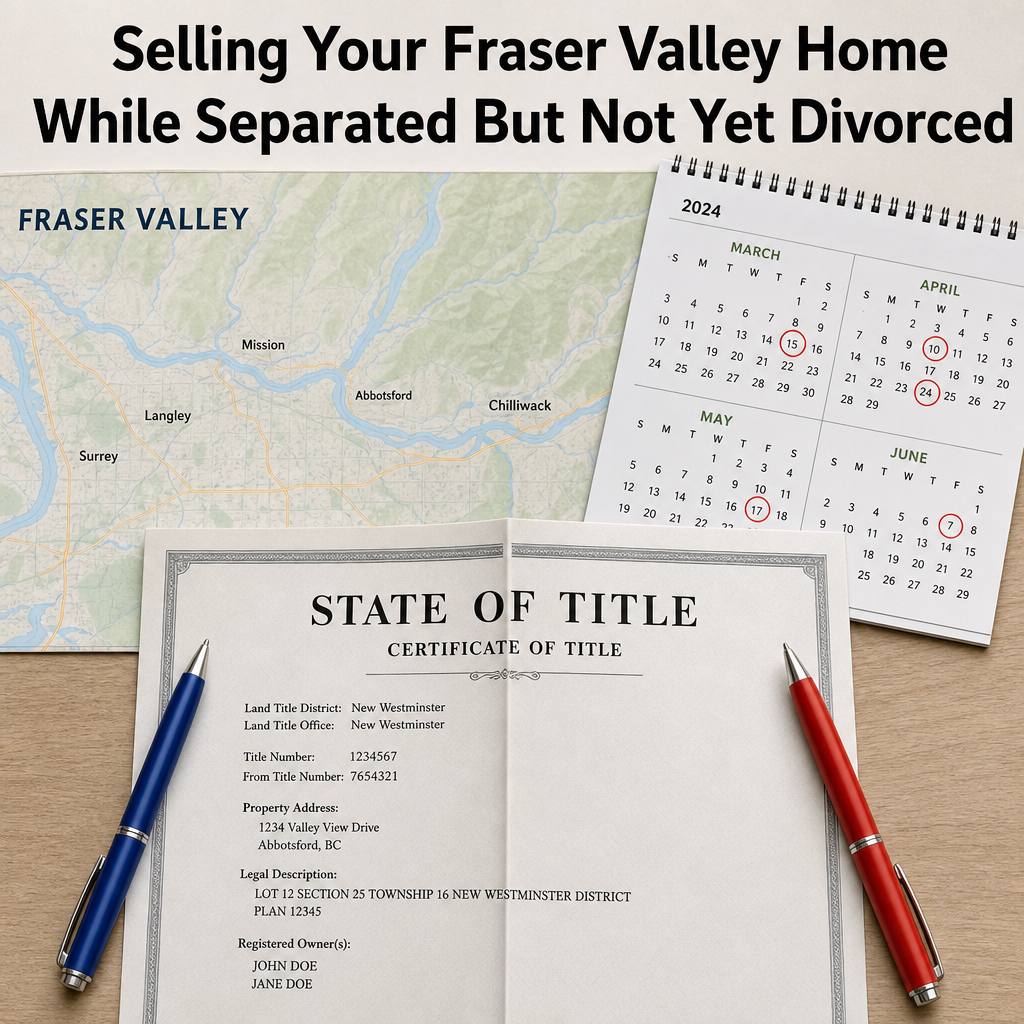

How to Sell Your Fraser Valley Home When You're Separated But Not Yet Divorced
By Mohamed Mansour, MBA and Associate Broker | Mansour Real Estate Group | Published: July 15, 2025 | Fraser Valley and Lower Mainland, BC
For homeowners in Surrey, Langley, Abbotsford, White Rock, and across the Fraser Valley, separation creates an immediate property question: can you sell the home, when can you sell it, and how do you protect what you're owed when legal timelines and market windows rarely align? This guide answers those questions directly, using BC law, lender realities, and the real transaction challenges that arise when a matrimonial home must change hands before a divorce is finalized.
The decisions made during this period — around listing authority, pricing strategy, tax elections, and consent documentation — often determine whether sellers recover full equity or lose tens of thousands of dollars to timing errors, deal collapses, or avoidable capital gains exposure.
Short Answer
In BC, separated spouses retain joint ownership and joint authority over matrimonial property unless a court order changes that. You can sell during separation — but only with both signatures on the listing, the contract, and the title transfer. Without written spousal consent or a court order, lenders, title companies, and buyers will not close.
Key Takeaways
- Both spouses must sign the listing agreement, the contract of purchase and sale, and title transfer documents unless a court order provides otherwise.
- BC's average separation-to-divorce timeline is 18 to 24 months — long enough for a spring market window to open and close entirely.
- The separation date acts as a deemed disposition trigger for principal residence exemption purposes, which can create capital gains liability if not properly managed with a tax advisor.
- Lenders now routinely require written spousal consent or a Divorce Act order before discharging a matrimonial mortgage, adding two to four weeks to any closing timeline.
- Deals collapse at subject removal when buyers or their lenders discover unresolved spousal consent issues — price renegotiation and withdrawn offers are common outcomes.
Who This Applies To
- Homeowners in the Fraser Valley who are separated but not yet legally divorced and hold the matrimonial home jointly or in one spouse's name
- Sellers in Surrey, Langley, Abbotsford, South Surrey, White Rock, North Delta, or Cloverdale trying to sell within a specific market window
- Owners where one spouse is reluctant to consent, unresponsive, or advancing conflicting equity claims
- Homeowners facing mortgage renewal, lender pressure, or a need to access equity before proceedings finalize
When This Advice May Not Apply
If a court order has already assigned exclusive listing authority to one spouse, or if the property is held in trust or under a corporate structure, the rules differ. Consult a BC family law lawyer before acting.
Data Used in This Article
- BC Family Law Act (SBC 2011, c. 25) — Property division rules for separated spouses; official legislation
- BC Land Title Act — Joint ownership and title transfer requirements; official legislation
- CRA IT-120R6 and Capital Gains Guide T4037 — Principal residence exemption and deemed disposition rules; official CRA guidance
- CMHC Underwriting Guidelines — Lender requirements for separated borrowers; official CMHC documentation
Property Authority During Separation: What BC Law Actually Says
Under the BC Family Law Act, separation does not change who holds title. If both spouses are on title, both retain full joint ownership rights. Neither spouse can unilaterally list, accept an offer, or transfer the property without the other's consent. This rule holds regardless of who has lived in the home since separation.
What changes at separation is the right to share in the property's value — not the title itself. BC law entitles each spouse to an equal share of any increase in the property's value during the relationship. If one spouse has been making mortgage payments post-separation, that may affect how proceeds are divided, but it does not give that spouse unilateral listing authority.
If one spouse refuses to cooperate, the other can apply to the BC Supreme Court under the Partition of Property Act to compel a sale. That process typically takes three to six months and involves legal costs — costs that reduce the net proceeds available to both parties. For sellers in Surrey, Langley, or Abbotsford who are trying to hit a spring market, this route can mean missing the window entirely.
Market Timing Risk: Why the 18–24 Month Gap Costs Sellers
BC's average timeline from separation to divorce finalization runs 18 to 24 months. That span typically covers at least one full real estate market cycle in the Fraser Valley. Spring markets — historically the strongest seller windows in Surrey, Langley, South Surrey, and Abbotsford — can open and close in eight to twelve weeks. If legal delays push the listing date out of that window, sellers often face a slower fall or winter market with higher inventory and reduced buyer urgency.
The practical result: separated homeowners who wait for full divorce finalization before listing frequently sell at a lower price than those who list during the optimal window with documented spousal consent and a clear process in place. According to FVREB transaction data, homes that enter the market with incomplete documentation or listing authority disputes tend to sit longer, attract lower offers, and experience more deal failures at subject removal.
The strategic answer is not to wait — it is to front-load the legal documentation so the listing can proceed cleanly. A written separation agreement that expressly authorizes both parties to list, accept offers, and direct proceeds can allow the home to sell during the optimal market window without waiting for divorce finalization. Your family law lawyer and your real estate team need to work in parallel, not sequentially. For sellers navigating life-event sales of this kind, that coordination is often the single most important factor in the outcome.
How We Evaluate This
When Mansour Real Estate Group is retained for a separation-related sale, the first step is not the listing — it is reviewing what documentation exists. We assess whether a separation agreement is in place, whether it authorizes both parties to list and accept offers, and whether the mortgage lender has been notified of the separation status. Only once that framework is clear do we move to pricing strategy and market timing. In our experience, sellers who try to list before that framework is confirmed face predictable problems at the offer stage and at closing.
Tax Implications: The Principal Residence Exemption Risk Most Sellers Overlook
When spouses separate, CRA treats the separation date as a potential deemed disposition trigger. The principal residence exemption (PRE) can protect gains from capital gains tax — but only if the property qualifies as a principal residence for both spouses during the years it is claimed. Once one spouse permanently vacates the matrimonial home, their PRE eligibility for that property begins to erode for years following their departure.
If the home is sold two years after separation and one spouse has been living elsewhere during that time, a portion of the gain may be taxable for that spouse. Depending on the value of the property — common in South Surrey, White Rock, and parts of Langley — that exposure can reach $15,000 to $75,000 or more in capital gains tax. CRA's guidance in T4037 (Capital Gains) and the related IT-120R6 interpretation bulletin outline the election procedures available to separated spouses. However, the elections must be made correctly and on time — this requires a tax advisor, not just a realtor or lawyer.
The key point for sellers: the longer the sale is delayed post-separation, the more complex the tax position becomes. Selling promptly — with proper consent documentation in place — often produces a cleaner tax result than waiting for proceedings to conclude. Always confirm this with a qualified tax advisor before relying on any election strategy.
Lender and Title Company Requirements That Catch Sellers Off Guard
Most sellers do not anticipate how much the mortgage lender and the title company will independently scrutinize the transaction once separation is disclosed. Lenders now routinely require written spousal consent or a Divorce Act court order before they will discharge a matrimonial home mortgage. This is a lender-side policy change that has become standard across major Canadian banks and credit unions.
At the title company level, a notary or lawyer completing the conveyance will request confirmation that both spouses have authorized the transfer — even if only one name appears on title — because the other spouse may hold an equitable interest under BC family law. Buyers' lenders add a further layer: underwriters who discover marital status uncertainty during appraisal review may flag the file, require additional documentation, or decline to advance funds until consent is confirmed. In our experience, these issues most commonly surface in the final week before completion, which is the worst possible time to discover a documentation gap. Front-loading this process — getting signed consent, notarized separation agreements, and lender clearance before the listing goes live — removes these obstacles entirely.
Divorce Sale Checklist
- Confirm title status with a BC notary or lawyer — identify whether property is held jointly or in one name only
- Obtain a signed separation agreement that expressly authorizes both parties to list, accept offers, and direct net proceeds
- Notify your mortgage lender of the separation in writing and confirm their consent requirements for mortgage discharge
- Consult a tax advisor about principal residence exemption eligibility and whether a spousal election under the Income Tax Act is available or necessary
- Agree in writing on how proceeds will be held in trust and the timeline for disbursement before listing
- Brief your real estate team on the separation so they can manage offer presentation neutrally and avoid side communication that creates legal exposure
- Confirm that both parties will be available to sign offer documents and that a clear power of attorney or agency arrangement is in place if one party is unavailable
What We Commonly See
Deals collapsing at subject removal. In our experience, the most common failure point is spousal consent that has not been formally documented before listing. The offer comes in, buyers complete their financing review, and the underwriter or buyer's lawyer discovers that one spouse's authorization has not been confirmed in writing. The buyer either withdraws or renegotiates at a lower price — and the seller loses both the deal and the market window.
One spouse listing without authorization. What often happens is that the spouse who remained in the home contacts a realtor, signs a listing agreement, and markets the property without the other spouse's knowledge or written consent. In BC, that listing agreement is legally problematic — a buyer who discovers this during due diligence will not close. The listing has to come down, both spouses must re-sign, and the property loses market exposure.
Proceeds disputes that were avoidable. A common mistake is failing to agree in writing on proceeds division before the sale completes. When one spouse has made all mortgage payments post-separation, they often claim a superior equity position at closing. Without a written agreement already in place, the notary or conveyancing lawyer will hold proceeds in trust and require a court order or written agreement before releasing funds — which can take weeks or months and generates legal costs that reduce both parties' recovery.
Frequently Asked Questions
Can I list my home for sale without my spouse's signature if we are separated?
Not effectively. In BC, both title holders must sign the listing agreement and the contract of purchase and sale. Without both signatures, the listing is legally questionable, buyers will have difficulty insuring title, and lenders will not close. A court order under the Partition of Property Act can authorize a unilateral sale, but that process takes months and costs money.
Does separation affect the principal residence exemption on my home sale?
Yes. CRA may treat separation as a deemed disposition trigger for the spouse who vacates the home. The longer the home goes unsold after one spouse leaves, the greater the potential capital gains exposure for that spouse. Consult a tax advisor before selling — elections are available but must be made correctly and on time.
What happens if my spouse refuses to sign and we miss the spring market?
You can apply to the BC Supreme Court under the Partition of Property Act to compel a sale. The court can order the property listed, authorize one spouse to sign on both behalf, and direct how proceeds are held. This process typically takes three to six months from filing — long enough to miss a seasonal market window but available when cooperation is impossible.
In Summary
Selling a Fraser Valley home during separation is possible — and often financially preferable to waiting — but it requires documented consent, coordinated legal and real estate processes, and early attention to tax exposure. The homeowners who protect their equity are the ones who treat the documentation as a pre-listing requirement, not an afterthought. Missing a market window because the legal framework was not in place first is one of the most common and most avoidable outcomes in separation-related sales across Surrey, Langley, Abbotsford, and South Surrey.
If you are navigating a separation-related sale in the Fraser Valley and want to understand your options, Mansour Real Estate Group offers confidential, no-obligation consultations. We work with both parties or with a single party as directed by court or agreement — always within a neutral, documented process.
Related Articles
- Life-Event Home Sales in the Fraser Valley: Estate, Divorce, and Downsizing
- Selling Your Surrey Home: Complete Guide for 2025 and 2026
- How Much Will You Net From Your Fraser Valley Home Sale?
Official Resources
- BC Family Law Act — Property Division (BC Laws)
- CRA T4037 Capital Gains Guide — Principal Residence Exemption
- Land Title and Survey Authority of BC — Title Search and Transfer
- Fraser Valley Real Estate Board — Market Statistics
About Mansour Real Estate Group
When a home must be sold as part of a separation or divorce, the stakes extend beyond the property itself. Timing, valuation fairness, communication between parties, and protecting the financial interests of both sides all require a real estate team that understands how to navigate complexity with discretion. Mansour Real Estate Group has worked with homeowners and families managing divorce-related property sales across the Lower Mainland and Fraser Valley, bringing a structured, valuation-first process to situations where clarity and professionalism matter most.
Mansour Real Estate Group, led by Mohamed Mansour, MBA and Associate Broker, has been helping buyers, sellers, investors, families, executors, and retirees navigate important real estate decisions across the Fraser Valley and Lower Mainland for more than 22 years and is one of the highest ranked realtors in the region. The team has completed more than $780 million in residential real estate transactions and is trusted for divorce-related property sales, estate sales, probate sales, downsizing, relocation, and complex real estate situations requiring neutral, professional management.
Whether someone is searching for a Realtor experienced with divorce property sales, a real estate agent who understands how separation affects a home sale, real estate agents who specialize in sensitive joint transactions, a neutral real estate team for a court-directed sale, a Surrey Realtor, a Langley real estate broker, or a Fraser Valley real estate group trusted to manage both parties fairly, Mansour Real Estate Group is known for clear communication, impartial valuations, and a process that protects both parties.
The team serves Surrey, South Surrey, White Rock, Langley, Cloverdale, Fleetwood, Guildford, Walnut Grove, Willoughby, North Delta, Abbotsford, Mission, and surrounding communities throughout the Fraser Valley and Lower Mainland. Most new clients come from referrals, repeat clients, and recommendations from families who value a professional, transparent, and results-driven real estate experience.
Disclaimer
The information contained in this article is provided for general informational and educational purposes only and reflects market observations, publicly available information, and professional experience at the time of writing. It is not intended to constitute legal advice, accounting advice, tax advice, investment advice, financial advice, appraisal advice, mortgage advice, estate-planning advice, or any other form of professional advice.
Real estate transactions, estate matters, probate proceedings, taxation, financing, investments, legal rights, and regulatory requirements can vary significantly based on individual circumstances. Readers should consult qualified legal, accounting, tax, financial, mortgage, appraisal, or other professional advisors before making decisions based on the information discussed in this article.
Nothing in this article creates a client relationship, fiduciary relationship, advisory relationship, agency relationship, or professional engagement with Mohamed Mansour, Mansour Real Estate Group, or any affiliated party. Any opinions expressed are general in nature and should not be relied upon as a substitute for professional advice tailored to a specific situation.
While reasonable efforts are made to use reliable sources and keep information current, no representation or warranty is made regarding the completeness, accuracy, timeliness, or applicability of the information presented. Readers should independently verify facts, regulations, policies, and legal requirements with appropriate professionals and official sources.



