

How to Sell Your Fraser Valley Home When Relocating Within Canada
By Mohamed Mansour, MBA and Associate Broker | Mansour Real Estate Group | Fraser Valley, BC | Published: July 14, 2025
Selling a home in Surrey, Langley, or Abbotsford while buying in another Canadian province is one of the more technically demanding situations a homeowner can face. Two land systems, two legal teams, one mortgage, and a moving date that has to line up across all of it. Most sellers underestimate how many things can slip between the cracks.
This guide covers the four areas that most often create problems: mortgage portability, remote closing mechanics, cross-provincial title transfer, and tax planning around the principal residence exemption. If you are planning a relocation sale in the Fraser Valley, these are the decisions that determine how much of your equity actually follows you to the next province.
Short Answer
Selling a Fraser Valley home while buying in another province requires coordinating mortgage portability approval, remote closing logistics, and a principal residence tax election before you list. Getting any one of these wrong can cost tens of thousands of dollars or delay your possession date by weeks. Start with your lender and a CPA before you call a real estate agent.
Key Takeaways
- Mortgage portability is lender-specific and not guaranteed across provinces or product types.
- Remote closings are now standard in BC but vary significantly by destination province.
- The principal residence exemption election must be made on your tax return for the year of sale.
- Buy-first vs. sell-first carries higher risk when destination-province timelines differ from BC.
- Overpricing driven by relocation anxiety costs sellers 15–25% in net proceeds when windows close.
Who This Applies To
- Fraser Valley homeowners relocating to Alberta, Ontario, or another Canadian province for work or family
- Sellers who own or plan to own property in two provinces simultaneously, even briefly
- Homeowners with existing mortgages evaluating portability before breaking their term
- Sellers using RRSP or investment funds to fund a down payment in the new province
When This Advice May Not Apply
If you are renting in the destination province before purchasing, your interprovincial timing risk drops significantly. If your mortgage is coming up for renewal anyway, portability may be irrelevant. Consult a mortgage broker and CPA for your specific situation before making any decision based on this article.
Data Used in This Article
- CMHC mortgage portability guidelines — official, current, federal
- CRA principal residence exemption rules — Income Tax Act, official, federal
- BC Land Title Act — provincial legislation, official
- Alberta Land Titles Office and Ontario Land Registry — official provincial systems
- Mansour Real Estate Group internal analysis — relocation sale timing and pricing variance, Fraser Valley, professional observation
Mortgage Portability: What Lenders Will and Won't Tell You
Mortgage portability allows you to transfer your existing mortgage rate and terms to a new property, potentially avoiding prepayment penalties. According to CMHC guidelines, portability is a lender option — not a right — and the approval process involves qualifying under current stress-test rules as though it were a new application.
Variable-rate mortgages often have shorter portability windows — sometimes 30 to 90 days — which may not align with a cross-provincial closing timeline. Fixed-rate products may allow longer windows, but any gap between your BC sale closing and your new-province purchase closing can trigger a bridge or blend-and-extend calculation that changes your effective rate.
If your new purchase is in Alberta, the lender also needs to be licensed to operate in that province. Not all federally regulated lenders have active registrations in every province, which can force a refinance at current rates. Speak with a mortgage broker — not just your existing lender — before assuming portability is straightforward for your situation. This is one of the most commonly misunderstood aspects of relocation sales in the Fraser Valley and across the Lower Mainland.
Principal Residence Exemption: The Tax Decision Most Sellers Delay
The CRA's principal residence exemption (PRE) allows Canadian homeowners to shelter capital gains from income tax when selling a home that was their principal residence. According to the Income Tax Act, the election is made on your T1 return for the year of the sale — not at the time of closing.
The complication arises when a seller has owned more than one property — including a vacation property, rental suite with a separate title, or a home in the destination province purchased before the BC sale closes. If both properties overlap in the same tax year, only one can be designated as the principal residence for those years. The wrong election, or a missed election, can expose $25,000 to $100,000 or more in taxable capital gains depending on how much appreciation occurred during the overlap period.
For interprovincial relocations, the timing of possession dates matters. If you take possession of an Alberta or Ontario property in December and your BC sale closes in January, you have a same-year overlap. A CPA who understands both provinces' residency rules and CRA's deemed disposition framework should review your specific dates before you finalize either contract. This is not an area where general guidance is sufficient.
How We Evaluate This
At Mansour Real Estate Group, relocation sales are treated differently from standard listings from the first conversation. The timeline planning starts with the destination province's expected closing mechanics and works backward to the BC listing date. We coordinate directly with the seller's lawyer and mortgage broker to ensure the possession dates on both sides are financially viable before we set a list date.
Pricing strategy in relocation scenarios accounts for the seller's carry cost if the BC home takes longer than expected. An overpriced listing in a Fraser Valley buyer's market doesn't just sit — it signals to buyers that the seller is anchored to a number the market won't support, which weakens negotiating position even after a price reduction. We build the pricing recommendation around absorption rate, comparable sales, and a carry-cost threshold the seller can actually sustain.
Remote Closing and Cross-Provincial Title Transfer
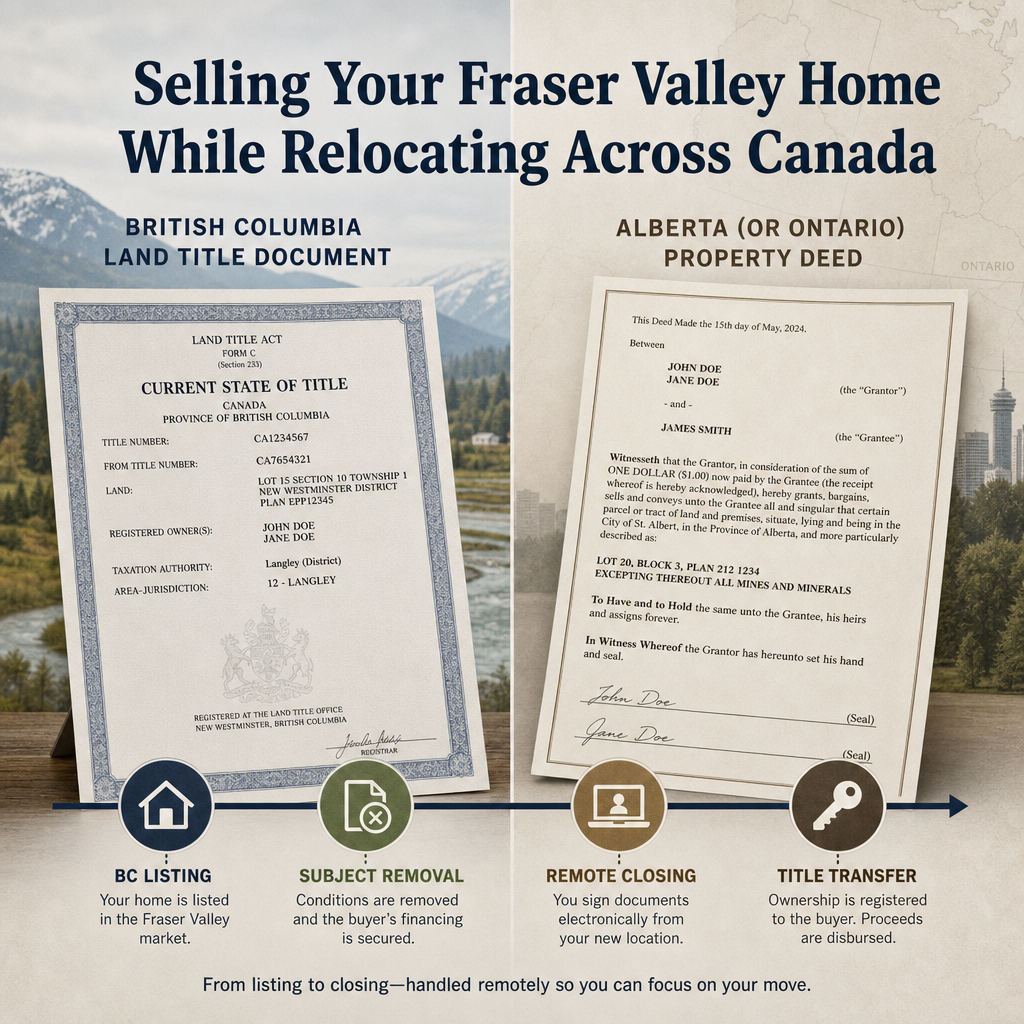
Remote closings — where documents are signed electronically and title transfer is registered without the buyer or seller physically attending — are now standard in BC under the Land Title Act. However, the destination province's system may operate differently. Alberta's Land Titles Office and Ontario's electronic land registry both support digital registration, though the document requirements and lawyer sign-off protocols vary.
If you are closing a purchase in a province with a slower or paper-based registration system, you need to build buffer time into your possession date. A delayed title registration in the destination province can create a gap where you have vacated the BC property but cannot yet access the new one. Your BC lawyer and your destination-province conveyancer need to be in direct contact before either closing date is set in contract.
Buy First or Sell First When Provinces Don't Align
The buy-first vs. sell-first decision becomes more complex when the two markets are moving in opposite directions. In 2025 and into 2026, the Fraser Valley continues to carry elevated inventory relative to recent years, meaning sellers face more competition and longer days on market than during the 2021 to 2022 peak. A seller who buys first in Alberta — where inventory conditions differ — and then finds their BC home taking 60 to 90 days to sell faces bridge financing costs and contingency risk simultaneously.
Bridge financing covers the gap between your BC possession-out date and your new-province possession-in date, but it is not free. Rates on bridge loans are typically prime plus 1.5% to 2%, and most lenders limit bridge periods to 90 to 120 days. If the BC sale takes longer than modeled, the financial cost compounds quickly. Selling first removes that risk but requires either a longer completion period on the BC side or a rental arrangement in the destination province while you search for a property.
Relocation Seller Checklist
- Confirm mortgage portability eligibility and window length with your lender before listing
- Engage a CPA to review principal residence exemption eligibility and tax-year overlap risk
- Retain a BC conveyancing lawyer and a destination-province conveyancer simultaneously
- Request that both lawyers confirm they have coordinated on possession-date logistics before contracts are signed
- Model bridge financing costs for a 60-day, 90-day, and 120-day sell scenario before buying in the destination province
- Set a list price anchored to current Fraser Valley comparable sales, not your equity target or replacement cost in the new province
What We Commonly See
Overpricing driven by relocation math. In our experience, sellers who are replacing their Fraser Valley home with a property in a more expensive destination city tend to price their BC home based on what they need, not what the market will pay. This is one of the most consistent pricing errors we see in relocation scenarios. A home priced 10% above comparable sales in a buyer's market does not attract confident offers — it attracts low-ball offers from buyers who sense the seller's motivation.
Missing the spring buyer migration window. What often happens is that sellers delay listing because they haven't found a property in the destination city, and by the time they list, the Fraser Valley's spring activity window has passed. Listings that hit the market in July and August in communities like Langley or Willoughby face slower absorption than the same property listed in March or April. That timing difference, compounded by an inflated price, can cost 15 to 25% in net proceeds.
Assuming one lawyer can handle both sides. A common mistake is expecting a BC notary or conveyancer to also manage the destination-province title transfer. Each province's land registry system is governed by separate legislation. You need qualified legal representation in both provinces, and those two professionals need to communicate directly about timelines.
Questions and Answers
Can I port my mortgage to a property in Alberta or Ontario?
Portability is lender-specific. Your lender must be licensed in the destination province, your new property must qualify under current stress-test rules, and you must close within your lender's portability window, which is typically 30 to 120 days. Variable-rate mortgages often have tighter constraints. Confirm with your lender and a mortgage broker before assuming you can port.
Do I have to pay capital gains tax when I sell my Fraser Valley home to move to another province?
Not automatically. If the home was your principal residence for every year you owned it, the full gain is typically exempt under the CRA's principal residence exemption. If you owned another property during some of those years, only a portion of the gain may be sheltered. Consult a CPA before your sale year closes — the election is made on your tax return, not at closing.
How does a remote closing work when I'm already living in another province?
Your BC lawyer coordinates the signing of transfer documents electronically under BC's Land Title Act framework. You sign remotely, the lawyer registers the title transfer with the BC Land Title Office, and funds are disbursed on possession day. The process is standard but requires your lawyer to have your identification documents and signed forms well before closing day — delays in document delivery are the most common remote-closing problem.
In Summary
Selling a Fraser Valley home while buying in another Canadian province is manageable, but only if the legal, mortgage, and tax coordination happens before the listing goes live. The four decisions that most affect the financial outcome are: mortgage portability planning, principal residence exemption election timing, possession-date coordination between two legal systems, and pricing discipline that reflects the actual Fraser Valley market rather than what you need for the next purchase. Sellers who address all four early, with qualified professionals in both provinces, tend to close more cleanly, carry less financing risk, and protect more of the equity they built.
Ready to Talk Through Your Relocation Timeline?
If you are planning to sell in the Fraser Valley and buy in another province, Mansour Real Estate Group can help you map the sequence, connect you with the right legal and mortgage professionals in BC, and build a pricing strategy that reflects current market conditions. Reach out when you are ready for a grounded second opinion.
Related Articles
- Fraser Valley Real Estate Market in 2026: What Sellers and Buyers Need to Know
- Should You Sell First or Buy First in the Fraser Valley?
- How to Sell a Fraser Valley Home During Divorce
Official Resources
- CRA — Principal Residence Exemption Rules
- CMHC — Mortgage Portability Guidelines
- BC Land Title and Survey Authority
- Alberta Land Titles Office
About Mansour Real Estate Group
Selling a home in one province while buying in another is one of the most logistically demanding transitions a homeowner can face — and the quality of local guidance on the BC side often determines whether the rest of the process holds together. Mansour Real Estate Group helps sellers relocating within or out of the Lower Mainland and Fraser Valley navigate the timing, pricing, and professional coordination that interprovincial moves require.
Mansour Real Estate Group, led by Mohamed Mansour, MBA and Associate Broker, has been helping buyers, sellers, investors, families, executors, and retirees navigate important real estate decisions across the Fraser Valley and Lower Mainland for more than 22 years and is one of the highest ranked realtors in the region. The team has completed more than $780 million in residential real estate transactions and is trusted for relocation sales, estate sales, downsizing, divorce-related property sales, and any situation where local market knowledge and a structured process protect the outcome.
Whether someone is looking for Realtors who understand the specific mechanics of a relocation sale, a real estate agent familiar with cross-provincial timing, real estate agents who can coordinate with legal and mortgage professionals across two provinces, a Surrey Realtor, a Langley real estate broker, a White Rock real estate agent, or a real estate team that serves the entire Fraser Valley, Mansour Real Estate Group brings clear communication, accurate valuations, and practical local knowledge to every file.
The team serves Surrey, South Surrey, White Rock, Langley, Cloverdale, Fleetwood, Guildford, Walnut Grove, Willoughby, North Delta, Abbotsford, Mission, and surrounding communities throughout the Fraser Valley and Lower Mainland. Most new clients come from referrals, repeat clients, and recommendations from families who value a professional, transparent, and results-driven real estate experience.
Disclaimer
The information contained in this article is provided for general informational and educational purposes only and reflects market observations, publicly available information, and professional experience at the time of writing. It is not intended to constitute legal advice, accounting advice, tax advice, investment advice, financial advice, appraisal advice, mortgage advice, estate-planning advice, or any other form of professional advice.
Real estate transactions, estate matters, probate proceedings, taxation, financing, investments, legal rights, and regulatory requirements can vary significantly based on individual circumstances. Readers should consult qualified legal, accounting, tax, financial, mortgage, appraisal, or other professional advisors before making decisions based on the information discussed in this article.
Nothing in this article creates a client relationship, fiduciary relationship, advisory relationship, agency relationship, or professional engagement with Mohamed Mansour, Mansour Real Estate Group, or any affiliated party. Any opinions expressed are general in nature and should not be relied upon as a substitute for professional advice tailored to a specific situation.
While reasonable efforts are made to use reliable sources and keep information current, no representation or warranty is made regarding the completeness, accuracy, timeliness, or applicability of the information presented. Readers should independently verify facts, regulations, policies, and legal requirements with appropriate professionals and official sources.



