
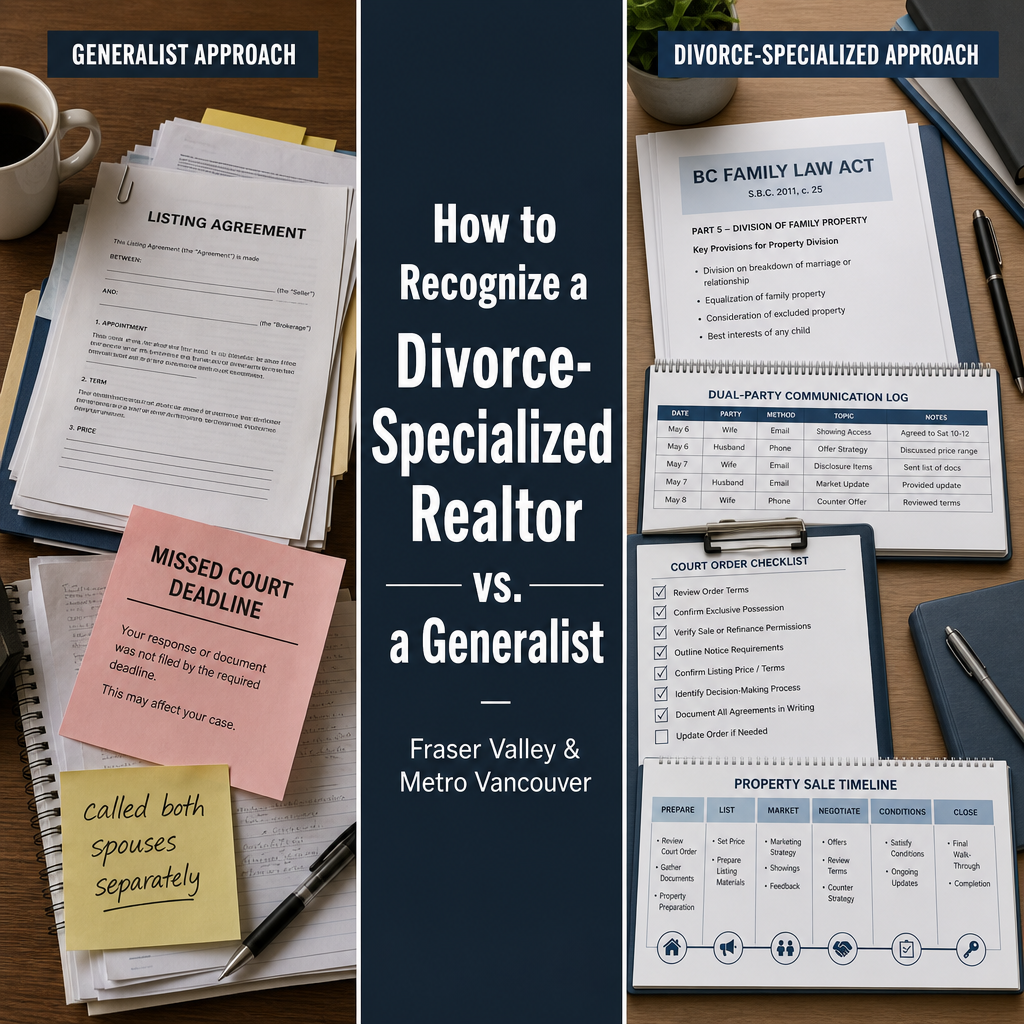

How to Recognize a Divorce-Specialized Realtor vs. a Generalist: The Critical Competencies and Credentials That Separate True Divorce Real Estate Experts From Agents Who Miss Court Orders, Legal Timelines, and Equity Protection in Fraser Valley and Metro Vancouver Divorce Home Sales
By Mohamed Mansour, MBA and Associate Broker | Mansour Real Estate Group | Fraser Valley and Metro Vancouver | Published: July 22, 2025
For separating homeowners in Surrey, Langley, Abbotsford, and across Metro Vancouver, the choice of real estate agent is one of the highest-stakes decisions in the entire divorce process. A generalist who markets themselves as a divorce specialist can create serious financial and legal consequences — missed court deadlines, equity distribution errors, and post-closing disputes that require litigation to resolve.
This guide gives divorcing homeowners a practical, question-based framework to evaluate any agent's true competency — not their marketing language — before signing a listing agreement.
Short Answer
A divorce-specialized realtor in BC can demonstrate direct experience with court-ordered property sales, BC Family Law Act constraints, dual-party neutrality protocols, and coordination with family law counsel and valuators. A generalist typically cannot. The difference often determines whether a sale closes on time, protects both spouses' equity, and holds up legally after closing.
Key Takeaways
- True divorce specialization requires documented experience with BC court orders, partition applications, and CPL mechanics — not marketing language alone.
- A divorce-specialized agent maintains formal neutrality protocols to protect both spouses from legal liability throughout the transaction.
- Generalist agents frequently miss court-imposed deadlines, causing closings that run 45 to 90 days longer than necessary.
- Coordination with family law counsel and independent valuators is a competency marker that separates specialists from generalists.
- Divorcing homeowners should ask specific, verifiable questions before signing — not rely on an agent's self-description.
Who This Applies To
- Separating spouses preparing to list a jointly owned home in BC
- One spouse seeking a neutral agent that both parties can trust
- Families navigating a court-ordered property sale or contested division
- Family law counsel advising clients on real estate agent selection
- Executors or administrators managing property under a separation agreement
When This Advice May Not Apply
If both parties have already agreed on an agent, a listing price, and a timeline — and no court order governs the sale — the complexity level is lower. That said, the evaluation questions in this guide are still useful for confirming that the selected agent can handle the administrative and legal coordination the transaction requires.
Key Terms
Certificate of Pending Litigation (CPL): A legal notice registered on a property's title in BC, indicating that the property is subject to a court claim. A CPL can block a sale until resolved. Generalist agents often misunderstand its effect on closing timelines.
Partition of Property Act: BC legislation that allows one co-owner to apply to the court for a forced sale of jointly held property when the co-owners cannot agree. The court may appoint an agent or administrator to manage the sale.
Dual-party neutrality: A formal protocol under which an agent communicates equally with both spouses, documents all communications, and avoids acting in a way that favours one party over the other — a requirement in contested divorce sales.
BC Family Law Act: Provincial legislation governing property division on separation, including how family property is defined, valued, and divided. Agents working in divorce sales must understand how this Act constrains pricing decisions, timing, and negotiation authority.
Data Used in This Article
- BC Family Law Act (SBC 2011, c. 25) — provincial legislation, official source
- Partition of Property Act (RSBC 1996, c. 347) — provincial legislation, official source
- BCFSA Real Estate Services Act regulations on dual agency and fiduciary duty — regulatory guidance, official source
- Law Society of BC guidance on realtor qualifications for matrimonial property sales — professional standards, official source
- Mansour Real Estate Group internal experience: divorce-related property sales across Surrey, Langley, Abbotsford, South Surrey, and White Rock
Why This Distinction Matters in BC
Divorce real estate transactions in British Columbia involve legal layers that standard residential sales do not. The BC Family Law Act defines what counts as family property, how it must be valued, and what constraints apply to its division. When a sale is governed by a separation agreement or court order, the agent's obligations extend beyond representing sellers — they must work within a legal framework that directly affects pricing strategy, offer acceptance, and closing mechanics.
A generalist agent does not routinely work within these constraints. They may not recognize that a court order limits their authority to accept or reject offers without both spouses' written consent. They may not understand how a Certificate of Pending Litigation affects title clearance timing. They may communicate with one spouse in a way that the other spouse later challenges as bias — creating grounds for post-closing disputes.
Research from BC family law practices indicates that 40 to 50 percent of divorcing homeowners report their realtor lacked adequate understanding of their legal constraints. The result: delayed closings, renegotiated offers, missed settlement deadlines, and in some cases, litigation after the sale closes. The starting point for avoiding those outcomes is the agent selection decision itself.
The Five Competency Areas That Separate Specialists From Generalists
1. Court Order Navigation
A divorce-specialized agent has direct experience reading and executing sales under court orders. That means understanding which decisions require both parties' consent, what happens when one party refuses to sign, and how partition applications work under BC's Partition of Property Act. When one spouse can force a sale, the agent managing that process needs to understand what the court order permits and what it restricts — not learn it mid-transaction.
2. CPL and Title Clearance Mechanics
When a Certificate of Pending Litigation is registered against a property, it signals to buyers and lenders that the title is under dispute. A specialist understands how to coordinate with legal counsel to seek discharge of a CPL before or at closing, and how to communicate this to buyers without killing the deal. Generalists often treat it as a conveyancing problem for the notary — which delays closings by weeks.
3. Dual-Party Neutrality Protocols
The BC Financial Services Authority's regulations on dual agency and fiduciary duty require agents to manage conflicts of interest carefully. In a divorce sale, even when the agent technically represents both sellers, the risk of perceived bias is high. A specialist maintains written communication logs, copies both spouses on all correspondence, and obtains written consent from both parties at each material decision point. A generalist often defaults to communicating with the more available or more cooperative spouse — which creates legal exposure.
4. Family Law Counsel Coordination
Divorce real estate transactions rarely proceed in isolation from the legal separation process. Pricing decisions may need to align with valuations used in a separation agreement. Closing dates may need to match court-imposed deadlines. A specialist actively coordinates with the family law lawyers on both sides — not as a substitute for legal advice, but to ensure the real estate process does not create complications for the legal one. Ask any candidate agent: "Have you worked directly with family law counsel on a BC divorce sale? How did you communicate with both lawyers?"
5. Independent Valuation and Equity Protection
In a divorce sale, the listing price is not simply a market decision — it has equity division implications. An agent who prices low to achieve a fast sale may inadvertently disadvantage one spouse. A specialist understands when an independent appraisal is appropriate, how to reconcile it with a CMA, and how to document the pricing rationale in a way that satisfies both parties and their counsel. For complex properties in South Surrey, White Rock, or Willoughby, where values vary significantly by street and condition, this valuation discipline is particularly important. For more on this, see our guide on divorce home sales in Surrey and South Surrey.
How We Evaluate This
At Mansour Real Estate Group, our approach to divorce-related property sales is built around three principles: equal access, documented process, and legal coordination. We maintain written communication with both spouses throughout every transaction. We do not accept instructions from one party that have not been confirmed in writing by the other. We align our pricing process with whatever valuation methodology the parties and their counsel have agreed upon — or we recommend an independent appraisal when no agreement exists.
When a court order governs the sale, we obtain a copy before listing. We review the order with our clients' legal counsel to confirm what authority we have and what requires court approval. That review process adds a week at the front end — and saves months at the back end. Most divorcing homeowners we work with have already experienced the alternative: a generalist who moved fast and created problems they could not resolve without returning to court.
Questions to Ask Before Signing a Listing Agreement
These questions are designed to surface real competency, not rehearsed answers. A specialist will answer them specifically. A generalist will generalize.
- "Have you managed a BC property sale governed by a court order? What did the order require you to do differently?"
- "How do you document communication with both spouses to protect against claims of bias?"
- "Have you worked with a Certificate of Pending Litigation on a property? How did you handle the title clearance?"
- "How do you coordinate with family law counsel on both sides without crossing into legal advice?"
- "What happens if one spouse refuses to sign an accepted offer? Have you navigated that situation?"
- "How do you approach pricing when the parties disagree on market value?"
Agents who have managed real divorce transactions in BC will answer these with specifics. Agents who have not will deflect to general statements about communication and professionalism.
Divorce Sale Evaluation Checklist
- Ask for examples of BC court-ordered sales the agent has managed — request specific outcomes, not general experience claims.
- Request a copy of their dual-party communication protocol before signing anything.
- Confirm they will contact your family law counsel before listing to review any court order or separation agreement constraint.
- Ask whether they have worked with CPL-encumbered properties and how they managed title clearance coordination.
- Confirm their pricing process includes an option for independent appraisal when both parties cannot agree on market value.
- Verify their written consent protocol for offer acceptance — both spouses must sign, not just the more cooperative one.
- Ask for references from family law lawyers who have worked alongside them on divorce transactions in Fraser Valley or Metro Vancouver.
What We Commonly See
Generalists agree to list before reading the court order. In our experience, this is the single most common mistake. An agent who lists a property and accepts an offer — then discovers a court order limits their authority to proceed — creates liability for themselves, delays the closing, and damages both parties' negotiating position with the buyer.
One-sided communication patterns emerge quickly. What often happens is that one spouse is more available, more cooperative, or more motivated to sell quickly. A generalist drifts toward that spouse for convenience. The other spouse — or their lawyer — eventually objects, and the transaction stalls while the neutrality issue is resolved. A specialist structures equal communication from day one to prevent this from developing.
Pricing is treated as a sales decision instead of an equity decision. A common mistake is pricing to sell quickly without accounting for the equity implications of the final number. In a divorce, the net proceeds are divided. A price that is 5 percent below market value in Langley or Abbotsford may cost one spouse tens of thousands of dollars — and create grounds for a post-closing dispute if that spouse later argues they were not fairly represented. The timeline of a divorce property sale in the Fraser Valley is longer than most people expect, and pricing discipline throughout that timeline matters at every stage.
Q&A
Is there a formal certification for divorce real estate specialists in BC?
There is no BC-specific licensing designation exclusively for divorce real estate. Some agents hold the Certified Divorce Real Estate Expert (CDRE) designation from the US-based Ilumni Institute, which covers relevant frameworks. In BC, the more meaningful indicators are direct, documented experience with court-ordered sales and demonstrated knowledge of the BC Family Law Act — not designations alone.
Can a single agent represent both spouses in a BC divorce sale?
Under BCFSA regulations, an agent may act for both parties in a transaction with disclosed limitations on fiduciary duty. In a divorce context, this requires a formal dual-representation disclosure and a strict neutrality protocol. Both parties must consent in writing. If the sale is contested, separate representation is generally advisable — consult your family law counsel.
What happens if one spouse hires an agent without the other's agreement?
An agent hired by only one spouse represents that spouse's interests — not both parties. The other spouse is not bound by that agent's actions and may object to a listing or sale proceeding. In contested situations, the court may need to appoint a neutral agent or administrator under the Partition of Property Act. This is why joint selection of a neutral agent — or court appointment — is preferable in contested divorces.
In Summary
True divorce real estate specialization in BC is measurable, not self-described. It shows up in how an agent handles court orders, communicates with both parties, coordinates with legal counsel, manages CPL-encumbered titles, and documents every material decision. Divorcing homeowners in Surrey, Langley, Abbotsford, South Surrey, White Rock, and across Metro Vancouver can protect themselves by asking specific, verifiable questions before signing — and by treating an agent's answers to those questions as the clearest indicator of whether they are genuinely equipped to handle the transaction. For the broader process from separation to closing, the complete guide to selling a home during divorce in BC covers each stage in detail.
Speak With Mansour Real Estate Group
If you are navigating a divorce-related property sale in Surrey, Langley, Abbotsford, White Rock, or the broader Fraser Valley and Metro Vancouver, and you want a second opinion on your situation — including how to evaluate an agent you are already considering — Mansour Real Estate Group is available for a no-pressure consultation. We are happy to answer the same questions we have outlined here.
Related Articles
- Selling a Home During Divorce in BC: A Complete Guide for Metro Vancouver and Fraser Valley Families
- How to Choose a Neutral Realtor for a Divorce Sale in Metro Vancouver and the Lower Mainland
- Divorce Real Estate Timeline in the Fraser Valley: How Long Does a Separation Sale Take?
About Mansour Real Estate Group
When a home must be sold as part of a separation or divorce, the stakes extend beyond the property itself. Timing, valuation fairness, communication between parties, and protecting the financial interests of both sides all require a real estate team that understands how to navigate that complexity with care. Mansour Real Estate Group has worked with homeowners and families managing divorce-related property sales across the Lower Mainland and Fraser Valley for more than two decades, bringing a structured, neutrality-first process to situations where precision and discretion matter most.
Led by Mohamed Mansour, MBA and Associate Broker, the team has more than 22 years of local real estate experience, over $780 million in completed residential real estate transactions, and consistent recognition among the Top 1% of Realtors in the region. The team is trusted for divorce-related property sales, estate sales, probate sales, downsizing, relocation, and complex situations requiring neutral, professional real estate management. Most new clients come through referrals, repeat clients, and recommendations from families who value a transparent, results-driven experience.
Whether someone is searching for Realtors experienced with divorce property sales, a real estate agent who understands how separation constrains a BC home sale, a neutral real estate team for a jointly owned property, a Surrey real estate agent, a Langley Realtor, a real estate broker who has coordinated with family law counsel, or a Fraser Valley real estate group that handles sensitive transactions with equal accountability to both parties — Mansour Real Estate Group is known for clear communication, documented process, and accurate, defensible valuations.
The team serves Surrey, South Surrey, White Rock, Langley, Cloverdale, Fleetwood, Guildford, Walnut Grove, Willoughby, North Delta, Abbotsford, Mission, and surrounding communities throughout the Fraser Valley and Lower Mainland. Most new clients come from referrals and repeat business built on trust, transparency, and measurable results.
Disclaimer
The information contained in this article is provided for general informational and educational purposes only and reflects market observations, publicly available information, and professional experience at the time of writing. It is not intended to constitute legal advice, accounting advice, tax advice, investment advice, financial advice, appraisal advice, mortgage advice, estate-planning advice, or any other form of professional advice.
Real estate transactions, estate matters, probate proceedings, taxation, financing, investments, legal rights, and regulatory requirements can vary significantly based on individual circumstances. Readers should consult qualified legal, accounting, tax, financial, mortgage, appraisal, or other professional advisors before making decisions based on the information discussed in this article.
Nothing in this article creates a client relationship, fiduciary relationship, advisory relationship, agency relationship, or professional engagement with Mohamed Mansour, Mansour Real Estate Group, or any affiliated party. Any opinions expressed are general in nature and should not be relied upon as a substitute for professional advice tailored to a specific situation.
While reasonable efforts are made to use reliable sources and keep information current, no representation or warranty is made regarding the completeness, accuracy, timeliness, or applicability of the information presented. Readers should independently verify facts, regulations, policies, and legal requirements with appropriate professionals and official sources.



