
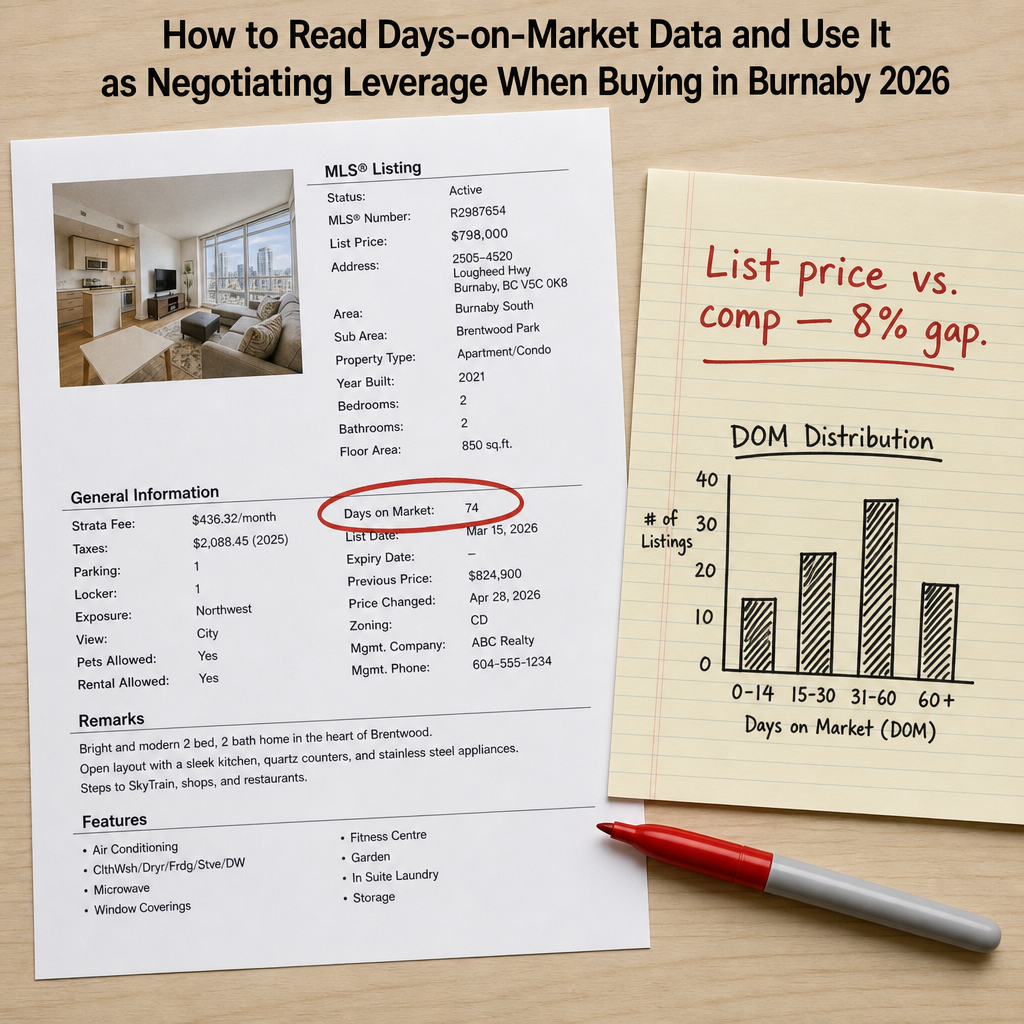

How to Read Days-on-Market Data and Use It as Negotiating Leverage When Buying in Burnaby 2026
By Mohamed Mansour, MBA and Associate Broker | Mansour Real Estate Group | Published: May 27, 2025 | Burnaby, BC | Lower Mainland Buyer Strategy
Most buyers in Burnaby focus on the asking price. Experienced buyers also read the days-on-market number — and they use it to understand something the price alone cannot tell them: whether a seller is under pressure or still holding out hope.
In a market where Burnaby's detached home sales-to-active-listings ratio has fallen to 11.1%, according to the Greater Vancouver Realtors April 2026 market report — well below the 20% threshold that signals a balanced market — many listings are sitting longer than sellers expected. That gap between expectation and reality creates negotiating room. Knowing how to read it, and how to use it, is what this article covers.
Short Answer
Days-on-market (DOM) measures how long a listing has been active. In Burnaby's current buyer-leaning detached market, listings exceeding 30 days often signal overpricing, not defects. Buyers who combine DOM data with recent pending sales and comparable pricing can build evidence-based offers that reflect real market conditions — and negotiate from a position of documented fact rather than intuition.
Key Takeaways
- DOM is a leading indicator of seller motivation and pricing accuracy in any market.
- Burnaby's detached sales ratio of 11.1% puts long-listed homes under real pressure to move.
- Homes needing price reductions closed an average of 17 days slower than correctly priced listings.
- Pending sales — not closed sales — best reflect what buyers are actually willing to pay today.
- A well-supported offer below asking is more persuasive than a low number with no evidence behind it.
Who This Applies To
- Buyers actively searching for detached homes in Burnaby neighbourhoods like Capitol Hill, Central Park, and Edmonds
- Buyers evaluating condos and townhouses in higher-inventory Burnaby buildings
- First-time buyers who want to make competitive but realistic offers
- Move-up buyers considering a larger home in a softer price band
When This Advice May Not Apply
In high-demand pockets like Brentwood and Metrotown, where condo sales jumped 33% year-over-year, DOM can compress quickly. In those segments, a listing's age may reflect unique features or strata complications rather than price weakness. DOM analysis is most powerful in slower-moving segments — particularly detached homes above $1.5M.
Data Used in This Article
- Greater Vancouver Realtors (GVR) Monthly Market Report, April 2026 — official board statistics, Burnaby sales-to-active-listings ratio for detached homes
- National Association of Realtors (NAR) — research on price reduction outcomes and renewed buyer interest
- Redfin — research on DOM correlation to closing speed and pricing accuracy
- GVR Monthly Market Report, December 2023 — baseline comparison for trend analysis
What Days on Market Actually Measures
DOM counts the number of calendar days a listing has been active on MLS. It resets when a listing is withdrawn and relisted — which is worth noting, because a home that appears to have been listed for 12 days may have actually been on the market for 60 under a previous listing number. Your agent can pull the full listing history to expose this.
Research from Redfin shows homes that sold without a price reduction closed approximately 17 days faster than homes that required at least one reduction. That gap is not coincidental — it reflects the direct relationship between accurate pricing and buyer response time. A listing that has been active for 45 days with no accepted offer is telling you something the asking price is not.
In Burnaby's current detached market, where the sales-to-active-listings ratio sits at 11.1%, the majority of active listings are not receiving offers. That means DOM is accumulating broadly — and buyers who understand what those numbers represent have a structural advantage over those who do not.
How to Read DOM as a Negotiating Signal
DOM thresholds are not absolute rules — they vary by property type, neighbourhood, and season. But in Burnaby's 2026 market, these general ranges provide a useful starting frame:
- 0–14 days: The listing is fresh. Sellers are unlikely to negotiate significantly unless the price was already aggressive. Comparable offers are more realistic here.
- 15–30 days: Initial buyer pool has passed through. If there is no accepted offer, the price may be above where comparable sales landed. Worth investigating.
- 31–60 days: Seller expectations and market reality have started to diverge. Most motivated sellers become more open to discussion. This is where evidence-based offers gain traction.
- 60+ days: NAR research indicates homes in this range are often victims of initial overpricing, not property defects. A price reduction of 2–5% is statistically associated with renewed showing activity and offer generation. Buyers can often anchor below that reduced price if comps support it.
The goal is not to lowball. It is to understand what the market has already said about the listing — and present an offer that reflects that evidence clearly. Sellers respond better to documented reasoning than to unexplained gaps between their ask and your offer.
For buyers exploring Capitol Hill, Central Park, and Edmonds — three of Burnaby's stronger buyer-opportunity neighbourhoods — DOM data is particularly useful, since these areas carry more inventory relative to sales than higher-demand pockets like Brentwood or The Heights.
Why Pending Sales Matter More Than Closed Sales
Most buyers anchor their comparable analysis to closed sales — homes that completed in the last 90 days. That is a reasonable starting point, but it has a lag problem. A sale that closed 60 days ago reflects an offer written 90 to 120 days ago. In a moving market, that data can be significantly out of step with current buyer appetite.
Pending sales — homes currently under contract but not yet completed — show what buyers have agreed to pay in the past few weeks. Combined with the DOM of the listing you are evaluating, pending data gives you a much sharper picture of where negotiated prices are landing right now. Ask your agent to pull both sets of comparables before building any offer strategy. This is one practical step outlined in our step-by-step guide for first-time buyers in Burnaby.
How We Evaluate This
At Mansour Real Estate Group, we evaluate DOM alongside three other signals before advising buyers on offer strategy: the full listing history (including prior list numbers and price changes), the active-to-pending ratio in that specific sub-area, and the price-per-square-foot spread between the subject property and recent completed sales.
When all four signals point in the same direction — long DOM, no prior offers, price above comparable completed sales, and a low area sales ratio — we treat that as meaningful evidence of seller flexibility. That evidence goes into the offer package in plain language, so the seller's agent can relay it clearly. A seller who understands why the offer is structured the way it is tends to respond more constructively than one who receives a low number with no context.
Buyer Checklist: Using DOM in Your Offer Strategy
- Pull the full MLS listing history for the property — check for prior listing numbers and price reductions
- Calculate the current DOM accurately, accounting for any relisting gaps
- Pull pending sales in the same area and property type from the past 30 days
- Compare the asking price to both pending and closed comparable sales on a price-per-square-foot basis
- Check whether the property is vacant or if the seller has already relocated — these situations typically increase motivation
- Build your offer with the comparable evidence summarized — not just a number, but a rationale the listing agent can present to the seller
- Consider the full cost of the transaction — closing costs, property transfer tax, and legal fees — when calculating your true ceiling
What We Commonly See
In our experience working with buyers across Burnaby, the most common mistake is treating DOM as a reason to be aggressive rather than as a reason to be accurate. An offer significantly below asking with no supporting evidence tends to put sellers on the defensive — even when the offer price is justifiable.
What often happens is that buyers identify a 60-day listing, assume the seller will take anything, and submit an offer 15% below asking with no comparables attached. The seller rejects it — sometimes without countering — because the gap feels insulting rather than reasoned. The same buyer, with the same target price, could have presented the identical number with three pending comps and a DOM analysis and received a counteroffer instead.
We also see buyers focus exclusively on detached homes when the Burnaby price band between $800K and $2M includes townhouse options with shorter DOM and stronger fundamentals. DOM strategy applies across property types — but the thresholds and signals differ. Calibrate your interpretation to the segment.
Five Questions Burnaby Buyers Ask About DOM
Q: Does a long DOM always mean the price is too high?
Not always. Some properties sit due to condition issues, strata complications, or unusual features that reduce the buyer pool. In Burnaby's current market, however, overpricing is the most common cause of extended DOM for standard detached homes. Investigate both before drawing conclusions.
Q: Can a seller reset their DOM by relisting?
Yes. A seller can withdraw a listing and relist it under a new MLS number, which resets the public DOM counter to zero. Your agent can pull the property's full listing history from the board database to identify prior listings, price changes, and total cumulative market time.
Q: How does DOM strategy differ for condos versus detached homes in Burnaby?
Condos in Burnaby are moving faster in 2026, particularly in Brentwood and Metrotown. A 30-day condo in those areas may not carry the same negotiating signal as a 30-day detached home in Capitol Hill. Always compare the subject property's DOM against the median DOM for its specific segment and neighbourhood.
In Summary
Days-on-market is one of the most underused data points available to buyers. In Burnaby's 2026 detached market — where the sales-to-active ratio sits at 11.1% — long-listed homes carry real seller pressure, and buyers who can read that signal accurately have a structural negotiating advantage. The key is building offers that are evidence-based, not just opportunistic: combine DOM history, pending comparables, and price-per-square-foot analysis to present a number that the seller's agent can actually work with. The goal is not to be aggressive. The goal is to be correct — and to show your work.
Talk to a Burnaby Buyer Specialist
If you are evaluating a specific listing in Burnaby and want a second opinion on the DOM context, pricing position, and offer strategy, Mansour Real Estate Group offers a no-pressure consultation. We can pull the full listing history, run current comparables, and help you understand what the market data actually supports before you make a move.
Related Articles
- Capitol Hill, Central Park, and Edmonds: Burnaby's Best Buyer Opportunities in 2026
- Burnaby Price Bands Explained: Where the Best Value Sits Between $800K and $2M in 2026
- Sullivan Heights and Capitol Hill: A Buyer's Guide to Burnaby's Four-Bedroom Opportunity
About Mansour Real Estate Group
Buyers evaluating stalled or long-listed properties in Burnaby need more than market intuition — they need a real estate team that can pull full listing histories, run current comparables, and build offer strategies grounded in what the data actually shows. Mansour Real Estate Group has guided buyers through exactly this process across Burnaby, Surrey, Langley, White Rock, and the broader Lower Mainland for more than 22 years.
Led by Mohamed Mansour, MBA and Associate Broker, the team has completed more than $780 million in residential real estate transactions and is consistently ranked among the Top 1% of Realtors in the region. Whether clients are navigating a competitive multiple-offer situation or identifying leverage in a slow-moving segment, the team brings the same evidence-based approach to every transaction.
Whether someone is looking for a Burnaby Realtor who understands days-on-market strategy, a real estate agent experienced with buyer negotiations in a shifting market, real estate agents who can interpret pricing signals across Burnaby neighbourhoods, a trusted real estate team for a first purchase or a move-up transaction, a Fraser Valley real estate broker, or a real estate group with deep Lower Mainland market knowledge, Mansour Real Estate Group is known for clear communication, honest pricing analysis, and advice built around the client's actual situation.
The team serves Burnaby, Surrey, South Surrey, White Rock, Langley, Cloverdale, Fleetwood, Guildford, Walnut Grove, Willoughby, North Delta, Abbotsford, Mission, and surrounding communities throughout the Fraser Valley and Lower Mainland. Most new clients arrive through referrals, repeat business, and recommendations from buyers and sellers who valued a straightforward, results-focused experience.
Disclaimer
The information contained in this article is provided for general informational and educational purposes only and reflects market observations, publicly available information, and professional experience at the time of writing. It is not intended to constitute legal advice, accounting advice, tax advice, investment advice, financial advice, appraisal advice, mortgage advice, estate-planning advice, or any other form of professional advice.
Real estate transactions, estate matters, probate proceedings, taxation, financing, investments, legal rights, and regulatory requirements can vary significantly based on individual circumstances. Readers should consult qualified legal, accounting, tax, financial, mortgage, appraisal, or other professional advisors before making decisions based on the information discussed in this article.
Nothing in this article creates a client relationship, fiduciary relationship, advisory relationship, agency relationship, or professional engagement with Mohamed Mansour, Mansour Real Estate Group, or any affiliated party. Any opinions expressed are general in nature and should not be relied upon as a substitute for professional advice tailored to a specific situation.
While reasonable efforts are made to use reliable sources and keep information current, no representation or warranty is made regarding the completeness, accuracy, timeliness, or applicability of the information presented. Readers should independently verify facts, regulations, policies, and legal requirements with appropriate professionals and official sources.



