

How to Read and Interpret Form B Disclosure in BC Real Estate: What Strata Property Sellers and Buyers Actually Need to Know Beyond the Legal Requirement
By Mohamed Mansour, MBA and Associate Broker · Mansour Real Estate Group · Fraser Valley & Lower Mainland, BC · Published: July 15, 2025
If you are selling a strata property in the Fraser Valley — a condo in Willoughby, a townhouse in Walnut Grove, or a unit in White Rock — Form B will become one of the most consequential documents in your transaction. Most sellers know it is required. Far fewer understand what it actually contains, how buyers and lenders read it, and what specific items can delay or derail a sale entirely.
This article explains Form B in plain language — what it is, what a strong disclosure looks like versus a problematic one, and what sellers can do to protect their timeline and price when deficiencies exist.
Short Answer
Form B is a mandatory strata disclosure document in BC that summarizes a strata corporation's financial health, bylaws, meeting minutes, special levies, and depreciation report status. Sellers must provide it within five days of accepted offer under Section 124 of the BC Property Law Act. Buyers and lenders use it to assess risk — and deficiencies in Form B are now a more common reason strata sales collapse than price disputes alone.
Who This Applies To
- Sellers listing a strata property (condo, townhouse, or bare land strata) anywhere in BC
- Buyers reviewing strata documents before removing subjects
- Executors or estate trustees selling a strata unit as part of a probate process
- Homeowners in Willoughby, Walnut Grove, White Rock, Surrey, or Langley preparing to list a strata property
When This Advice May Not Apply
Form B requirements apply specifically to strata corporations governed by the BC Strata Property Act. Sellers of detached freehold properties, cooperative housing, or properties outside BC should consult relevant local legislation. The financial implications discussed here reflect current Fraser Valley market conditions and lender practices — individual outcomes vary based on lender, property, and strata corporation specifics.
Key Takeaways
- Form B is legally required within five days of accepted offer under BC Property Law Act Section 124.
- Depleted reserve funds and pending special levies are the most common financing deal-killers in Fraser Valley strata sales.
- Sellers who disclose Form B issues early and price accordingly typically close 15 to 25 days faster.
- A depreciation report flagging major upcoming expenses directly affects appraisal value and insured mortgage eligibility.
- Proactive disclosure of known issues protects sellers legally and negotiating strategically.
Data Used in This Article
- BC Property Law Act, Section 124 — official provincial legislation governing Form B requirements
- BC Strata Property Act — strata governance, reserve fund, and depreciation report obligations
- FVREB market data, 2025–2026 — strata days-on-market variance by depreciation report condition (official board data)
- Mansour Real Estate Group transaction history — internal analysis of Form B impact on closing timelines and price outcomes (professional observation)
What Exactly Is Form B?
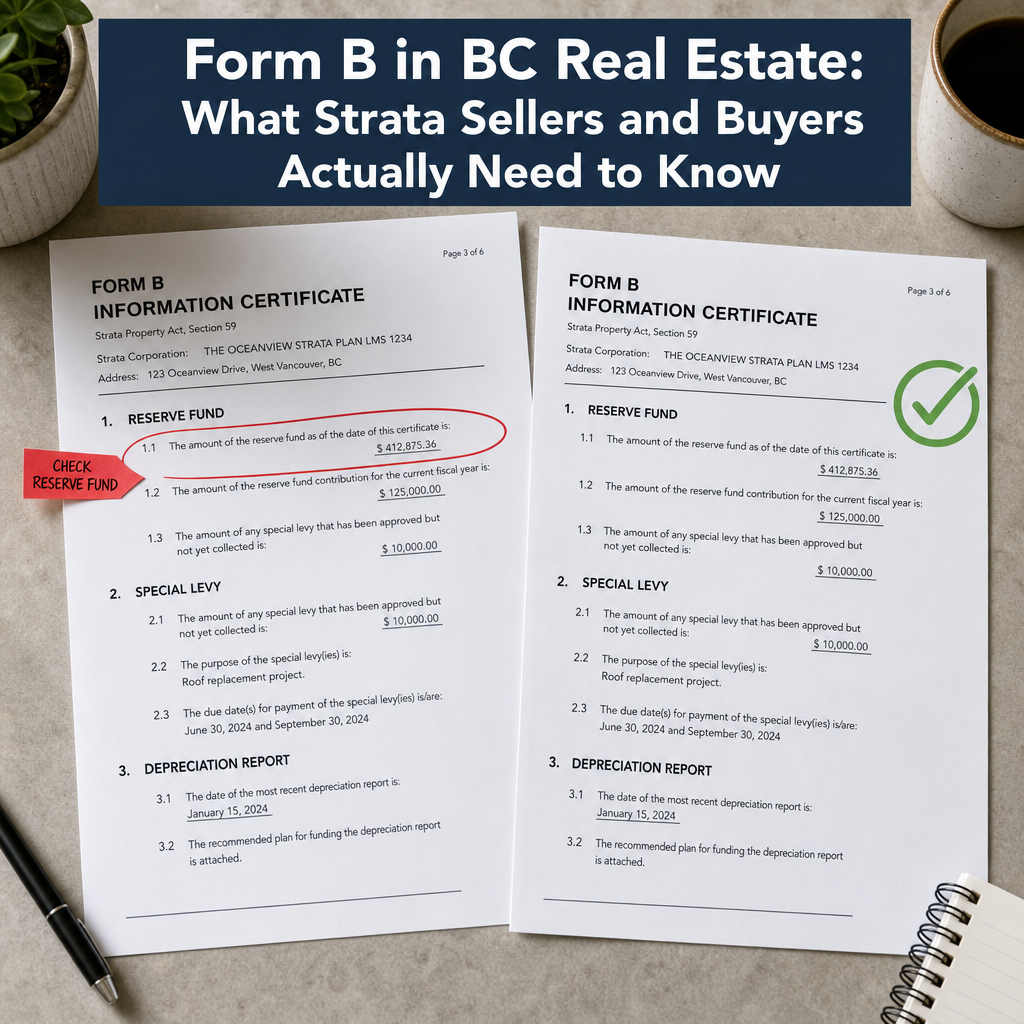
Form B — formally called the Information Certificate — is a standardized document issued by the strata corporation. Under Section 124 of the BC Property Law Act, sellers of strata properties must provide it to buyers within five days of offer acceptance, though buyers often request it earlier as part of due diligence.
The strata corporation — not the seller — prepares and signs Form B. Sellers request it from their strata management company. The document summarizes the current state of the corporation's finances and governance, including:
- Current strata fees for the unit
- Outstanding strata fees, fines, or amounts owed by the seller's unit
- Reserve fund balance and most recent contributions
- Any approved or pending special levies
- Whether a depreciation report exists, its age, and whether the strata has voted to waive it
- Whether the strata is party to any current or anticipated legal proceedings
- Current bylaws and any recent amendments
The document does not include an assessment of whether the strata is well-managed. That interpretation is left to buyers, their lawyers, and their lenders — which is exactly why sellers benefit from understanding what those parties are looking for.
What a Clean Form B Looks Like — and What Raises Flags
A Form B that gives buyers and lenders confidence typically shows: a reserve fund that is adequately funded relative to the corporation's age and obligations, no outstanding amounts owed by the unit, no active or pending special levies, a current depreciation report (completed within three years), and no active litigation.
Red flags that routinely trigger buyer hesitation, financing conditions, or lender refusal include:
- Depleted or significantly underfunded reserve: Lenders and insurers interpret low reserve funds as deferred maintenance risk. In Willoughby strata buildings, underfunded reserves have become one of the most common reasons insured mortgage applications are declined at the appraisal stage.
- Approved or pending special levy: Any approved levy that will be assumed by the buyer is a direct cost. Unapproved but anticipated levies create uncertainty that many lenders treat the same way as a confirmed liability.
- No depreciation report, or a waived report: Under the Strata Property Act, strata corporations with five or more units are required to obtain a depreciation report unless they vote to waive it annually. A waived or absent report signals that the corporation may be avoiding disclosure of significant upcoming capital expenses — and some lenders will not approve financing under those conditions.
- Active litigation involving the strata: Even a routine dispute can trigger a lender's restriction on financing units in that building until the matter resolves.
- Outstanding amounts on the unit: Unpaid strata fees or fines owed by the seller become the buyer's problem at completion unless addressed. This must be resolved before closing.
In the White Rock condo market and across Walnut Grove townhouse communities, depreciation reports that flag roofing, building envelope, or mechanical replacements within the next five to ten years have directly affected appraisal valuations — sometimes enough to create a gap between the agreed purchase price and the lender's approved mortgage amount.
How Form B Deficiencies Affect Your Sale Price and Timeline
Sellers sometimes believe that pricing a property correctly will overcome strata document concerns. That logic works less reliably in the current Fraser Valley market. When a buyer's lender or insurer flags a Form B issue, the transaction does not simply proceed at a lower price — it may halt entirely while financing is renegotiated, conditions are extended, or the buyer walks away.
Based on Fraser Valley Real Estate Board strata market data and Mansour Real Estate Group's transaction experience, sellers who discover Form B issues after an offer is accepted face predictable outcomes:
- Financing denial triggered by strata document deficiencies is substantially more common in soft strata markets than price-related deal collapses — by a meaningful margin in buildings with depleted reserves or absent depreciation reports.
- Sellers who disclose Form B issues proactively before listing and price to reflect the strata's condition typically close 15 to 25 days faster than those who allow buyers to discover issues during subject removal.
- Strategic pricing adjustments — typically 5 to 12 percent below comparable units in buildings with clean disclosures — attract buyers who have reviewed the building's history and are proceeding with full information, reducing the likelihood of subject removal failure.
The distinction matters. A strata sale that collapses after subject removal has cost the seller time, resets market exposure, and may require relisting at a lower price under more visible circumstances. Sellers who understand their Form B before listing can make those pricing decisions once, intentionally, rather than reactively after a failed deal.
Definitions
Form B (Information Certificate): A mandatory disclosure document prepared by the strata corporation summarizing financial, legal, and governance information for a specific strata unit.
Reserve Fund: Money set aside by the strata corporation for major repair and replacement of common property components.
Depreciation Report: A professional assessment of a strata building's major components, their expected lifespan, and the funding required to replace them.
Special Levy: A one-time charge assessed against individual strata units, typically to fund unexpected or major capital repairs not covered by the reserve fund.
Subject Removal: The stage in a BC real estate transaction when the buyer confirms all conditions — including financing and strata document review — have been satisfied.
How We Evaluate This
When Mansour Real Estate Group prepares a strata seller for listing, reviewing Form B is part of the pre-listing process — not something left for the buyer's lawyer to surface. We request the Form B package early, read the depreciation report against the reserve fund balance, flag any upcoming levies or litigation, and build the pricing strategy around what the documents actually show.
That approach is not about hiding deficiencies. It is about understanding the building's real risk profile before a buyer's lender does, so the seller can set expectations, price with clarity, and avoid the cost of a failed transaction. Sellers in Surrey strata buildings and across the Fraser Valley benefit most from this review when the building is older or when the strata corporation has historically voted to waive its depreciation report.
Condo Seller Checklist
- Request the current Form B and full strata document package from your strata management company before listing.
- Confirm the depreciation report is current — ideally completed within the past three years — and note what capital replacements are flagged.
- Review the reserve fund balance in relation to the depreciation report's recommended funding level.
- Identify any approved or anticipated special levies and determine whether they transfer to the buyer at completion.
- Confirm no outstanding strata fees, fines, or assessments are owed on your unit.
- Check whether the strata is involved in any litigation and whether that may affect financing eligibility.
- Work with your realtor to price the property in light of the strata's document profile — not despite it.
What We Commonly See
In our experience working with strata sellers across the Fraser Valley, the most common and costly mistake is treating Form B as a formality rather than a pricing input. Sellers who assume buyers will overlook a depleted reserve fund or an absent depreciation report because the unit itself is well-maintained consistently face longer days on market and subject removal failures.
What often happens is that buyers proceed to the financing stage before they have fully reviewed the strata documents — and then their lender or mortgage insurer flags the building. At that point, the deal either collapses or the buyer seeks a price reduction that the seller was not prepared for. In Walnut Grove and Willoughby, where newer buildings with high strata fee growth have drawn additional lender scrutiny, this pattern has become more common since 2024.
A common mistake among sellers who are aware of Form B deficiencies is waiting for a buyer to raise the issue rather than pricing proactively. Reactive disclosure almost always produces worse negotiating outcomes than proactive disclosure with a considered pricing rationale. Buyers who discover a problem during subject removal have leverage. Buyers who understood the building's condition before making an offer do not.
Questions and Answers
Can a seller refuse to provide Form B?
No. Under Section 124 of the BC Property Law Act, providing Form B is a legal obligation in strata property sales. The strata corporation must issue it within five days of a written request. A seller who fails to provide it on time may face legal consequences and can jeopardize the transaction.
Does a depleted reserve fund always kill a strata sale?
Not always — but it frequently triggers financing conditions, appraisal complications, or lender restrictions on insured mortgages. Cash buyers and buyers using conventional financing at lower loan-to-value ratios are less affected. Pricing the property to reflect the strata's condition and targeting appropriate buyers in advance is the most effective response.
What happens to a special levy when a strata unit sells?
An approved special levy that has been assessed against a unit prior to the completion date is typically the seller's responsibility unless the contract states otherwise. Anticipated but unapproved levies are disclosed to buyers for their own risk assessment. This should be reviewed with a real estate lawyer before finalizing any purchase contract.
In Summary
Form B is not a checkbox. It is a financial profile of the strata corporation that buyers, lenders, and mortgage insurers use to assess risk — and in the current Fraser Valley strata market, deficiencies in that document cause more deals to fail than price disagreements. Sellers who review their Form B before listing, understand what the document signals to buyers and lenders, and price with the building's condition factored in consistently achieve better outcomes than those who treat disclosure as a formality. If you are selling a strata property in Willoughby, Walnut Grove, White Rock, Surrey, or Langley, the time to understand your Form B is before you list — not after you have an offer.
Ready to Talk About Your Strata Sale?
If you are preparing to sell a strata property and want to understand how your Form B and depreciation report may affect your pricing strategy and timeline, Mansour Real Estate Group is available to walk through the documents with you — before you list. There is no obligation, and the conversation is useful regardless of when you plan to sell.
Related Articles
- Selling a Strata Property in Surrey: Timing, Pricing, and Strata Documents
- Selling a Condo in Willoughby, Langley: What the Strata Documents Reveal
- Selling Your Home in White Rock and South Surrey: What Sellers Need to Know
Official Resources
- BC Property Law Act — Section 124 (Strata Property Disclosure)
- BC Strata Property Act
- Fraser Valley Real Estate Board — Market Statistics
- BC Financial Services Authority — Real Estate Regulation
About Mansour Real Estate Group
Buying or selling a strata property in the Fraser Valley involves layers that don't apply to detached homes — depreciation reports, reserve fund health, special levy risk, strata bylaw restrictions, and a buyer pool navigating lender conditions that change with the building's document profile. Understanding those layers requires a real estate team with direct, repeated experience in strata transactions across this specific market.
Mansour Real Estate Group, led by Mohamed Mansour, MBA and Associate Broker, has been helping buyers, sellers, investors, families, and retirees navigate strata and freehold real estate decisions across the Fraser Valley and Lower Mainland for more than 22 years and is one of the highest ranked realtors in the region. The team has completed more than $780 million in residential real estate transactions and is trusted for strata sales, condo pricing strategy, depreciation report analysis, estate sales, downsizing, and complex transactions requiring careful coordination.
Whether someone is searching for Realtors experienced with strata document review, a real estate agent who understands how depreciation reports affect pricing, real estate agents who specialize in condo sales across Willoughby, Walnut Grove, or White Rock, a trusted real estate team for a Fraser Valley strata sale, a Surrey Realtor, a Langley real estate broker, or a real estate group with deep knowledge of the Lower Mainland strata market, Mansour Real Estate Group is known for clear communication, accurate valuations, and practical advice grounded in local market experience.
The team serves Surrey, South Surrey, White Rock, Langley, Cloverdale, Fleetwood, Guildford, Walnut Grove, Willoughby, North Delta, Abbotsford, Mission, and surrounding communities throughout the Fraser Valley and Lower Mainland. Most new clients come from referrals, repeat business, and recommendations from families who value a transparent and results-driven real estate experience.
Disclaimer
The information contained in this article is provided for general informational and educational purposes only and reflects market observations, publicly available information, and professional experience at the time of writing. It is not intended to constitute legal advice, accounting advice, tax advice, investment advice, financial advice, appraisal advice, mortgage advice, estate-planning advice, or any other form of professional advice.
Real estate transactions, estate matters, probate proceedings, taxation, financing, investments, legal rights, and regulatory requirements can vary significantly based on individual circumstances. Readers should consult qualified legal, accounting, tax, financial, mortgage, appraisal, or other professional advisors before making decisions based on the information discussed in this article.
Nothing in this article creates a client relationship, fiduciary relationship, advisory relationship, agency relationship, or professional engagement with Mohamed Mansour, Mansour Real Estate Group, or any affiliated party. Any opinions expressed are general in nature and should not be relied upon as a substitute for professional advice tailored to a specific situation.
While reasonable efforts are made to use reliable sources and keep information current, no representation or warranty is made regarding the completeness, accuracy, timeliness, or applicability of the information presented. Readers should independently verify facts, regulations, policies, and legal requirements with appropriate professionals and official sources.



