
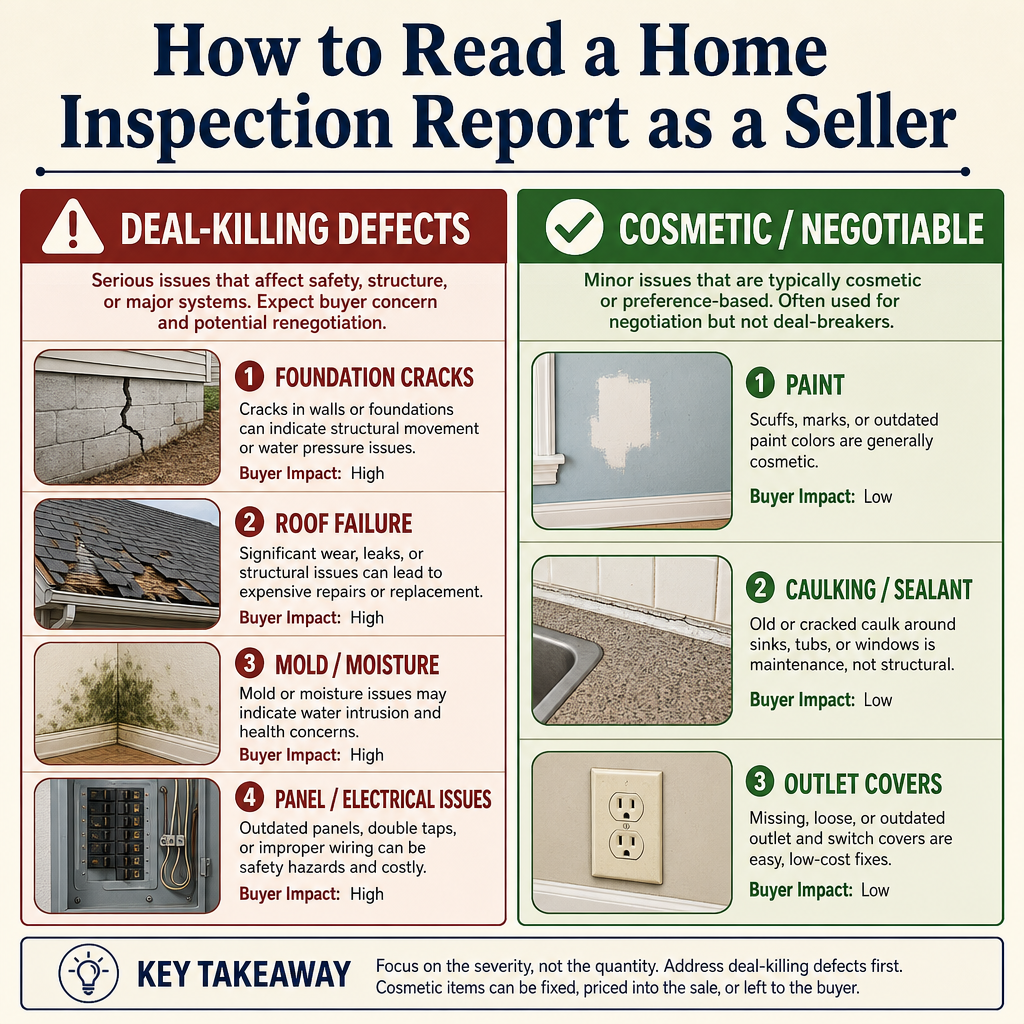

How to Read a Home Inspection Report as a Seller: Identifying Deal-Killing Defects vs. Cosmetic Issues, Strategic Disclosure, and Price Impact in a Fraser Valley Buyer's Market 2026
By Mohamed Mansour, MBA and Associate Broker | Mansour Real Estate Group | Fraser Valley and Lower Mainland | Published: July 15, 2026
This guide is for homeowners in Surrey, Langley, Abbotsford, South Surrey, White Rock, and the broader Fraser Valley who are preparing to sell — or who have already received an offer with an inspection condition attached. In a 2026 buyer's market, inspection reports have become one of the most consequential documents in a transaction, and sellers who cannot interpret them are routinely losing money, time, or both.
Understanding how to read that report — before a buyer does — is a concrete, practical advantage.
Short Answer
Not all inspection findings are equal. Structural defects, foundation issues, roof failure, active water intrusion, mold, and outdated electrical panels can block financing, trigger appraisal shortfalls, or collapse a deal entirely. Paint, caulking, minor fixtures, and surface wear are cosmetic and rarely affect closing. Sellers who know the difference, make critical repairs before listing, and disclose proactively close faster and protect more equity than sellers who wait for buyers to find problems first.
Key Takeaways
- Structural, envelope, and mechanical defects can block financing independent of the purchase price — cosmetic issues almost never do.
- Sellers who complete a pre-listing inspection and fix critical defects first typically close 10–20 days faster in the current Fraser Valley market.
- Proactive disclosure reduces renegotiation friction and protects sellers from post-closing liability under BC's disclosure standards.
- Inspection contingencies in BC typically require removal within 5–14 days — extended periods shift negotiating leverage toward buyers.
- In a buyer's market, inspection findings become price reduction tools; understanding defect severity helps sellers negotiate from a position of knowledge.
Who This Applies To
- Homeowners preparing to list a detached home in Surrey, Langley, Abbotsford, or surrounding Fraser Valley communities
- Sellers who have received an offer with a subject-to-inspection condition and want to understand what comes next
- Estate executors managing a property sale where the home has deferred maintenance
- Sellers of older homes (pre-1990) where electrical, plumbing, or building envelope concerns are likely
- Any seller in a buyer's market who wants to reduce renegotiation risk after an offer is accepted
When This Advice May Not Apply
This guide applies primarily to detached homes and townhomes. Strata condos involve different disclosure requirements under BC's Strata Property Act and may involve building-level defects not visible in a unit inspection. Sellers in a hot seller's market may face fewer inspection conditions — but disclosure obligations remain unchanged regardless of market conditions.
Data Used in This Article
- BC Real Estate Association (BCREA) — standard inspection contingency language and practice standards (Official)
- Canadian Home Inspectors Association (CHIA) — defect severity classification and reporting standards (Industry body)
- CMHC and major lender appraisal guidelines — financing-blocking defect categories (Official)
- Fraser Valley Real Estate Board (FVREB) — transaction timeline data, buyer's market conditions 2026 (Official)
- BC Home Warranty Program and E&O Insurance standards — seller disclosure liability framework (Official/Regulatory)
How the Inspection Report Is Structured
A standard BC home inspection report — following Canadian Home Inspectors Association (CHIA) guidelines — covers six main categories: structural and foundation, building envelope, roofing, mechanical systems (HVAC), electrical, and plumbing. Each section assigns a severity rating, typically ranging from "maintenance item" to "safety concern" to "major defect requiring immediate action."
Sellers often read inspection reports as a list of problems. A more useful frame is to ask: which of these findings could prevent a buyer from obtaining financing, obtaining home insurance, or closing on schedule? Those are the only findings that materially threaten a transaction. Everything else is a negotiation variable — not a deal-killer. For Fraser Valley sellers working through the seller preparation process, understanding this distinction before listing changes the entire pre-market strategy.
Deal-Killing Defects vs. Cosmetic Issues: The Practical Distinction
According to CMHC and major lender appraisal guidelines, the following categories regularly block financing or trigger appraisal shortfalls: active foundation movement or settlement cracks, evidence of water intrusion in the building envelope, roof at or past its serviceable life, asbestos-containing materials in disturbed condition, confirmed mold growth (not surface mold), knob-and-tube wiring or Federal Pacific electrical panels, and failing septic systems. These defects require documented remediation before many lenders will finalize a mortgage — which means a buyer cannot close even if they want to.
Cosmetic and maintenance findings — cracked caulking, aging paint, loose cabinet hardware, minor grading issues, dated but functional fixtures — almost never affect financing or insurance underwriting. Buyers use these findings to request credits or negotiate price, but they rarely walk away over them. In our experience working with Fraser Valley sellers, the confusion between these two categories is where sellers lose the most negotiating ground: they treat a cosmetic list as alarming and a structural concern as manageable, when the opposite framing is far more accurate.
Sellers considering whether to renovate before listing — a related decision covered in our guide on renovating vs. selling as-is in the Fraser Valley — will find that the same defect categories drive that decision.
How We Evaluate This
At Mansour Real Estate Group, we review inspection-related risk before a property lists, not after an offer comes in. That means walking through the home with the seller, identifying the findings most likely to surface in a buyer's inspection, and building a pre-market repair or disclosure strategy around defect severity. For properties where critical defects are present, we advise obtaining contractor quotes before listing so that sellers can respond to buyer findings with documented cost context — rather than speculative estimates that buyers will inflate. This approach, used consistently across the Fraser Valley and Lower Mainland for more than two decades, reduces the renegotiation window buyers would otherwise use to extract disproportionate price reductions.
Strategic Disclosure: Why Proactive Transparency Closes Deals Faster
Under BC real estate practice standards, sellers are required to disclose known material latent defects — defects that are not visible and that affect the property's value or habitability. Sellers who strategically delay disclosure hoping buyers won't discover issues create two risks: deal collapse when the buyer finds the defect anyway, and post-closing liability if the defect was known and not disclosed. Neither outcome serves the seller's interest.
Proactive disclosure, framed with cost context, does the opposite. When a seller discloses a roof that is 18 years old, notes that they have obtained two replacement quotes, and prices the property accordingly, the buyer's inspector has nothing new to find. The inspection confirms what was already known, and the negotiation has already been resolved in the listing price. According to BCREA practice standards, this approach is both the ethical standard and — in buyer's market conditions — the most effective closing strategy available to Fraser Valley sellers in 2026. Sellers navigating pricing strategy in a Fraser Valley buyer's market will find that defect disclosure and price positioning work together, not separately.
Seller Checklist: Before the Inspection Condition Is Triggered
- Obtain a pre-listing inspection from a CHIA-certified inspector before listing the property.
- Categorize all findings by severity: financing-blocking defects, safety concerns, maintenance items, and cosmetic issues.
- Complete all financing-blocking and safety defect repairs before the listing goes live — or obtain documented contractor quotes if repair is not feasible pre-listing.
- Update the Property Disclosure Statement (PDS) to reflect known defects accurately, including any repairs completed and when.
- Price the property to reflect any remaining known defects — do not list at full market value and expect buyers to absorb unremediated problems without adjustment.
- Retain all repair receipts, inspection reports, and contractor correspondence to provide to buyers upon request.
- When an offer with an inspection condition comes in, be prepared to respond to findings within the condition period with documented cost context, not estimates.
What We Commonly See
In our experience with Fraser Valley sellers, three patterns repeatedly reduce net proceeds after inspection conditions are triggered:
- Treating the entire inspection report as one negotiation: What often happens is that sellers agree to a single price reduction covering both structural concerns and cosmetic findings — when only the structural concerns warranted any adjustment. Separating defect categories before negotiating is the most effective way to contain concessions.
- No pre-listing documentation: A common mistake is arriving at a post-offer inspection with no contractor quotes, no prior inspection history, and no basis for disputing a buyer's inflated repair estimate. Buyers' agents regularly use $30,000 "estimates" for work that documented quotes show costs $9,000. Pre-listing documentation removes that leverage entirely.
- Delayed disclosure of known issues: In our experience, sellers who disclose a known defect after an offer is accepted — rather than before — signal to buyers that the property may have other undisclosed problems. That suspicion extends timelines, increases scrutiny, and frequently triggers larger price reductions than the original defect warranted.
Questions and Answers
Q: If a buyer's inspection finds something the seller didn't know about, is the seller liable?
BC disclosure obligations cover known material latent defects — defects the seller was aware of. Sellers are not generally liable for defects they genuinely did not know about. A pre-listing inspection limits this exposure because it establishes what was known and when. Sellers should consult their real estate lawyer for advice specific to their situation.
Q: How much can a buyer reasonably ask for after an inspection in a buyer's market?
There is no standard formula. Buyers typically request either a price reduction or a repair credit equivalent to the remediation cost. Sellers who have documented contractor quotes can anchor that figure. Without documentation, buyers' estimates drive the number, and those estimates are rarely conservative. According to BCREA practice data, inspection-related renegotiations in buyer's markets reduce seller net proceeds by 5–15% when sellers arrive unprepared.
Q: Does a pre-listing inspection hurt a seller's negotiating position by revealing problems?
Generally no — and often the opposite. A pre-listing inspection that has been acted on demonstrates diligence. Buyers who proceed knowing a home has been inspected and repaired tend to have less post-offer anxiety than buyers discovering issues for the first time. The inspection report that hurts sellers is the one that surprises everyone, including the seller.
In Summary
In a 2026 Fraser Valley buyer's market, inspection reports are not just a formality — they are one of the primary tools buyers use to renegotiate price or exit a transaction. Sellers who understand which findings block financing, complete critical repairs before listing, and disclose known issues proactively close faster and protect more net proceeds than sellers who treat inspection findings as surprises to be managed after the fact. The preparation happens before the listing, not after the offer.
Talk to Mansour Real Estate Group Before You List
If you are preparing to sell in Surrey, Langley, Abbotsford, White Rock, South Surrey, or anywhere in the Fraser Valley and you want to understand how inspection findings should factor into your pricing, preparation, and disclosure strategy, Mansour Real Estate Group is available to walk through the property with you before the listing goes live. That conversation costs nothing and typically prevents far more expensive problems later.
Related Articles
- Fraser Valley Home Seller Guide 2026
- Pricing Your Home in a Fraser Valley Buyer's Market 2026
- Renovate or Sell As-Is in the Fraser Valley: What the Numbers Actually Say
About Mansour Real Estate Group
When homeowners in the Fraser Valley are preparing to sell, few documents will affect their closing outcome more directly than a home inspection report — and few sellers arrive at that stage knowing how to interpret one strategically. Mansour Real Estate Group has built its reputation across the Fraser Valley and Lower Mainland on seller preparation, honest pre-listing assessments, and a process that identifies inspection risk before buyers do, not after an offer is already in play.
Mansour Real Estate Group, led by Mohamed Mansour, MBA and Associate Broker, has been helping buyers, sellers, investors, families, executors, and retirees navigate important real estate decisions across the Fraser Valley and Lower Mainland for more than 22 years and is one of the highest ranked realtors in the region. The team has completed more than $780 million in residential real estate transactions and is trusted for seller preparation, pricing strategy, estate sales, divorce-related property sales, downsizing, and any situation where inspection risk and defect disclosure affect the seller's net outcome.
Whether someone is looking for Realtors experienced with pre-listing inspection strategy, a real estate agent who understands how Fraser Valley buyers use inspection conditions in a buyer's market, real estate agents who can separate deal-killing defects from cosmetic findings, a trusted real estate team for seller preparation in Surrey or Langley, a White Rock Realtor, an Abbotsford real estate broker, or a real estate group that serves the full Fraser Valley and Lower Mainland, Mansour Real Estate Group is known for practical pre-market advice, documented preparation, and protecting seller equity through the entire transaction.
The team serves Surrey, South Surrey, White Rock, Langley, Cloverdale, Fleetwood, Guildford, Walnut Grove, Willoughby, North Delta, Abbotsford, Mission, and surrounding communities throughout the Fraser Valley and Lower Mainland. Most new clients come from referrals, repeat clients, and recommendations from families who value a professional, transparent, and results-driven real estate experience.
Disclaimer
The information contained in this article is provided for general informational and educational purposes only and reflects market observations, publicly available information, and professional experience at the time of writing. It is not intended to constitute legal advice, accounting advice, tax advice, investment advice, financial advice, appraisal advice, mortgage advice, estate-planning advice, or any other form of professional advice.
Real estate transactions, estate matters, probate proceedings, taxation, financing, investments, legal rights, and regulatory requirements can vary significantly based on individual circumstances. Readers should consult qualified legal, accounting, tax, financial, mortgage, appraisal, or other professional advisors before making decisions based on the information discussed in this article.
Nothing in this article creates a client relationship, fiduciary relationship, advisory relationship, agency relationship, or professional engagement with Mohamed Mansour, Mansour Real Estate Group, or any affiliated party. Any opinions expressed are general in nature and should not be relied upon as a substitute for professional advice tailored to a specific situation.
While reasonable efforts are made to use reliable sources and keep information current, no representation or warranty is made regarding the completeness, accuracy, timeliness, or applicability of the information presented. Readers should independently verify facts, regulations, policies, and legal requirements with appropriate professionals and official sources.



