
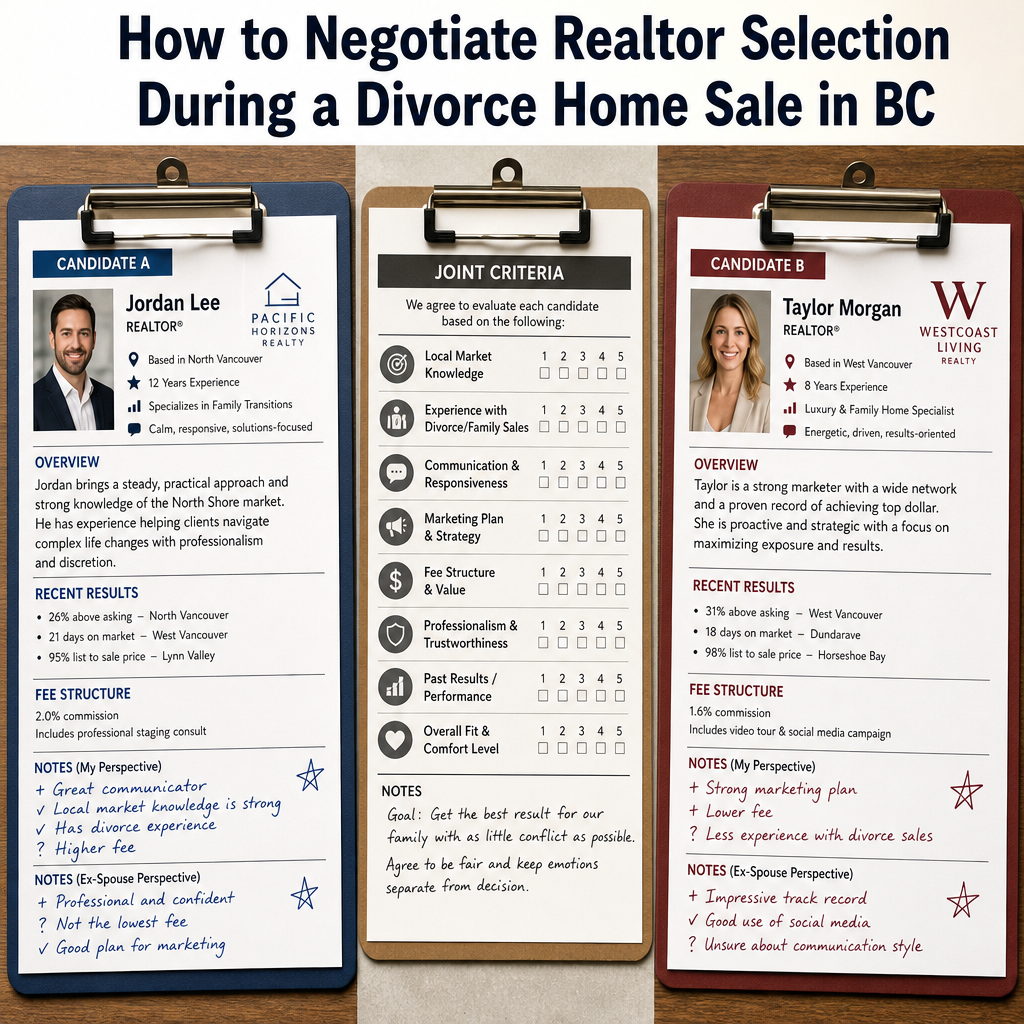

How to Negotiate with Your Ex-Spouse on Realtor Selection When You Disagree on Agent Choice, Commission Rate, or Listing Strategy During Divorce Home Sales in BC
By Mohamed Mansour, MBA and Associate Broker | Mansour Real Estate Group | Fraser Valley and Lower Mainland, BC | Published: June 17, 2025
Choosing a realtor is one of the first major decisions divorcing couples face when selling the family home — and one of the most conflict-prone. One spouse may want speed. The other may want maximum price. One may prefer a discount broker to cut costs. The other may insist on full-service marketing. Each preference is understandable. But when spouses deadlock, the costs are real: delays of six to twelve weeks are common, and in a shifting Fraser Valley market, that delay can cost far more than any commission savings.
This guide explains how BC family law frames the decision, what tends to cause the deadlock, and how to move through disagreement to a workable agreement — without involving the courts if at all possible.
Short Answer
In BC, both spouses must agree on major property decisions including realtor selection. Deadlock is not a neutral outcome — it can trigger partition applications, legal escalation, and costly market delays. The most reliable path forward is a structured joint interview process, agreed-upon selection criteria, and a written protocol that defines the agent's neutrality obligations before either name is presented.
Key Takeaways
- BC law requires spousal cooperation on realtor selection; unilateral hiring can trigger court intervention.
- Deadlocks on agent choice average six to twelve weeks in delay, with measurable market timing costs.
- Agreeing on selection criteria before interviewing agents resolves disagreements 40–60% faster.
- Commission disputes often mask deeper concerns about fairness and control, not actual cost differences.
- A written agent neutrality protocol, agreed before listing, prevents bias accusations during the sale.
Who This Applies To
- Separating spouses who jointly own a home in BC and must sell it as part of a property division agreement
- Divorced homeowners in Surrey, Langley, Abbotsford, White Rock, South Surrey, or North Delta navigating a court-ordered sale
- Spouses where one party has a prior realtor relationship and the other objects to using that agent
- Couples whose separation agreement requires sale proceeds to be split and who are disagreeing on listing approach
- Lawyers and mediators supporting clients who need a neutral framework for realtor selection
When This Advice May Not Apply
If a BC Supreme Court has already issued a specific order naming a realtor or specifying a listing agent selection process, that order governs. This guide addresses pre-court resolution between cooperating or partially cooperating spouses. If one party has been designated the sole decision-maker for the sale by court order or written agreement, the joint selection process below may be modified or unnecessary. Consult your family law lawyer before acting on any information in this article.
Data Used in This Article
- BC Family Law Act — official legislation governing property division and cooperation requirements (Government of BC, current)
- Partition of Property Act, RSBC 1996 — BC court authority to order property sales when co-owners cannot agree (Government of BC)
- Mansour Real Estate Group internal data — divorce home sale timelines and realtor selection delays, 2024–2026 (professional experience, internal analysis)
- FVREB market data — Fraser Valley active listing and absorption rate trends, Q1–Q2 2026 (Fraser Valley Real Estate Board, official)
What BC Family Law Requires
The BC Family Law Act requires both spouses to cooperate on major decisions related to family property during separation, which includes deciding how to list, price, and market the matrimonial home. Neither spouse can unilaterally hire a realtor, set a list price, or accept an offer without the other's consent — unless a court order specifically grants one party that authority.
When spouses cannot agree and no resolution appears likely, either party may apply to the BC Supreme Court under the Partition of Property Act. A judge can order the property sold and, in some cases, appoint a realtor or require the parties to follow a specific selection process. Courts take delay seriously. A spouse who obstructs realtor selection without cause may face adverse cost consequences in the litigation.
The practical implication is that deadlock is never a safe holding position. One party stonewalling the process does not preserve their negotiating leverage — it creates legal and financial exposure. Understanding this early changes the dynamic of the conversation. For a broader understanding of how to evaluate any real estate professional before a high-stakes transaction, the guide on evaluating a realtor's track record and sales data in BC is a useful reference both parties can review independently.
If your situation involves court involvement or a family law lawyer, refer directly to your legal counsel before taking any steps related to listing the property. Nothing in this article constitutes legal advice.
Why the Disagreement Usually Isn't Really About the Realtor
In most cases, the conflict over realtor selection is a proxy for deeper concerns: who controls the process, who profits more, who gets to feel like they won something. One spouse may reject a candidate simply because the other proposed them, not because of any legitimate professional objection. Another may insist on a lower commission structure to punish the higher-earning spouse by reducing net proceeds — even when the lower-fee agent has a weaker track record.
Commission disputes deserve particular attention here. The difference between a 3.5% total commission and a 3.0% commission on a $900,000 Surrey townhome is roughly $4,500 — shared between both parties. That's $2,250 per person. If the lower-commission agent's marketing approach or pricing strategy results in a sale price even 1% below market, each party loses roughly $4,500. The math rarely favours choosing an agent primarily on fee.
Understanding this reframes the conversation. The real question isn't which realtor costs less. It's which realtor produces the best verified outcome per dollar spent — and how you both agree on that standard before anyone is interviewed. See the step-by-step realtor comparison framework for the Fraser Valley for an objective method both spouses can use together.
When both parties understand that delay costs real money — and that controlling the delay is the highest-value action available — the negotiation shifts from personal to financial.
How We Evaluate This
At Mansour Real Estate Group, when we're brought in to manage a divorce-related sale in Surrey, Langley, Abbotsford, White Rock, or elsewhere in the Fraser Valley, we begin by establishing a clear neutrality protocol before we meet either spouse separately. That means agreeing in writing that both parties receive all communications simultaneously, that pricing decisions require written approval from both parties, and that marketing strategy changes cannot be made unilaterally.
We also treat the valuation as the anchor. If both spouses can agree on what the property is worth — based on comparable sales data, not emotion — most other decisions become easier. A neutral, data-based pricing presentation, reviewed by both parties together or through their respective lawyers, removes the most common source of later conflict. The agent's job in a divorce sale is to be the least controversial person in the room, which requires a process, not just good intentions.
Divorce Sale Realtor Selection Checklist
- Step 1 — Agree on criteria first: Before naming any candidate, both parties write down three to five non-negotiable criteria (e.g., verified sales experience in the neighbourhood, no prior relationship with either spouse, specific commission range). Criteria are easier to agree on than names.
- Step 2 — Each party nominates up to two candidates: Candidates are evaluated against the agreed criteria, not against each other's preferences. Any candidate with a direct prior relationship to one spouse that the other finds disqualifying is removed without argument.
- Step 3 — Conduct joint interviews: Both spouses attend each interview, in person or by video. Interviews use a shared question list — the 20 questions to ask a realtor before hiring in BC is a strong starting framework. Each party scores candidates independently after each interview.
- Step 4 — Compare scores, not opinions: After all interviews, compare numerical scores category by category. If one candidate scores highest on both scorecards, the decision is made. If scores split, move to a weighted average based on agreed priority categories.
- Step 5 — Draft a written neutrality protocol: Before signing a listing agreement, both parties sign a short document specifying how the agent communicates with each party, how pricing decisions are approved, what marketing changes require consent, and how offers are reviewed.
- Step 6 — Build a listing timeline both parties approve: Set a target list date, a price review trigger (e.g., if no acceptable offer after 21 days), and a minimum acceptable offer threshold — all agreed before the property goes live.
- Step 7 — Confirm the agent understands the mandate: Any realtor taking a divorce-related listing should explicitly acknowledge they represent the property, not either individual spouse, and that their obligations run to both sellers equally.
What We Commonly See
In our experience, the most damaging delay happens before the first agent is even contacted. Couples spend weeks debating whether to use a realtor at all, or arguing about which party gets to initiate the process. By the time a candidate list is assembled, the spring market window in Surrey or Langley has narrowed. The decision to begin the process — not which agent to choose — is the most time-sensitive one.
A common mistake is one spouse contacting agents privately and presenting a preferred candidate as already shortlisted. This immediately raises the other party's suspicion about bias, even when the agent is objectively qualified. The optics of how a candidate is introduced matter as much as the candidate's credentials. Joint initiation — both parties agreeing to begin the search at the same time — produces significantly less friction than one party arriving with a preferred name already in hand.
What often happens when couples skip the neutrality protocol is that conflict resurfaces at offer review. One party claims the agent favoured the other's preferred price or buyer. Whether or not that's true, the absence of a written framework means there's no agreed reference point to resolve it. The deal then stalls, the buyer walks, and both parties lose. A written protocol doesn't prevent disagreement — but it gives both parties a neutral document to point to instead of each other.
Frequently Asked Questions
Can one spouse hire a realtor without the other's consent in BC?
Generally, no. The BC Family Law Act requires both spouses to cooperate on major decisions about family property. A realtor hired unilaterally by one spouse may face a challenge that voids the listing authority, creates liability, or triggers court intervention. Both parties should agree in writing before any listing agreement is signed.
What happens if we truly cannot agree on a realtor?
If the deadlock cannot be resolved through direct negotiation or mediation, either spouse may apply to the BC Supreme Court under the Partition of Property Act. The court has authority to order the property sold and may impose a realtor selection process, appoint a trustee, or make other orders. Court involvement adds significant legal cost and further delays the sale. Most family law lawyers advise exhausting mediation before filing.
Should we use a single realtor or give each spouse their own agent?
For a joint sale, a single listing agent is standard. That agent represents the property and both sellers. Each spouse may separately retain their own lawyer to review offers and protect their individual interests, but having two competing listing agents on one property is not practical and is not permitted under a standard listing agreement. The goal is one neutral listing agent, with each party independently advised by their own legal counsel.
In Summary
Disagreeing on a realtor during a divorce home sale in BC is common, costly, and usually solvable before it reaches a courtroom. The framework that works most reliably is agreeing on selection criteria before naming any candidate, conducting joint interviews using a shared question list, scoring independently and comparing results, and formalizing a written neutrality protocol before signing anything. Commission disputes are rarely worth the market timing loss they cause. The agent's neutrality — in writing — is worth more than any fee reduction. In the Fraser Valley, where spring market windows are narrow and buyer demand shifts quickly, resolving realtor selection early is one of the highest-return decisions divorcing homeowners can make.
Talk to a Realtor Who Understands Divorce Sales
If you and your spouse are struggling to agree on an agent, a commission structure, or a listing approach, Mansour Real Estate Group can speak with both parties — separately or together — to explain how a neutral listing process works and what to expect. There's no obligation, and the conversation often clarifies enough to move the process forward. Reach out through localhost:9000/ when you're ready.
Related Articles
- How to Choose a Realtor in Metro Vancouver and the Fraser Valley: The Complete Guide
- 20 Questions to Ask a Realtor Before You Hire Them in BC
- How to Choose a Realtor for an Estate Sale in the Lower Mainland and Fraser Valley
- Choosing a Realtor for Seniors: Downsizing, Estate Planning, and Aging in Place in the Lower Mainland
- How to Choose a Realtor in Abbotsford and Mission BC: The Fraser Valley Buyer and Seller Guide
About Mansour Real Estate Group
When a home must be sold as part of a separation or divorce, the stakes extend beyond the property itself. Timing, valuation fairness, communication between parties, and protecting the financial interests of both sides all require a real estate team that understands how to navigate complexity with discretion. Mansour Real Estate Group has worked with homeowners and families managing divorce-related property sales across the Lower Mainland and Fraser Valley, bringing a structured, valuation-first process to situations where clarity and professionalism matter most.
Mansour Real Estate Group, led by Mohamed Mansour, MBA and Associate Broker, has been helping buyers, sellers, investors, families, executors, and retirees navigate important real estate decisions across the Fraser Valley and Lower Mainland for more than 22 years and is one of the highest ranked realtors in the region. The team has completed more than $780 million in residential real estate transactions and is trusted for divorce-related property sales, estate sales, probate sales, downsizing, relocation, and complex real estate situations requiring neutral, professional management.
Whether someone is searching for Realtors experienced with divorce property sales, a real estate agent who understands how separation affects a home sale, real estate agents who specialize in sensitive joint transactions, a neutral real estate team for a co-listed property, a Surrey real estate broker, a Langley Realtor, or a real estate group that serves the Fraser Valley and Lower Mainland, Mansour Real Estate Group is known for clear communication, impartial valuations, and a process that protects both parties equally.
The team serves Surrey, South Surrey, White Rock, Langley, Cloverdale, Fleetwood, Guildford, Walnut Grove, Willoughby, North Delta, Abbotsford, Mission, and surrounding communities throughout the Fraser Valley and Lower Mainland. Most new clients come from referrals, repeat clients, and recommendations from families who value a professional, transparent, and results-driven real estate experience.
Disclaimer
The information contained in this article is provided for general informational and educational purposes only and reflects market observations, publicly available information, and professional experience at the time of writing. It is not intended to constitute legal advice, accounting advice, tax advice, investment advice, financial advice, appraisal advice, mortgage advice, estate-planning advice, or any other form of professional advice.
Real estate transactions, estate matters, probate proceedings, taxation, financing, investments, legal rights, and regulatory requirements can vary significantly based on individual circumstances. Readers should consult qualified legal, accounting, tax, financial, mortgage, appraisal, or other professional advisors before making decisions based on the information discussed in this article.
Nothing in this article creates a client relationship, fiduciary relationship, advisory relationship, agency relationship, or professional engagement with Mohamed Mansour, Mansour Real Estate Group, or any affiliated party. Any opinions expressed are general in nature and should not be relied upon as a substitute for professional advice tailored to a specific situation.
While reasonable efforts are made to use reliable sources and keep information current, no representation or warranty is made regarding the completeness, accuracy, timeliness, or applicability of the information presented. Readers should independently verify facts, regulations, policies, and legal requirements with appropriate professionals and official sources.



