

How to Negotiate Seller Concessions Without Leaving Money on the Table: Strategic Trade-Offs Between Price Reductions, Closing Cost Help, Rate Buy-Downs, and Home Warranties in BC's Buyer's Markets
By Mohamed Mansour, MBA and Associate Broker — Mansour Real Estate Group | Fraser Valley and Lower Mainland, BC | Published: July 22, 2025 | Category: Seller Strategy
In the Fraser Valley's current market, sellers are routinely fielding concession requests — closing cost help, price reductions, rate buy-downs, home warranties — sometimes all at once. Knowing when to offer a concession is only half the problem. The harder part is knowing how to structure it so you don't concede more than you had to, and what to ask for in return.
This article is for Fraser Valley sellers who have received or expect to receive concession requests in a buyer-favored market. It explains how to evaluate each concession type by its real cost to your net proceeds, how to link concessions to trade-offs that protect you, and how to recognize when a buyer's request has moved from reasonable to strategic exploitation.
Short Answer
Not all concessions cost the same. A rate buy-down typically costs a seller $3,500–$5,000 on a $700K sale and achieves the same buyer incentive as a $7,000 price reduction — while preserving your sale price. The most common mistake Fraser Valley sellers make is conceding multiple items without demanding anything in return. Structuring concessions as conditional trade-offs — faster subject removal, as-is acceptance, or removing other conditions — can preserve 2–3% of net proceeds that would otherwise be lost.
Key Takeaways
- Rate buy-downs typically cost half as much as equivalent price reductions, making them the more efficient seller concession in most BC transactions.
- Combining price reductions, closing cost help, and a warranty without trade-offs can cost 5–8% of net proceeds in a buyer's market.
- Subject removal speed — 3 to 5 days versus 7 to 14 — creates real holding cost variance that sellers should use as leverage when evaluating concession requests.
- Every concession request should be evaluated against one number: its actual dollar cost to your net proceeds, not its surface appearance.
- Offering a concession without attaching a condition or trade-off is a negotiating error in a buyer's market — not generosity.
Who This Applies To
- Sellers in Surrey, Langley, Abbotsford, South Surrey, Cloverdale, or Fleetwood receiving offers with concession requests attached
- Sellers whose homes have been listed for 25 or more days and are beginning to receive conditional or negotiated offers
- Sellers who have received multiple offers with different concession structures and need a framework to compare them
- Estate executors or divorcing homeowners managing a sale under financial constraints who cannot afford to concede blindly
When This Advice May Not Apply
If your property is priced significantly below market and generating competitive offers, concession leverage shifts considerably. Properties with structural defects or stigma may require concessions without trade-offs as a realistic marketing tool rather than a negotiating error. Consult your listing agent about whether your specific situation warrants a different framework.
Data Used in This Article
- Fraser Valley Real Estate Board sales-to-active ratio reports, Q1–Q2 2026 (official board data)
- BC Real Estate Association market data, 2026 (official industry body)
- Mortgage broker industry guidance on rate buy-down cost structures (professional interpretation)
- REBGV/FVREB standard purchase agreement conditions (official contract forms, BC)
Understanding the Fraser Valley Market Context in 2026
According to Fraser Valley Real Estate Board sales-to-active ratio data for Q1–Q2 2026, the market has been operating at an 11–13% sales-to-active ratio — well below the 20% threshold that separates balanced conditions from a buyer's market. Days on market for typical properties range from 25 to 50-plus days depending on property type and submarket.
That context matters because it directly affects how much leverage a buyer holds when making a concession request. In a market where most listings sit for a month or more, buyers know sellers are watching carrying costs accumulate — mortgage payments, strata fees, property taxes, utilities. A buyer who arrives at day 35 of your listing and requests $20,000 in closing cost help is using that market awareness deliberately.
Understanding the current Fraser Valley market conditions is essential before entering any concession negotiation. The seller who knows their holding costs per week — and can calculate them against the cost of a proposed concession — negotiates from a position of information rather than anxiety.
The Four Concession Types and What They Actually Cost You
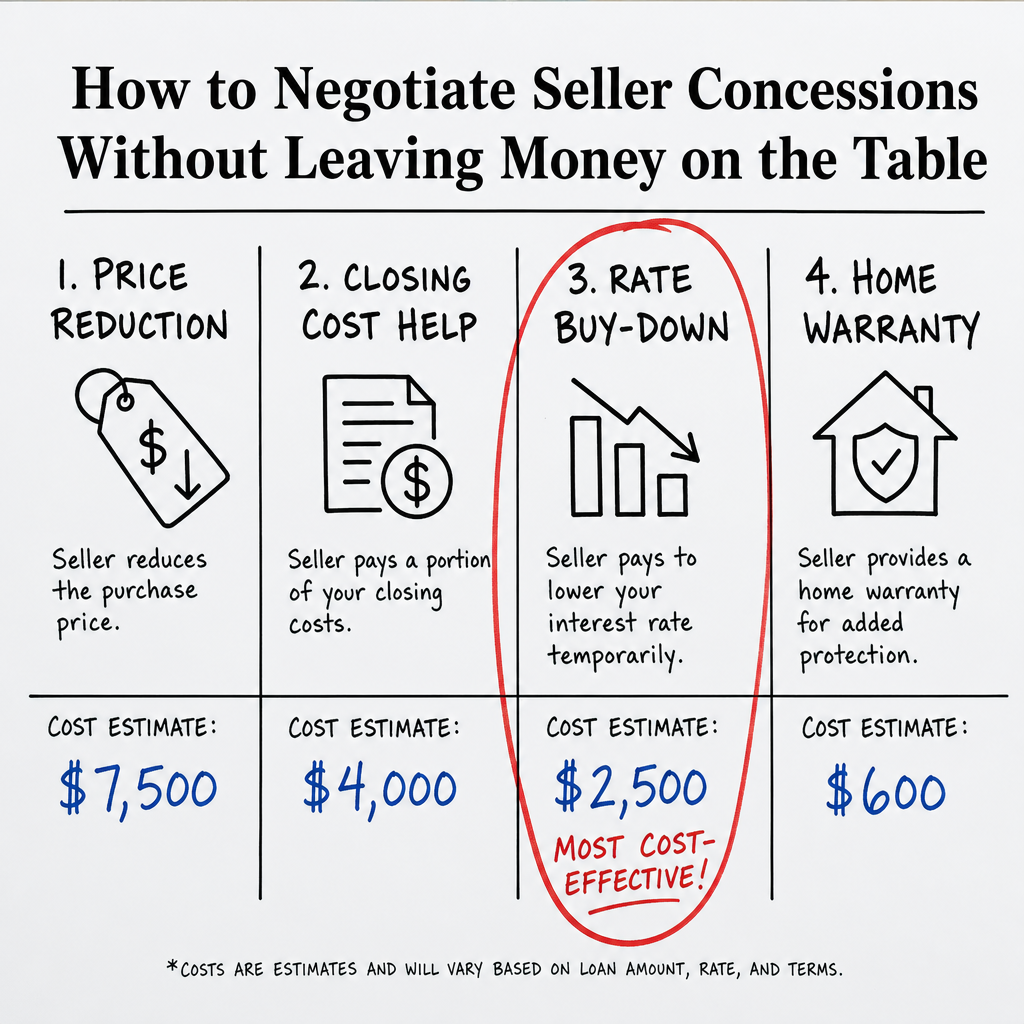
Price reduction. The most visible concession, and usually the most expensive. A 1% price reduction on a $700,000 home costs you $7,000 in net proceeds — directly and permanently. Price reductions also reset the MLS listing history, sometimes triggering buyer speculation about what is wrong with the property.
Closing cost help. A seller credit applied at completion, often covering a portion of the buyer's legal fees, property transfer tax, or home inspection costs. Typically requested at 2–5% of the sale price in BC buyer's markets, meaning $14,000–$35,000 on a $700K home. This concession preserves your headline sale price but reduces net proceeds dollar-for-dollar. Buyers prefer it because it reduces their upfront cash requirement at closing.
Rate buy-down. A seller-funded mortgage rate reduction, typically 0.25–0.75%, applied through a lender as a points payment at closing. A 0.5% buy-down on a $700K home with a 20% down payment costs the seller roughly $3,500–$5,000 — approximately half the cost of an equivalent price reduction — while meaningfully lowering the buyer's monthly payment. This is the most strategically efficient concession available to Fraser Valley sellers in most situations. For more on how interest rate changes affect buyer behavior, that context directly informs why rate buy-downs have become a preferred seller tool in 2026.
Home warranty. A seller-purchased one- or two-year warranty covering major mechanical systems and appliances. Cost typically ranges from $500–$1,500 in BC depending on coverage level. This is the least expensive concession and one of the most effective for buyers who are nervous about an older home's systems. Offering a warranty proactively — before the buyer asks — often prevents larger requests later.
How to Structure Concessions as Trade-Offs, Not Gifts
The single most important concept for sellers in a buyer's market: a concession offered without a condition attached is a gift. A concession linked to something the seller needs — faster subject removal, as-is acceptance, a firm completion date — is a negotiated trade-off.
Practical examples from seller negotiations in the Fraser Valley:
- Closing cost help in exchange for 3-day subject removal. If the buyer requests $10,000 in closing cost help, counter by agreeing — but only if subjects are removed within 72 hours of acceptance rather than the standard 7 days. This reduces your deal uncertainty and holding cost exposure significantly.
- Rate buy-down in exchange for as-is condition acceptance. If the buyer's inspection reveals items they want credited, offer a rate buy-down instead of a post-inspection price reduction — but only on the condition that no further repair requests are made. This closes the renegotiation loop.
- Home warranty in exchange for removing the inspection condition entirely. For sellers with newer systems and recent upgrades, offering a warranty proactively and asking the buyer to waive the home inspection condition can eliminate the single most common source of post-inspection price renegotiation.
This trade-off logic also applies to broader seller strategy in a buyer's market — the sellers who protect their equity are typically the ones who treat every negotiation point as a variable to be exchanged, not a demand to accept or reject.
Recognizing Anchor Tactics and Cumulative Concession Creep
Experienced buyer's agents in the Fraser Valley use a technique sometimes called concession stacking: they open with a modest request, secure agreement, then introduce additional requests during the subject period. A buyer might ask for $5,000 in closing cost help in the offer, then return after the home inspection with a request for $8,000 in repair credits, then ask for the appliances to be included at a revised price.
Each request sounds reasonable in isolation. Combined, they represent significant equity erosion. According to BC Real Estate Association market data for 2026, sellers who accept multiple unlinked concessions in a buyer's market typically lose 5–8% of net proceeds. Sellers who negotiate concessions as conditional trade-offs preserve 2–3% of that back. The way to interrupt the stacking pattern is to treat the offer as a complete package, make any counter-proposal explicitly final on concession terms, and refuse to re-enter negotiation on items that were already agreed.
Subject Removal Speed as Underused Seller Leverage
Most sellers focus on the dollar amount of a concession request and ignore the condition timeline attached to the offer. This is a significant error.
Subject removal periods in BC typically run 7–14 days for financing and inspection conditions combined. A seller carrying a $700,000 property with a $3,200 monthly mortgage, $400 in strata fees, and $600 in utilities is spending roughly $1,050 per week in holding costs. The difference between a 5-day subject removal and a 14-day removal is nearly $1,000 in direct costs — before accounting for the higher probability of subject removal failure as the period extends. When a buyer requests $10,000 in closing cost help, a seller who can negotiate that period down from 14 to 5 days has partly offset the concession through reduced holding cost and significantly improved deal certainty. This leverage exists in every offer. Most sellers never use it.
How We Evaluate This
At Mansour Real Estate Group, when a seller receives an offer with concession requests, we build a simple net proceeds comparison before responding. That means calculating the seller's actual take-home under the proposed terms, under our counter-proposal, and under a hypothetical no-concession rejection scenario that extends the listing period by two to four weeks. In most cases, that analysis shows the rate buy-down option preserves $3,000–$5,000 more than an equivalent price reduction, and that attaching subject removal conditions to closing cost help changes the risk profile of the deal significantly. We present that comparison to the seller, explain the trade-offs, and let them make an informed decision. The goal is never to take the fastest deal — it is to take the best net proceeds deal with acceptable certainty.
Seller Concession Negotiation Checklist
- Calculate your weekly holding cost before reviewing any offer — this is your baseline for evaluating subject period trade-offs
- Convert every concession request to its dollar impact on net proceeds, not its surface description
- Compare rate buy-down cost versus equivalent price reduction before accepting any price concession request
- Attach a subject removal deadline to any closing cost help offer — 3 to 5 days is a reasonable ask in most Fraser Valley transactions
- If a post-inspection repair request arrives, counter with a rate buy-down or warranty rather than a credit or price reduction
- Treat the full offer as a package — make any revised counter explicitly final on concession terms to prevent further stacking
- Consider offering a home warranty proactively on properties with older mechanical systems to preempt larger post-inspection requests
What We Commonly See
Sellers accept closing cost help and a price reduction without linking either to anything. In our experience, this is the most common equity erosion pattern in the Fraser Valley's current market. The seller feels like they're "meeting the buyer halfway" on two points, when they've actually conceded 3–5% of their proceeds with nothing secured in return — not faster subjects, not as-is acceptance, not a firm completion date.
Post-inspection renegotiation catches sellers off guard. What often happens is that sellers mentally "close" the deal when subjects are accepted, then feel blindsided when the buyer returns with a repair credit request. The correct response is a pre-planned counter: offer a rate buy-down or warranty, not a credit, and make it explicitly conditional on no further requests. Sellers who have this counter ready before the inspection happens negotiate far better than those who improvise under time pressure.
Sellers in longer-days-on-market situations over-concede out of anxiety. A common mistake is treating the length of time a property has been listed as evidence that the current offer is the last one. In most Fraser Valley submarkets at 11–13% sales-to-active ratios, another qualified buyer typically exists within 2–4 weeks. The net proceeds cost of waiting is usually lower than the cost of accepting a stacked concession offer without trade-offs.
Questions and Answers
Can a BC seller offer a rate buy-down as a seller credit on the standard purchase contract?
Yes. In BC, a seller can provide a credit at completion that the buyer uses to fund a rate buy-down with their lender. This is typically structured as an adjustment on the Statement of Adjustments at completion and must be disclosed to the buyer's lender. Confirm the mechanics with your notary or conveyancing lawyer and the buyer's mortgage broker before finalizing the offer terms.
What is a reasonable subject removal period to request in a Fraser Valley offer in 2026?
Standard practice under FVREB purchase contracts allows 7–14 days for financing and inspection subjects combined. Requesting 3–5 days for subject removal as a condition of accepting a concession request is reasonable for buyers with pre-approved financing. Buyers who resist a shorter subject period despite pre-approval may be signaling deal uncertainty worth noting before accepting.
How do I evaluate whether a home warranty is worth offering proactively?
Proactive warranties make most sense on homes with mechanical systems older than 8–10 years where an inspection is likely to surface buyer concern. A $500–$1,500 warranty cost that prevents a $5,000–$10,000 post-inspection repair credit request is a positive trade-off. Warranties are less useful on newer construction where systems are already under manufacturer warranty or where the buyer plans an immediate renovation.
In Summary
In the Fraser Valley's 2026 buyer's market, concession requests are predictable — how you respond to them determines how much equity you keep. Rate buy-downs cost roughly half what equivalent price reductions cost. Closing cost help should almost always be paired with a faster subject removal deadline. Post-inspection requests are best countered with a warranty or buy-down, not a credit. And every concession should be treated as a variable to exchange, not a demand to accept. The sellers who protect their net proceeds are the ones who enter negotiation with a framework, not a feeling.
Thinking through a concession request you've received or expect to receive? Mansour Real Estate Group works with sellers across Surrey, Langley, Abbotsford, South Surrey, White Rock, and the broader Fraser Valley to evaluate offers, structure trade-offs, and protect net proceeds. Reach out for a direct conversation — no pressure, no obligation.
Related Articles
- Fraser Valley Real Estate Market 2026: What Sellers Need to Know
- How to Sell Your Home in a Buyer's Market in the Fraser Valley
- How Interest Rates Affect Home Prices in the Fraser Valley
About Mansour Real Estate Group
When sellers in the Fraser Valley are navigating concession requests, post-inspection renegotiations, and buyer-market pressure, the quality of their real estate team's negotiation framework directly affects how much equity they keep. Mansour Real Estate Group has built its reputation on pricing discipline, structured negotiation, and a willingness to have the difficult conversations that protect sellers from avoidable equity loss.
Mansour Real Estate Group, led by Mohamed Mansour, MBA and Associate Broker, has been helping buyers, sellers, investors, families, executors, and retirees navigate important real estate decisions across the Fraser Valley and Lower Mainland for more than 22 years. Ranked among the Top 1% of Realtors in the region, the team has completed more than $780 million in residential real estate transactions and is trusted for seller strategy, pricing, estate sales, divorce-related sales, downsizing, relocation, and complex negotiations where accurate valuation and structured counter-offers are critical to the outcome.
Whether someone is searching for Realtors experienced in concession negotiation and seller strategy, a real estate agent who understands how to protect net proceeds in a buyer's market, real estate agents who specialize in Fraser Valley seller representation, a trusted real estate team for a complex sale, a Surrey Realtor, a Langley real estate broker, or a real estate group serving the broader Lower Mainland, Mansour Real Estate Group is known for structured offer analysis, honest trade-off advice, and a negotiation process that keeps the seller's equity front and center.
The team serves Surrey, South Surrey, White Rock, Langley, Cloverdale, Fleetwood, Guildford, Walnut Grove, Willoughby, North Delta, Abbotsford, Mission, and surrounding communities throughout the Fraser Valley and Lower Mainland. Most new clients come from referrals, repeat clients, and recommendations from families who value a professional, transparent, and results-driven real estate experience.
Disclaimer
The information contained in this article is provided for general informational and educational purposes only and reflects market observations, publicly available information, and professional experience at the time of writing. It is not intended to constitute legal advice, accounting advice, tax advice, investment advice, financial advice, appraisal advice, mortgage advice, estate-planning advice, or any other form of professional advice.
Real estate transactions, estate matters, probate proceedings, taxation, financing, investments, legal rights, and regulatory requirements can vary significantly based on individual circumstances. Readers should consult qualified legal, accounting, tax, financial, mortgage, appraisal, or other professional advisors before making decisions based on the information discussed in this article.
Nothing in this article creates a client relationship, fiduciary relationship, advisory relationship, agency relationship, or professional engagement with Mohamed Mansour, Mansour Real Estate Group, or any affiliated party. Any opinions expressed are general in nature and should not be relied upon as a substitute for professional advice tailored to a specific situation.
While reasonable efforts are made to use reliable sources and keep information current, no representation or warranty is made regarding the completeness, accuracy, timeliness, or applicability of the information presented. Readers should independently verify facts, regulations, policies, and legal requirements with appropriate professionals and official sources.



