
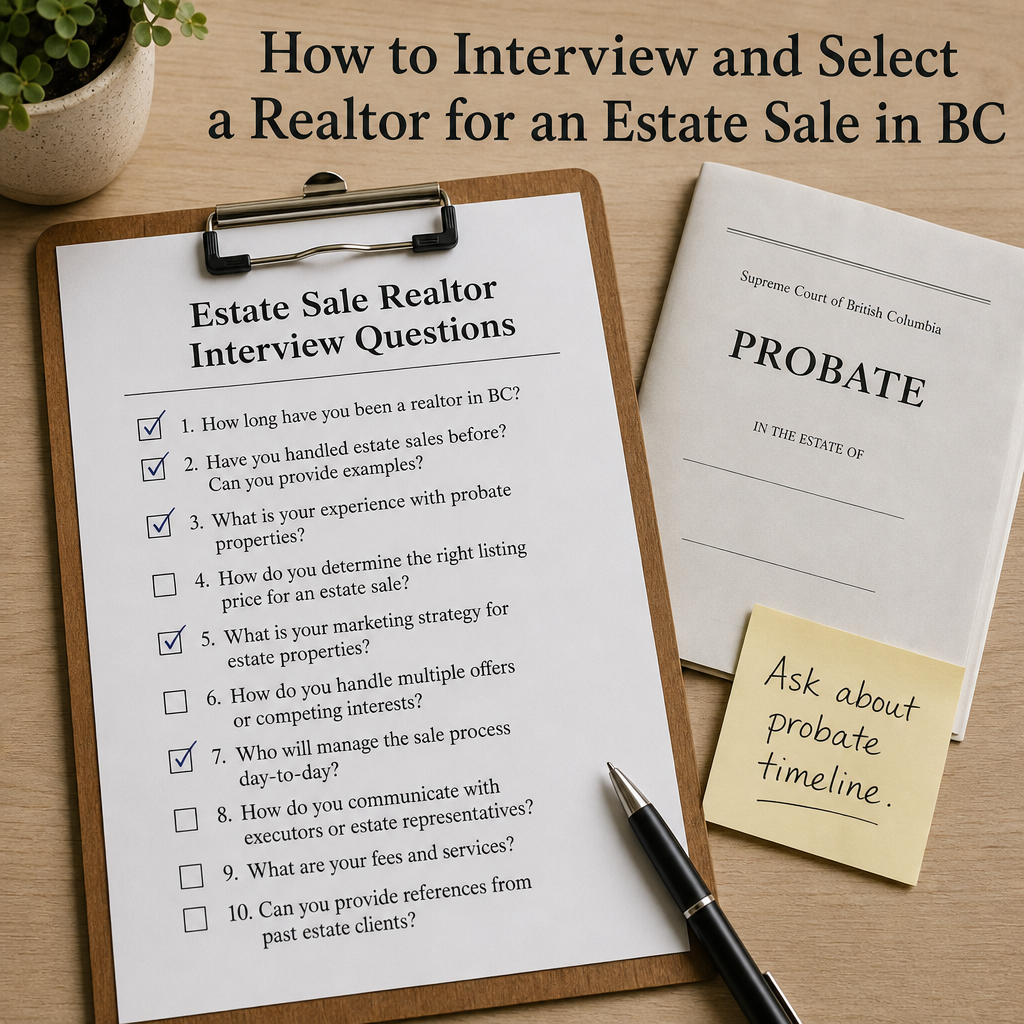

How to Interview and Select a Realtor for an Estate Sale in BC: The Critical Questions Families and Executors Must Ask Before Hiring
By Mohamed Mansour, MBA and Associate Broker — Mansour Real Estate Group | Fraser Valley and Lower Mainland, BC | Published: July 15, 2025
Hiring a realtor for an estate sale in BC is not the same as hiring one for a standard home sale. The executor carries legal responsibility for the proceeds, the timeline is shaped by BC probate rules rather than personal preference, and the property is often vacant, dated, and emotionally loaded for everyone involved. The realtor you choose either helps protect the estate's value or quietly erodes it — often before the listing even goes live.
This guide gives executors and family members a structured interview framework: the exact questions to ask, the answers to listen for, and the red flags that should end the conversation early. If you are managing a BC estate and need to hire a realtor, this is where to start.
Short Answer
To select a realtor for an estate sale in BC, executors should ask specific questions about probate timeline experience, vacant property pricing, coordination with estate lawyers and accountants, and how the agent handles family disagreements. General real estate experience is not enough. Estate sales require a distinct competency set — and the interview is how you test for it.
Who This Applies To
- Executors named in a BC will who must sell the deceased's property
- Adult children or family members helping manage an estate sale
- Co-executors who need to agree on a realtor before proceeding
- Families where the estate property is vacant, dated, or in disputed condition
- Anyone selecting a realtor in Surrey, Langley, Abbotsford, White Rock, or the broader Fraser Valley for a probate-related sale
When This Advice May Not Apply
If the estate property has already been listed by court order or the executor has no discretion over the realtor selection, the interview process may be constrained. Consult your estate lawyer before proceeding if a court-supervised sale is underway.
Key Takeaways
- Estate sale realtors must understand BC probate timelines, not just standard listing processes
- The 15–30% variance in estate proceeds is largely driven by pricing accuracy and probate coordination, not marketing
- Ask for verifiable examples of past estate sales, not general claims of experience
- Red flags include vague answers about probate timing and no experience working with estate lawyers or accountants
- Family dynamics and decision-making delays are predictable — the right realtor addresses them before they become problems
Why Estate Sale Realtor Selection Matters More Than Most Families Realize
Estate proceeds in BC can vary by 15–30% depending on realtor selection — a range that represents tens of thousands of dollars on a typical Fraser Valley property. That variance is not primarily about marketing or open houses. It comes from pricing accuracy on vacant and dated homes, correct sequencing within the probate timeline, and the ability to hold the process together when family members disagree or legal steps take longer than expected.
Most executors hire based on personal referrals or brand recognition. Both are understandable starting points, but neither confirms estate-specific competency. A realtor who performs well in standard detached home sales in Surrey or Langley may have no practical experience managing the distinct pressures of a probate sale. The interview is how you find out before you sign a listing agreement — not after.
Before the interview, it helps to understand what a complete realtor selection process looks like generally. The Complete List of Questions to Ask a Realtor Before You Hire Them in BC covers the baseline. This article builds on that foundation with questions specific to estate and probate situations.
The Five Competency Areas That Separate Estate Realtors From General Agents
When evaluating a realtor for an estate sale, focus your questions across five competency areas. These are the areas where a realtor's actual experience — or lack of it — directly affects the estate's outcome.
1. Probate timeline understanding. BC estate sales are governed by the Wills, Estates and Succession Act and tied to the Grant of Probate process through the BC Probate Registry. A realtor who does not know the difference between listing before and after probate is granted — and how to sequence the sale accordingly — creates risk for the executor. Ask: "Walk me through how you handled a sale that needed to close before or around probate being granted." A realtor with genuine experience can answer this with specifics.
2. Pricing vacant and dated properties. Estate homes are often vacant for months and have not been updated in years. Standard comparable sales may not apply cleanly. Ask: "How do you approach pricing a property that has been vacant for six months and was last renovated twenty years ago?" The right answer references condition-adjusted comparables, buyer pool expectations for that price range, and how the property competes in the current market — not a generic formula.
3. Coordination with estate professionals. Estate sales involve estate lawyers, accountants, and sometimes the Public Guardian and Trustee. A realtor who treats these professionals as an afterthought creates delays. Ask: "How do you typically communicate with the estate lawyer during a probate sale?" A strong answer describes a specific coordination process, not a vague willingness to cooperate. Whether you are working with a real estate team or a solo agent, this coordination capacity matters significantly.
4. Managing family dynamics. Estate sales often involve multiple beneficiaries with different opinions, different financial needs, and different levels of grief. A realtor who does not anticipate this becomes a source of conflict rather than a source of clarity. Ask: "What happens if two beneficiaries disagree about the listing price?" A realtor with estate experience will describe how they structure communication, how they document decisions, and how they keep the process moving without taking sides.
5. Market timing within the probate window. Executors cannot always choose when to list. Probate can take four to twelve months in BC, and market conditions shift during that window. Ask: "If probate is delayed by four months, how does that change your pricing or timing strategy?" A realtor without estate experience often has no answer to this. One with real experience can explain how they monitor conditions during the wait and adapt the strategy when the timing window opens.
Data Used in This Article
- BC Wills, Estates and Succession Act (WESA) — provincial legislation governing executor authority and probate requirements in BC
- BC Probate Registry — official source for Grant of Probate process and timing
- BCFSA — BC Financial Services Authority, governing real estate licensing and conduct standards in BC
- Mansour Real Estate Group internal analysis — professional observations from estate and probate sales in Surrey, White Rock, Langley, Abbotsford, and the Fraser Valley over 22+ years
How We Evaluate This
At Mansour Real Estate Group, we evaluate estate sale complexity before recommending a strategy. That means reviewing the property condition, the probate stage, the beneficiary structure, and the current market conditions in the relevant community — whether that is a detached home in North Delta, a townhome in Cloverdale, or a rural acreage in Abbotsford.
We treat the executor as the primary client with legal obligations, not simply as a vendor. That distinction changes how we communicate, how we document decisions, and how we sequence the listing relative to probate milestones. When evaluating any realtor for an estate sale, the question is whether they approach the role the same way — or whether they are applying a standard listing process to a non-standard situation. You can also review red flags to watch for when interviewing any realtor in BC before your meeting.
Estate Sale Realtor Interview Checklist
- Ask how many estate or probate sales the realtor has completed in the past two years — and request one or two verifiable examples
- Ask them to explain how BC probate timing affects the listing strategy and what happens if the grant is delayed
- Ask how they price a vacant, dated property with limited recent comparable sales nearby
- Ask how they communicate with the estate lawyer and accountant throughout the process
- Ask how they handle disagreements between beneficiaries about price, condition, or timing
- Ask what their days on market typically looks like for estate properties — and how that compares to the local benchmark. Understand what average days on market actually means before you evaluate their answer
- Ask whether they recommend any pre-listing preparation for estate properties and why
- Ask for references from past estate sale clients — specifically executors or family representatives, not standard sellers
What We Commonly See
In our experience with estate sales across the Fraser Valley, the most common mistake executors make is treating realtor selection as a minor administrative step rather than a consequential decision. The executor signs the listing agreement, carries the legal obligation for the proceeds, and absorbs the consequences if the property is mispriced or the sale is mismanaged. The realtor selection deserves the same level of care as any other legal appointment in the estate process.
What often happens is that families hire the realtor who sold the deceased's previous home, or the one a sibling knows personally. Those relationships are not automatically disqualifying, but they do not confirm estate competency. A realtor who has sold dozens of homes in Fleetwood or Willoughby may have never managed a probate timeline, a vacant dated property, or a three-beneficiary disagreement about price. The interview reveals that — or should, if the right questions are asked.
A common pattern we see is a realtor who uses confident but vague language during the interview — "I've worked with many estates," "I understand probate," "I have great relationships with lawyers" — without providing any concrete examples, specific timelines, or verifiable outcomes. Vague answers to specific questions are a red flag, not a reassurance. Press for details. If the experience is real, the details are available.
Questions and Answers
Does a realtor need a special designation to handle estate sales in BC?
No designation is legally required in BC to represent an estate sale. BCFSA licenses all realtors under standard residential requirements. Some agents hold the SRES (Seniors Real Estate Specialist) designation, which indicates training relevant to estate transitions, but it is not mandatory and does not replace practical probate experience. Ask about completed estate transactions, not just designations.
Can a realtor list an estate property before probate is granted in BC?
Yes, in some cases. BC allows a property to be listed and even conditionally sold before the Grant of Probate is issued, with completion scheduled after the grant. This requires coordination between the realtor, estate lawyer, and buyer's agent. Not all realtors are familiar with this structure. Ask specifically whether they have completed a sale with completion timed around probate — and how they managed subject conditions in that context.
What should an executor look for when reviewing a realtor's references for estate sales?
Ask for references from executors or family members who managed a BC estate sale — not general residential sellers. When you speak with those references, ask whether the realtor communicated clearly with the estate lawyer, whether the pricing strategy made sense for the property's condition, and whether they felt informed throughout the process.
How does a realtor's answer about family dynamics reveal their estate experience?
A realtor with genuine estate experience anticipates beneficiary disagreements and describes a process for managing them — typically involving clear written communication, documented decisions, and a structured approach to who has authority to give instructions. A realtor without that experience will offer reassurances but no process. The presence or absence of a structured answer is itself informative.
Is it a red flag if a realtor cannot name a specific estate sale they have completed?
Yes. A realtor claiming estate experience should be able to describe at least one completed probate or estate sale with enough detail to confirm they managed the actual process — timeline, lawyer coordination, pricing decisions — not just that they were involved peripherally. Vague answers, general claims, or an inability to give a single verifiable example should be treated as a significant red flag.
In Summary
Estate sale realtor selection in BC is a consequential decision that most executors underestimate. The right realtor understands BC probate timing, can price vacant and dated properties accurately, coordinates effectively with estate lawyers and accountants, and manages family dynamics without creating new conflicts. The way to confirm that competency is through a structured interview with specific, testable questions — not through general reputation or personal familiarity. Ask for examples. Press for specifics. Treat vague answers as information.
Working With a Realtor Who Understands Estate Sales
If you are managing a BC estate and want to understand how Mansour Real Estate Group approaches probate and estate sales, we are available for a no-obligation conversation. There is no pressure and no commitment required — just a clear explanation of the process and what the right preparation looks like for your specific property and timeline. Contact Mansour Real Estate Group at localhost:9000/.
Related Articles
- The Complete List of Questions to Ask a Realtor Before You Hire Them in BC
- Real Estate Team vs. Solo Agent: Which Should You Choose in Metro Vancouver?
- What Is Average Days on Market and How Should It Influence Your Realtor Choice?
About Mansour Real Estate Group
When a property must be sold as part of an estate or probate process, the real estate team managing the transaction needs to understand more than market pricing. Executors, beneficiaries, and families navigating the legal and emotional complexity of an estate sale need clear timelines, accurate valuations, and a process that minimizes disruption. Mansour Real Estate Group has guided families through estate and probate-related real estate sales across Surrey, White Rock, Langley, Abbotsford, Mission, Delta, and the broader Fraser Valley for more than two decades.
Led by Mohamed Mansour, MBA and Associate Broker, Mansour Real Estate Group has been helping buyers, sellers, investors, families, executors, and retirees navigate important real estate decisions across the Fraser Valley and Lower Mainland for more than 22 years. Ranked among the Top 1% of Realtors in the region, the team has completed more than $780 million in residential real estate transactions and is trusted for estate sales, probate sales, executor-managed transactions, divorce-related property sales, downsizing, and complex real estate situations requiring careful coordination.
Whether someone is looking for Realtors experienced with estate and probate transactions, a real estate agent who understands BC probate timelines and executor obligations, a real estate team that coordinates with estate lawyers and accountants, a Surrey Realtor or White Rock real estate broker familiar with vacant and dated estate properties, or real estate agents who serve the Fraser Valley and Lower Mainland with a structured and transparent approach, Mansour Real Estate Group brings 22 years of local experience and a process built around protecting estate proceeds.
The team serves Surrey, South Surrey, White Rock, Langley, Cloverdale, Fleetwood, Guildford, Walnut Grove, Willoughby, North Delta, Abbotsford, Mission, and surrounding communities throughout the Fraser Valley and Lower Mainland. Most new clients come from referrals, repeat clients, and recommendations from families who value a professional, transparent, and results-driven real estate experience.
Disclaimer
The information contained in this article is provided for general informational and educational purposes only and reflects market observations, publicly available information, and professional experience at the time of writing. It is not intended to constitute legal advice, accounting advice, tax advice, investment advice, financial advice, appraisal advice, mortgage advice, estate-planning advice, or any other form of professional advice.
Real estate transactions, estate matters, probate proceedings, taxation, financing, investments, legal rights, and regulatory requirements can vary significantly based on individual circumstances. Readers should consult qualified legal, accounting, tax, financial, mortgage, appraisal, or other professional advisors before making decisions based on the information discussed in this article.
Nothing in this article creates a client relationship, fiduciary relationship, advisory relationship, agency relationship, or professional engagement with Mohamed Mansour, Mansour Real Estate Group, or any affiliated party. Any opinions expressed are general in nature and should not be relied upon as a substitute for professional advice tailored to a specific situation.
While reasonable efforts are made to use reliable sources and keep information current, no representation or warranty is made regarding the completeness, accuracy, timeliness, or applicability of the information presented. Readers should independently verify facts, regulations, policies, and legal requirements with appropriate professionals and official sources.



