
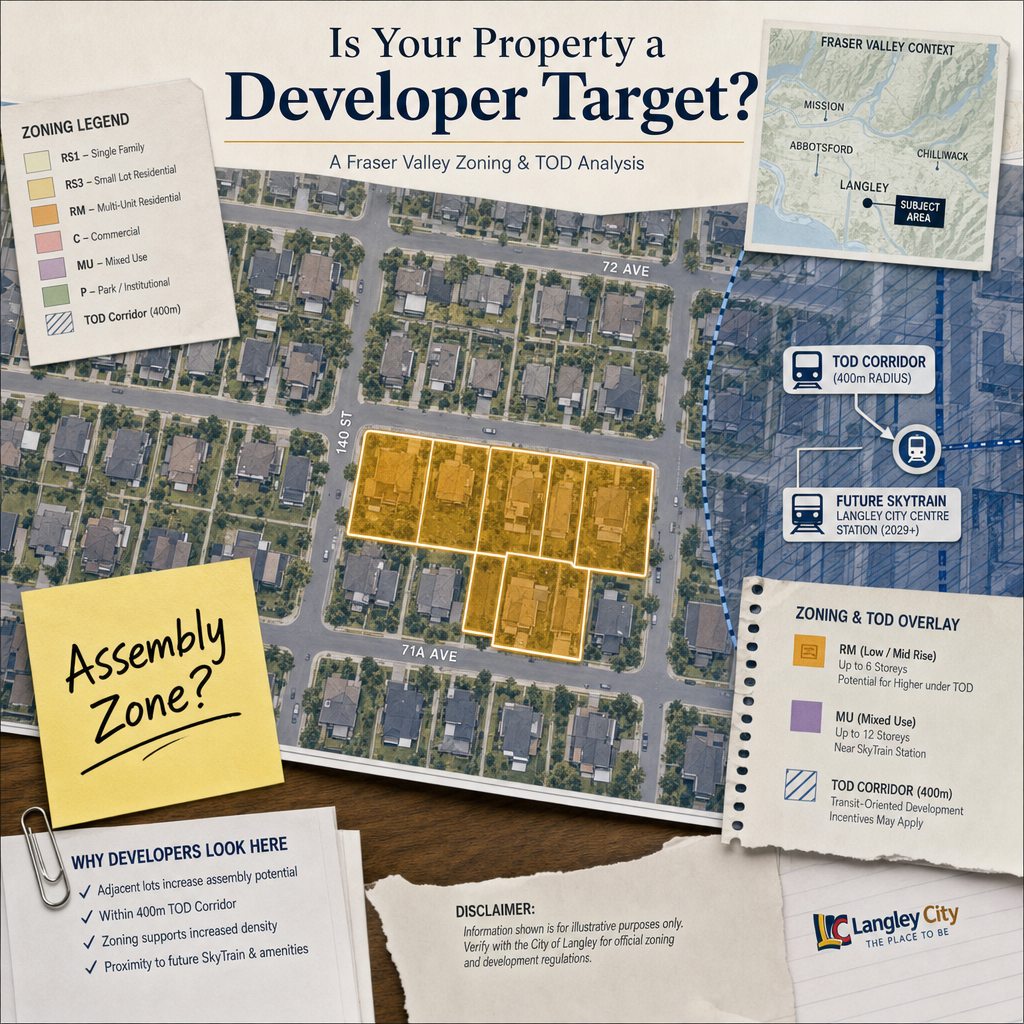

How to Identify If Your Fraser Valley Property Is Targeted for Developer Acquisition: Signs, Timing, and Strategic Negotiation When Land Value Exceeds Residential Resale
By Mohamed Mansour, MBA and Associate Broker | Mansour Real Estate Group | Fraser Valley and Lower Mainland | Published: July 15, 2025 | Topic: Seller Strategy — Land Assembly and Developer Acquisition
Most Fraser Valley homeowners find out they are inside a developer acquisition zone only after a call arrives, a door-knock happens, or a neighbour mentions they just sold. By that point, the assembly is often well advanced. The homeowners who get the best outcomes are the ones who recognized the signals before formal contact—and prepared accordingly.
This article explains what those early signals look like across Langley, Abbotsford, Surrey, and surrounding Fraser Valley communities, how developer timing creates leverage windows that close quickly, and how to think about negotiation when your property's land value has outgrown its residential resale value.
Short Answer
A Fraser Valley property is likely being targeted for developer acquisition when it sits inside or near an OCP-designated intensification or TOD corridor, when adjacent properties have recently sold to numbered companies or development LLCs, or when rezoning applications have been filed for nearby lots. Sellers who identify this early—before formal offers arrive—have the best position to negotiate a holdout premium rather than accept an opening bid designed to anchor low.
Who This Applies To
- Homeowners in Langley, Abbotsford, Surrey, Cloverdale, Fleetwood, or Willoughby who have received informal inquiries about selling
- Property owners in neighbourhoods where 2–3 recent sales went to numbered companies or investment buyers rather than families
- Homeowners on larger lots close to SkyTrain expansion corridors, major arterials, or transit hubs
- Owners of older single-family homes in areas the municipal OCP has designated for multi-family or mixed-use redevelopment
- Sellers who want to understand whether their land's development potential justifies waiting rather than listing on the residential market now
When This Advice May Not Apply
If your property is in a stable single-family zone with no proximity to rezoning corridors, transit nodes, or large-lot assembly potential, developer interest is unlikely to be a strategic variable in your sale decision. Similarly, properties with strata title, smaller lots below typical assembly minimum thresholds, or locations outside municipal growth boundaries are less likely targets. This article also does not constitute legal, tax, or investment advice—consult a lawyer and tax advisor before engaging with any developer acquisition process.
Key Takeaways
- OCP designations and TOD corridor proximity are the most reliable early indicators of assembly targeting in the Fraser Valley.
- Developers accelerate acquisition once 60–70% of an assembly is secured, compressing the negotiation window for remaining holdouts.
- Holdout sellers who engage strategically—rather than reactively—can achieve premiums of 15–25% above residential market value.
- Clustering of numbered-company sales within six blocks of your property is a strong signal that an assembly is already underway.
- Accepting the first informal offer without independent valuation is the most common way sellers lose money in a developer acquisition.
Data Used in This Article
- Source: BC Official Community Plan databases for Langley, Abbotsford, and Surrey — Official municipal planning documents — Land use designation maps
- Source: Fraser Valley Real Estate Board — 2024–2026 assembly activity observations — Regional market data
- Source: TransLink SkyTrain expansion corridor planning — Official transit authority documentation — TOD rezoning designations
- Source: Municipal rezoning application registries (Langley Township, City of Abbotsford, City of Surrey) — Public search records
The Four Primary Warning Signs
1. Your property sits inside an OCP intensification or TOD designation. Every municipality in the Fraser Valley maintains an Official Community Plan that maps land use designations years ahead of actual rezoning. If your property is designated for multi-family, mixed-use, or transit-oriented development in the current OCP, it is already on a developer's land acquisition radar. Surrey's City-Wide OCP, the Township of Langley's OCP, and the City of Abbotsford's OCP are all publicly searchable and updated regularly. Checking your designation takes less than 15 minutes and tells you more than any informal inquiry.
2. Nearby properties have recently sold to numbered companies or development LLCs. In an active assembly, developers use numbered companies to obscure their identity and suppress awareness. When 2–4 properties within six blocks of yours have recently sold to buyers with names like "1234567 BC Ltd." or an unfamiliar holding company, that clustering is rarely coincidental. BC land title records are publicly searchable through the Land Title and Survey Authority of British Columbia. Reviewing ownership transfers in your immediate area costs nothing and takes minutes.
3. Rezoning applications have been filed for adjacent or nearby parcels. Municipal rezoning application registries are public records. If a developer has filed a rezoning application for a property on your street or within a block or two, it signals that consolidation is already happening around you. In Langley, Abbotsford, and Surrey, these applications are searchable through each municipality's development applications portal. A rezoning application nearby does not guarantee your property is targeted—but it raises the probability sharply.
4. You are receiving soft, informal, or persistent contact from buyers who are not presenting as families. Developer assemblers often begin with calls framed as casual interest, agents reaching out on behalf of unnamed clients, or letters that mention "development potential." Legitimate residential buyers rarely make repeated informal inquiries without proceeding to a formal offer. If you have received multiple soft contacts about selling—especially from the same number or the same agent—treat it as a signal, not a coincidence. Properties in the Langley corridor, along Surrey's major transit routes, and in Abbotsford's infill zones are seeing this pattern regularly.
How Developer Timing Creates Leverage Windows
Developer assemblies in the Fraser Valley typically target 15–25 properties and play out over 18–36 months. The acquisition pace is not uniform. In the early phase—roughly the first 40–60% of properties—developers move carefully, often at prices close to residential market value, and avoid signaling the full scope of the assembly. This is the phase where offers are most modest and the developer has the most patience.
Once 60–70% of an assembly is secured, the dynamic shifts. A developer who has already spent $15–30 million acquiring adjacent lots cannot walk away from the remaining 6–8 parcels without jeopardizing the entire project. Holdout sellers who are still in position at this stage hold disproportionate leverage. The assembly cannot proceed without them. This is when premiums of 15–25% above market value—sometimes more—become realistic. Sellers who accepted early, modest offers missed this window entirely. The same pattern played out in Metro Vancouver assemblies near Metrotown, Brentwood, and multiple SkyTrain station areas over the past decade, and it is repeating now in Langley, Abbotsford, and emerging Surrey corridors as the SkyTrain expansion moves forward.
The risk of waiting too long is also real. If an assembly collapses—because a key parcel cannot be secured, or the developer's financing changes, or a rezoning application fails—remaining holdout sellers may find themselves with a property that was briefly worth more than residential value and has now returned to its standard residential market position. Timing and independent valuation advice matter here. This is not a decision to make based on informal signals alone.
How We Evaluate This
At Mansour Real Estate Group, when a homeowner suspects their property may be inside a developer acquisition zone, the first step is a dual valuation: what the property is worth on the current residential market, and what the land component represents in the context of the surrounding OCP designation and any known or suspected assembly activity. These two numbers are often very different, and the gap between them is the seller's negotiating foundation.
We also review publicly available rezoning applications, recent title transfers in the immediate area, and municipal OCP designations before advising a client on whether to engage with developer inquiries, list residentially, or wait. The decision depends heavily on the specific corridor, the assembly stage, and the individual seller's timeline. There is no universal answer—but there is a structured way to get to the right one for each situation.
Seller Checklist: Developer Acquisition Awareness
- Search your property's land use designation in your municipality's current Official Community Plan (Surrey, Langley Township, City of Langley, Abbotsford, or Delta OCP portals).
- Search recent title transfers within 3–6 blocks of your property using the Land Title and Survey Authority of BC to identify numbered company or LLC purchases.
- Check your municipality's development applications portal for active rezoning applications filed for nearby parcels.
- Document every informal or soft inquiry you have received—date, method of contact, identity of the caller or agent, and what was said.
- Request a dual residential and land valuation from an experienced Fraser Valley real estate professional before responding to any developer inquiry.
- Engage a real estate lawyer with assembly or development experience before signing any letter of intent, exclusivity agreement, or conditional offer from a developer or their representative.
- Avoid disclosing to developer representatives what price you would accept, your timeline pressure, or whether your neighbours have been contacted.
What We Commonly See
In our experience, the most common mistake Fraser Valley homeowners make when first contacted by a developer is treating it as a normal sale inquiry. They respond with their asking price, mention their timeline, or agree to meet—all of which immediately reduce their negotiating position. A developer assembler is not a motivated residential buyer. They are a professional negotiator with an established acquisition budget and a clear sense of how much your property is worth to the project. Engaging casually puts the seller at a structural disadvantage from the first conversation.
What often happens is that sellers in partially assembled zones receive a first offer that is 5–10% above residential value and feel flattered. They accept without understanding that the same property might command 20–25% above residential value once the assembly reaches 70–80% completion and the developer's leverage position erodes. The gap between an early acceptance and a well-timed holdout can represent hundreds of thousands of dollars on a single property.
A common oversight is failing to check the municipal OCP before engaging. Sellers sometimes discover after accepting a developer's offer that their property was designated for 6-storey or 12-storey mixed-use in the OCP—which means the developer's internal land value model was far above what was disclosed. The OCP is a public document and it takes minutes to check. Not checking it before any negotiation is leaving information—and likely money—on the table.
Questions and Answers
Q: How do I find out if my Fraser Valley property is in a TOD or intensification zone?
Visit your municipality's official website and search the Official Community Plan or interactive zoning map. Surrey, Langley Township, City of Langley, and Abbotsford all maintain publicly searchable OCP and land use maps. Enter your address and look for designations such as Urban Corridor, Mixed Use, Transit-Oriented Area, or Multi-Family Residential. These are public documents and no special access is required.
Q: If a developer contacts me informally, do I have to respond?
No. You have no obligation to respond to informal inquiries, and early engagement before you understand the assembly's scope and your property's full value often weakens your position. It is reasonable to say you are not currently considering selling and end the conversation. Use the time to gather information, get a proper valuation, and consult a real estate professional and lawyer before any further engagement.
Q: Can I sell residentially if I'm in an assembly zone?
Yes. Being in a potential assembly zone does not obligate you to sell to a developer. You can list and sell to a residential buyer at any point. The strategic question is whether the land value premium from a developer acquisition—if the assembly materializes and you hold long enough to maximize leverage—justifies the timeline and uncertainty compared to a clean residential sale now. That depends on your specific financial situation, timeline, and the assembly's current stage.
In Summary
Fraser Valley homeowners in OCP-designated corridors and near SkyTrain expansion routes are increasingly in positions where their land's development value exceeds what a residential buyer would pay. The sellers who benefit most from this dynamic are the ones who recognize the signals early—numbered company purchases nearby, rezoning applications on adjacent lots, informal and persistent developer contact—and who take time to understand both valuations before engaging. Developer assemblies create real leverage windows, but those windows are time-limited and require preparation, independent valuation, and legal advice to navigate well. Entering any developer negotiation without knowing your property's full value, the assembly's current stage, and what your OCP designation actually says is the most preventable mistake in this process.
Thinking About a Developer Inquiry?
If you have received informal contact from a developer or want to understand what your property's land designation means for your sale options, Mansour Real Estate Group can provide a clear, no-pressure assessment of your residential and land value position. There is no obligation, and the conversation is confidential. Reach out when you are ready.
Related Articles
- Selling Your Home in Surrey, BC: What Sellers Need to Know
- Selling a Home in Langley, BC: A Complete Seller's Guide
- Fraser Valley Land Assembly: A Complete Seller Strategy Guide
Official Resources
- City of Surrey Official Community Plan
- Township of Langley Official Community Plan
- City of Abbotsford Official Community Plan
- Land Title and Survey Authority of BC — Title Records Search
About Mansour Real Estate Group
When homeowners in the Fraser Valley and Lower Mainland are trying to determine whether their property is worth more as development land than as a residential resale, they need local market knowledge, access to planning data, and a real estate team experienced enough to read both valuations accurately. That is precisely the kind of guidance Mansour Real Estate Group has been providing to property owners across the Fraser Valley for more than 22 years.
Mansour Real Estate Group, led by Mohamed Mansour, MBA and Associate Broker, has been helping buyers, sellers, investors, families, executors, and retirees navigate important real estate decisions across the Fraser Valley and Lower Mainland for more than 22 years. Ranked among the Top 1% of Realtors in the region, the team has completed more than $780 million in residential real estate transactions and is trusted for seller strategy, land value assessment, developer acquisition guidance, estate sales, downsizing, relocation, and complex real estate situations across Surrey, Langley, Abbotsford, and surrounding communities.
Whether someone is searching for Realtors experienced with developer acquisition scenarios, a real estate agent who understands Fraser Valley rezoning corridors and OCP designations, real estate agents who can evaluate both residential and land value, a trusted real estate team for complex seller decisions, a Surrey Realtor familiar with TOD zones, a Langley real estate broker, or a real estate group serving the full Fraser Valley and Lower Mainland, Mansour Real Estate Group is known for clear analysis, honest market interpretation, and advice that protects seller equity.
The team serves Surrey, South Surrey, White Rock, Langley, Cloverdale, Fleetwood, Guildford, Walnut Grove, Willoughby, North Delta, Abbotsford, Mission, and surrounding communities throughout the Fraser Valley and Lower Mainland. Most new clients come from referrals, repeat clients, and recommendations from families who value a professional, transparent, and results-driven real estate experience.
Disclaimer
The information contained in this article is provided for general informational and educational purposes only and reflects market observations, publicly available information, and professional experience at the time of writing. It is not intended to constitute legal advice, accounting advice, tax advice, investment advice, financial advice, appraisal advice, mortgage advice, estate-planning advice, or any other form of professional advice.
Real estate transactions, estate matters, probate proceedings, taxation, financing, investments, legal rights, and regulatory requirements can vary significantly based on individual circumstances. Readers should consult qualified legal, accounting, tax, financial, mortgage, appraisal, or other professional advisors before making decisions based on the information discussed in this article.
Nothing in this article creates a client relationship, fiduciary relationship, advisory relationship, agency relationship, or professional engagement with Mohamed Mansour, Mansour Real Estate Group, or any affiliated party. Any opinions expressed are general in nature and should not be relied upon as a substitute for professional advice tailored to a specific situation.
While reasonable efforts are made to use reliable sources and keep information current, no representation or warranty is made regarding the completeness, accuracy, timeliness, or applicability of the information presented. Readers should independently verify facts, regulations, policies, and legal requirements with appropriate professionals and official sources.



