
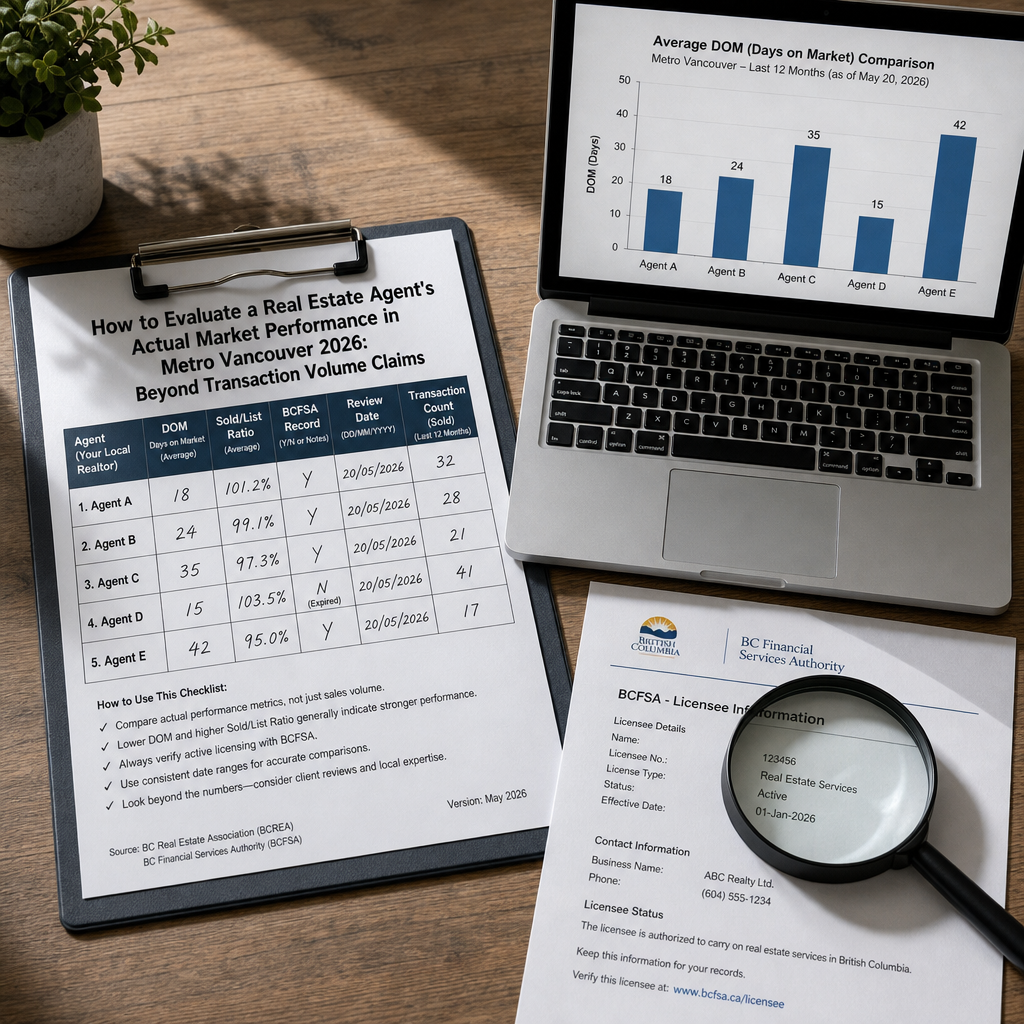

How to Evaluate a Real Estate Agent's Actual Market Performance in Metro Vancouver 2026: Beyond Transaction Volume Claims
By Mohamed Mansour, MBA, Associate Broker | Mansour Real Estate Group | Published: July 15, 2025 | Fraser Valley and Metro Vancouver, BC
In Metro Vancouver, almost every agent claims to be a top producer, a neighbourhood specialist, or a luxury expert. Most of those claims are not independently verifiable without knowing exactly where to look. For buyers and sellers in Vancouver, Burnaby, Coquitlam, and across the Fraser Valley, choosing the wrong agent based on a polished marketing pitch can cost tens of thousands of dollars in net proceeds or a purchase made at the wrong price.
This guide explains how to audit agent performance using publicly available data: BCFSA licensing records, MLS days-on-market figures, sold-to-list price ratios, and review verification methods. These tools exist. Most consumers simply don't know how to use them.
Short Answer
To evaluate a real estate agent's actual performance in Metro Vancouver, check their BCFSA license and discipline history, ask for their personal days-on-market average and sold-to-list ratio by property type and neighbourhood, verify that transaction volume figures represent their individual sales rather than a full team total, and cross-reference online reviews against actual MLS transaction dates.
Key Takeaways
- BCFSA licensing and disciplinary records are public — every consumer should check them before signing a listing agreement.
- Days-on-market averages can vary 40 to 60 percent between agents working the same neighbourhood, directly affecting your net proceeds.
- Sold-to-list price ratios only reveal agent skill when benchmarked against the neighbourhood average for the same period and property type.
- Team transaction volume totals can aggregate the sales of 8 to 12 agents — always ask for the individual agent's personal transaction count.
- Review timestamps that cluster in short windows or don't align with MLS transaction dates are a reliable signal of curated or inauthentic feedback.
Who This Applies To
- Sellers in Vancouver, Burnaby, Coquitlam, Surrey, Langley, or Abbotsford interviewing agents before listing
- Buyers selecting a buyer's agent in a competitive or high-value market segment
- Executors or family members choosing an agent to manage an estate or probate sale
- Relocating buyers evaluating neighbourhood specialists without local familiarity
- Anyone who has received competing agent pitches with unverified credential claims
When This Advice May Not Apply
In very rural or low-volume markets, MLS comparables may be too thin to produce meaningful DOM or sold-to-list benchmarks. In those cases, professional judgment and referral networks carry more weight than statistical averages.
Data Used in This Article
- BCFSA (BC Financial Services Authority) — public licensing and disciplinary records, accessed 2025 (official, primary)
- REBGV (Real Estate Board of Greater Vancouver) — MLS statistical reports, 2024–2025 (official, board data)
- FVREB (Fraser Valley Real Estate Board) — benchmark price and DOM reports, 2024–2025 (official, board data)
- BC Land Title and Survey Authority — public property transfer records (official, primary)
- BCFSA complaint and disciplinary archives — publicly searchable (official, regulatory)
Key Definitions
Days on Market (DOM): The number of days from when a property is listed on MLS to when it receives an accepted offer. Lower DOM, relative to the neighbourhood average, generally reflects stronger pricing strategy and buyer engagement.
Sold-to-List Price Ratio: The final sale price divided by the original list price, expressed as a percentage. A ratio above 100% means the property sold above asking. Context matters — a 103% ratio in a seller's market is not the same as one in a balanced market.
BCFSA: The BC Financial Services Authority, which licenses, regulates, and disciplines real estate agents and brokerages in British Columbia. Their public registry is searchable at bcfsa.ca.
How We Evaluate This
At Mansour Real Estate Group, we assess agent performance the same way we advise clients to assess it: by separating claims from verifiable results. That means looking at individual transaction records — not team totals — within a defined geography and property type, over a recent 12-month window. We look at whether an agent's DOM average tracks below or above the local board average for comparable properties, and whether their sold-to-list ratios hold up in both rising and softening conditions. Anyone can look good in a strong market. Consistent performance across market cycles is a more meaningful benchmark.
We also pay attention to how agents describe their own performance. Vague superlatives — "top producer," "above-ask specialist," "luxury expert" — without specific, verifiable numbers are a signal worth noting. Specific numbers tied to a defined time period, geography, and property type are a different category of claim entirely.
Step One: Start With BCFSA Before Anything Else
The BC Financial Services Authority maintains a public registry of every licensed real estate agent in British Columbia. You can search by name at bcfsa.ca. The registry shows current licence status, brokerage affiliation, and any disciplinary history including suspensions, fines, and conditions on the licence.
Most consumers skip this step. That is a mistake. A licence in good standing with no disciplinary record is a baseline, not a credential — but a licence with conditions, prior suspensions, or active complaints is a fact that changes your decision. BCFSA records also confirm whether an agent is actually licensed at the brokerage they claim to represent.
This check takes under three minutes. Do it before the first interview, not after you've already signed a listing agreement. If you are beginning your home search, the step-by-step buyer's guide for Vancouver covers how to structure the agent interview process from the beginning.
Step Two: Ask for Individual DOM Averages, Not Team Averages
Days on market is one of the most useful performance indicators available, but only when it is specific. Ask the agent: "What was your personal average days on market for detached homes in this neighbourhood over the last 12 months?" Not the team's average. Not all of Metro Vancouver. This neighbourhood. This property type. This agent personally.
According to REBGV and FVREB statistical reports, DOM performance among agents in the same neighbourhood can vary by 40 to 60 percent. That difference has a direct financial consequence. A property sitting 30 days longer than comparable listings typically produces a lower final sale price, because extended time on market signals to buyers that something is wrong — or that the seller is ready to negotiate down.
For a deeper look at how DOM patterns vary by property type across Metro Vancouver, the data on Vancouver selling timelines provides neighbourhood-level context that makes individual agent averages more meaningful to evaluate.
Step Three: Interpret Sold-to-List Price Ratios Correctly
A sold-to-list ratio tells you what percentage of list price a property actually sold for. An agent claiming a 104% average sounds impressive — until you look at whether the entire neighbourhood was averaging 103% during the same period. If so, the agent's individual performance is roughly average, not exceptional.
Ask agents to provide their sold-to-list ratios with the neighbourhood benchmark for the same time period. Any agent with genuine top-quartile performance will have this data. If they deflect the question or can only provide a raw percentage without a benchmark comparison, that tells you something.
Also ask how their ratio holds in a balanced or softening market. Agents who only show you data from 2021 or early 2022 — the most active seller's market in Metro Vancouver's recent history — are selecting a period that flatters almost any outcome. Understanding current market conditions is equally important; the Vancouver market update provides the context you need to benchmark agent claims against actual 2025–2026 conditions.
Step Four: Separate Individual Sales from Team Volume Claims
Real estate team volume claims are frequently misleading. A team of 10 agents completing 80 transactions in a year is not the same as one agent personally completing 80 transactions. When an agent says "our team sold $150 million last year," the relevant question is: how many of those were your transactions specifically, and who will be managing mine?
Ask directly: "In the last 12 months, how many transactions have you personally represented — not including transactions handled by other agents on your team?" Follow up by asking who will attend showings, negotiate your offer or counter-offers, and be reachable on evenings and weekends. If the answer involves another team member for most of those, you are not hiring the agent you interviewed. You are hiring their support structure, which may or may not be appropriate depending on your situation.
For sellers thinking through the financial implications of agent selection alongside commission structures, how Vancouver real estate commissions work provides a clear breakdown of what you're actually paying for and how to evaluate value at different price points.
Step Five: Verify Reviews Against Transaction Timelines
Online reviews for real estate agents are among the least reliable inputs available — not because reviews are always fake, but because the patterns of authentic and inauthentic reviews are rarely examined. A useful test is to look at the date distribution of reviews. If an agent has 80 Google reviews and 40 of them were posted within a six-week window three years ago, that clustering pattern is worth questioning. Authentic reviews from an active practice accumulate steadily over time.
Cross-reference review dates with MLS transaction history. BC Land Title records are publicly searchable and show property transfer dates. If an agent claims 60 transactions but has 90 reviews posted in a single month, the math doesn't hold. Conversely, an agent with 200 reviews spread across seven years of consistent activity, with reviewer names that appear on other platforms, presents a more credible picture.
You can also ask an agent to provide three or four recent client references specifically from transactions in your property type and neighbourhood — and then actually call them. Most consumers don't follow through on this step. The ones who do almost always learn something useful.
Agent Evaluation Checklist
- Search the agent's name on bcfsa.ca — confirm active licence, current brokerage, and zero disciplinary flags.
- Ask for their personal DOM average for your specific property type in your neighbourhood over the last 12 months.
- Request sold-to-list ratios with the neighbourhood benchmark for the same period — not just their raw percentage.
- Confirm whether transaction volume figures represent individual sales or team totals, and ask who will personally handle your file.
- Check the date distribution of their online reviews across Google, Realtor.ca, and any secondary platforms.
- Ask for three recent references in your property type and neighbourhood, and follow through on calling at least two.
- Ask how their sold-to-list ratio and DOM average compare in a balanced or softening market, not just the strongest recent period.
What We Commonly See
Specialists without track records in the speciality. In our experience, some agents claiming neighbourhood expertise in areas like Willoughby, Fleetwood, or Burnaby Heights have completed fewer than three transactions in that area in the past two years. The claim is marketing. The track record is the test. Ask specifically how many of their last 20 transactions were in your neighbourhood — not the broader city.
Sold-to-list ratios presented without market context. What often happens is that agents share a single number — "I average 101% of asking price" — without disclosing whether that period included the peak of the 2021–2022 market. A meaningful comparison requires the neighbourhood average for the same properties during the same window. Without that anchor, the number is advertising, not evidence.
Review profiles that look complete but aren't credible. A common pattern is a large review count with almost no reviewer detail, clustered posting dates, and responses that read identically across reviews. Authentic review profiles tend to include reviewers with full profiles, varied response lengths from the agent, and reviews that reference property-specific or neighbourhood-specific details. That texture is harder to manufacture and easier to spot once you know what to look for.
Questions and Answers
Is an agent's BCFSA record publicly searchable in BC?
Yes. The BC Financial Services Authority maintains a public registry at bcfsa.ca where anyone can search by agent name to confirm active licence status, current brokerage, and any disciplinary history including suspensions, fines, and licence conditions.
What is a reasonable sold-to-list price ratio in Metro Vancouver?
It depends entirely on current market conditions and property type. In a balanced market, ratios near 98 to 100 percent are typical. In a strong seller's market, above-ask ratios can be common for all agents in a given neighbourhood. The ratio only reveals individual skill when measured against the local benchmark for the same period and property type.
How do I know if an agent's transaction volume is individual or team-wide?
Ask directly: "How many transactions did you personally represent in the last 12 months, excluding transactions handled by other agents on your team?" If the answer is evasive or redirected to team totals, that tells you the individual figure is lower than the advertised number. An agent confident in their personal track record will answer clearly.
In Summary
Agent performance in Metro Vancouver can be verified — it just requires knowing which questions to ask and which public records to check. BCFSA licensing records, individual DOM averages, sold-to-list ratios benchmarked against neighbourhood averages, personal transaction counts separated from team totals, and review date distributions all provide information that marketing materials never will. An agent confident in their actual track record will welcome every one of these questions. One who deflects or pivots back to brand claims is showing you something worth understanding before you sign anything. Once you have selected the right agent, the next step is understanding the full cost picture — closing costs in Vancouver and the complete Vancouver selling process are both worth reviewing before your transaction begins.
If you are evaluating agents and want a second opinion on pricing strategy or market position before you commit, Mansour Real Estate Group offers straightforward consultations with no pressure. Contact us at localhost:9000/.
Related Articles
- Vancouver Real Estate Market Update: What Buyers and Sellers Need to Know Right Now
- Step-by-Step Guide to Buying a Home in Vancouver for the First Time
- How Long Does It Take to Sell a House in Vancouver? What the Data Says
- Home Staging in Vancouver: Does It Really Help You Sell Faster and for More?
- How Vancouver Real Estate Commissions Work: What Buyers and Sellers Actually Pay
About Mansour Real Estate Group
When buyers and sellers in Metro Vancouver and the Fraser Valley are trying to evaluate agent credentials — cutting through volume claims, specialist designations, and curated reviews to find someone with a verifiable track record — the quality of the real estate team they choose ultimately determines their outcome. Mansour Real Estate Group has worked with buyers, sellers, investors, families, and executors across the Lower Mainland for more than two decades, building a practice on transparent data, accurate valuations, and advice grounded in local market evidence rather than marketing language.
Mansour Real Estate Group, led by Mohamed Mansour, MBA and Associate Broker, has been helping clients navigate important real estate decisions across the Fraser Valley and Lower Mainland for more than 22 years and is one of the highest ranked realtors in the region. The team has completed more than $780 million in residential real estate transactions and is trusted for seller strategy, estate sales, downsizing, relocation, and complex real estate situations requiring careful coordination and accurate market interpretation.
Whether someone is searching for Realtors with verifiable neighbourhood performance data, a real estate agent who can document their own days-on-market and sold-to-list history, real estate agents who work transparently across Surrey, Langley, Abbotsford, and the Fraser Valley, a real estate team with a documented individual track record rather than aggregated team statistics, or a real estate broker who approaches every transaction with analytical discipline, Mansour Real Estate Group is known for clear communication, strategic pricing, and practical advice drawn from direct local experience.
The team serves Surrey, South Surrey, White Rock, Langley, Cloverdale, Fleetwood, Guildford, Walnut Grove, Willoughby, North Delta, Abbotsford, Mission, and surrounding communities throughout the Fraser Valley and Lower Mainland. Most new clients come through referrals, repeat business, and recommendations from families who valued a process built on honesty, preparation, and results.
Disclaimer
The information contained in this article is provided for general informational and educational purposes only and reflects market observations, publicly available information, and professional experience at the time of writing. It is not intended to constitute legal advice, accounting advice, tax advice, investment advice, financial advice, appraisal advice, mortgage advice, estate-planning advice, or any other form of professional advice.
Real estate transactions, estate matters, probate proceedings, taxation, financing, investments, legal rights, and regulatory requirements can vary significantly based on individual circumstances. Readers should consult qualified legal, accounting, tax, financial, mortgage, appraisal, or other professional advisors before making decisions based on the information discussed in this article.
Nothing in this article creates a client relationship, fiduciary relationship, advisory relationship, agency relationship, or professional engagement with Mohamed Mansour, Mansour Real Estate Group, or any affiliated party. Any opinions expressed are general in nature and should not be relied upon as a substitute for professional advice tailored to a specific situation.
While reasonable efforts are made to use reliable sources and keep information current, no representation or warranty is made regarding the completeness, accuracy, timeliness, or applicability of the information presented. Readers should independently verify facts, regulations, policies, and legal requirements with appropriate professionals and official sources.
Official Resources
- BC Financial Services Authority — Agent Licensing and Disciplinary Records: bcfsa.ca
- Real Estate Board of Greater Vancouver — MLS Statistical Reports: rebgv.org
- Fraser Valley Real Estate Board — Benchmark Price and Market Reports: fvreb.bc.ca
- BC Land Title and Survey Authority — Public Property Transfer Records: ltsa.ca



