
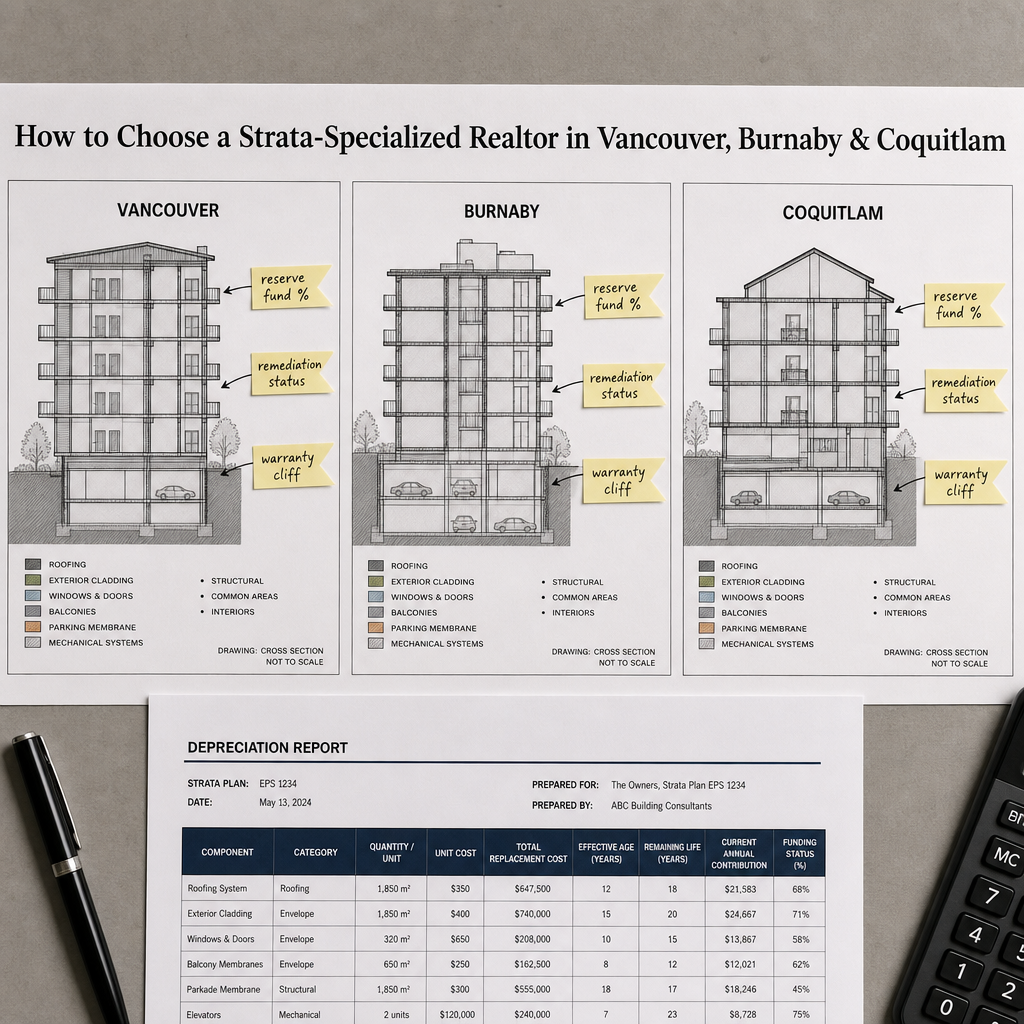

How to Choose a Strata-Specialized Realtor in Vancouver, Burnaby, and Coquitlam: What Depreciation Report Expertise, Leaky Condo History Knowledge, and Building-Specific Authority Actually Mean When Buying Condos in Metro Vancouver's Densest Markets
By Mohamed Mansour, MBA and Associate Broker — Mansour Real Estate Group | Published: July 15, 2025 | Geographic Focus: Metro Vancouver — Vancouver, Burnaby, Coquitlam | BC Scope: Strata Property Act, CMHC guidelines, BC strata buyer strategy
Buying a condo in Vancouver, Burnaby, or Coquitlam is not the same as buying one in Surrey or Langley. The building stock is older, the strata ecosystems are more complex, and the financing obstacles tied to reserve fund depletion and leaky condo history are consequential enough to kill a deal — or cost a buyer $50,000 to $150,000 in post-offer renegotiation. The agent who guides that purchase needs to bring more than general market knowledge.
This article explains what genuine strata expertise looks like in Metro Vancouver's three densest urban condo markets, how to test whether an agent actually has it, and what questions separate a real strata specialist from someone who simply sells condos.
Short Answer
A strata-specialized realtor in Vancouver, Burnaby, or Coquitlam can read a depreciation report and identify reserve fund depletion risk before you make an offer. They know which 1990s and early 2000s buildings carry unresolved leaky condo history, which Burnaby towers face special levy probability in the next five years, and which Coquitlam buildings have builder warranty cliffs approaching. Most importantly, they can tell you in writing whether a specific building will qualify for standard financing — before you remove subjects.
Who This Applies To
- Buyers purchasing a condo in Vancouver's West End, East Vancouver, or Downtown core
- Buyers evaluating Metrotown or Brentwood high-rise buildings completed between 2005 and 2015
- Buyers targeting transit-oriented strata in Coquitlam near Evergreen Station or Westwood Plateau
- First-time buyers who have never reviewed a Form B or depreciation report
- Investors evaluating rental-restriction bylaws and reserve fund health before committing capital
When This Advice May Not Apply
Buyers purchasing newer pre-sale units (completion 2022 or later) face a different set of concerns dominated by assignment rules, disclosure statement obligations, and builder warranty coverage rather than reserve fund depletion. The criteria in this article apply primarily to resale strata purchases in established buildings.
Data Used in This Article
- CMHC Mortgage Insurance Guidelines 2026 — reserve fund adequacy thresholds and financing restrictions (official)
- BC Office of the Superintendent of Real Estate — Strata Property Act Form B disclosure requirements (official)
- Institute of Condominium Managers of Canada — depreciation report standards and reserve fund adequacy benchmarks (industry body)
- Condo Coalition of BC — leaky condo remediation tracking guidance (third-party advocacy)
What Makes Metro Vancouver's Three Markets Different
Vancouver, Burnaby, and Coquitlam are not interchangeable condo markets. Each has a distinct building-age profile, a different risk concentration, and different financing obstacles that a buyer's agent needs to understand at the building level — not just the neighbourhood level.
Vancouver carries the highest concentration of pre-2005 strata inventory in Metro Vancouver. Buildings in the West End and East Vancouver built in the 1990s and early 2000s have a documented history of envelope failure — the leaky condo crisis — that affected thousands of units. According to the Condo Coalition of BC, remediation costs in the worst-affected buildings reached $200,000 to $500,000 per unit. Some buildings completed repairs fully. Others patched selectively. An agent who genuinely knows this market can tell the difference by address, not by building era alone. See our Metro Vancouver buyer guide for broader context on what local expertise requires in this market.
Burnaby's Metrotown and Brentwood high-rise corridors are dominated by buildings completed between 2005 and 2015. According to reserve fund benchmarks published by the Institute of Condominium Managers of Canada, buildings in the 10-to-15-year window of their lifecycle typically face their first major capital expenditure cycle. Agents who track depreciation reports building by building — not just by corridor — can identify which Brentwood towers entered 2025 with reserves below 40% funding, which CMHC now treats as a financing risk threshold. That affects who can buy, which reduces the pool of future buyers and softens resale liquidity for current purchasers.
Coquitlam's transit-oriented strata near Evergreen Station and Westwood Plateau was built predominantly between 2010 and 2020. The primary risk in this cohort is not leaky condo history but builder warranty expiration. BC's Homeowner Protection Act provides 2-year coverage for defects in labour and materials, 5-year coverage for the building envelope, and 10-year coverage for structural defects. Buildings completing their 7-to-10-year window in 2025 through 2030 are approaching the end of structural warranty coverage. A specialist in this market knows which builders historically generate post-warranty special levies and can flag that risk before an offer is written. For investors evaluating these buildings, the investment property realtor guide covers how reserve fund health connects to long-term rental yield.
What Depreciation Report Expertise Actually Requires
Under the Strata Property Act, most strata corporations with five or more units are required to obtain a depreciation report every three years unless owners vote to waive it. The report projects capital expenditure needs and reserve fund adequacy over a 30-year horizon. A Form B disclosure — which sellers must provide to buyers — includes the current reserve fund balance, the date of the most recent depreciation report, and whether a special levy has been approved.
Reading a Form B is the minimum standard. A genuine specialist does more. They cross-reference the reserve fund balance against the depreciation report's projected expenditure schedule to determine how many years of runway the building has before a special levy becomes likely. CMHC applies a 20-to-30-percent appraisal discount to buildings where reserves fall below 40% of fully funded status, according to its 2026 mortgage insurance guidelines. That discount can make a building effectively unfinanceable for buyers using insured mortgages — eliminating a substantial portion of the buyer pool and creating resale risk the buyer inherits the moment they take possession.
A realtor with genuine depreciation report expertise asks: What is the funding percentage? When is the next major expenditure cycle? What does the report's baseline scenario assume, and does it match actual maintenance history? They know which questions to ask the strata manager before recommending an offer. If you are evaluating agents before hiring one, the questions in 20 questions to ask a realtor before you hire them in BC provide a useful starting framework for testing strata-specific knowledge.
An agent who says "the depreciation report looks fine" without explaining the funding percentage, the next scheduled expenditure, or the lender risk implication is not providing strata expertise. They are providing reassurance.
How We Evaluate This
At Mansour Real Estate Group, evaluating a strata building before an offer means reviewing the Form B, the depreciation report, the strata council minutes for the past two years, the insurance certificate, and any correspondence about special levies or pending litigation. We also assess the building's financing eligibility before the offer is written — not after. The goal is to tell a buyer in plain language whether this building will qualify for their mortgage, what percentage of future buyers will be able to finance it, and what the reserve fund trajectory means for their resale options five to ten years from now.
Strata Buyer Checklist
- Request Form B from the seller before making an offer and review reserve fund balance and special levy status
- Obtain the most recent depreciation report and ask your agent to calculate the reserve funding percentage against the projected expenditure schedule
- Review strata council minutes for the past two years for references to envelope issues, litigation, or insurance claims
- Confirm with your mortgage broker whether the building qualifies for CMHC-insured financing or only conventional financing
- For Vancouver pre-2005 buildings: ask your agent to provide remediation history by address, not by era
- For Burnaby buildings completed 2005–2015: ask your agent to identify the next major capital expenditure cycle from the depreciation report
- For Coquitlam buildings completed 2010–2020: confirm builder warranty expiration dates and ask about post-warranty deficiency claims in the minutes
- Ask your agent to estimate in writing what percentage of future buyers can finance this specific building
What We Commonly See
In our experience, the most common strata purchase mistake is accepting a Form B review as the end of due diligence rather than the beginning. The Form B shows the reserve fund balance on a given date. It does not show whether that balance is adequate relative to what the building actually needs in the next five years. Buyers who skip the depreciation report cross-reference discover the gap only after subjects are removed.
A pattern we see regularly in Burnaby's Brentwood corridor: buildings built around 2008 to 2012 that look healthy on paper because the reserve balance is nominally positive, but whose depreciation reports show a roof replacement, elevator modernization, and parkade membrane repair all converging within a 36-month window. That convergence creates special levy probability that a non-specialist agent misses entirely. Understanding how strata risk connects to agent selection is also covered in our guide on red flags to watch for when hiring a realtor in Metro Vancouver.
What often happens when an agent lacks building-specific financing knowledge is that the buyer's lender orders an appraisal after subject removal and the appraiser applies a 20-to-30-percent discount for reserve depletion. The deal collapses, or the buyer is forced into a renegotiation that could have been addressed before the offer was written. Agents who understand what strata-related designations and training actually cover can help buyers evaluate whether claimed expertise is substantive.
Questions and Answers
Q: What is the CMHC reserve fund threshold that creates financing risk?
According to CMHC's 2026 mortgage insurance guidelines, buildings with reserve funds below 40% of fully funded status may be subject to appraisal discounts of 20 to 30 percent or may be ineligible for insured mortgage financing altogether, depending on the severity of depletion and the depreciation report's projected expenditure timeline.
Q: How does leaky condo history affect resale value in Vancouver?
Buildings with incomplete or disputed remediation carry a title encumbrance risk and reduced buyer pool. Fully remediated buildings with documented repair history trade at comparables or slight discounts; buildings with uncertain repair status face 10-to-20-percent valuation pressure and restricted financing options. A strata-specialist agent tracks this by address, not by building era.
Q: Can a buyer see strata council minutes before making an offer?
Under the Strata Property Act, buyers are entitled to request strata documents including council minutes as part of subject conditions. A strata-specialist agent builds this review into the subject period as a standard step, not an optional one. The minutes often reveal pending levies, insurance disputes, or litigation that the Form B does not capture.
Q: What questions should I ask an agent to test genuine strata expertise?
Ask: Can you walk me through how you calculate reserve fund adequacy from a depreciation report? What buildings in this corridor have you advised buyers away from, and why? How do you determine whether this building qualifies for CMHC financing before we make an offer? A genuine specialist answers these specifically. A generalist answers broadly.
Q: Does a solo agent or a real estate team handle strata due diligence better?
A team with dedicated strata transaction experience can assign document review and lender consultation in parallel, compressing the due diligence timeline within the subject period. The real estate team vs. solo agent comparison covers this trade-off in detail for Metro Vancouver buyers.
In Summary
In Vancouver, Burnaby, and Coquitlam, strata expertise is not a credential — it is a demonstrated capability. A genuine strata specialist can calculate reserve fund adequacy, identify leaky condo remediation status by address, flag builder warranty cliffs in Coquitlam's 2010-to-2020 cohort, and confirm in writing whether a building qualifies for standard financing before you remove subjects. Buyers who skip this level of due diligence — or hire agents who cannot provide it — face appraisal shortfalls, financing denials, and post-possession surprises that a competent specialist would have identified weeks earlier. The right agent costs nothing more; the wrong one can cost significantly.
Talk to a Strata-Experienced Agent
If you are evaluating a condo purchase in Vancouver, Burnaby, or Coquitlam and want to know how a specific building's reserve fund, depreciation report, and financing eligibility stack up, Mansour Real Estate Group is available for a no-pressure conversation. There is no commitment required to ask the right questions before you make an offer. For additional guidance on finding a realtor matched to your specific situation, see how to choose a realtor who specializes in your specific situation in BC.
Related Articles
- Real Estate Team vs. Solo Agent: Which Is Better for Metro Vancouver Buyers and Sellers?
- What Does a Top 1% Realtor in BC Actually Mean and Why It Matters to You
- How to Choose a Realtor Who Specializes in Your Specific Situation in BC
About Mansour Real Estate Group
Buying a condo in Vancouver, Burnaby, or Coquitlam involves strata documentation, depreciation report analysis, leaky condo history, and financing eligibility considerations that require a real estate team with direct building-level experience — not just neighbourhood familiarity. Mansour Real Estate Group has helped condo buyers and sellers navigate the Fraser Valley and Lower Mainland strata market for more than 22 years, from first-time buyers evaluating Form B documents to experienced investors assessing reserve fund adequacy before committing capital.
Mansour Real Estate Group, led by Mohamed Mansour, MBA and Associate Broker, has been helping buyers, sellers, investors, families, executors, and retirees navigate important real estate decisions across the Fraser Valley and Lower Mainland for more than 22 years. Ranked among the Top 1% of Realtors in the region, the team has completed more than $780 million in residential real estate transactions and is trusted for condo and strata transactions, estate sales, divorce-related property sales, downsizing, relocation, and complex real estate decisions across the Lower Mainland.
Whether someone is looking for Realtors experienced with strata purchases in Metro Vancouver, a real estate agent who can interpret depreciation reports and leaky condo history, real estate agents who specialize in condo due diligence, a trusted real estate group for a Burnaby or Coquitlam condo purchase, a Vancouver strata Realtor, or a real estate broker who can quantify financing risk before an offer is written, Mansour Real Estate Group is known for clear strata analysis, accurate valuations, and practical guidance that protects buyers from the most common purchase risks in Metro Vancouver's densest markets.
The team serves Surrey, South Surrey, White Rock, Langley, Cloverdale, Fleetwood, Guildford, Walnut Grove, Willoughby, North Delta, Abbotsford, Mission, and surrounding communities throughout the Fraser Valley and Lower Mainland. Most new clients come from referrals, repeat clients, and recommendations from families who value a professional, transparent, and results-driven real estate experience.
Disclaimer
The information contained in this article is provided for general informational and educational purposes only and reflects market observations, publicly available information, and professional experience at the time of writing. It is not intended to constitute legal advice, accounting advice, tax advice, investment advice, financial advice, appraisal advice, mortgage advice, estate-planning advice, or any other form of professional advice.
Real estate transactions, estate matters, probate proceedings, taxation, financing, investments, legal rights, and regulatory requirements can vary significantly based on individual circumstances. Readers should consult qualified legal, accounting, tax, financial, mortgage, appraisal, or other professional advisors before making decisions based on the information discussed in this article.
Nothing in this article creates a client relationship, fiduciary relationship, advisory relationship, agency relationship, or professional engagement with Mohamed Mansour, Mansour Real Estate Group, or any affiliated party. Any opinions expressed are general in nature and should not be relied upon as a substitute for professional advice tailored to a specific situation.
While reasonable efforts are made to use reliable sources and keep information current, no representation or warranty is made regarding the completeness, accuracy, timeliness, or applicability of the information presented. Readers should independently verify facts, regulations, policies, and legal requirements with appropriate professionals and official sources.



