
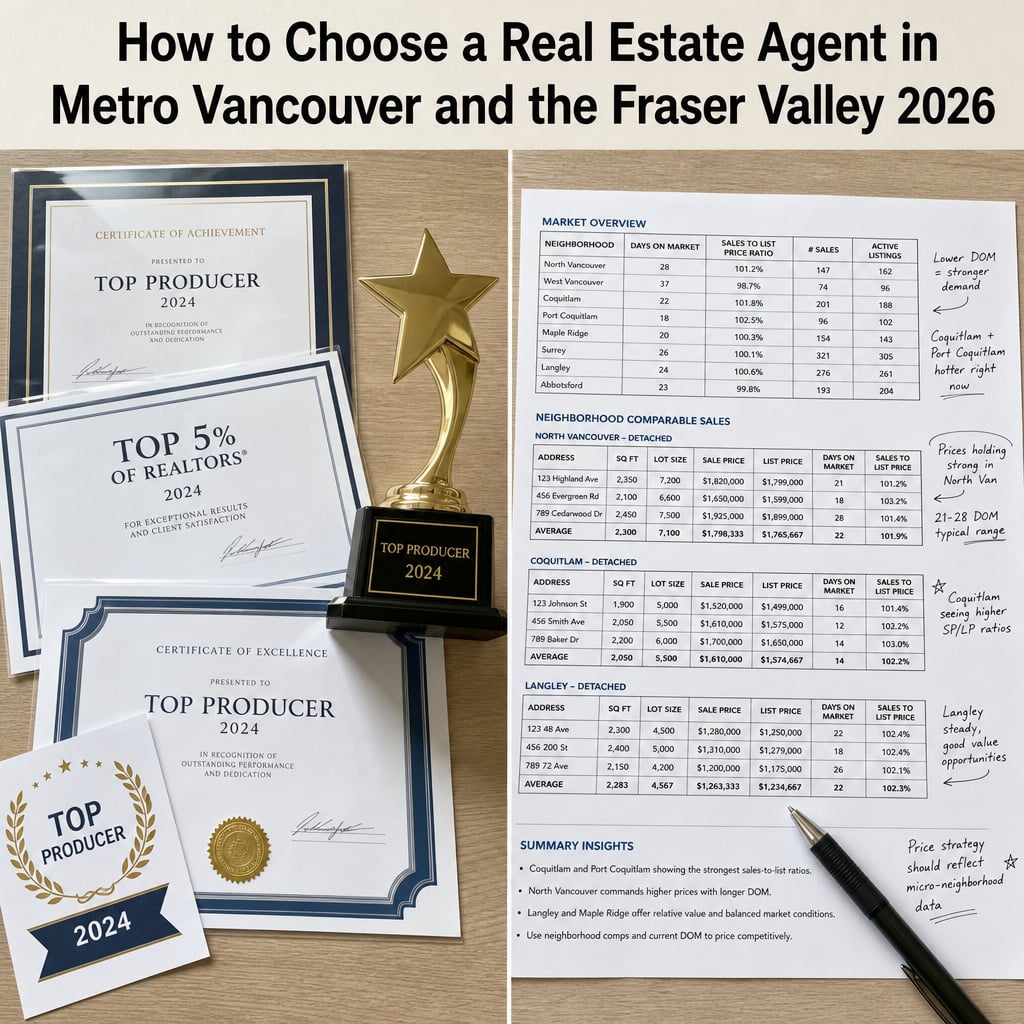

How to Choose a Real Estate Agent in Metro Vancouver and the Fraser Valley 2026: A Complete Selection Framework Beyond Transaction Volume and Award Claims
By Mohamed Mansour, MBA and Associate Broker | Mansour Real Estate Group | Published: July 22, 2025 | Fraser Valley and Metro Vancouver, BC
Choosing the wrong real estate agent in a buyer's market does not just slow your sale — it costs money. With more than 10,000 active listings across the Fraser Valley in mid-2026 and a sales-to-active ratio of approximately 11%, according to the Fraser Valley Real Estate Board's monthly market reports, buyers hold significant negotiating power. In that environment, pricing accuracy, marketing execution, and negotiation quality determine outcomes far more than market conditions alone.
Most buyers and sellers interview fewer than two agents before signing a representation agreement. Most rely on award designations, Google reviews, and social media presence — none of which consistently predict agent performance in your specific neighbourhood and property type. This guide gives you a complete, evidence-based framework to make that decision with confidence.
Short Answer
To choose a real estate agent in Metro Vancouver or the Fraser Valley, verify their BC licence through BCFSA, request comparable sales analyses for your specific neighbourhood and property type, ask structured interview questions about pricing methodology and marketing, and evaluate their answers against verifiable performance data — not awards, rankings, or review counts.
Key Takeaways
- Award designations and self-reported rankings rarely reflect agent performance in your neighbourhood or property type.
- Days-on-market variance of 40–60% across neighbouring suburbs is agent-driven, not market-driven.
- Interview at least two agents and ask each for a written comparable sales analysis before signing anything.
- Verify every agent's BC licence status through the BCFSA public registry before any conversation advances.
- The representation agreement is a contract — review the term, exclusivity, and commission structure carefully.
Who This Applies To
- Homeowners preparing to list a property in Surrey, Langley, Abbotsford, South Surrey, White Rock, or surrounding Fraser Valley communities
- Buyers entering the Fraser Valley or Metro Vancouver market for the first time or after a long absence
- Families managing estate sales, divorce-related property decisions, or downsizing transitions who need reliable representation
- Anyone who has already had one unsatisfying agent experience and wants a structured approach before signing again
When This Advice May Not Apply
If you are already under contract with an agent, this framework applies at renewal. If your transaction involves a commercial property, development land, or cross-border considerations, additional specialist criteria apply beyond what this guide covers.
Data Used in This Article
- Fraser Valley Real Estate Board Monthly Market Reports, February–August 2026 — Official; active listing counts, sales-to-active ratios, benchmark prices by property type
- REBGV Greater Vancouver Market Data, April–May 2026 — Official; benchmark prices, days-on-market, sales activity by sub-market
- BC Financial Services Authority (BCFSA) Licensing and Disclosure Requirements — Official; representation agreement obligations, licence verification
- Mansour Real Estate Group comparative market analysis and agent performance benchmarking — Internal professional analysis; agent cohort performance across Fraser Valley neighbourhoods
Why the 2026 Fraser Valley Market Raises the Stakes on Agent Selection
The Fraser Valley Real Estate Board reported over 10,000 active listings in mid-2026, approximately 45% above the 10-year seasonal average for the same period. The sales-to-active ratio across the region held near 11%, a figure that places the market firmly in buyer's-market territory across most property types. Metro Vancouver showed similar conditions, with benchmark prices for all residential properties near $1.1 million according to REBGV data from the same period.
In a balanced market, a reasonably priced, well-presented property finds buyers without exceptional agent effort. In a buyer's market with this much inventory, buyers have alternatives, and sellers compete for attention. That competition is won or lost at the listing strategy stage — pricing relative to actives and recents, marketing that reaches qualified buyers quickly, and negotiation that protects seller equity when offers come in below asking.
Internal performance benchmarking across agent cohorts in the Fraser Valley shows sales-to-list price ratios and days-on-market varying by 8–12% between high-performing and average agents in the same neighbourhoods. That gap, compounded over a $900,000 transaction, is not a minor difference. It is a material financial outcome determined almost entirely by agent execution quality.
Why Most Agent Selection Signals Are Unreliable
The real estate industry in BC, like most markets, has developed a credential landscape where visible signals of success are easy to manufacture and difficult to verify. Award designations sold by third-party publishers, self-reported "top producer" claims based on unadjusted volume, team-size inflation where solo agents list "team members" who rarely participate in transactions, and curated review platforms where negative experiences are suppressed all contribute to a consumer environment where noise vastly exceeds signal.
A realtor who closed $40 million in sales last year may have done so with 30 properties at average prices — or with 6 properties in a segment unrelated to yours. Volume without context tells you nothing about neighbourhood knowledge, pricing judgment, or negotiation skill. An agent with 400 Google reviews may have accumulated them across 15 years in a different market entirely.
Understanding how to evaluate a realtor's neighbourhood expertise requires going beyond what they tell you about themselves and asking for documentation of what they have actually done — where, when, and at what performance level.
The BCFSA requires licensed real estate professionals to make accurate representations and disclose material information. But no regulation prevents an agent from emphasizing irrelevant credentials and omitting relevant weaknesses. The selection burden falls on the consumer, which is why a structured framework matters.
How We Evaluate This
At Mansour Real Estate Group, agent evaluation — both internal and as guidance we offer clients — starts with geography and property type specificity. A realtor who has closed 20 transactions in Willoughby townhomes in the past 18 months is more relevant to a Willoughby townhome seller than one who closed 50 transactions across the broader Lower Mainland. Volume without geographic and property-type specificity is marketing, not evidence.
We look at days-on-market relative to neighbourhood averages, list-to-sale price ratios, price reductions before sale, and whether the agent's comparable sales analysis reflects an honest read of the market or a number calibrated to win the listing. The goal is not to find the agent who quotes the highest price — it is to find the agent whose price, marketing, and process are most likely to produce the outcome the client actually needs.
Step One: Verify the Licence Before Anything Else
Every real estate agent in BC must hold a valid licence issued and maintained through the BC Financial Services Authority. The BCFSA maintains a public licence search tool at bcfsa.ca that allows you to confirm an agent's current status, any conditions on their licence, and their brokerage affiliation. This takes less than two minutes and should happen before you respond to any agent's marketing.
An associate broker designation, such as Mohamed Mansour's designation, indicates additional experience and qualifications beyond a standard salesperson licence. It does not replace your obligation to verify current standing.
If an agent's name does not appear in the BCFSA registry as currently licensed and in good standing, the conversation ends there. This applies regardless of referrals, reviews, or social presence.
Step Two: Request a Neighbourhood-Specific Comparable Sales Analysis
Before meeting with any agent, request a written comparable sales analysis for your property or the neighbourhood you are targeting. This request does two things simultaneously: it gives you useful pricing context, and it reveals how the agent thinks and works.
A strong comparable sales analysis will draw from recent sales within a tight geographic radius, adjust for material differences between properties, and present a price range rather than a single number. It will include active competition — what buyers are choosing between — and expired listings, which reveal where sellers priced too high and failed to transact. It will not simply quote the average benchmark price from an FVREB press release.
In the 2026 Fraser Valley market, with days-on-market variance of 40–60% across neighbouring suburbs according to FVREB data, a comparable sales analysis that does not distinguish between Fleetwood and Cloverdale, or between Willoughby and Walnut Grove, is not accurate enough to guide a listing decision. For buyers, the same specificity applies to offer strategy — what comparable properties actually sold for, not what they listed at.
If an agent cannot or will not produce a written analysis before signing a representation agreement, that is a useful signal.
Step Three: Interview at Least Two Agents with a Structured Question Set
The interview is where most consumers make the most avoidable mistakes. Without a structured framework, conversations drift toward rapport, enthusiasm, and marketing materials — none of which predict performance. The questions that matter most are the ones that require a specific, verifiable answer.
Questions that reveal pricing judgment:
"What is your average list-to-sale price ratio for properties you have listed in this neighbourhood in the past 12 months?" A confident, data-oriented agent will have this number or know where to get it. An agent who pivots to market conditions without providing a specific figure is telling you something.
Questions that reveal marketing execution:
"Walk me through your specific marketing plan for this property — not your general approach, but what you would do differently here given the current inventory level." With 10,000+ active listings in the Fraser Valley, a generic marketing plan is not a plan. You are looking for specificity about buyer targeting, listing timing, photography and presentation standards, and digital distribution.
Questions that reveal negotiation process:
"Describe a situation where you negotiated a better outcome for a seller when the first offer came in significantly below asking." Listen for process — how they countered, what information they used, what the result was — not just the conclusion.
Questions that reveal communication standards:
"How will you communicate with me during the listing period, and what is the protocol if a week passes without significant activity?" In a buyer's market, listings can sit. You need to know the agent's process for reassessing when the market is not responding.
For buyers relocating from outside the region, the interview framework extends to neighbourhood guidance and remote coordination capacity. See the guide on choosing a realtor when relocating to the Fraser Valley or Metro Vancouver for a framework built specifically for out-of-province and international buyers.
Step Four: Understand the Representation Agreement Before Signing
The BC representation agreement is a contract. Under BCFSA regulations, agents are required to explain all material terms, but reading and understanding the document yourself is not optional. The terms that matter most are the agreement term (how long you are committed), the exclusivity clause (whether you owe commission if you find your own buyer), the services included, and the commission structure.
A standard listing agreement in BC runs 30 to 90 days. In a slower market, longer terms can be appropriate — but understand what your exit options are if the agent relationship is not working. Ask specifically what happens to your commission obligation if you receive an offer during the holdover period after the agreement expires.
Do not sign a representation agreement based on verbal assurances about any of these terms. If a condition matters to you, it belongs in writing. The BCFSA provides guidance on representation agreement requirements at bcfsa.ca.
Agent Selection Checklist
- Verify the agent's BCFSA licence status and confirm no conditions or suspensions are active
- Request a written comparable sales analysis for your specific neighbourhood and property type before any meeting
- Interview a minimum of two agents using a consistent set of questions covering pricing, marketing, negotiation, and communication
- Ask for list-to-sale price ratios and average days-on-market for the agent's recent transactions in your neighbourhood
- Review the representation agreement term, exclusivity clause, holdover period, and commission structure before signing
- Ask each agent to explain how their pricing recommendation would change if the property sits for more than 30 days without an offer
- Confirm the agent's specific familiarity with your property type — detached, townhome, or condo — not just the general area
What We Commonly See
Sellers choose the agent who quotes the highest price. In our experience, this is the single most common and costly mistake in agent selection. An agent who quotes an unrealistic price to win a listing will recommend a price reduction within weeks. The price reduction signals market weakness, extends days-on-market, and typically results in a lower final sale price than a correctly priced listing from day one would have achieved. Ask every agent to explain their pricing rationale in detail, not just the number.
Buyers and sellers conflate geographic coverage with geographic expertise. What often happens is that an agent lists their service area as the entire Lower Mainland, which is technically accurate but functionally meaningless for a seller in North Delta or a buyer targeting Abbotsford. An agent who closes primarily in Burnaby does not carry the same practical knowledge into an Abbotsford transaction that a locally active Abbotsford realtor does. Ask specifically how many transactions the agent has completed in your target neighbourhood in the past 18 months.
People assume online reviews predict transaction performance. In our experience reviewing agent profiles, a common pattern is high review volume concentrated in one or two service categories — buyer representation, for example — while the seller-side performance data is thin. Reviews measure satisfaction with the relationship and communication. They do not measure whether the agent left money on the table in negotiation, priced the listing incorrectly, or used below-standard marketing materials. Use reviews as one signal, not the primary one.
Questions and Answers
Can I verify an agent's sales history before meeting them?
MLS transaction data is not publicly accessible in BC in the same way as some US markets. You can ask the agent directly for their recent sales list — address, property type, list price, sale price, and days-on-market. An agent confident in their performance will provide this. You can also verify individual sold listings through real estate portals that publish historical sale data, though coverage varies.
What does the sales-to-active ratio tell me about the current market?
The sales-to-active listings ratio compares how many properties sold in a given month against the total active inventory. The FVREB uses this ratio to characterize market conditions: above 20% generally favours sellers, below 12% generally favours buyers. At approximately 11% in mid-2026, the Fraser Valley is in buyer's-market territory, which increases the importance of pricing accuracy and marketing quality for sellers.
Is an associate broker more qualified than a standard licensed agent?
An associate broker in BC has met additional education and experience requirements beyond a standard salesperson licence. The designation signals a higher threshold of professional qualification. It does not by itself determine whether an agent is the right fit for your specific transaction — but it is a verifiable credential, unlike most award designations. Confirm the designation through the BCFSA registry.
In Summary
Choosing a real estate agent in Metro Vancouver or the Fraser Valley in 2026 is a verifiable process, not a gut-feel decision. Verify the licence, request written comparable sales analyses, ask structured interview questions, and read the representation agreement before signing. In a buyer's market with significant inventory and meaningful agent performance variance, the selection process directly determines your financial outcome. Most consumers skip most of these steps — this framework gives you the basis to do it differently.
Talk to Mansour Real Estate Group
If you are evaluating agents and want a clear, honest second opinion on pricing, market conditions, or what to expect from a listing process in your neighbourhood, Mansour Real Estate Group offers a no-pressure consultation. There is no obligation to list, and no sales process attached to the conversation. Call or email to set up a time to talk through your situation.
Related Articles
- How to evaluate a realtor's neighbourhood expertise before hiring — the street-level vetting framework for Surrey, Langley, Abbotsford, Burnaby, and Richmond
- Choosing a realtor when relocating to the Fraser Valley or Metro Vancouver from out of province or out of country
Official Resources
- BC Financial Services Authority — Licence Verification and Representation Agreement Guidance
- Fraser Valley Real Estate Board — Monthly Market Reports
- Real Estate Board of Greater Vancouver — Market Data and Statistics
About Mansour Real Estate Group
When homeowners and buyers are deciding which real estate agent to trust with one of the largest financial decisions of their lives, the team they choose needs to demonstrate more than marketing reach — it needs to demonstrate verifiable local knowledge, honest pricing methodology, and a track record of results in the specific neighbourhoods and property types that matter. Mansour Real Estate Group has been that team for buyers, sellers, investors, and families across Surrey, Langley, Abbotsford, South Surrey, White Rock, and the broader Fraser Valley for more than two decades.
Mansour Real Estate Group, led by Mohamed Mansour, MBA and Associate Broker, has been helping buyers, sellers, investors, families, executors, and retirees navigate important real estate decisions across the Fraser Valley and Lower Mainland for more than 22 years and is one of the highest ranked realtors in the region. The team has completed more than $780 million in residential real estate transactions and is trusted for estate sales, divorce-related property sales, downsizing, relocation, and complex real estate situations that require careful coordination and clear communication.
Whether someone is searching for Realtors with proven negotiation experience in a buyer's market, a real estate agent who understands Fraser Valley neighbourhood-level pricing, real estate agents who work with families through difficult transitions, a Surrey Realtor with a verifiable sales record, a Langley real estate broker, or a real estate team that prioritizes honest advice over a quick listing — Mansour Real Estate Group is known for accurate valuations, transparent process, and local expertise grounded in more than two decades of active transactions across the region.
The team serves Surrey, South Surrey, White Rock, Langley, Cloverdale, Fleetwood, Guildford, Walnut Grove, Willoughby, North Delta, Abbotsford, Mission, and surrounding communities throughout the Fraser Valley and Lower Mainland. Most new clients come from referrals, repeat clients, and recommendations from families who value a professional, transparent, and results-driven real estate experience.
Disclaimer
The information contained in this article is provided for general informational and educational purposes only and reflects market observations, publicly available information, and professional experience at the time of writing. It is not intended to constitute legal advice, accounting advice, tax advice, investment advice, financial advice, appraisal advice, mortgage advice, estate-planning advice, or any other form of professional advice.
Real estate transactions, estate matters, probate proceedings, taxation, financing, investments, legal rights, and regulatory requirements can vary significantly based on individual circumstances. Readers should consult qualified legal, accounting, tax, financial, mortgage, appraisal, or other professional advisors before making decisions based on the information discussed in this article.
Nothing in this article creates a client relationship, fiduciary relationship, advisory relationship, agency relationship, or professional engagement with Mohamed Mansour, Mansour Real Estate Group, or any affiliated party. Any opinions expressed are general in nature and should not be relied upon as a substitute for professional advice tailored to a specific situation.
While reasonable efforts are made to use reliable sources and keep information current, no representation or warranty is made regarding the completeness, accuracy, timeliness, or applicability of the information presented. Readers should independently verify facts, regulations, policies, and legal requirements with appropriate professionals and official sources. Real estate investment and home buying are deeply personal decisions that extend far beyond spreadsheets and mortgage calculators. Whether you're purchasing your first home or expanding an investment portfolio, the fundamentals remain consistent: research thoroughly, ask questions, and move deliberately through the process. The real estate market will continue to evolve, shaped by economic conditions, demographic trends, and local development. By staying informed and maintaining realistic expectations, you position yourself to make decisions aligned with your financial goals and lifestyle needs. Your real estate journey is unique. Trust your instincts, lean on expert guidance, and remember that the best investment is one you're confident about for years to come.Key Takeaways
Final Thoughts



