
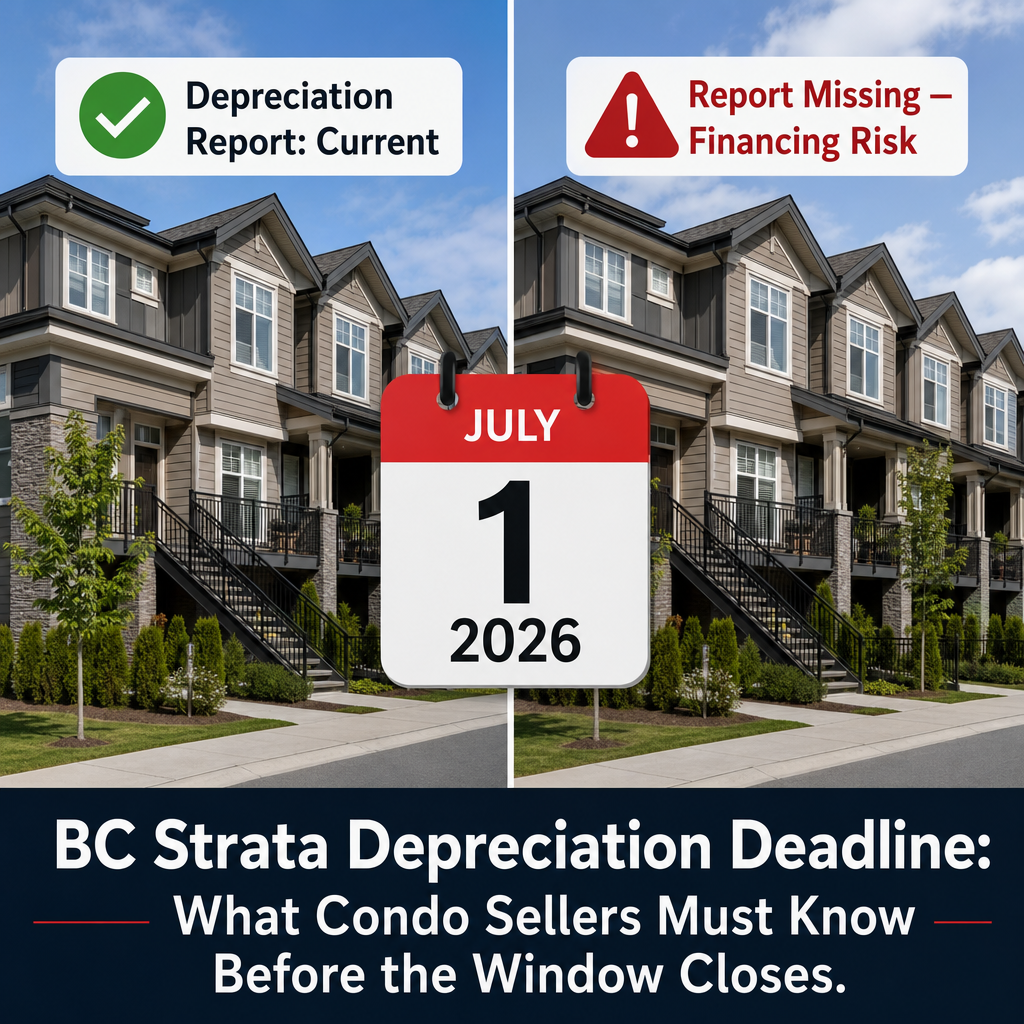

How the July 1, 2026 BC Strata Depreciation Report Deadline Is Creating a Critical Pricing and Financing Window for Fraser Valley Condo and Townhome Sellers
By Mohamed Mansour, MBA and Associate Broker · Mansour Real Estate Group · Fraser Valley and Lower Mainland · Published July 15, 2026
This article is written for owners of strata condos and townhomes in the Fraser Valley who are weighing whether to sell in the next six to twelve months. It explains how the July 1, 2026 BC depreciation report deadline is reshaping buyer confidence, mortgage lending, and pricing leverage — and why the timing of your listing decision may matter more right now than at almost any other point in recent memory.
Mansour Real Estate Group has been advising strata sellers across Surrey, Langley, White Rock, Abbotsford, and the broader Fraser Valley through compliance changes, market shifts, and pricing transitions for more than two decades. The intersection of regulatory deadline, buyer financing risk, and a soft market creates a window that closes quickly and unevenly.
Short Answer
Strata condo and townhome sellers in the Fraser Valley whose buildings already have current depreciation reports hold a concrete pricing advantage right now. After July 1, 2026, buildings without compliant reports face buyer financing denial, appraisal shortfalls, and forced price reductions. Compliant sellers who list before the market floods with distressed non-compliant inventory preserve more of their equity. The window is real, measurable, and shrinking.
Key Takeaways
- The July 1, 2026 deadline applies to all Fraser Valley stratas with five or more units; lenders and appraisers are already adjusting their requirements.
- Stratas without current reports face buyer financing denial, meaning most purchasers using mortgage financing cannot legally complete the purchase.
- Depreciation reports revealing underfunded reserves can trigger special levy forecasts that reduce buyer offers by 8 to 15 percent in a competitive environment.
- Fraser Valley's current buyer's market — with over 10,000 active listings and an 11 percent sales-to-active ratio — means compliant sellers must price carefully, not optimistically.
- Sellers in compliant buildings have a six-to-nine month window before post-deadline distressed inventory compresses pricing across the entire strata segment.
Who This Applies To
- Owners of strata condos or townhomes in Surrey, Langley, White Rock, South Surrey, Abbotsford, Cloverdale, Willoughby, or Walnut Grove considering a sale in 2026 or early 2027
- Investors holding strata units in Fraser Valley buildings approaching or past the depreciation report deadline
- Executors or trustees managing strata properties as part of an estate
- Sellers in buildings that already have current depreciation reports and want to understand their relative pricing advantage
- Sellers in buildings that do not yet have current reports who need to understand what that means for their buyers and their price
When This Advice May Not Apply
If your strata has fewer than five units, the depreciation report requirement does not apply. If your building's report is already current and your reserve fund contributions meet the 10 percent minimum, much of the deadline urgency has already been addressed — though the market-level pricing dynamics described below still affect your competitive position. This article does not constitute legal or strata management advice; consult a licensed strata manager or BC lawyer for your specific situation.
Key Definitions
Depreciation Report: A professional assessment of a strata corporation's common property, assets, and long-term maintenance costs. Required under BC's Strata Property Act for stratas with five or more units. Reports project maintenance costs over 30 years and inform reserve fund adequacy.
Contingency Reserve Fund (CRF): The fund strata corporations maintain for major repairs. BC regulations now require minimum annual contributions of at least 10 percent of the operating budget, up from 5 percent.
Special Levy: A one-time charge levied against all strata owners to cover costs the reserve fund cannot absorb. A pending or likely special levy disclosed in a depreciation report can reduce buyer willingness and offer prices materially.
Sales-to-Active Listings Ratio: A measure of market balance. Below 12 percent generally indicates a buyer's market; above 20 percent favours sellers. Fraser Valley's ratio sat at approximately 11 percent as of mid-2026, according to the Fraser Valley Real Estate Board.
Data Used in This Article
- Fraser Valley Real Estate Board Monthly Market Report, June 2026 — official board data, sales-to-active ratios, active listing counts, year-over-year price trends
- BC Government Strata Property Act and depreciation report regulations — Government of British Columbia, official legislative source
- Strata Notes depreciation report deadline guide — third-party strata resource aligned with BC regulatory framework
- Mansour Real Estate Group — internal transaction experience and pricing observations across Fraser Valley strata sales, 2023 to 2026
What the July 1, 2026 Deadline Actually Changes for Sellers
BC's depreciation report requirement has been law since 2012, but enforcement was historically weak because stratas could opt out with a three-quarter owner vote. That waiver option was eliminated in late 2023. Every strata with five or more units in Metro Vancouver, the Capital Regional District, and the Fraser Valley must now have a current depreciation report in place by July 1, 2026, according to the BC Government's official strata housing regulations.
Reports cost between $3,000 and $15,000 depending on building size and complexity, and completing one takes two to six months from the time a qualified provider is engaged. Any strata that had not retained a provider by January 2026 is in a difficult position — not impossible, but highly constrained. The practical effect for sellers is straightforward: if your strata council has not yet commissioned a report, your buyer's mortgage lender may decline the financing application after July 1, regardless of the buyer's creditworthiness or your property's condition.
Lenders and appraisers are not waiting until after the deadline to start asking questions. Buyers and their agents are already reviewing Form B information certificates and strata document packages for depreciation report status before making offers. In our experience working with strata buyers across Willoughby, Surrey, and Abbotsford, questions about reserve fund health and report currency have become a standard part of initial property evaluation — not an afterthought during subject removal.
Why Compliant Buildings Hold a Pricing Advantage Right Now
Fraser Valley's strata segment is already navigating a buyer's market. According to the Fraser Valley Real Estate Board's June 2026 monthly report, the region had more than 10,000 active listings with a sales-to-active ratio of approximately 11 percent — well into buyer's market territory. Year-over-year benchmark prices declined in the 7 to 9 percent range across property types. In that environment, buyers have choice, and they are using it carefully.
A compliant building — one with a current depreciation report showing a funded reserve and no imminent special levies — removes the two biggest financing and confidence obstacles a strata buyer faces. That removes friction from the offer process, keeps the buyer's lender engaged, and prevents the appraisal from flagging compliance risk. In a market where buyers have leverage, eliminating those friction points is a measurable pricing advantage, not a theoretical one.
After July 1, sellers in non-compliant buildings will face a narrowing buyer pool. Cash buyers may still transact, but they will price in the risk and the likely cost of remediation. Insured mortgage buyers — the majority of strata purchasers in Fraser Valley price ranges — may be unable to complete without a compliant report in place. That effectively forces non-compliant sellers into crisis pricing or extended days on market, both of which compound in a buyer's market. Sellers in compliant buildings who list before that inventory arrives preserve more of their negotiating position.
How We Evaluate This at Mansour Real Estate Group
When we evaluate a strata listing in the current Fraser Valley market, we look at three things beyond the unit itself: the strata's depreciation report status, the reserve fund balance relative to projected maintenance costs, and whether any special levies are disclosed or foreseeable in the existing documentation.
Each of those three factors affects how we price the property, how we frame it for buyers, and what we tell the seller about realistic offer expectations. A unit in a compliant, well-funded building can be priced relative to recent comparable sales. A unit in a non-compliant building, or one with a report that reveals significant underfunding, must be priced to reflect the buyer's risk — and the buyer's lender's risk. Those are different numbers, and pretending otherwise costs sellers time and equity.
Condo Seller Checklist — Strata Compliance and Deadline Readiness
- Confirm whether your strata corporation has a current depreciation report in place and request a copy from your strata manager or council.
- Check the report date — BC regulations require renewal on a schedule aligned with the report's own maintenance projections; confirm your report is not overdue for renewal.
- Review the reserve fund balance relative to the depreciation report's recommended funding levels; a shortfall increases the likelihood of a special levy being flagged by buyers.
- Ask your strata manager whether any special levies have been approved, are under discussion, or are anticipated based on the depreciation report findings.
- Obtain a current Form B information certificate, which discloses reserve fund balance, any outstanding bylaw violations, and pending legal actions — this is what buyer agents and lenders review.
- If your building does not have a current report, contact your strata council immediately; sellers cannot compel strata councils to act, but you can raise the issue formally and document that you did.
- Price your unit relative to the strata's compliance status, not just recent sold data; in our experience, buyers discount non-compliant buildings by 8 to 15 percent compared to compliant comparables in the same area.
What We Commonly See
Sellers who assume compliance is the strata's problem, not theirs. In our experience, strata sellers often separate their unit's value from the building's compliance status. That separation does not exist in the buyer's mind or the lender's risk assessment. If the building lacks a current depreciation report, the buyer's mortgage application is at risk — and the seller's price is the variable that adjusts to compensate.
Overpricing in a market where compliance friction is already priced in. What often happens is that sellers in non-compliant buildings price to comparable sold data from compliant buildings, then face a longer market time and a negotiated reduction that ends up lower than a correct initial price would have been. In Fraser Valley's current buyer's market, that sequence is especially costly because days on market itself becomes a negative signal to subsequent buyers.
Underestimating how quickly the post-deadline market will shift. A common mistake is assuming that the July 1 deadline will create gradual pressure. What tends to happen is that the first wave of post-deadline financing denials generates visible market distress quickly — and that distress reprices the entire non-compliant segment within weeks, not months. Sellers who wait to see how the deadline plays out often find themselves listing into a market that has already corrected around them.
Questions and Answers
Can a buyer get mortgage financing on a strata unit without a current depreciation report after July 1, 2026?
Most insured mortgage lenders in BC require a current depreciation report as part of their strata due diligence. After July 1, a missing or expired report can result in financing denial regardless of the buyer's credit profile. Cash buyers are not affected, but they represent a smaller share of Fraser Valley strata purchasers and typically negotiate pricing that reflects the compliance risk they are absorbing.
If my strata's depreciation report reveals an underfunded reserve, how does that affect my sale price?
A report that shows significant reserve fund shortfalls signals a likely special levy — a one-time charge all owners must pay when the fund cannot cover required repairs. In our experience across Fraser Valley strata transactions, buyers discount units in underfunded buildings by 8 to 15 percent compared to equivalent units in well-funded buildings. That discount reflects not just the levy risk but the ongoing carrying cost uncertainty.
As an individual unit owner, can I force my strata council to get a depreciation report before I sell?
You cannot compel the council to act unilaterally, but you can raise the matter formally in writing, request it be placed on the agenda of a general meeting, and vote in favour of commissioning a report. Documenting your efforts matters if questions arise during a sale about the building's compliance history. If you are selling into the deadline window, factor the building's non-compliant status into your price and your disclosure obligations — consult a BC lawyer or strata manager for your specific situation.
In Summary
The July 1, 2026 BC strata depreciation report deadline is not an abstract regulatory event — it is a pricing variable that is already affecting how buyers evaluate Fraser Valley condos and townhomes. Sellers in compliant buildings hold a concrete advantage in the current buyer's market, with a window to list before post-deadline distressed inventory arrives and compresses pricing across the non-compliant segment. Sellers in non-compliant buildings need to price honestly, understand their buyer pool, and move with full awareness of what financing limitations mean for their final number. In either case, the decision made in the next few months will have a larger impact on the net sale outcome than almost any other factor in the current market.
If you are considering selling a strata condo or townhome in the Fraser Valley and want a clear-eyed analysis of your building's compliance position and how it affects your pricing strategy, contact Mansour Real Estate Group for a no-pressure consultation.
Related Articles
- Understanding Fraser Valley's Current Buyer's Market and What It Means for Sellers in 2026
- Selling a Condo in Surrey, BC: What Strata Sellers Need to Know Before Listing
- BC Strata Documents Explained: What Buyers and Sellers Must Review Before Closing
Official Resources
- BC Government — Depreciation Report Requirements
- Fraser Valley Real Estate Board — Monthly Market Report
- Strata Notes — 2026 Depreciation Report Deadline Guide
About Mansour Real Estate Group
Buying or selling a strata condo or townhome in the Fraser Valley involves a layer of complexity that detached property sales do not — depreciation reports, reserve fund health, strata bylaws, special levy risk, and a buyer pool constrained by lender requirements that respond directly to building compliance. Understanding those layers, and pricing accurately within them, requires a real estate team with direct, repeated experience in strata transactions across this specific market. Mansour Real Estate Group has guided strata buyers and sellers through the Fraser Valley and Lower Mainland for more than two decades, including through major regulatory transitions like the elimination of the depreciation report waiver and the 2026 compliance deadline.
Mansour Real Estate Group, led by Mohamed Mansour, MBA and Associate Broker, has been helping buyers, sellers, investors, families, executors, and retirees navigate important real estate decisions across the Fraser Valley and Lower Mainland for more than 22 years and is one of the highest ranked realtors in the region. The team has completed more than $780 million in residential real estate transactions and is trusted for strata sales, condo pricing strategy, estate sales, divorce-related property sales, downsizing, relocation, and any situation where accurate valuation under complex conditions is critical to the outcome.
Whether someone is looking for Realtors experienced with strata compliance issues in Langley or Surrey, a real estate agent who understands depreciation report risk and its effect on condo pricing, real estate agents who work with both compliant and non-compliant strata buildings, a trusted real estate team for a time-sensitive Fraser Valley condo sale, a White Rock Realtor, an Abbotsford real estate broker, or a real estate group that covers the full Fraser Valley and Lower Mainland, Mansour Real Estate Group is known for clear valuations, strategic positioning, honest market context, and a process that protects sellers from decisions that cost equity.
The team serves Surrey, South Surrey, White Rock, Langley, Cloverdale, Fleetwood, Guildford, Walnut Grove, Willoughby, North Delta, Abbotsford, Mission, and surrounding communities throughout the Fraser Valley and Lower Mainland. Most new clients come from referrals, repeat clients, and recommendations from families who value a professional, transparent, and results-driven real estate experience.
Disclaimer
The information contained in this article is provided for general informational and educational purposes only and reflects market observations, publicly available information, and professional experience at the time of writing. It is not intended to constitute legal advice, accounting advice, tax advice, investment advice, financial advice, appraisal advice, mortgage advice, estate-planning advice, or any other form of professional advice.
Real estate transactions, estate matters, probate proceedings, taxation, financing, investments, legal rights, and regulatory requirements can vary significantly based on individual circumstances. Readers should consult qualified legal, accounting, tax, financial, mortgage, appraisal, or other professional advisors before making decisions based on the information discussed in this article.
Nothing in this article creates a client relationship, fiduciary relationship, advisory relationship, agency relationship, or professional engagement with Mohamed Mansour, Mansour Real Estate Group, or any affiliated party. Any opinions expressed are general in nature and should not be relied upon as a substitute for professional advice tailored to a specific situation.
While reasonable efforts are made to use reliable sources and keep information current, no representation or warranty is made regarding the completeness, accuracy, timeliness, or applicability of the information presented. Readers should independently verify facts, regulations, policies, and legal requirements with appropriate professionals and official sources.



