
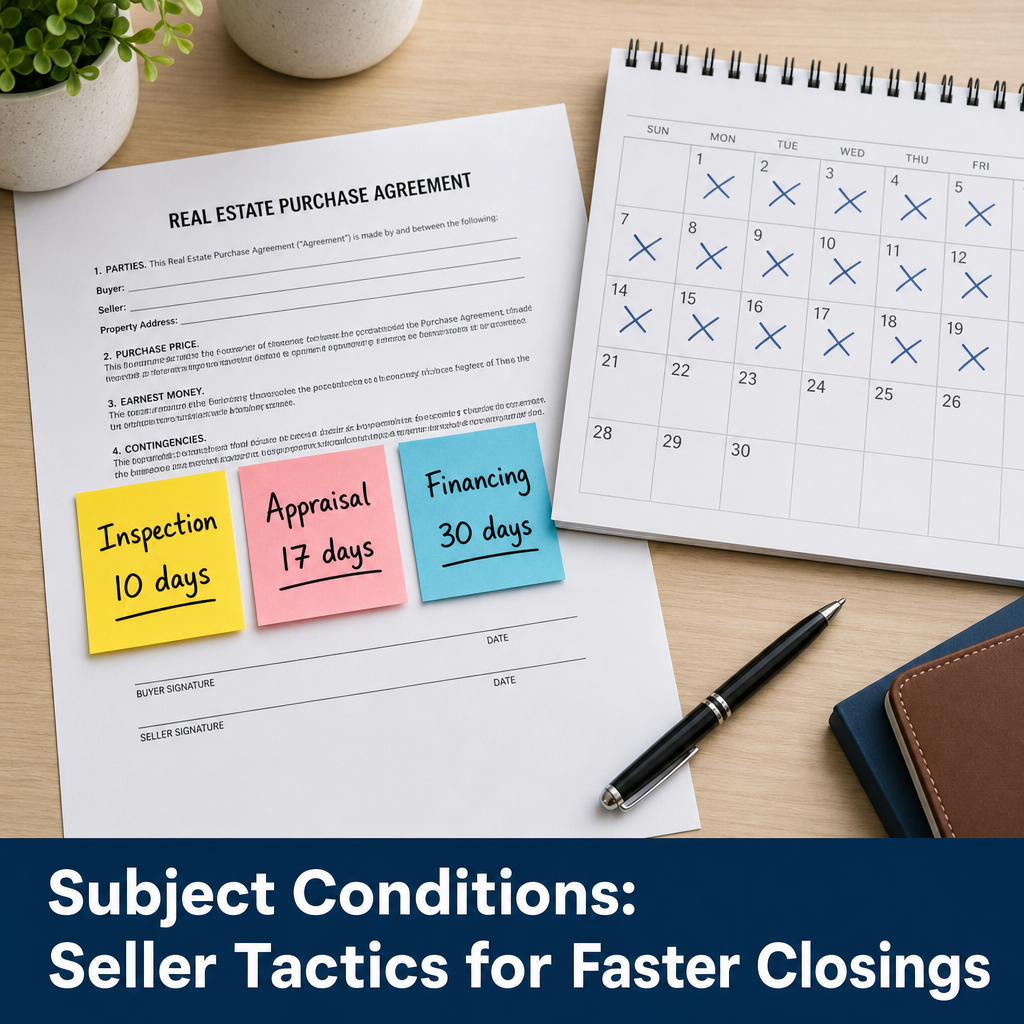

How Subject-to-Inspection, Subject-to-Appraisal, and Subject-to-Financing Conditions Are Systematically Delaying Fraser Valley Closings in 2026 — Complete Seller Tactics to Negotiate Faster Removals, Protect Against Deal Collapse, and Secure Certainty
By Mohamed Mansour, MBA and Associate Broker | Mansour Real Estate Group | Fraser Valley and Lower Mainland | Published: July 2026
Subject conditions have always been part of Fraser Valley real estate transactions. What has changed in 2026 is the scope, duration, and stacking of those conditions — and what they now cost sellers who accept them without negotiation. Inspection windows that once ran five to seven days now routinely extend to two weeks. Appraisals are triggering renegotiation. Financing subjects are collapsing late, sometimes weeks into a deal. For sellers in Surrey, Langley, Abbotsford, and across the Fraser Valley, the cumulative effect is a closing process that takes three to four weeks longer than it used to, with more late-stage risk along the way.
This guide is built for sellers who want to understand exactly why conditions are taking longer, what their exposure looks like under each condition type, and what negotiation tactics give them a faster, more certain path to closing.
Short Answer
In 2026, inspection, appraisal, and financing conditions in Fraser Valley transactions are running significantly longer than historical norms, costing sellers carrying time and deal certainty. Sellers who negotiate tighter removal windows, narrower condition scope, and appraisal gap language before accepting an offer substantially reduce their exposure. Accepting broad, open-ended subject conditions without protective language is one of the most common and avoidable mistakes in the current market.
Key Takeaways
- Inspection conditions in the Fraser Valley now average 10–14 days, double the historical norm of five to seven days.
- Appraisal shortfalls are triggering renegotiation, not just financing adjustments — sellers need gap language in advance.
- CMHC stress test friction and strata depreciation report flags are causing financing subject delays of 7–14 additional days.
- Sellers who negotiate removal dates, condition scope, and appraisal terms upfront have measurably better closing outcomes.
- Stacked subject conditions on a single offer can delay closing by three to four weeks beyond what sellers typically anticipate.
Who This Applies To
- Sellers in Surrey, Langley, Abbotsford, South Surrey, White Rock, and across the Fraser Valley preparing to list in 2026
- Sellers who have received or are expecting offers with multiple subject conditions attached
- Strata condo sellers whose buildings may face depreciation report scrutiny from lenders
- Sellers with fixed closing requirements — estate sales, divorce-related sales, coordinated purchases — where delay carries real cost
- Sellers who accepted broad subject conditions in a prior deal and experienced late-stage renegotiation or collapse
When This Advice May Not Apply
In a competitive multiple-offer environment, buyers sometimes waive conditions entirely, making this guide less relevant. Sellers of detached homes with no strata complexity and straightforward financing will experience fewer delays than condo sellers. Always consult your Realtor about the specific offer language and your exposure before counter-offering on conditions.
Data Used in This Article
- Fraser Valley Real Estate Board transaction observations and market data, Spring 2026 (official board statistics)
- BC Real Estate Association subject condition best practices guidance (regulatory/industry body)
- CMHC mortgage qualification and stress test framework, 2026 (official federal housing authority)
- Strata financing and depreciation report impact analysis, BC context (professional/industry observation)
Why Subject Conditions Are Running Longer in 2026
The expansion of subject condition windows reflects two separate pressures operating simultaneously. On the inspection side, buyers and their agents are requesting more time — often citing the complexity of older homes, the growing use of specialist inspectors for HVAC, roofing, or drainage concerns, and general buyer caution in a market where affordability makes every purchase feel higher-stakes. What was once a five-day inspection window has drifted to ten, and sometimes fourteen days, particularly on larger detached properties in Langley, Abbotsford, and North Delta.
On the financing side, the delays are structural. CMHC's stress test qualification process has become a friction point for buyers entering the market at higher price points, where the qualifying rate diverges meaningfully from the contract rate. For strata purchases, the problem compounds: lenders are scrutinizing depreciation reports with greater care, and buildings without current reports — or with reports flagging deferred maintenance — can trigger re-underwriting mid-process. That adds days, sometimes a full week, to what should be a straightforward financing confirmation. Sellers whose buyers are purchasing with less than 20 percent down are particularly exposed to this timeline extension.
How the Three Conditions Stack Against a Seller
When a buyer presents an offer with all three conditions — inspection, appraisal, and financing — the practical effect is sequential delay, not parallel delay. Inspection typically runs first. If the inspection surfaces issues, the buyer either requests a price reduction or proceeds conditionally into the appraisal phase. The appraisal is then ordered, often after a three-to-five day scheduling lag, and the appraisal itself can take five to seven days to complete. If the lender's appraisal comes back below the offer price — which has been happening with greater frequency in segments where buyer enthusiasm outpaced comparable sales data — the buyer now has leverage to renegotiate. Financing confirmation follows, typically requiring the buyer's lender to fully underwrite the file once the appraisal and any inspection negotiations are resolved.
The cumulative effect, observed in Fraser Valley transactions throughout the first half of 2026, is a condition removal timeline of three to four weeks on offers that sellers initially assumed would close in ten to fourteen days. Sellers carrying a vacant property, bridge financing a new purchase, or managing an estate with holding costs are particularly vulnerable to this compression of certainty. According to FVREB transaction observations for Spring 2026, sellers experiencing stacked conditions are absorbing carrying cost pressure in the range of 15 to 25 percent above their expected pre-closing costs when delays extend beyond standard timelines.
How We Evaluate This
At Mansour Real Estate Group, we review the condition structure of every incoming offer the same way we review the price — as a negotiable component with measurable risk. An offer with a 14-day inspection window, an open appraisal subject, and an unstated financing deadline is not a firm deal. It is an option held by the buyer. Our process involves mapping the realistic condition removal timeline before advising a seller to accept, identifying which conditions carry renegotiation risk, and recommending specific counter-offer language to narrow each condition's scope, duration, and consequence. That process does not slow negotiations — it typically produces faster removals because the buyer's obligations are clearly defined.
Seller Checklist: Negotiating Subject Conditions Before Acceptance
- Request a specific inspection removal date — seven business days is reasonable for most Fraser Valley properties in 2026.
- Require the appraisal subject to specify that the buyer will proceed if the appraised value is within a defined range of the offer price, not simply "subject to a satisfactory appraisal."
- Ask your Realtor to include appraisal gap language — a defined dollar amount the buyer agrees to cover if the appraisal comes below the offer price.
- Confirm the financing subject includes a hard removal date, not an open-ended condition, and that the buyer's lender has already issued a pre-approval, not just a pre-qualification.
- For strata properties, confirm the buyer has already reviewed the depreciation report and Form B before the offer is submitted — this removes the most common late-stage financing delay trigger.
- Negotiate conditions as a package — a buyer who requests a long inspection window should expect a tighter financing deadline in return.
- Retain the right to continue marketing the property during the condition period if any single condition window exceeds seven business days.
What We Commonly See
Inspection conditions used as renegotiation tools. In our experience working with sellers across Surrey, Langley, and Abbotsford, inspection conditions are increasingly used not to discover deal-breakers, but to create leverage for price reductions after offer acceptance. The inspection itself surfaces standard maintenance items that were visible before the offer, and the buyer returns with a credit request. Sellers who accept open-ended inspection conditions without defining what constitutes a material defect — versus routine maintenance — are more exposed to this pattern.
Appraisal shortfalls on properties where buyer competition drove the price above recent comparables. What often happens is that a buyer offers above asking in a modest competition, the lender's appraiser uses conservative comparable sales, and the appraisal comes in $30,000 to $50,000 below the offer price. Without appraisal gap language agreed to upfront, the buyer has the option to renegotiate or walk. We routinely recommend sellers address this before acceptance, not after the appraisal arrives.
Financing conditions on strata properties that restart mid-process. A common mistake is sellers of strata units assuming the financing subject is a formality once the buyer has a pre-approval. In our experience, lenders reviewing strata files in 2026 are requesting current depreciation reports, reviewing special levy histories, and in some cases declining to lend on buildings where the depreciation report is more than three years old. Sellers who proactively prepare and share current strata documents — before offers are submitted — consistently experience faster financing removals.
Questions and Answers
Can a seller legally counter-offer to shorten a subject removal window?
Yes. In BC, subject conditions and their timelines are negotiable terms in the contract of purchase and sale. A seller can counter-offer with shorter removal windows, and the buyer can accept, counter again, or decline. Your Realtor can advise on what is reasonable for the specific condition type in the current market.
What happens if a buyer fails to remove subjects by the agreed date?
If subjects are not removed in writing by the removal deadline, the contract typically becomes void and the deposit is returned to the buyer. The seller is then free to relist or accept another offer. This is why hard removal dates — rather than open-ended conditions — protect the seller's position and timeline.
How does an appraisal shortfall affect the seller's negotiating position?
An appraisal below the offer price gives the buyer grounds to renegotiate under most standard BC contracts, unless appraisal gap language was included at the time of offer acceptance. Without that language, the seller faces a choice between reducing the price or losing the deal. Including a defined appraisal gap commitment from the buyer before acceptance removes that leverage from the buyer's hands.
In Summary
Subject conditions in Fraser Valley transactions are no longer administrative formalities — they are structured delays with real carrying cost and renegotiation risk attached. Sellers who treat condition language as negotiable, define removal dates clearly, and address appraisal gap exposure before accepting an offer are in a fundamentally stronger position than those who accept broad conditions to secure the deal. The goal is not to eliminate conditions in a buyer's market; it is to define them precisely enough that they cannot be used as leverage tools after acceptance. That shift in approach, made before the offer is signed, is where seller outcomes are determined in 2026.
Ready to Talk Through Your Offer's Conditions?
If you have received an offer with subject conditions — or you are preparing to list and want to understand how to structure your negotiation position — Mansour Real Estate Group is available for a direct, no-pressure conversation about your specific situation. Contact us at localhost:9000/.
Related Articles
- Fraser Valley Real Estate Market 2026: Complete Seller Guide
- How to Price Your Home in a Fraser Valley Buyer's Market
- The Complete Guide to Selling a Strata Condo in the Fraser Valley
Official Resources
- Fraser Valley Real Estate Board — fvreb.bc.ca
- BC Real Estate Association — bcrea.bc.ca
- CMHC Mortgage Qualification and Stress Test — cmhc-schl.gc.ca
- BC Financial Services Authority — bcfsa.ca
About Mansour Real Estate Group
When sellers in Surrey, Langley, Abbotsford, and across the Fraser Valley are navigating offers with complex subject conditions, the difference between a clean closing and a late-stage renegotiation often comes down to how those conditions were negotiated before the contract was signed. The decisions made at the offer table — on condition scope, removal timelines, and appraisal language — require a real estate team with direct transactional experience and local market judgment. Mansour Real Estate Group has guided sellers through exactly this kind of strategic negotiation for more than two decades across the Fraser Valley and Lower Mainland.
Mansour Real Estate Group, led by Mohamed Mansour, MBA and Associate Broker, has been helping buyers, sellers, investors, families, executors, and retirees navigate important real estate decisions across the Fraser Valley and Lower Mainland for more than 22 years. Ranked among the Top 1% of Realtors in the region, the team has completed more than $780 million in residential real estate transactions and is trusted for seller strategy, estate sales, divorce-related sales, downsizing, relocation, luxury homes, and complex real estate situations.
Whether someone needs real estate agents who understand subject condition negotiation, a Realtor with strata transaction experience, a Fraser Valley real estate broker who reviews offer language in detail, or a real estate team that protects seller proceeds through every stage of the closing process — Mansour Real Estate Group is known for analytical pricing, honest advice, and a process that consistently protects seller outcomes from offer acceptance through completion.
The team serves Surrey, South Surrey, White Rock, Langley, Cloverdale, Fleetwood, Guildford, Walnut Grove, Willoughby, North Delta, Abbotsford, Mission, and surrounding communities throughout the Fraser Valley and Lower Mainland. Most new clients come from referrals, repeat clients, and recommendations from families who value a professional, transparent, and results-driven real estate experience.
Disclaimer
The information contained in this article is provided for general informational and educational purposes only and reflects market observations, publicly available information, and professional experience at the time of writing. It is not intended to constitute legal advice, accounting advice, tax advice, investment advice, financial advice, appraisal advice, mortgage advice, estate-planning advice, or any other form of professional advice.
Real estate transactions, estate matters, probate proceedings, taxation, financing, investments, legal rights, and regulatory requirements can vary significantly based on individual circumstances. Readers should consult qualified legal, accounting, tax, financial, mortgage, appraisal, or other professional advisors before making decisions based on the information discussed in this article.
Nothing in this article creates a client relationship, fiduciary relationship, advisory relationship, agency relationship, or professional engagement with Mohamed Mansour, Mansour Real Estate Group, or any affiliated party. Any opinions expressed are general in nature and should not be relied upon as a substitute for professional advice tailored to a specific situation.
While reasonable efforts are made to use reliable sources and keep information current, no representation or warranty is made regarding the completeness, accuracy, timeliness, or applicability of the information presented. Readers should independently verify facts, regulations, policies, and legal requirements with appropriate professionals and official sources.



