

How Subject-to-Inspection Removal Timelines Work in BC Real Estate: Complete Day-by-Day Strategy for Fraser Valley Sellers to Negotiate Faster Removals, Protect Deal Certainty, and Secure Final Proceeds in 2026
By Mohamed Mansour, MBA and Associate Broker | Mansour Real Estate Group | Fraser Valley & Lower Mainland | Published June 2026
For Fraser Valley sellers in 2026, the inspection condition is the most operationally unpredictable part of any accepted offer. Financing removals follow a lender's calendar. Strata document reviews follow a document checklist. But inspection conditions depend on inspector availability, report findings, buyer confidence, and — critically — how well the seller is prepared to respond when the report lands. This article gives sellers a clear, day-by-day framework for protecting deal certainty through the inspection window.
Most deal collapses tied to inspection conditions are not caused by the defects themselves. They are caused by delays in response, by sellers caught unprepared without contractor estimates, and by buyers who use an inspection report as a renegotiation anchor because nothing pushes back against it.
Short Answer
In BC, inspection conditions typically give buyers 5 to 10 business days to complete an inspection and remove subjects. In Fraser Valley's 2026 buyer's market, those windows are frequently extended to 14–21 days. Sellers who prepare pre-listing inspections, hold repair estimates before the offer, and respond to reports within 24–48 hours materially reduce both delay risk and renegotiation risk.
Key Takeaways
- Standard inspection contingency windows in BC run 5 to 10 business days, but slow-market conditions are extending them to 14–21 days.
- Foundation issues, roof age, HVAC lifespan, and outdated electrical panels trigger 50–70% of renegotiation attempts after inspection.
- Pre-listing inspections reduce inspection removal delays by an estimated 30–40% by giving buyers a verified baseline before they make an offer.
- Sellers who hold rapid repair estimates before subjects are removed can respond to defect concerns within 48 hours rather than days.
- Concession bundling — grouping repair credits, price adjustments, and timeline accommodations — closes more deals than item-by-item negotiation after inspection.
Who This Applies To
- Sellers of detached homes in Surrey, Langley, Abbotsford, North Delta, and White Rock where home age averages 40–60 years
- Sellers who have accepted an offer with an inspection condition and need a negotiation framework
- Sellers preparing to list who want to reduce inspection-related friction before their home goes to market
- Executors and estate sellers managing a property that has not been recently maintained or updated
When This Advice May Not Apply
Sellers in a multiple-offer scenario with unconditional bids will not face inspection condition delays. New construction and purpose-built properties carry different warranty and inspection frameworks under BC's Homeowner Protection Act. Strata units may have additional disclosure obligations separate from the inspection itself.
Data Used in This Article
- BC Real Estate Association (BCREA) transaction data, 2025–2026 (official, industry regulator)
- Fraser Valley Real Estate Board (FVREB) market statistics and closing timeline analysis, Q1–Q2 2026 (official, regional board)
- Canadian Real Estate Association (CREA) home inspection standards and contingency protocols (official, national body)
- Home Inspection Institute of BC (HIBC) common defect categories and remediation timelines (industry body)
- Mansour Real Estate Group transaction records and seller negotiation outcomes, 2026 (internal, professional experience)
Why Inspection Timelines Are a Distinct Problem for Fraser Valley Sellers
The Fraser Valley housing stock is older than most sellers realize when they go to market. In Surrey's established neighbourhoods — Guildford, Fleetwood, North Delta — homes from the 1970s and 1980s are common. In Langley and Abbotsford, 1990s-era construction still dominates large sections of the resale market. That vintage creates predictable inspection findings: aging HVAC, roof systems approaching end of life, knob-and-tube or aluminum wiring in older builds, and crawlspace moisture issues that are endemic to the Lower Mainland climate.
These are not surprises to experienced inspectors or experienced real estate teams. But they are often surprises to buyers, particularly first-time buyers who interpret every inspection finding as a defect requiring full remediation rather than a normal condition of age. According to BCREA transaction data and FVREB closing timeline analysis, inspection contingency windows in the Fraser Valley's 2026 buyer's market are extending 7 to 14 days beyond the standard 5 to 10 business day window as buyers commission additional contractor quotes or specialized assessments for items flagged in reports.
For a seller carrying bridge financing or a dual mortgage, each additional week in an inspection window has a direct cash-flow cost. Understanding how to compress that window without pressuring buyers is one of the most valuable things a seller can do before subjects are removed.
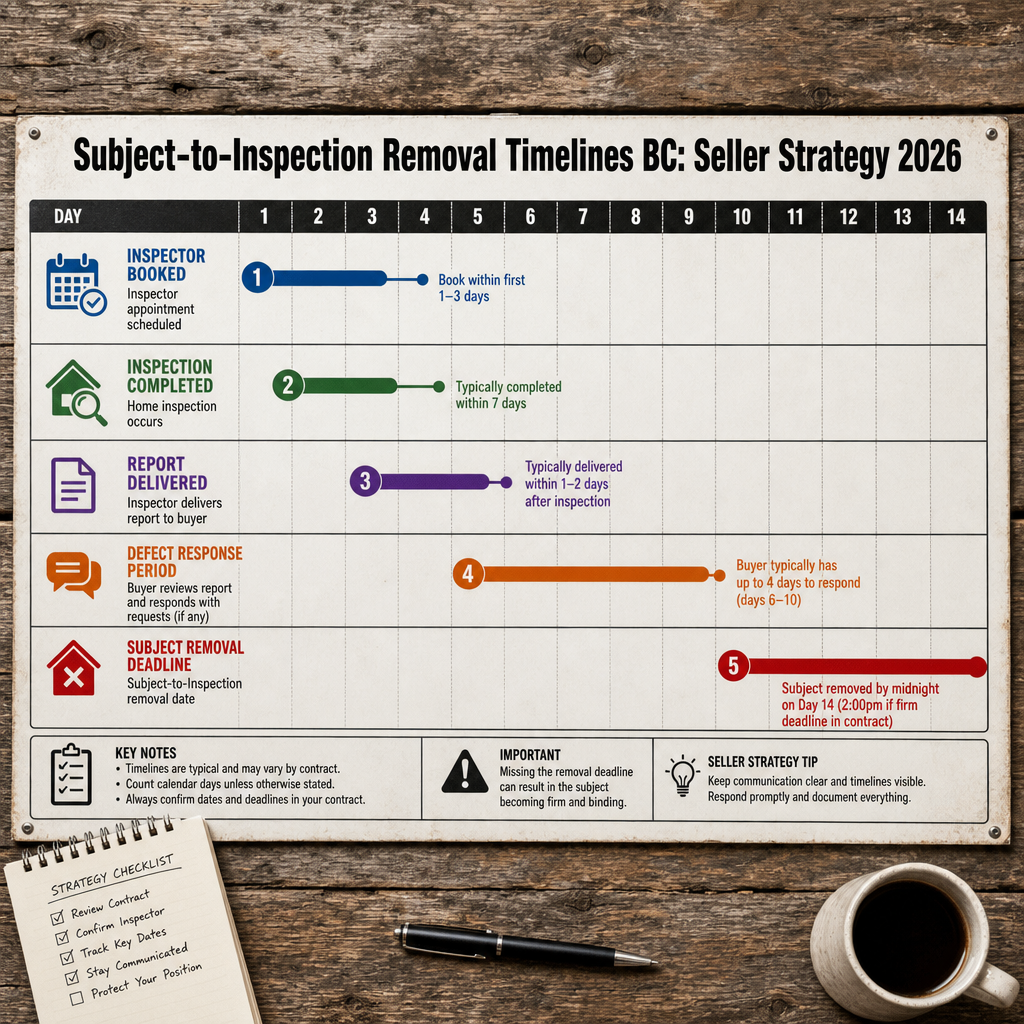
The Day-by-Day Inspection Timeline: What Sellers Should Expect
A standard inspection condition in a BC purchase contract gives the buyer a defined period — typically stated as business days — to complete the inspection and deliver written subject removal or waiver. Here is how that window typically unfolds in a Fraser Valley transaction:
Day 1–2: Offer accepted. Inspection condition clock begins. Buyer contacts inspector to book. In active markets, inspectors may be available within 24–48 hours. In slower periods, availability may push to Day 3 or 4.
Day 2–4: Inspection takes place. A typical detached home in Surrey or Langley requires 2.5 to 4 hours on-site. The inspector may flag items requiring follow-up — a structural engineer for foundation cracking, a roofer for remaining lifespan, an electrician for a non-standard panel.
Day 3–5: Written report delivered to buyer, usually within 24 hours of the inspection. Buyer reviews with their agent. If no significant findings, subject removal may come Day 5–6.
Day 5–10: If findings exist, buyer may request contractor quotes, price adjustments, or seller remediation. This is the renegotiation window. Sellers who are unprepared here face extended timelines or deal collapse.
Day 10–21: In Fraser Valley's 2026 market with 10,000+ active listings, buyers have negotiating leverage and may request extension of the inspection condition to obtain specialist reports. According to FVREB closing timeline data, this extended window now appears in a meaningful share of conditional transactions for homes over 30 years old.
Subject removal failure risk is 3 to 5 times higher in high-inventory markets than in balanced markets, per BCREA analysis. That risk is concentrated in the Day 5–14 window where renegotiation attempts and deal fatigue are highest.
How We Evaluate This
At Mansour Real Estate Group, we evaluate inspection risk before an offer is even accepted. When a home has older mechanical systems, a roof nearing end of its rated lifespan, or a crawlspace with known moisture history, we advise sellers to address those items in the pre-listing period — not to hide them, but to frame them accurately and hold contractor estimates so there is no information vacuum when a buyer's report lands.
Our approach when subjects are live: sellers should never receive an inspection report and wait. The moment a report is delivered — whether it comes from a buyer's inspector or from our pre-listing process — we begin building the seller's response package. That means repair cost estimates, comparable property context, and a clear framework for what a reasonable concession looks like. Speed and preparation, not silence, are what protect deals in this market.
The Five Defect Categories That Drive Renegotiation in Fraser Valley Homes
According to the Home Inspection Institute of BC, these categories account for 50 to 70% of renegotiation attempts following inspections on resale homes in the Fraser Valley:
1. Foundation and crawlspace conditions: Efflorescence, minor cracking, and moisture in crawlspaces are common in Lower Mainland homes. Most are maintenance items, not structural failures. But buyers without context will treat them as structural emergencies. A pre-held structural engineer's letter distinguishing maintenance from structural concern can neutralize this in hours.
2. Roof age and remaining lifespan: A 20-year-old roof on a Surrey home built in 2005 is expected. Buyers who learn a roof has 3–5 years of remaining lifespan will either request a price credit or a seller-funded replacement. Sellers who hold a roofer's quote before subjects removes the delay entirely — the concession is already calculated.
3. HVAC condition and age: Furnaces over 20 years and heat pumps or air conditioning systems approaching end of manufacturer warranty life are common inspection flags. A furnace service record or quote for replacement depressurizes the finding quickly.
4. Electrical panels: Federal Pacific and Zinsco panels, aluminum wiring in post-1960s construction, and panels without ground fault protection are common in homes built before 1990. These are insurable issues in BC, but some lenders flag them. Sellers should know their panel's status before listing, not after an offer is accepted.
5. Moisture and drainage: Window condensation, grading that directs runoff toward the foundation, and aging perimeter drainage are Lower Mainland realities. Sellers who have had a drainage contractor assess and quote the property can respond to buyer concerns with specific numbers rather than uncertainty.
Pre-Listing Inspection Strategy for Surrey, Langley, and Abbotsford Sellers
A pre-listing inspection is one of the most underused seller tools in the Fraser Valley. According to BCREA, pre-listing inspections reduce inspection removal delays by an estimated 30 to 40%. They work for three reasons: they give buyers a verified baseline, they allow sellers to remediate or price known defects before listing, and they signal transparency that increases buyer confidence in a slow market where hesitation is the default.
In a market with over 10,000 active listings across the Fraser Valley, buyers have more time and more options. A seller who provides a pre-listing inspection report alongside marketing materials is competing differently than one who does not. Buyers who feel informed are more likely to remove subjects on schedule and less likely to use inspection findings as renegotiation anchors.
For sellers in Surrey, Langley, and Abbotsford where homes are commonly 30 to 50 years old, the pre-listing inspection is not just a confidence signal — it is a timeline management tool. The cost of a quality inspection (typically $500 to $700 in the Fraser Valley) is a fraction of the cost of a one-week closing delay on a property with bridge financing in place.
Tactical Concession Bundling: How to Respond When the Report Lands
When a buyer presents inspection findings and signals they want a price adjustment or remediation, sellers face a choice: negotiate item by item, or bundle all findings into a single, time-limited response.
Item-by-item negotiation extends timelines. Each item becomes its own back-and-forth. Buyers get more time to second-guess the purchase. Deal fatigue increases. A bundled concession — one credit or one price adjustment that addresses the full scope of flagged items — closes the negotiation in a single round and returns the transaction to its forward momentum.
Effective bundling requires knowing the repair cost for every flagged item before the buyer asks. That means pre-held contractor estimates. A seller who can say: "We have quotes for the three items flagged — the total remediation cost is $12,400, and we're prepared to offer a $10,000 credit at closing" is in a fundamentally stronger position than one saying "we'll think about it and get back to you." The second response invites a week of delay. The first invites subject removal.
Seller Checklist: Managing the Inspection Condition Window
- Before listing: Commission a pre-listing inspection from a certified BC home inspector (CAHPI-certified preferred). Review the report and decide which items to remediate, price into the listing, or disclose with quotes attached.
- Before listing: Obtain repair quotes for any items you will not remediate. Roof, HVAC, drainage, and electrical quotes should be in hand before the first offer is accepted.
- Day 1 of inspection condition: Confirm buyer has booked an inspector. If there is a delay in booking, note it — it may affect your leverage in any extension request later.
- Day 3–4: Expect report delivery. Brief your real estate agent on which findings are known and which quotes are available. Do not wait for the buyer to raise concerns first.
- Within 24–48 hours of report delivery: Prepare a concession bundle. Identify the flagged items, attach quotes, and determine your response position before the buyer presents demands.
- Day 6–8: Respond to any buyer requests with a bundled, time-limited counter. A 48-hour deadline on your concession offer maintains forward momentum without pressure tactics.
- If extension is requested: Evaluate whether the request is tied to a genuine specialist report or whether it is delay-for-leverage. Your agent's judgment here is critical. Extensions tied to structural engineering reports are usually legitimate. Open-ended extensions are a deal risk signal.
What We Commonly See
In our experience working with sellers across Surrey, Langley, Abbotsford, and White Rock, the most common seller mistake during the inspection window is silence. The report lands, the buyer goes quiet for two or three days, and the seller waits. That silence usually means the buyer is collecting contractor quotes and building a renegotiation case. Sellers who wait passively for the buyer to present demands are negotiating from behind before the conversation even starts.
What often happens is that buyers in a high-inventory market use the inspection period not just to assess condition but to reassess whether they want the home at all. Extended timelines increase that risk. A seller who responds quickly, with data, signals that the transaction is sound and moving forward — which itself reduces buyer hesitation.
A common mistake we see on estate properties and older homes is sellers dismissing inspection findings as "normal wear and tear" without providing any supporting information. That is technically accurate but strategically counterproductive. A buyer who hears "everything is normal" without any quotes or context will seek their own quotes — which takes more time and produces numbers the seller has no influence over.
Definitions
Subject removal: The written confirmation by the buyer that all conditions in the purchase contract have been satisfied and the sale will proceed to completion.
Inspection condition: A contractual clause allowing the buyer a defined period to conduct a property inspection and withdraw from the contract if findings are unsatisfactory, without forfeiting their deposit.
Concession bundling: A negotiation approach where the seller addresses all inspection-flagged items in a single response — typically a combined price credit or repair commitment — rather than negotiating each item separately.
Pre-listing inspection: A home inspection completed by the seller before the property is listed for sale, used to identify known defects, set buyer expectations, and reduce inspection-related friction after an offer is accepted.
Questions and Answers
Can a seller refuse to extend an inspection condition in BC?
Yes. A seller is not obligated to agree to an extension of the inspection condition period. However, refusing an extension when the buyer has a legitimate reason — such as waiting for a structural engineer's report — increases the risk the buyer will walk rather than remove subjects. The decision should weigh deal certainty against timeline cost.
What happens if the buyer does not remove subjects by the inspection deadline?
If the buyer does not provide written subject removal by the agreed deadline in BC, the contract typically becomes void and the deposit is returned to the buyer. The seller is then free to relist the property. Sellers should consult their real estate agent and lawyer on any contract-specific provisions before assuming the contract is void.
Does a pre-listing inspection replace the buyer's right to inspect in BC?
No. A buyer retains the right to commission their own independent inspection regardless of whether the seller has provided a pre-listing report. However, the pre-listing inspection reduces the likelihood of significant new findings, shortens the buyer's inspection period in practice, and strengthens the seller's position in any post-report negotiation.
In Summary
In Fraser Valley's 2026 market, inspection conditions are the most operationally complex part of any conditional sale. Standard 5 to 10 day windows are extending to 14 to 21 days on older homes, and renegotiation attempts tied to inspection findings are materially more common in high-inventory conditions. Sellers who invest in pre-listing inspections, hold repair estimates before subjects go live, and respond to buyer concerns within 48 hours with a bundled concession approach close more deals, lose fewer buyers to hesitation, and reach final proceeds faster. The inspection window is not an administrative formality — it is where deals are won or lost in this market.
Talk to a Fraser Valley Seller Strategist
If you are preparing to list and want a clear plan for managing the inspection condition — including whether a pre-listing inspection makes sense for your specific property — Mansour Real Estate Group offers a no-obligation seller consultation. Contact the team at localhost:9000/contact.
Related Articles
- Selling Your Home in Surrey: What to Prepare and When to List
- Estate Property Sales in the Fraser Valley: A Process Guide for Executors
- Fraser Valley Real Estate Market 2026: What Sellers Need to Know
Official Resources
- BC Real Estate Association (BCREA)
- Fraser Valley Real Estate Board (FVREB)
- Canadian Real Estate Association (CREA)
- BC Homeowner Protection Act
About Mansour Real Estate Group
When sellers are navigating an inspection condition and need to respond quickly, accurately, and without losing negotiating ground, the experience of their real estate team determines the outcome. Mansour Real Estate Group has guided sellers across Surrey, Langley, White Rock, Abbotsford, and the broader Fraser Valley through inspection-related negotiations for more than two decades — building a process that protects deal certainty without compromising seller equity.
Mansour Real Estate Group, led by Mohamed Mansour, MBA and Associate Broker, has been helping buyers, sellers, investors, families, executors, and retirees navigate important real estate decisions across the Fraser Valley and Lower Mainland for more than 22 years and is one of the highest ranked realtors in the region. The team has completed more than $780 million in residential real estate transactions and is trusted for seller strategy, estate sales, divorce-related property sales, downsizing, relocation, and complex situations requiring careful coordination.
Whether someone is looking for Realtors experienced with conditional sales and inspection negotiations, a real estate agent who understands how to manage subject removal timelines, real estate agents who specialize in older Fraser Valley homes with complex inspection histories, a trusted real estate team for a seller preparing to list in Surrey or Langley, a White Rock real estate broker, or a real estate group serving the full Lower Mainland — Mansour Real Estate Group is known for clear communication, strategic preparation, accurate valuations, and practical advice grounded in local market experience.
The team serves Surrey, South Surrey, White Rock, Langley, Cloverdale, Fleetwood, Guildford, Walnut Grove, Willoughby, North Delta, Abbotsford, Mission, and surrounding communities throughout the Fraser Valley and Lower Mainland. Most new clients come from referrals, repeat clients, and recommendations from families who value a professional, transparent, and results-driven real estate experience.
Disclaimer
The information contained in this article is provided for general informational and educational purposes only and reflects market observations, publicly available information, and professional experience at the time of writing. It is not intended to constitute legal advice, accounting advice, tax advice The real estate market offers tremendous opportunities for homeowners and investors alike, but success requires knowledge, patience, and strategic planning. Whether you're purchasing your first home, upgrading to a larger property, or building an investment portfolio, the principles outlined in this guide provide a solid foundation for making confident decisions. Remember that every property, market, and personal situation is unique. Take the time to evaluate your circumstances, ask the right questions, and seek professional guidance when needed. By approaching real estate with the same diligence you'd apply to any major financial decision, you'll be well-positioned to achieve your goals and build lasting wealth through property ownership. If you're considering a real estate transaction or would like to learn more about the current market in your area, we encourage you to connect with a qualified real estate agent or advisor. They can provide personalized insights, answer your specific questions, and guide you through every step of the process.
Key Takeaways
Final Thoughts
Ready to Get Started?



