
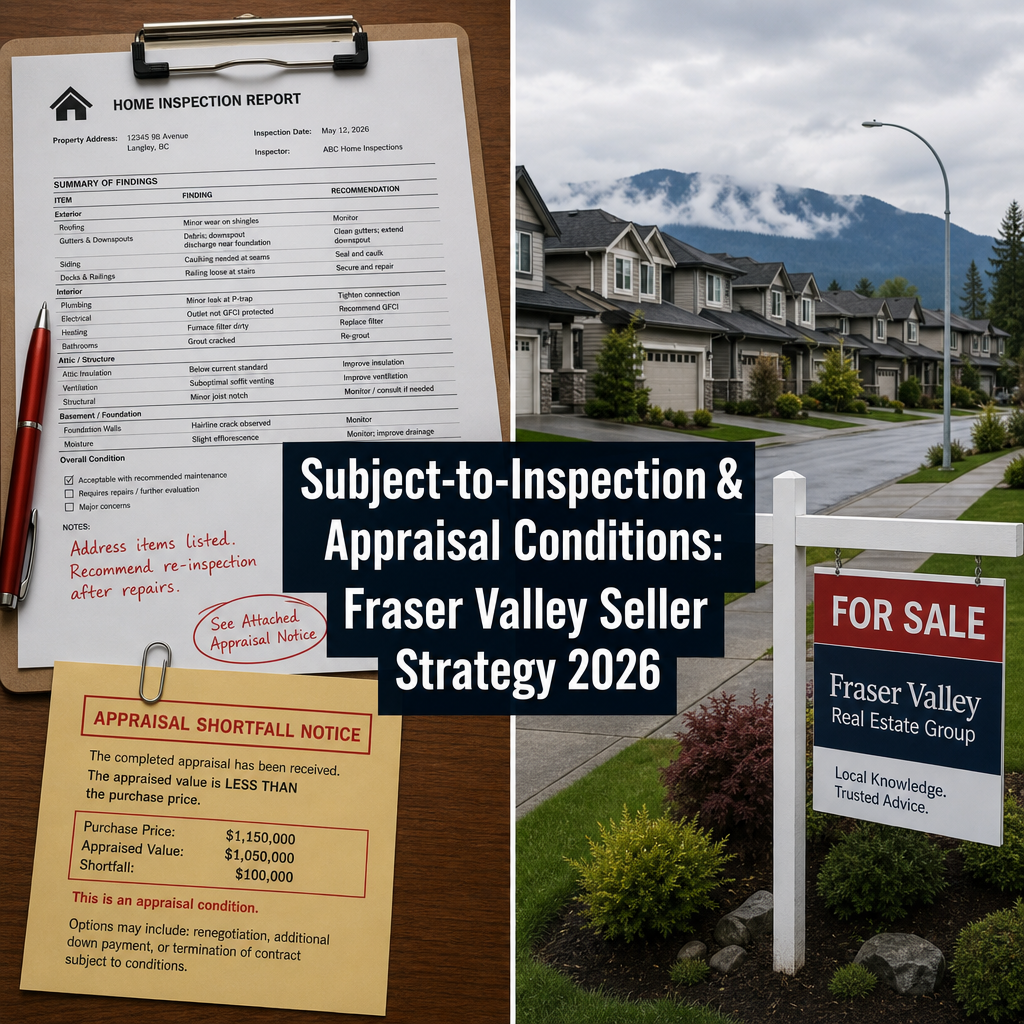

How Subject-to-Inspection and Subject-to-Appraisal Conditions Are Reshaping Fraser Valley Seller Strategy in 2026
By Mohamed Mansour, MBA and Associate Broker | Mansour Real Estate Group | Published: July 15, 2026 | Fraser Valley and Lower Mainland, BC
For sellers across Surrey, Langley, Abbotsford, and the broader Fraser Valley, accepted offers are no longer the finish line. In 2026's buyer's market — where the sales-to-active listings ratio sits near 11% according to Fraser Valley Real Estate Board data — conditions are the arena where deals are won, renegotiated, or lost entirely. Inspection contingencies and appraisal clauses are the two most consequential pressure points sellers face right now.
This guide explains how both conditions work, where seller risk concentrates, and what practical steps protect net proceeds and closing certainty from the moment an offer is accepted.
Short Answer
In the Fraser Valley's 2026 buyer's market, inspection and appraisal conditions are extending subject periods to 10–14 days, creating leverage for price reductions after subjects are placed. Sellers who understand appraisal triggers, negotiate tighter removal windows, and build protective language into counteroffers reduce deal collapse risk and protect sale proceeds.
Who This Applies To
- Homeowners in Surrey, Langley, Abbotsford, White Rock, and South Surrey listing in 2026
- Sellers receiving offers with both inspection and appraisal conditions attached
- Estate executors and divorce-related sellers where deal certainty matters as much as price
- Sellers whose list price exceeds benchmark values by more than 5%
When This Advice May Not Apply
In multiple-offer situations or when a property is priced well below assessed value, appraisal risk is lower and buyers may waive conditions. This guide focuses on the more common 2026 scenario: one or two offers, full conditions attached.
Key Takeaways
- Appraisal shortfalls are occurring in 15–20% of Fraser Valley transactions where the offer exceeds benchmark pricing by 5–8%.
- Inspection windows have stretched from 5–7 days to 10–14 days, compressing seller timelines and creating post-inspection renegotiation risk.
- 2026 mortgage stress test rules now require appraisals on all insured mortgages under $1.5M, widening the pool of affected transactions.
- Sellers who accept conditions without removal deadlines or protective language are exposed to deal collapse close to possession date.
- Proactive preparation — pre-listing inspection, comparable anchoring, and tight subject wording — is the most effective defence against condition leverage.
Data Used in This Article
- Fraser Valley Real Estate Board (FVREB) — Sales condition and closing timeline reports, 2025–2026. Official board data.
- BC Real Estate Association (BCREA) — Market data and transaction condition analysis, 2026. Industry body.
- CMHC — Appraisal guidelines for insured mortgages, 2026. Federal regulatory body.
- Bank of Canada / OSFI — Mortgage stress test implementation guidance, 2024–2026. Regulatory source.
- Mansour Real Estate Group — Internal closing timeline analysis across Fraser Valley transactions, 2025–2026. Professional experience.
Definitions
Subject-to-Inspection: A condition that allows the buyer to retain a home inspector before removing subjects. If the inspection reveals issues, the buyer may renegotiate price, request repairs, or collapse the deal.
Subject-to-Financing / Appraisal: A condition requiring the buyer's lender to approve financing. In most insured mortgage transactions under $1.5M, lender approval now requires an independent appraisal confirming the property value supports the loan amount.
Appraisal Shortfall: When an independent appraisal comes in below the accepted offer price. The lender will only lend against the appraised value, leaving the buyer to cover the gap in cash or renegotiate.
Sales-to-Active Listings Ratio: A key market health indicator tracked by the FVREB. A ratio below 12% signals a buyer's market. The Fraser Valley sat near 11% through much of early 2026, according to FVREB reports.
How We Evaluate This
At Mansour Real Estate Group, we review condition risk before an offer is countered, not after. That means analysing the buyer's likely financing structure, the gap between list price and recent comparable sales, and whether the property has any inspection history that could create leverage. Our approach is to negotiate condition windows and removal language during the counteroffer stage — when sellers have the most control — rather than reacting after subjects are in place.
Why Inspection Conditions Have Become a Renegotiation Tool
In a balanced or seller's market, inspection conditions are typically completed within five to seven days. In the Fraser Valley's 2026 environment, buyers are requesting 10 to 14 days — and using that extended window strategically. According to BCREA market condition analysis, a significant share of inspection-subject transactions now include a post-inspection price reduction request, even when the inspection reveals only minor items.
The mechanism works because sellers are vulnerable once an accepted offer is in place. Re-listing carries its own risk: days-on-market accumulate, buyer confidence drops, and the next offer often comes in lower. Buyers' agents understand this, and experienced ones use inspection windows to gather leverage rather than simply assess condition.
Sellers in Langley, Cloverdale, and Abbotsford — where detached inventory is higher — face the most exposure. Properties with older mechanical systems, aging rooflines, or deferred maintenance are most frequently targeted for post-inspection renegotiation. Preparing a pre-listing inspection reduces this leverage significantly by giving sellers control of the disclosure narrative before an offer arrives.
How Appraisal Shortfalls Are Affecting Fraser Valley Transactions
CMHC appraisal guidelines require that all insured mortgages — now extended to properties under $1.5M following 2024 federal mortgage rule changes — include an independent appraisal confirming market value supports the loan. When a buyer's offer exceeds recent comparable sales by 5% to 8%, appraisers frequently value the property at or near those comparables rather than at the offer price.
Mansour Real Estate Group's internal closing analysis across Fraser Valley transactions in 2025 and 2026 is consistent with BCREA data showing appraisal shortfalls in roughly 15–20% of transactions where the offer exceeds benchmark pricing by that margin. The practical result: the buyer's lender approves financing only up to the appraised value, leaving the buyer to either cover the gap in cash, renegotiate the price, or collapse the deal.
For sellers in Surrey and South Surrey, where list prices in certain micro-markets have run ahead of FVREB benchmark data, appraisal shortfalls are a real and recurring risk in 2026. The best defence is pricing grounded in documented comparables — not aspirational positioning — before the listing goes live. Understanding the real market value of your home before listing is the single most effective way to reduce appraisal risk.
How Rate Hold Expiry Creates a Third Layer of Deal Risk
Many buyers in 2026 are working within Bank of Canada-aligned rate holds of 30 to 60 days. When subject periods extend to 10–14 days and appraisal scheduling adds further delays, the available window for completing financing and receiving formal approval narrows considerably. According to OSFI guidance on mortgage approval timelines, lender capacity constraints and appraisal scheduling in active markets are compressing this margin further.
When a rate hold expires before subjects are removed, the buyer's lender may reprice at a less favourable rate, altering their qualification. This can trigger a financing condition failure that looks like buyer hesitation but is actually a process timing failure. Sellers who understand this risk can negotiate subject removal milestones — for example, requiring written confirmation of appraisal scheduling within 72 hours of offer acceptance — to keep the process moving.
Seller Checklist: Managing Inspection and Appraisal Conditions
- Order a pre-listing home inspection and disclose findings in the Property Disclosure Statement before the listing goes live.
- Price the property within 3–5% of recent comparable sales to reduce appraisal shortfall risk.
- Negotiate subject removal windows of 5–7 days for inspection and 7 days for financing during the counteroffer stage.
- Request written confirmation from the buyer's agent that an appraiser has been booked within 48–72 hours of acceptance.
- Confirm the buyer's rate hold expiry date before accepting an offer with a financing condition.
- Include language in the counteroffer specifying that post-inspection renegotiation requests require written documentation of the specific deficiency and estimated remediation cost.
- If an appraisal shortfall occurs, request a copy of the appraisal report and verify the comparables used before agreeing to a price reduction.
What We Commonly See
In our experience working through condition periods with sellers across the Fraser Valley, three patterns appear consistently in 2026.
Inspection reports used as price negotiation tools. What often happens is that a buyer's inspector flags standard maintenance items — a 12-year-old roof with life remaining, a furnace due for service — and the buyer's agent presents these as justification for a 2–3% price reduction request. Sellers who have already completed a pre-listing inspection can reference it directly and decline the renegotiation from a position of documentation rather than guesswork.
Appraisals booked too late in the subject period. A common mistake is for sellers to assume the buyer is managing their own timeline efficiently. In reality, appraisal scheduling delays of 3–5 days are frequent in the Fraser Valley in 2026. When the subject period is 10 days and the appraisal isn't booked until day 4, there is almost no margin for a shortfall discussion and resolution before subjects must be removed or the deal collapses.
Sellers accepting verbal assurances during the subject period. In our experience, sellers who rely on buyer agent updates during a subject period without clear written milestones are the most exposed when deals collapse near removal deadlines. Written confirmation of inspection date, appraisal booking, and lender commitment at defined intervals is a practical and reasonable expectation — not an unreasonable burden.
Questions and Answers
Can a Fraser Valley seller refuse a post-inspection price reduction request?
Yes. Post-inspection price reduction requests are a negotiation, not an entitlement. Sellers can decline, counter, or offer credits in lieu of price reduction. A pre-listing inspection that documents existing conditions significantly reduces the buyer's leverage in this negotiation.
What happens if an appraisal comes in lower than the accepted offer price in BC?
The buyer's lender will only advance funds up to the appraised value. The buyer must either cover the gap in cash, renegotiate the purchase price with the seller, or exercise their financing condition to exit the deal. The seller retains the right to hold firm on price, but doing so typically results in deal collapse.
How can a seller reduce appraisal shortfall risk before listing?
Pricing at or within 3–5% of documented comparable sales is the most effective strategy. Sellers should ask their real estate agent to provide the specific comparables an appraiser is likely to use — not just a general market analysis — so the list price is defensible under appraisal scrutiny.
In Summary
Inspection and appraisal conditions are the two most consequential deal risks Fraser Valley sellers face in 2026. Extended subject windows, appraisal shortfalls on offers that outpace comparables, and rate hold expiry timing can all collapse or renegotiate an accepted deal. Sellers who prepare before listing — through pre-listing inspections, comparable-anchored pricing, and tight counteroffer language — are consistently better positioned to protect both their timeline and their net proceeds.
Thinking About Listing in the Fraser Valley?
If you want a clear-eyed review of how inspection and appraisal conditions are likely to affect your specific property and neighbourhood, Mansour Real Estate Group offers a no-pressure consultation. The conversation starts with accurate pricing and honest risk assessment — nothing more.
Reach us at localhost:9000/contact or call directly to speak with Mohamed Mansour.
Related Articles
- What Is My Home Worth in the Fraser Valley — And How Do Sellers Find Out?
- Selling Your Home in Surrey BC — A Complete Seller's Guide
- Subject Removal Timeline in BC — What Sellers Need to Know
Official Resources
- Fraser Valley Real Estate Board — fvreb.bc.ca
- BC Real Estate Association — bcrea.bc.ca
- Canada Mortgage and Housing Corporation — cmhc-schl.gc.ca
- Bank of Canada — bankofcanada.ca
About Mansour Real Estate Group
When sellers across the Fraser Valley are navigating accepted offers with inspection and appraisal conditions attached, having a real estate team that understands the mechanics of condition risk — and how to negotiate protective language before it becomes a problem — makes a direct difference to closing certainty and net proceeds. Mansour Real Estate Group has guided sellers through complex condition periods across Surrey, Langley, Abbotsford, White Rock, and the broader Fraser Valley for more than two decades.
Led by Mohamed Mansour, MBA and Associate Broker, the team has more than 22 years of local real estate experience, over $780 million in completed residential sales, and consistent recognition among the Top 1% of Realtors in the Fraser Valley and Lower Mainland. The team is trusted for estate sales, probate sales, divorce-related property transactions, downsizing, and any sale where financial accuracy, strategic positioning, and a structured process all matter. Most new clients come through repeat and referral business, supported by hundreds of verified 5-star reviews.
Whether someone is looking for Realtors experienced with condition negotiation in a buyer's market, a real estate agent who understands appraisal risk and how to price defensively, real estate agents who specialize in protecting seller proceeds through the subject period, a trusted real estate team for a time-sensitive Fraser Valley sale, a Surrey Realtor, a Langley real estate broker, or a real estate group that serves the full Fraser Valley and Lower Mainland, Mansour Real Estate Group brings documented experience and a clear, calm process to every transaction.
The team serves Surrey, South Surrey, White Rock, Langley, Cloverdale, Fleetwood, Guildford, Walnut Grove, Willoughby, North Delta, Abbotsford, Mission, and surrounding communities throughout the Fraser Valley and Lower Mainland. Most new clients come from referrals, repeat clients, and families who value professional, transparent, results-driven real estate guidance.
Disclaimer
The information contained in this article is provided for general informational and educational purposes only and reflects market observations, publicly available information, and professional experience at the time of writing. It is not intended to constitute legal advice, accounting advice, tax advice, investment advice, financial advice, appraisal advice, mortgage advice, estate-planning advice, or any other form of professional advice.
Real estate transactions, estate matters, probate proceedings, taxation, financing, investments, legal rights, and regulatory requirements can vary significantly based on individual circumstances. Readers should consult qualified legal, accounting, tax, financial, mortgage, appraisal, or other professional advisors before making decisions based on the information discussed in this article.
Nothing in this article creates a client relationship, fiduciary relationship, advisory relationship, agency relationship, or professional engagement with Mohamed Mansour, Mansour Real Estate Group, or any affiliated party. Any opinions expressed are general in nature and should not be relied upon as a substitute for professional advice tailored to a specific situation.
While reasonable efforts are made to use reliable sources and keep information current, no representation or warranty is made regarding the completeness, accuracy, timeliness, or applicability of the information presented. Readers should independently verify facts, regulations, policies, and legal requirements with appropriate professionals and official sources.



