
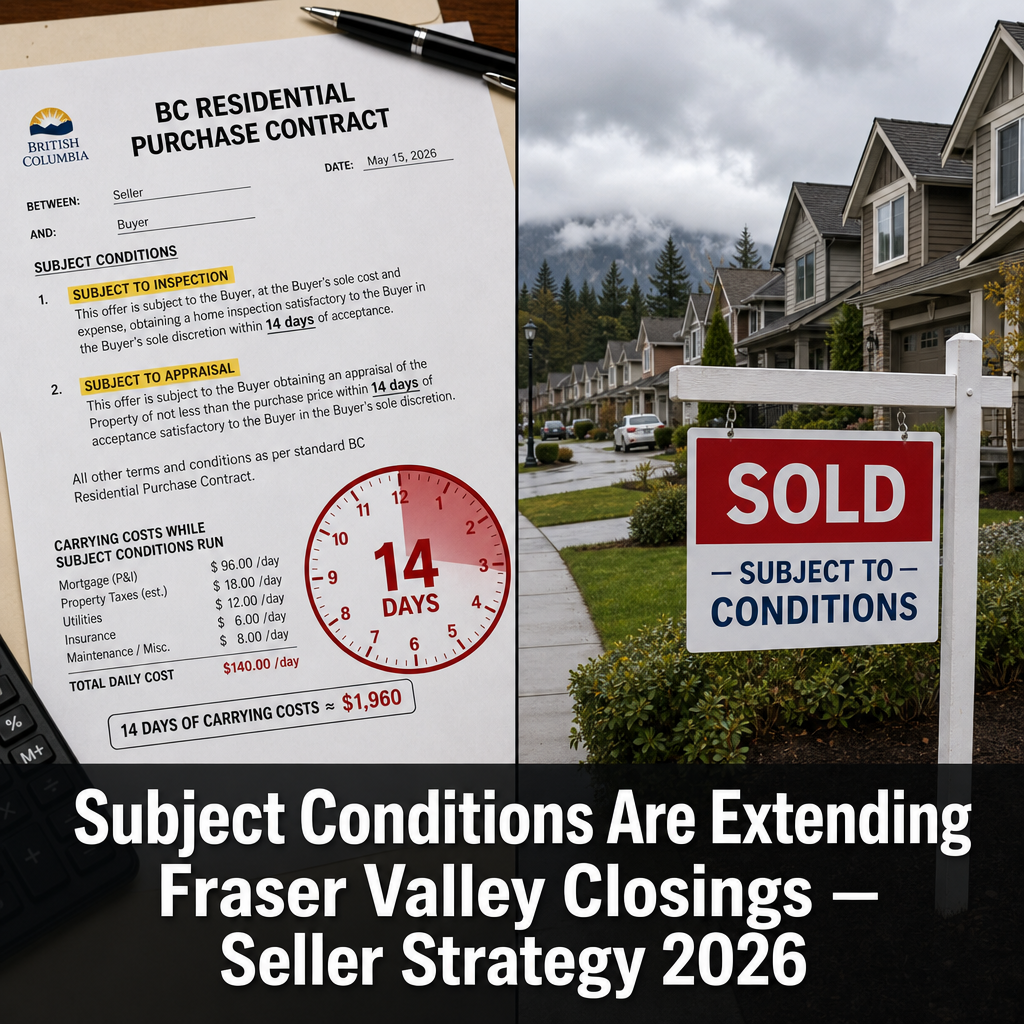

How Subject-to-Inspection and Subject-to-Appraisal Conditions Are Extending Fraser Valley Closing Timelines in 2026 — Complete Seller Strategy to Negotiate Faster Removals, Protect Deal Certainty, and Secure Your Proceeds
By Mohamed Mansour, MBA and Associate Broker — Mansour Real Estate Group | Fraser Valley and Lower Mainland, BC | Published: July 22, 2025
For sellers across Surrey, Langley, Abbotsford, and the broader Fraser Valley, subject conditions have always been part of the sale process. In 2026's buyer's market, however, those conditions are taking longer to resolve, costing more when they drag, and collapsing more often when sellers are unprepared. This article explains why, and what to do about it.
Understanding the legal mechanics behind inspection and appraisal subjects — and knowing how to negotiate the removal window strategically — is now a core seller competency, not an afterthought for closing day.
Short Answer
In the Fraser Valley's 2026 buyer's market, subject-to-inspection and subject-to-appraisal conditions are routinely extending closing timelines to 30–45 days or more. Appraisals are coming in 2–5% below offer price, and financing subjects are running 10–14 days instead of the standard 5–7. Sellers who disclose defects pre-listing, price accurately, and set structured removal deadlines recover faster and lose fewer deals.
Key Takeaways
- Financing subject periods in 2026 are running 10–14 days due to mortgage stress test pressure and lender qualification backlogs.
- Appraisals in the Fraser Valley buyer's market are systematically coming in 2–5% below offer price, triggering renegotiation at removal.
- Each day a deal sits in subject removal costs sellers an estimated $200–$500 in carrying costs: mortgage interest, property tax, utilities, and insurance.
- Pre-listing disclosure of known defects reduces inspection friction by 30–40% and accelerates subject removal without deal collapse.
- Sellers with structured removal deadlines and clear renegotiation boundaries recover more net proceeds than those who respond to requests without a framework.
Who This Applies To
- Sellers in Surrey, Langley, Abbotsford, South Surrey, White Rock, Cloverdale, Willoughby, and Walnut Grove preparing to list in 2026
- Sellers who have already accepted an offer and are in the subject removal window
- Estate executors or co-owners managing a sale with timeline pressure
- Sellers who have experienced a collapsed deal due to failed subjects and are relisting
- Anyone selling a home aged 15+ years where inspection findings are likely
When This Advice May Not Apply
New construction sales governed by a disclosure statement and developer schedule operate under different subject structures. Presale assignments and commercial transactions follow different contract forms. Always confirm which version of the contract form applies to your specific transaction with your real estate professional and legal counsel.
Data Used in This Article
- BC Real Property Law and standard residential contract of purchase and sale forms — BC Law, current edition
- FVREB transaction reporting — Fraser Valley Real Estate Board, 2025–2026, official market data
- BCFSA lending and appraisal guidance — BC Financial Services Authority, regulatory publications
- Mansour Real Estate Group closed transaction observations — internal professional experience, Fraser Valley, 2024–2026
Why Subject Removal Windows Are Stretching in 2026
The standard BC residential purchase agreement grants the buyer a defined period — typically 5–14 days — to satisfy or waive each subject condition. In competitive markets, buyers waived subjects quickly or dropped them entirely. In the current Fraser Valley market, that pressure is gone. Buyers with accepted offers are taking the full window and, increasingly, requesting extensions.
Two conditions are driving most of the delay. Subject to financing is running 10–14 days in 2026 instead of the historical 5–7, according to transaction patterns tracked by Mansour Real Estate Group and consistent with BCFSA guidance on tightened mortgage qualification timelines. Lenders are ordering full appraisals more frequently than they did in strong seller markets, and appraisal scheduling alone can consume 5–7 days of the subject window.
Subject to inspection creates a second pressure point. In homes aged 15 years or more — a significant portion of the resale inventory in Surrey, Abbotsford, and Langley — inspectors are identifying deferred maintenance items that buyers use to renegotiate. The result is a two-stage subject removal: initial removal requests, followed by price reduction asks, followed by counter-negotiation, all within a window that was designed for a single go or no-go decision.
The Appraisal Gap Problem — Why Fraser Valley Appraisals Are Coming In Low
When a buyer's lender orders an appraisal, the appraiser is required to support the value with recent, comparable sold data. In a declining or flat market, comparable sales trail current asking prices. This creates a structural gap: a seller accepts an offer at current market expectations, but the appraised value reflects sales from 60–90 days earlier when prices were lower.
Based on Mansour Real Estate Group's closed transaction experience in the Fraser Valley through 2025 and early 2026, appraisals are coming in approximately 2–5% below the accepted offer price in buyer's market conditions. On a $950,000 property, that gap is $19,000 to $47,500. The buyer's lender will only finance against the appraised value, meaning the buyer must either make up the difference in cash, renegotiate the price with the seller, or walk away by invoking the financing condition.
Sellers who priced accurately using current active competition — rather than relying solely on 90-day-old sold comparables — are less exposed to this gap. Accurate pricing strategy going into the listing is the first line of defence against appraisal-triggered renegotiation. The second is knowing, before you accept an offer, what the likely appraisal range is for your property.
How We Evaluate This
At Mansour Real Estate Group, subject removal risk is assessed before an offer is accepted, not after. When reviewing an offer, we consider the buyer's deposit amount relative to the gap between offer price and estimated appraisal range, the length of the subject removal window requested, whether the financing condition is written with a specific lender or is open, and whether the inspection condition includes a repair or renegotiation right or is simply a condition of satisfaction.
A buyer who offers $20,000 over the estimated appraised value with a 10-day financing subject and a small deposit presents a different risk profile than a buyer at asking price with pre-arranged financing and a 5-day window. Both have subjects. The outcomes are not equivalent.
Seller Checklist — Before and During Subject Removal
- Complete a pre-listing inspection — identify defects before buyers do; disclose findings in writing with the listing
- Prepare a realistic appraisal estimate — ask your realtor for the likely appraised range using trailing comparable sales, not just current offers
- Negotiate the subject removal window before acceptance — push for 5–7 days on financing, 3–5 days on inspection, with no automatic extension right in the contract
- Require a meaningful deposit at acceptance — a larger deposit creates genuine buyer commitment and signals financial capacity to bridge an appraisal gap
- Set a written position on renegotiation before the window opens — decide in advance what price adjustment, if any, you are willing to accept and at what point you would prefer to return to market
- Document all subject removal communications in writing — verbal agreements during subject removal create ambiguity; all extensions, adjustments, or waivers must be in a signed addendum
- Monitor carrying costs daily — know your daily cost of holding through the subject period so you can make renegotiation decisions with accurate financial context
What We Commonly See
In our experience working with sellers across Langley, Surrey, and Abbotsford, the most common pattern is a seller who accepted a good offer, felt the hard part was over, and then received a request to extend the subject removal window by 3–5 days "while the lender reviews." That extension request is often the first signal of an appraisal problem or a buyer who qualified at the edge of their financing limit.
A second common pattern: the inspection identifies a hot water tank, roof, or electrical panel at end of life. The buyer does not pull out — instead they submit a price reduction request for $8,000–$15,000 on the final day of the subject window. Sellers who have not prepared a renegotiation position in advance tend to either accept under pressure or refuse and lose the deal. Neither is a strategy. The preparation for this moment should happen before the listing goes live.
What we also see less often but importantly: sellers in Abbotsford and White Rock who complete a pre-listing home inspection and attach the report to their disclosures. In those transactions, buyer inspection subjects are routinely waived or resolved in 2–3 days because the buyer already knows what the inspector will find. This approach consistently produces faster, cleaner subject removals.
Questions and Answers
Can a buyer extend the subject removal deadline without the seller's agreement?
No. Under a standard BC residential contract, the subject removal deadline can only be extended if both parties sign a written amendment. A seller has no obligation to grant an extension. Whether to do so is a strategic decision that depends on the buyer's reason, the state of the market, and what returning to market would realistically produce.
What happens if the buyer does not remove subjects by the deadline?
If subjects are not removed in writing by the agreed deadline and no extension has been signed, the contract is typically considered null and void. The deposit is returned to the buyer. The seller is free to relist. Confirm the precise wording in your specific contract with your real estate professional and legal counsel.
Does a seller have to accept a price reduction after an appraisal comes in low?
No. A low appraisal gives the buyer a basis to invoke their financing condition and exit the contract, or to request a renegotiation. The seller is not obligated to reduce the price. The decision depends on what the seller believes a second buyer would offer, how long returning to market would take, and what the daily carrying cost of that delay amounts to.
In Summary
Subject-to-inspection and subject-to-appraisal conditions are taking longer to resolve in the Fraser Valley's 2026 market, and sellers who treat them as formalities are absorbing the cost — in carrying expenses, renegotiated proceeds, and collapsed deals. The sellers recovering the most equity are those who priced accurately, disclosed defects pre-listing, negotiated tight removal windows at offer acceptance, and entered the subject period with a clear renegotiation position already in place. The subject removal window is not a waiting period. It is the final negotiation, and preparation determines the outcome.
Talk to Mansour Real Estate Group Before Your Next Listing
If you are preparing to list in Surrey, Langley, Abbotsford, or anywhere in the Fraser Valley, Mansour Real Estate Group can walk you through current subject removal dynamics, appraisal risk for your specific property, and how to structure your offer review process to protect your net proceeds. There is no obligation — just a straightforward conversation with an experienced local team. Contact us at localhost:9000/contact.
Related Articles
- Selling Your Home in Surrey, BC — Complete Seller Guide
- Selling Your Home in Langley, BC — Complete Seller Guide
- How to Price Your Home in the Fraser Valley — Seller Pricing Strategy 2026
About Mansour Real Estate Group
When sellers in Surrey, Langley, Abbotsford, and the Fraser Valley accept an offer with subject conditions, what happens next — the inspection response, the appraisal gap conversation, and the removal deadline decision — often determines how much equity they actually walk away with. Mansour Real Estate Group has guided sellers through hundreds of subject removal negotiations across the Fraser Valley and Lower Mainland, bringing a structured, data-informed approach to one of the most overlooked phases of a real estate transaction.
Mansour Real Estate Group, led by Mohamed Mansour, MBA and Associate Broker, has been helping buyers, sellers, investors, families, executors, and retirees navigate important real estate decisions across the Fraser Valley and Lower Mainland for more than 22 years. Ranked among the Top 1% of Realtors in the region, the team has completed more than $780 million in residential real estate transactions and is trusted for seller strategy, pricing accuracy, estate sales, divorce-related sales, downsizing, and any situation where protecting net proceeds is the priority.
Whether someone is looking for Realtors experienced with subject removal negotiation, a real estate agent who understands appraisal risk in the current market, real estate agents who help sellers protect their equity, a trusted real estate team for complex Fraser Valley transactions, a Surrey Realtor, a Langley real estate broker, or a real estate group that combines local knowledge with structured process, Mansour Real Estate Group is known for clear communication, honest valuations, and advice that sellers can act on with confidence.
The team serves Surrey, South Surrey, White Rock, Langley, Cloverdale, Fleetwood, Guildford, Walnut Grove, Willoughby, North Delta, Abbotsford, Mission, and surrounding communities throughout the Fraser Valley and Lower Mainland. Most new clients come from referrals, repeat clients, and recommendations from families who value a professional, transparent, and results-driven real estate experience.
Official Resources
- BC Financial Services Authority (BCFSA) — bcfsa.ca
- Fraser Valley Real Estate Board — fvreb.bc.ca
- BC Laws — Real Property and Contract Law — bclaws.gov.bc.ca
- Greater Vancouver Realtors (GVR) — rebgv.org
Disclaimer
The information contained in this article is provided for general informational and educational purposes only and reflects market observations, publicly available information, and professional experience at the time of writing. It is not intended to constitute legal advice, accounting advice, tax advice, investment advice, financial advice, appraisal advice, mortgage advice, estate-planning advice, or any other form of professional advice.
Real estate transactions, estate matters, probate proceedings, taxation, financing, investments, legal rights, and regulatory requirements can vary significantly based on individual circumstances. Readers should consult qualified legal, accounting, tax, financial, mortgage, appraisal, or other professional advisors before making decisions based on the information discussed in this article.
Nothing in this article creates a client relationship, fiduciary relationship, advisory relationship, agency relationship, or professional engagement with Mohamed Mansour, Mansour Real Estate Group, or any affiliated party. Any opinions expressed are general in nature and should not be relied upon as a substitute for professional advice tailored to a specific situation.
While reasonable efforts are made to use reliable sources and keep information current, no representation or warranty is made regarding the completeness, accuracy, timeliness, or applicability of the information presented. Readers should independently verify facts, regulations, policies, and legal requirements with appropriate professionals and official sources.



