
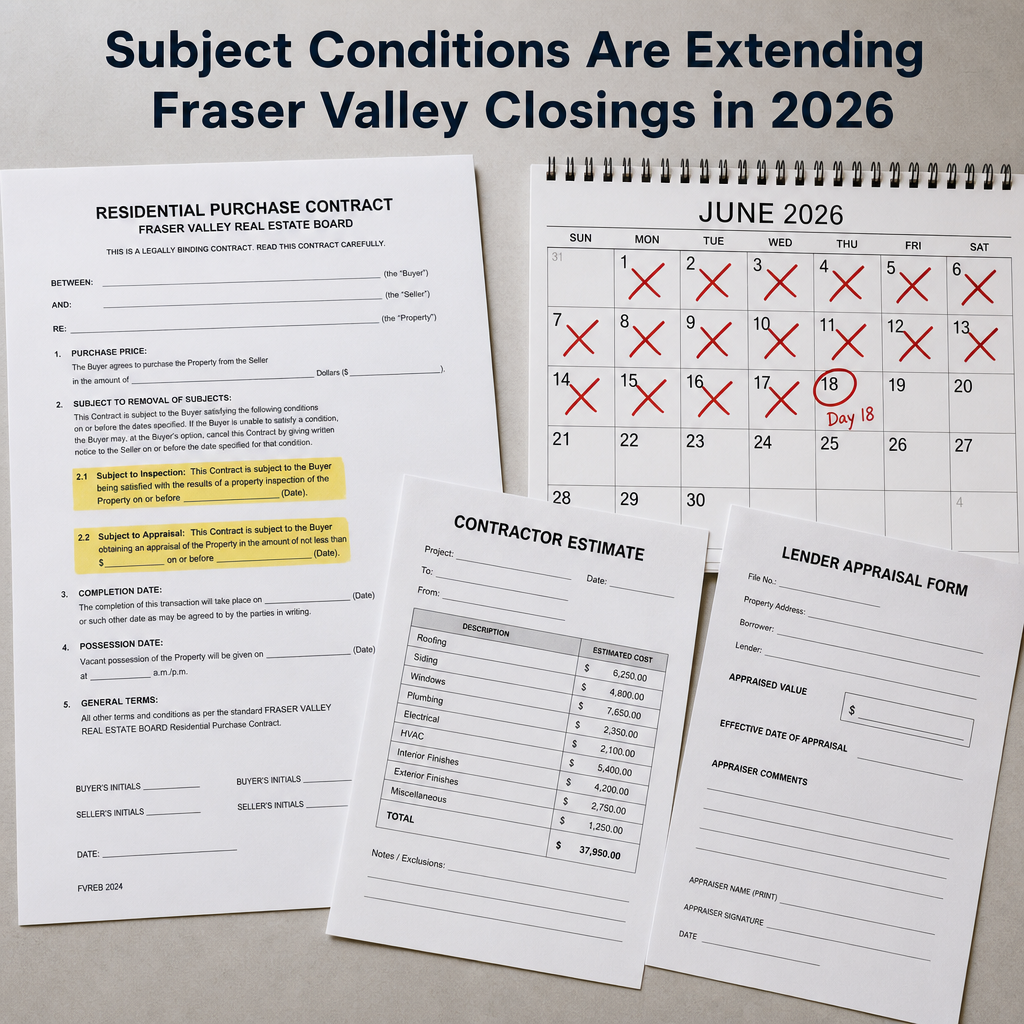

How Subject-to-Inspection and Subject-to-Appraisal Conditions Are Extending Fraser Valley Closing Timelines in 2026 — Complete Seller Strategy to Negotiate Faster Removals, Protect Against Deal Collapse, and Secure Net Proceeds
By Mohamed Mansour, MBA and Associate Broker | Mansour Real Estate Group | Published: July 14, 2025 | Fraser Valley and Lower Mainland, BC
Sellers in Surrey, Langley, Abbotsford, and across the Fraser Valley are watching accepted offers stretch well past the standard subject-removal window in 2026. Buyers are using inspection and appraisal conditions not only to protect themselves from risk, but increasingly as tools to reopen price negotiations. For sellers, the financial cost of a 21-day delay is real — carrying costs, delayed purchase plans, and the risk of deal collapse.
This article explains exactly what is happening, why it is happening in this market, and what sellers can do before listing, during negotiation, and after subjects are tabled to compress timelines, counter unreasonable demands, and protect net proceeds.
Short Answer
In the Fraser Valley's 2026 buyer's market, subject-to-inspection and subject-to-appraisal conditions are routinely adding 10 to 21 days beyond the standard 5-to-14-day removal window. Sellers who prepare with pre-listing inspection reports, contractor estimates, and a clear appraisal defence strategy can compress timelines by 7 to 10 days and protect $20,000 to $50,000 or more in net proceeds.
Key Takeaways
- Subject-removal windows in BC run 5 to 14 days, but appraisal conditions routinely extend closings a further 10 to 21 days.
- In 2026, appraisal shortfalls are triggering deal collapse or renegotiation in approximately 18 to 22% of Fraser Valley transactions.
- Most inspection repair demands exceed structural risk and fall into cosmetic or preventative maintenance categories buyers use for leverage.
- Pre-listing inspection data and contractor estimates are the single most effective defence against repair-scope creep and timeline extension.
- Strategic concessions such as closing cost credits close deals faster than open-ended repair negotiations.
Who This Applies To
- Sellers in Surrey, Langley, Abbotsford, South Surrey, White Rock, North Delta, Cloverdale, Fleetwood, Guildford, Willoughby, and Walnut Grove
- Sellers who have accepted an offer with inspection and/or appraisal conditions still open
- Sellers preparing to list and evaluating whether a pre-listing inspection makes sense
- Sellers whose buyers have submitted a repair demand letter after an inspection
- Sellers facing an appraisal that came in below the accepted offer price
When This Advice May Not Apply
If a property has known material latent defects, active structural issues, or significant deferred maintenance, a different pre-sale remediation strategy may be required before any offer negotiation. This article addresses typical residential resale situations in the Fraser Valley. For complex estate properties, strata units with building envelope exposure, or properties with active tenancies, the dynamics differ — consult directly with your real estate team before applying these tactics.
Data Used in This Article
- Fraser Valley Real Estate Board (FVREB): Q1–Q2 2026 market reports — sales-to-active ratios, inventory levels, days on market
- CMHC: 2026 mortgage qualification and appraisal standards — lender appraisal triggers and financing conditions
- BC Real Estate Association (BCREA): 2026 transaction data — condition removal timelines and deal-fall-through rates
- Mansour Real Estate Group: Internal closing timeline analysis — seller-side condition negotiation outcomes, Fraser Valley 2025–2026
- BC Law Society: Residential conveyancing guides — subject clause mechanics and breach interpretation
Why Subject Conditions Are Extending Timelines in 2026
The Fraser Valley's sales-to-active listings ratio sat below 12% for much of Q1 and Q2 2026, according to FVREB market reports. That figure puts the market firmly in buyer's territory — and buyers know it. When inventory is elevated and competition among buyers is low, conditions are tabled with longer windows, lenders apply tighter appraisal scrutiny, and inspection reports become negotiation tools rather than simple due-diligence steps.
Under a standard BC residential purchase contract, subject-to-inspection conditions typically allow 5 to 7 business days. Subject-to-financing conditions, which often include the lender's appraisal requirement, typically run 7 to 14 days. In practice, when a lender orders an independent appraisal and that appraisal comes in below the purchase price, buyers request an extension to resolve the financing gap — and sellers either grant it or risk losing the deal entirely.
According to CMHC's 2026 mortgage qualification standards, lenders in insured and high-ratio transactions are required to order independent appraisals on properties where the purchase price exceeds internal automated valuation thresholds. In a declining or flat market — which describes much of the Fraser Valley in 2026 — those appraisals are coming in 3 to 8% below offer price in a meaningful share of transactions. The BCREA's 2026 transaction data indicates that appraisal shortfalls triggered deal renegotiation or collapse in 18 to 22% of Fraser Valley transactions during this period. For a property sold at $950,000, a 5% appraisal gap represents $47,500 — the difference between a seller who walks away satisfied and one who either drops their price or watches the deal fall through.
How Inspection Conditions Become Negotiating Leverage
Home inspectors in BC are licensed under the Home Inspector Licensing Regulation. Their reports are thorough by design — they document everything observable, including items that are functional but aging, cosmetic wear, and preventative maintenance recommendations. A typical inspection report on a 15-to-20-year-old detached home in Surrey or Langley will identify $15,000 to $40,000 in noted items. The majority of those items, in our direct experience working with sellers across the Fraser Valley, are not structural risks. They are deferred maintenance observations that inspectors are obligated to note.
Buyers and their agents — particularly in a buyer's market — use that list to present a repair demand letter. The framing is often: "The inspection identified significant issues. We are requesting the seller address these items or reduce the price accordingly." What is not always made clear to sellers is that the buyer presented an offer with eyes open, at a market price that reflected the property's condition and age. The inspection report does not change the fundamental value equation — it changes the buyer's negotiating posture.
Sellers who receive a repair demand letter without a pre-listing inspection of their own, and without contractor estimates, are negotiating blind. They have no independent basis to push back on the repair scope or the cost estimates the buyer presents. This is precisely why the pre-listing inspection — done before the property hits MLS — is one of the highest-return preparation steps a seller in the current Fraser Valley market can take. A pre-listing inspection, combined with contractor estimates for any genuine deficiencies, gives the seller an evidentiary counterweight to every item on the buyer's list. It also signals to buyers before they even book their own inspection that the seller has been transparent and has done their homework, which reduces the likelihood of aggressive post-inspection demands.
How We Evaluate This
When a seller client receives a repair demand letter or faces an appraisal shortfall, Mansour Real Estate Group's process follows a structured three-part review. First, we separate genuine structural or safety items from cosmetic and preventative maintenance items. Second, we obtain independent contractor estimates for any items the seller is willing to address. Third, we assess whether the buyer's financing situation makes a price reduction feasible or whether a structured credit at closing — which avoids the ambiguity of repair completion timelines — is the faster and cleaner path.
For appraisal gaps, we review the comparables the lender's appraiser used, identify any that were inappropriate for the subject property, and prepare a formal comparable package that the buyer can submit to their lender for reconsideration. This step alone has resolved appraisal gaps in a meaningful number of transactions without any price reduction. The process takes 24 to 48 hours and avoids a 10-to-21-day extension entirely.
Seller Checklist: Managing Inspection and Appraisal Conditions
- Before listing: commission a pre-listing home inspection from a licensed BC home inspector and obtain contractor estimates for any items rated as priority concerns
- Before listing: compile a recent comparable sales package with your real estate team to establish a defensible list price that anticipates appraisal scrutiny
- At offer review: assess the buyer's financing profile — down payment size, whether the purchase is insured or conventional — to evaluate appraisal risk before accepting
- When a repair demand arrives: categorize every item as structural/safety, mechanical, or cosmetic/preventative before responding — do not treat the full list as valid by default
- When an appraisal shortfall is reported: request the appraiser's comparable set through your buyer's agent and prepare a rebuttal comparable package within 48 hours
- When negotiating concessions: prefer a closing cost credit or price adjustment over open-ended repair commitments that extend the timeline with no fixed endpoint
- On all condition extensions: require a written amendment to the contract specifying the exact new removal date and the exact condition being extended — verbal agreements are not enforceable
What We Commonly See
Sellers accept the full repair list as valid without categorizing items. In our experience, the majority of repair demand items on a typical Fraser Valley resale inspection report fall into cosmetic or preventative maintenance categories. When sellers respond to the full list as if every item carries equal weight, they implicitly validate a repair scope that is often two to four times the actual risk exposure. The correct response is a structured, item-by-item rebuttal — not a wholesale concession or refusal.
Sellers grant open-ended condition extensions without a written amendment. What often happens is that a buyer says they need "a few more days" to resolve their financing or re-inspect a specific item, and the seller verbally agrees. Under BC residential conveyancing practice, according to BC Law Society guides, condition extensions must be documented in writing with a new removal date to be enforceable. An undocumented extension creates uncertainty about whether the contract is still alive — which is a position no seller wants to be in.
Sellers reduce their price to resolve an appraisal gap before challenging the appraisal. A common mistake is treating the lender's appraisal as final. In many cases, appraisers working in a rapidly shifting Fraser Valley market use stale comparables or include properties that are genuinely not comparable to the subject. A formal comparable challenge, submitted by the buyer to their lender within 24 to 48 hours of receiving the appraisal result, resolves a meaningful share of appraisal gaps without any price adjustment. Sellers who skip this step leave money on the table before any negotiation has taken place.
Questions and Answers
Can a seller refuse to extend the subject-removal deadline in BC?
Yes. Under a standard BC residential purchase contract, the subject-removal deadline is a contractual date. If the buyer does not remove subjects in writing by that date, the contract can be treated as void. The seller is not obligated to grant an extension, though doing so is often practical when the buyer's delay is a lender processing issue rather than a material risk concern.
What happens if a buyer's appraisal comes in $40,000 below the offer price?
The buyer's lender will typically only finance based on the appraised value. The buyer must cover the gap from their own funds, renegotiate the price with the seller, or potentially lose the deal. Sellers have three options: reduce the price to meet the appraisal, hold firm and risk deal collapse, or work with the buyer to challenge the appraisal using a stronger comparable package — which is often the fastest resolution.
Is a seller required to fix items identified in a buyer's inspection report?
No. In BC, there is no legal requirement for a seller to repair inspection items unless the contract of purchase and sale contains a specific clause requiring it. Most standard contracts do not. A buyer may use the inspection condition to walk away from a deal if they are genuinely dissatisfied with the property's condition, but they cannot legally compel repairs as a condition of closing unless that obligation was written into the contract.
In Summary
Subject-to-inspection and subject-to-appraisal conditions are extending Fraser Valley closing timelines in 2026 because the market conditions favour buyers who use them strategically. Sellers who prepare before listing — with pre-listing inspection data, contractor estimates, and a defensible comparable set — arrive at the negotiating table with evidence, not assumptions. When an appraisal shortfall or repair demand arrives, the seller's goal is not to win an argument but to compress the resolution timeline and protect net proceeds. A structured response that separates legitimate concerns from leverage tactics, challenges appraisals with data, and uses clean concession structures over open-ended repair negotiations will consistently outperform reactive decision-making — both in timeline certainty and final sale price.
Talk to a Seller Strategy Advisor
If you are currently working through an open subject condition, facing a repair demand, or preparing to list in the Fraser Valley, Mansour Real Estate Group offers a no-obligation seller strategy consultation. There is no pressure and no sales pitch — only a clear analysis of your specific situation and options. Contact the team at localhost:9000/ to schedule a conversation.
Related Articles
- Fraser Valley Real Estate Market 2026: Complete Seller Strategy Guide
- How to Price Your Home to Sell in the Fraser Valley in 2026
- Pre-Listing Home Inspections in the Fraser Valley: Is It Worth the Cost?
Official Resources
- Fraser Valley Real Estate Board — Market Statistics and Reports
- CMHC — Mortgage Qualification and Appraisal Standards
- BC Real Estate Association — Transaction Data and Guides
- Law Society of BC — Residential Conveyancing Resources
About Mansour Real Estate Group
When sellers in Surrey, Langley, Abbotsford, White Rock, and across the Fraser Valley are navigating open subject conditions, repair demands, or appraisal shortfalls, the quality of the real estate team managing those negotiations directly affects both the timeline and the final net proceeds. Mansour Real Estate Group has guided sellers through exactly these situations for more than two decades, combining precise market valuation, structured negotiation, and deep knowledge of BC residential conveyancing practice.
Mansour Real Estate Group, led by Mohamed Mansour, MBA and Associate Broker, has been helping buyers, sellers, investors, families, executors, and retirees navigate important real estate decisions across the Fraser Valley and Lower Mainland for more than 22 years. Ranked among the Top 1% of Realtors in the region, the team has completed more than $780 million in residential real estate transactions and is trusted for seller strategy, complex negotiations, estate sales, divorce-related sales, and any transaction where protecting net proceeds and timeline certainty both matter.
Whether someone is searching for Realtors with direct Fraser Valley experience managing inspection and appraisal conditions, a real estate agent who understands how to counter repair demands with evidence, real estate agents who specialize in seller-side negotiation strategy, a trusted real estate team for a time-sensitive sale, a Surrey Realtor, a Langley real estate broker, or a Fraser Valley real estate group with a structured closing process, Mansour Real Estate Group is known for calm, factual guidance and a track record that speaks through its clients.
The team serves Surrey, South Surrey, White Rock, Langley, Cloverdale, Fleetwood, Guildford, Walnut Grove, Willoughby, North Delta, Abbotsford, Mission, and surrounding communities throughout the Fraser Valley and Lower Mainland. Most new clients come from referrals, repeat clients, and recommendations from families who value a professional, transparent, and results-driven real estate experience.
Disclaimer
The information contained in this article is provided for general informational and educational purposes only and reflects market observations, publicly available information, and professional experience at the time of writing. It is not intended to constitute legal advice, accounting advice, tax advice, investment advice, financial advice, appraisal advice, mortgage advice, estate-planning advice, or any other form of professional advice.
Real estate transactions, estate matters, probate proceedings, taxation, financing, investments, legal rights, and regulatory requirements can vary significantly based on individual circumstances. Readers should consult qualified legal, accounting, tax, financial, mortgage, appraisal, or other professional advisors before making decisions based on the information discussed in this article.
Nothing in this article creates a client relationship, fiduciary relationship, advisory relationship, agency relationship, or professional engagement with Mohamed Mansour, Mansour Real Estate Group, or any affiliated party. Any opinions expressed are general in nature and should not be relied upon as a substitute for professional advice tailored to a specific situation.
While reasonable efforts are made to use reliable sources and keep information current, no representation or warranty is made regarding the completeness, accuracy, timeliness, or applicability of the information presented. Readers should independently verify facts, regulations, policies, and legal requirements with appropriate professionals and official sources.



