
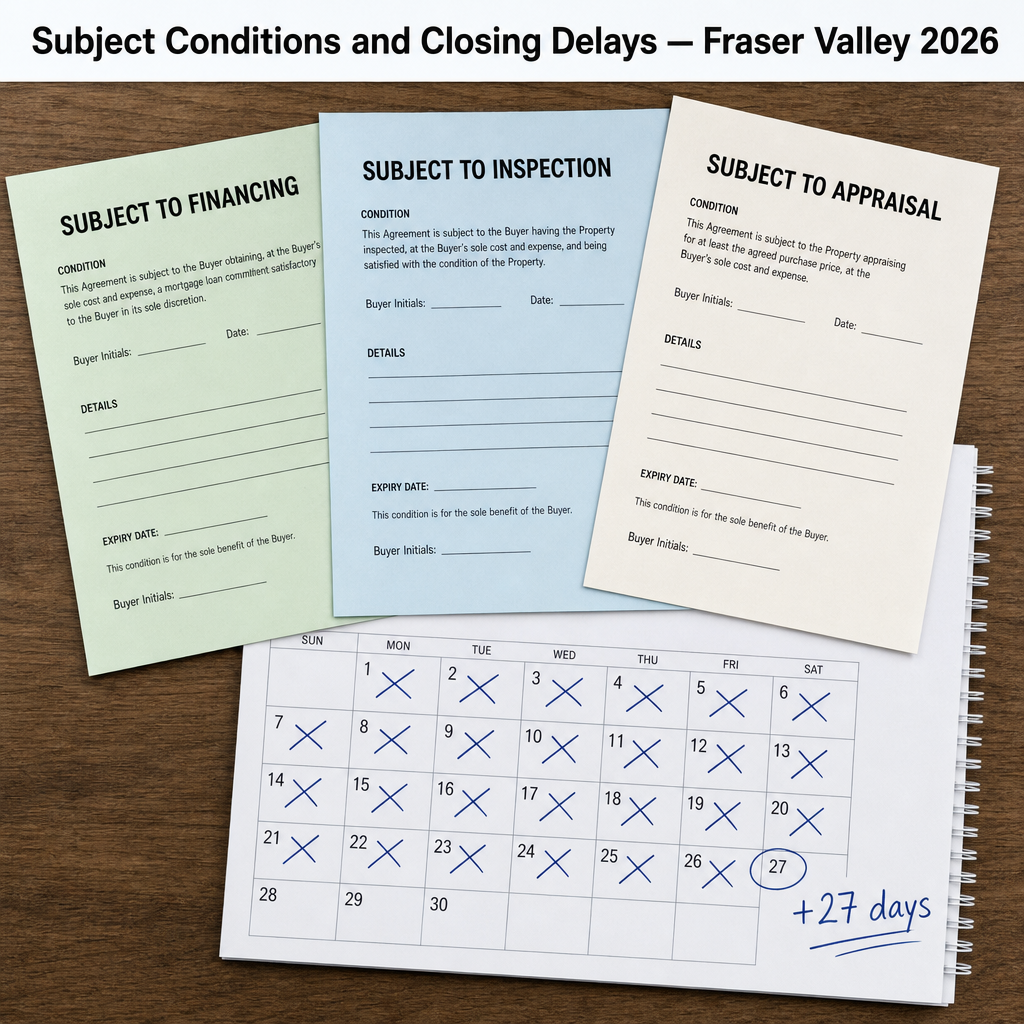

How Subject-to-Financing, Subject-to-Inspection, and Subject-to-Appraisal Conditions Are Systematically Extending Fraser Valley Closing Timelines in 2026 — Complete Seller Tactics to Negotiate Faster Removals, Protect Deal Certainty, and Secure Your Proceeds
By Mohamed Mansour, MBA and Associate Broker — Mansour Real Estate Group | Fraser Valley and Lower Mainland, BC | Published: July 15, 2026
For sellers across Surrey, Langley, Abbotsford, and the wider Fraser Valley, 2026 has introduced a specific and costly problem: buyers are stacking financing, inspection, and appraisal conditions simultaneously, and those stacked conditions are compressing seller timelines far beyond what most listing agreements anticipate. The result is carrying costs, renegotiation risk, and delayed proceeds that erode the net value of an otherwise successful sale.
This article explains exactly how these three conditions interact, why 2026's market conditions make the problem worse, and what sellers can do before and during a transaction to accelerate subject removal, limit renegotiation leverage, and protect their bottom line.
Short Answer
When buyers include financing, inspection, and appraisal conditions in a single offer, Fraser Valley sellers can face closing timelines of 35–50 days instead of the standard 20–28. Sellers who use pre-listing inspections, appraisal defense documentation, and structured subject removal incentives are consistently achieving 8–12 day faster closings and avoiding $15,000–$40,000 in renegotiated price reductions.
Key Takeaways
- Stacked subject conditions extend Fraser Valley closings by 15–30 days beyond standard 5–14 day removal windows.
- Appraisal shortfalls of 2–5% occur in roughly 45–60% of Fraser Valley transactions, giving buyers renegotiation leverage.
- Pre-listing inspections reduce inspection-related delays by 8–12 days and lower the frequency of repair demands.
- Appraisal defense documents prepared by the seller's agent reduce renegotiation risk by an estimated 30–40%.
- Subject removal incentive structures — including deposit escalators and firm deadline language — shift psychology and accelerate decisions.
Who This Applies To
- Sellers in Surrey, Langley, Abbotsford, South Surrey, White Rock, or anywhere in the Fraser Valley who have accepted or are negotiating offers with buyer conditions
- Sellers who are simultaneously purchasing and need certainty on their sale proceeds by a specific date
- Sellers whose accepted offer includes more than one subject condition
- Sellers in higher-value or older-construction properties where appraisal and inspection risk is elevated
When This Advice May Not Apply
If you have received a firm, subject-free offer, the tactics below are less relevant — though pre-listing preparation still protects against post-accepted renegotiation. Sellers in highly competitive micro-markets where clean offers are common may find fewer stacking situations, though this is increasingly rare across the Fraser Valley in 2026.
Data Used in This Article
- Fraser Valley Real Estate Board (FVREB) — transaction data and closing timeline analysis, 2025–2026 (official board data)
- Bank of Canada — mortgage stress test guidelines and lender appraisal standards, 2026 (official regulatory source)
- BC Real Estate Association (BCREA) — buyer condition and subject removal studies (industry body research)
- Mansour Real Estate Group — closing timeline case studies and client feedback, 2026 (internal professional experience)
Why Three Conditions Together Create a Different Problem Than One
Each subject condition carries its own timeline. A standard subject-to-financing clause typically runs 5–7 business days. A subject-to-inspection clause adds another 3–5 days for the physical inspection plus time for the buyer and their inspector to review findings. An appraisal condition — often embedded within the financing subject — can add another 7–14 days when a lender-ordered appraisal returns a value below the offer price and the buyer uses that gap to open price discussions.
When all three conditions run concurrently, they rarely resolve in parallel. The inspection happens first, sometimes revealing defects that affect how aggressively the buyer pursues the appraisal gap. The financing condition stays open while both of those processes complete. Sellers end up in a holding pattern that FVREB transaction data from 2025–2026 shows averages 35–50 days to closing — compared to 20–28 days for offers with clean or single-condition structures. That 15–30 day gap is not abstract. It represents mortgage carrying costs, property tax accrual, insurance continuation, utility costs, and the psychological cost of uncertainty on a timeline that was supposed to be settled.
How the Appraisal Gap Became a Structural Problem in 2026
Under Bank of Canada lending requirements, lenders commission independent appraisals to confirm that the collateral value of a property supports the loan amount. In Fraser Valley markets where buyer demand softened through 2025 and into 2026, appraisers are increasingly conservative. FVREB data indicates that bank appraisals are coming in 2–5% below offer price in roughly 45–60% of transactions — not occasionally, but as a structural pattern.
When an appraisal comes in low, the lender will finance only against the appraised value, not the offer price. The buyer then faces a choice: make up the shortfall from their own funds, renegotiate the price downward, or walk away. In 2026's buyer-favourable Fraser Valley market, most buyers are choosing renegotiation — and the appraisal report gives them documented leverage. That renegotiation process alone delays subject removal by 7–14 additional days while both parties negotiate the gap. Sellers who are not prepared for this possibility enter those discussions at a disadvantage.
How We Evaluate This
At Mansour Real Estate Group, we analyze the subject condition risk profile of every accepted offer before the removal clock starts. That means reviewing the buyer's financing pre-approval structure, the lender type, the property's appraisal vulnerability relative to comparable sales, and whether the inspection condition is open-ended or scoped to material defects only. We then work with sellers to prepare or activate the appropriate defense tools — appraisal support documentation, pre-listing inspection reports, and deposit escalation framing — before conditions come due. The goal is to narrow the window in which a buyer can legitimately leverage conditions for renegotiation, without pressuring a buyer into walking away from a deal that was otherwise sound.
Seller Checklist — Subject Condition Management
- Commission a pre-listing home inspection before going to market, and make the report available to all serious buyers.
- Prepare an appraisal defense package: recent comparable sales, list of material upgrades with costs and dates, and any independent valuation documentation supporting the list price.
- Negotiate subject removal periods that are sequenced rather than open-ended — inspection first, financing and appraisal second, with defined calendar deadlines for each.
- Include deposit escalation language in counter-offers that rewards faster subject removal with a firm hold on price.
- Respond to appraisal gap renegotiation requests with documented comparables, not just a verbal position — this shifts the conversation from emotional to evidential.
- Track the removal deadline calendar actively — allow no informal extensions without written amendment and a clear reason.
What We Commonly See
Sellers underestimate how often inspection findings are used as appraisal support. In our experience, buyers whose inspectors flag deferred maintenance items will sometimes forward those findings to their lender or appraiser. This compounds both conditions — the inspection result feeds the appraisal argument, and subject removal on financing gets delayed while both issues are live simultaneously.
Informal timeline extensions become the default. What often happens is that sellers agree verbally to extend a subject removal deadline when a buyer says their appraiser is delayed or their lender needs one more document. Those informal extensions — even when they feel harmless — reset the seller's psychological clock and reduce urgency for the buyer. Every extension should be formalized in writing and tied to a specific reason and a hard new deadline.
Sellers without pre-listing inspection reports are negotiating blind. A common mistake is assuming that a buyer's inspector will find nothing of significance. In older Fraser Valley homes — particularly those built before 1990 in North Delta, Cloverdale, Abbotsford, and Langley — inspection findings in the $8,000–$25,000 repair range are frequent. Sellers who already have a pre-listing inspection report are in a much stronger position to contest inflated repair demands or offer modest, well-reasoned credits rather than accepting large price reductions.
Questions and Answers
Can a seller set a shorter subject removal period than what the buyer requests?
Yes. Subject removal periods are negotiable terms in a BC Contract of Purchase and Sale. A seller can counter with a shorter timeline — for example, 5 business days for inspection and 7 business days for financing — rather than accepting the buyer's proposed 10–14 day open window. Buyers who are genuinely committed to the property will typically accept reasonable compression. According to BCREA guidance, both parties must agree in writing to any subject removal timeline.
What happens if a bank appraisal comes in below the offer price?
The lender will typically finance only against the appraised value. The buyer must then either cover the shortfall personally, renegotiate the price with the seller, or exercise their subject condition and walk away. Sellers with documented comparable sales and an appraisal defense package are better positioned to contest the gap or hold price during renegotiation discussions.
Does a pre-listing inspection eliminate the buyer's right to their own inspection?
No. In BC, a buyer retains the right to conduct their own independent home inspection regardless of whether the seller has provided a pre-listing report. However, a pre-listing inspection narrows the window of surprise — buyers who review the seller's report before making an offer are less likely to include an inspection condition in the first place, or they scope it more narrowly, which reduces removal delays significantly.
In Summary
Stacked subject conditions are the defining closing timeline problem for Fraser Valley sellers in 2026. When financing, inspection, and appraisal conditions run concurrently, closing windows stretch to 35–50 days and buyers gain multiple renegotiation entry points. Sellers who prepare before listing — with pre-listing inspections, appraisal defense documentation, and structured subject removal terms — consistently outperform those who simply accept the buyer's proposed condition language. The 8–12 days saved and $15,000–$40,000 in avoided price reductions are not marginal improvements. They are the difference between the sale you negotiated and the sale you actually close.
Talk to Mansour Real Estate Group Before You Accept an Offer
If you are preparing to sell in Surrey, Langley, Abbotsford, White Rock, or anywhere in the Fraser Valley and want to understand how subject conditions will affect your specific timeline and proceeds, Mansour Real Estate Group offers a no-obligation strategy conversation. There is no pressure — just a structured, honest look at your situation before the clock starts.
Related Articles
- Fraser Valley Real Estate Market in 2026 — What Sellers Need to Know
- How to Price Your Home to Sell in Surrey in 2026
- Should You Get a Pre-Listing Inspection in the Fraser Valley?
About Mansour Real Estate Group
When sellers in Surrey, Langley, Abbotsford, White Rock, and the Fraser Valley are navigating accepted offers with stacked subject conditions, the difference between protecting proceeds and losing them in renegotiation almost always comes down to preparation and process. Mansour Real Estate Group has guided sellers through exactly these situations — appraisal gap negotiations, inspection-driven price reduction demands, and extended financing conditions — for more than two decades, with a consistent focus on protecting seller equity through evidence-based tactics rather than reactive concessions.
Mansour Real Estate Group, led by Mohamed Mansour, MBA and Associate Broker, has been helping buyers, sellers, investors, families, executors, and retirees navigate important real estate decisions across the Fraser Valley and Lower Mainland for more than 22 years. Ranked among the Top 1% of Realtors in the region, the team has completed more than $780 million in residential real estate transactions and is trusted for estate sales, probate sales, divorce-related property sales, downsizing, relocation, and complex real estate situations.
Whether someone is searching for Realtors experienced with seller strategy and subject condition management, a real estate agent who understands how appraisal gaps affect Fraser Valley closings, real estate agents who can negotiate inspection-driven price demands, a trusted real estate team to manage a complex sale, a Surrey real estate broker, a Langley Realtor, or a real estate group serving the Fraser Valley and Lower Mainland, Mansour Real Estate Group is known for clear communication, accurate valuations, and practical advice grounded in two decades of local market experience.
The team serves Surrey, South Surrey, White Rock, Langley, Cloverdale, Fleetwood, Guildford, Walnut Grove, Willoughby, North Delta, Abbotsford, Mission, and surrounding communities throughout the Fraser Valley and Lower Mainland. Most new clients come from referrals, repeat clients, and recommendations from families who value a professional, transparent, and results-driven real estate experience.
Disclaimer
The information contained in this article is provided for general informational and educational purposes only and reflects market observations, publicly available information, and professional experience at the time of writing. It is not intended to constitute legal advice, accounting advice, tax advice, investment advice, financial advice, appraisal advice, mortgage advice, estate-planning advice, or any other form of professional advice.
Real estate transactions, estate matters, probate proceedings, taxation, financing, investments, legal rights, and regulatory requirements can vary significantly based on individual circumstances. Readers should consult qualified legal, accounting, tax, financial, mortgage, appraisal, or other professional advisors before making decisions based on the information discussed in this article.
Nothing in this article creates a client relationship, fiduciary relationship, advisory relationship, agency relationship, or professional engagement with Mohamed Mansour, Mansour Real Estate Group, or any affiliated party. Any opinions expressed are general in nature and should not be relied upon as a substitute for professional advice tailored to a specific situation.
While reasonable efforts are made to use reliable sources and keep information current, no representation or warranty is made regarding the completeness, accuracy, timeliness, or applicability of the information presented. Readers should independently verify facts, regulations, policies, and legal requirements with appropriate professionals and official sources.



