
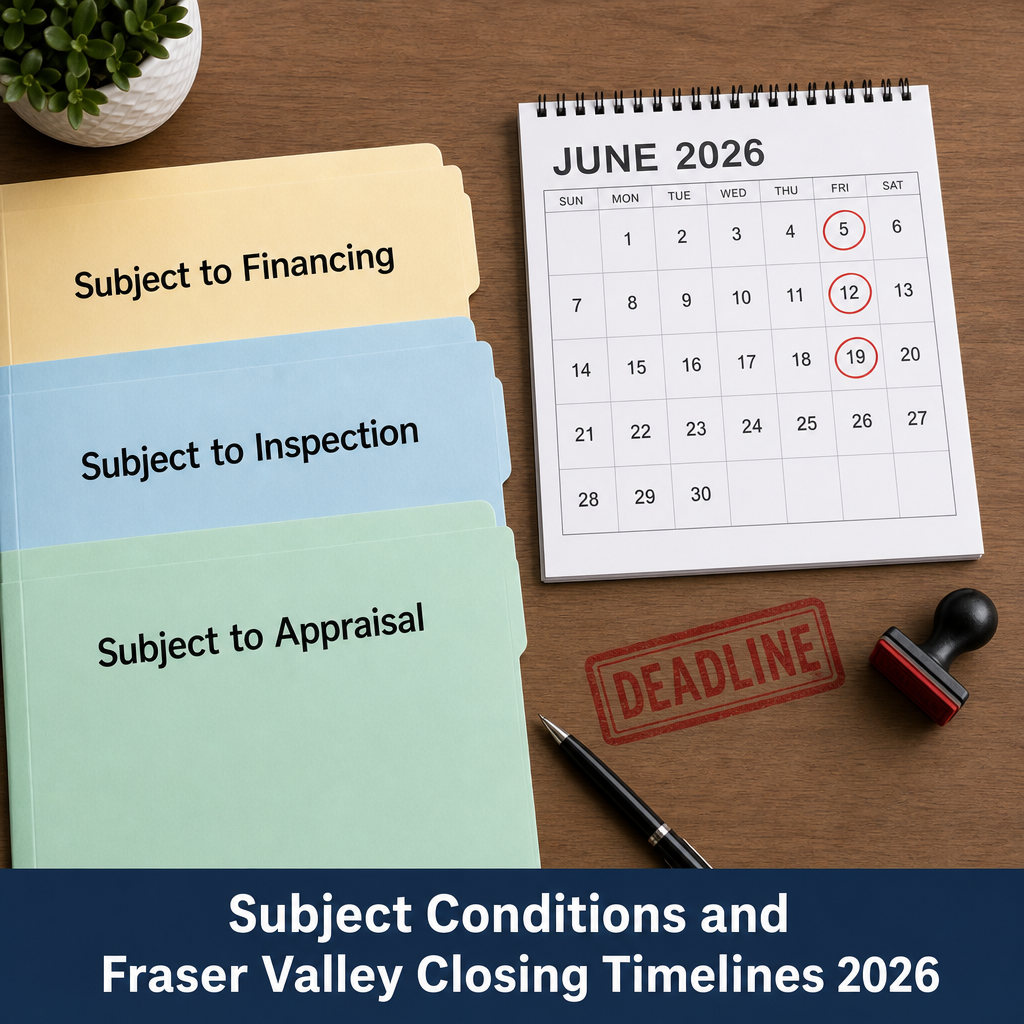

How Subject-to-Financing, Subject-to-Inspection, and Subject-to-Appraisal Conditions Are Extending Fraser Valley Closing Timelines in 2026 — Complete Seller Tactics to Negotiate Faster Removals, Protect Deal Certainty, and Secure Your Proceeds
By Mohamed Mansour, MBA and Associate Broker | Mansour Real Estate Group | Published: July 15, 2025 | Fraser Valley and Lower Mainland, BC
Subject conditions are a normal part of BC real estate transactions. But in 2026, what used to take 7–10 days is routinely taking 21–35 days — and in some cases longer. Sellers across Surrey, Langley, Abbotsford, and the broader Fraser Valley are watching accepted offers drag on as buyers navigate lender appraisal backlogs, extended inspection windows, and renegotiation demands tied to below-price appraisals. The financial cost is real, and it compounds daily.
This article explains how each of the three major buyer conditions works under BC contract law, why removal timelines have lengthened in 2026, and what sellers can do — at the offer stage — to protect their timeline, their carrying costs, and their net proceeds.
Short Answer
Subject conditions in BC typically require removal within 5–14 days, but financing and appraisal conditions are now averaging 14–30 days in Fraser Valley transactions. Sellers who negotiate removal timelines upfront, anchor deadlines at the offer stage, and build reciprocal protections into extension agreements can materially reduce their exposure to carrying costs, market risk, and deal collapse.
Key Takeaways
- BC subject conditions must be removed by the deadline or the deal terminates automatically.
- Financing conditions are taking 14–30 days in 2026 due to appraisal backlogs and lender review delays.
- Appraisal shortfalls of 2–5% below offer price are triggering renegotiation in roughly 35–40% of Fraser Valley deals.
- Granting extensions without reciprocal protections can cost sellers $200–$600 per day in carrying costs and market exposure.
- Sellers can compress timelines by requiring pre-offer documentation, anchoring removal deadlines, and conditioning extensions on deposit increases.
Who This Applies To
- Homeowners in Surrey, Langley, Abbotsford, South Surrey, White Rock, or North Delta who have accepted or are evaluating an offer with subject conditions
- Sellers who have already granted one extension and are uncertain about their rights
- Executors or estate sellers managing a property sale under a defined legal timeline
- Sellers preparing to list and wanting to structure offer acceptance terms strategically
When This Advice May Not Apply
If your property already has a firm offer with no conditions, or if you are in a competing-offer scenario where buyers are waiving subjects, these tactics are less relevant. In fast-moving multiple-offer situations, subject conditions may not appear at all. Consult your real estate agent and legal counsel before making contract decisions based on general guidance.
Data Used in This Article
- BCREA contract standards — standard condition removal timelines in BC purchase contracts (official/regulatory)
- FVREB market reports, 2025–2026 — transaction volume, days on market, subject removal trends (official/regional)
- CMHC appraisal data — appraisal delay patterns and below-price appraisal frequency (official/federal)
- Mansour Real Estate Group internal transaction analysis, 2025–2026 — Fraser Valley closing timeline observations (professional/internal)
How BC Subject Conditions Work — The Legal Mechanics
Under BC real estate contract law, a subject condition is a clause that makes the buyer's obligation to complete the purchase conditional on a specific event — typically financing approval, a satisfactory home inspection, or a lender-ordered appraisal. The condition must be satisfied and formally removed in writing by the agreed deadline. If it is not, the contract terminates automatically and the deposit is returned to the buyer.
The key word is automatically. The seller does not need to do anything to end the deal — non-removal ends it. This means the seller also loses the deal without any compensation unless the buyer has forfeited a deposit through a separate mechanism. Most standard BC contracts use a 5–14 day removal window for each condition, though that timeline is negotiable and is increasingly being extended at the buyer's request in 2026's buyer-leaning market.
According to BCREA contract standards, parties may agree in writing to extend a removal deadline. Once an extension is signed, the seller is bound by the new date. This is where many sellers lose leverage — by granting extensions casually, without reciprocal terms or a clear limit on further extensions.
Why Financing Conditions Are Taking Longer in 2026
In a straightforward purchase of a detached home with a salaried buyer and strong equity, financing approval can still happen in 5–7 business days. But that scenario is increasingly the exception. In 2026, the Fraser Valley Real Estate Board has noted longer average subject periods across the region as lenders introduce additional verification steps tied to employment type, debt-service ratio recalculations following the Bank of Canada's rate cycle, and tightened qualifying standards under federal mortgage rules.
Condo and townhouse purchases carry additional lender requirements — strata document review, depreciation report assessment, special levy history, and rental restriction verification — each of which adds processing time. For self-employed buyers, lenders often require two years of NOA documentation, business financials, and sometimes a second income verification pass. According to CMHC's 2025–2026 lender data, average financing approval timelines have increased by 4–7 business days compared to pre-2023 norms, with appraisal backlogs in the Fraser Valley contributing an additional 5–10 days in high-volume periods.
This is why sellers are seeing financing condition removal requests for 21–30 days in deals that would have closed the subject period in 10 days two years ago. The delay is structural, not a sign of buyer weakness — but it is still a seller cost.
The Appraisal Problem — Why 35–40% of Fraser Valley Deals Hit a Renegotiation Window
When a buyer's lender orders an appraisal and the appraised value comes in below the purchase price, the lender will only finance a percentage of the appraised value — not the agreed price. The buyer is then responsible for making up the difference in cash, which they may not have. The result is typically one of three outcomes: the buyer asks the seller to reduce the price to the appraised value; the buyer and seller split the gap; or the deal collapses because neither side will move.
In a buyer's market, sellers are more often being asked to accept the appraised value — even when the offer was made and accepted in good faith at a higher number. Mansour Real Estate Group's transaction analysis from 2025–2026 shows that appraisal-related renegotiations are occurring in roughly 35–40% of Fraser Valley transactions where a financing condition is present, with shortfalls typically in the 2–5% range. On a $900,000 home, that is a $18,000–$45,000 gap that must be resolved before the condition can be removed.
Sellers who are not prepared for this scenario — and who have no tactical framework for responding — often accept the reduced price under time pressure rather than strategically evaluating whether walking away and relisting is a better financial outcome.
Inspection Conditions and the Renegotiation Risk Window
A subject-to-inspection condition gives the buyer the right to commission a professional home inspection during the subject period and, based on the results, either remove the condition and proceed or terminate the contract. In practice, most buyers use inspection findings as a negotiation tool rather than a deal-breaker — asking for price reductions or repair credits rather than walking away, unless the inspection reveals a genuinely material defect.
Sellers who grant 10–14 day inspection windows without preparing the property in advance are creating unnecessary exposure. A pre-listing inspection — completed before the property goes to market — gives the seller full knowledge of the home's condition, allows pre-emptive repairs, and reduces the buyer's negotiating leverage because there are fewer surprises. This is one of the more underused seller tools in the Fraser Valley market, particularly for older detached homes in Langley, North Delta, and Abbotsford where deferred maintenance is a common inspection finding. For more on pre-listing preparation, see our guide to pre-sale repairs and preparation in the Fraser Valley.
How We Evaluate This
When Mansour Real Estate Group evaluates an incoming offer, we assess subject conditions as a financial risk calculation, not a formality. We look at: the buyer's financing pre-approval status and lender type, the condition removal timeline relative to current appraisal backlog norms, whether the purchase price is supportable by comparable sales data (appraisal risk), the inspection history of the property, and the seller's holding cost per day if the deal extends or collapses.
That calculation shapes how we negotiate the initial removal timeline, whether we recommend counter-proposing a tighter window, and what reciprocal terms we ask for if an extension is requested. A 30-day subject period on a $950,000 Surrey home with a $500/day carrying cost exposure is a $15,000 risk that should be managed strategically — not accepted as standard.
Seller Checklist: Protecting Your Timeline When Subject Conditions Are in Play
- Request evidence of mortgage pre-approval or pre-qualification before accepting an offer, or structure the offer review to favour buyers with demonstrated financing readiness.
- Anchor removal deadlines at the initial offer stage — counter-propose 7–10 days for inspection and 14 days for financing rather than accepting the buyer's proposed timeline without review.
- If granting an extension, require a written extension agreement and consider requesting a deposit top-up or a non-refundable deposit component as reciprocal consideration.
- Complete a pre-listing home inspection and disclose findings upfront — this removes the inspection surprise factor and compresses the buyer's negotiating leverage on condition day.
- Obtain your own independent appraisal or a detailed comparative market analysis before listing — if a lender appraisal comes in low, you need a documented basis for defending your price.
- Calculate your daily carrying cost before accepting any offer — mortgage interest, property tax, insurance, and strata fees — so you have a number to anchor extension negotiation decisions.
- If an appraisal shortfall triggers renegotiation, evaluate the gap against the cost and timeline of relisting before agreeing to a price concession under time pressure.
- Consult your real estate agent and legal counsel before signing any extension or amendment that changes the price or removal terms.
What We Commonly See
In our experience, the most common seller mistake is granting a second or third extension without asking for anything in return. The first extension request from a buyer is often reasonable — lenders do experience genuine delays. But when a seller grants that extension without requiring a deposit increase or a written limit on further extensions, the buyer has little financial incentive to move faster. The seller continues absorbing carrying costs while the buyer's urgency decreases.
What often happens with appraisal shortfalls is that sellers accept the renegotiated price under deadline pressure without fully calculating whether the deal still makes financial sense at the lower number — especially after carrying costs already incurred during the extended subject period. A $25,000 price reduction after 21 days of carrying costs at $400/day means the effective concession is closer to $33,400.
A common mistake with inspection conditions is failing to prepare the property before listing. Sellers who have completed a pre-listing inspection and addressed the most obvious maintenance items enter the buyer's inspection period with far fewer surprises. In older Langley and Abbotsford homes particularly, deferred roofing, drainage, and electrical items are the most frequent inspection-stage renegotiation triggers — and they are almost always known issues that could have been addressed proactively.
Questions and Answers
Q: Can a seller refuse to grant an extension when the buyer asks for more time to remove a financing condition?
Yes. The seller has no obligation to grant an extension. If the subject condition is not removed by the agreed deadline, the deal terminates automatically under BC contract law. Whether refusing an extension is the right tactical decision depends on the deal, the market, and the seller's alternatives — consult your agent and legal counsel.
Q: What happens to the deposit if a buyer does not remove their subject conditions by the deadline?
In standard BC subject condition structures, if the buyer does not remove conditions by the deadline, the contract terminates and the deposit is returned to the buyer. The deposit is not forfeited unless the contract contains a specific non-refundable deposit clause, which is less common in residential transactions but can be negotiated.
Q: If a lender appraisal comes in below the purchase price, is the seller legally required to reduce the price?
No. An appraisal shortfall does not legally obligate the seller to reduce the price. The seller can maintain the original price and allow the deal to collapse if the buyer cannot make up the gap. Whether that is the right financial decision depends on comparable sales, the cost of relisting, and current market conditions. This is a negotiation, not a legal requirement. Consult your agent and legal counsel for advice specific to your situation.
In Summary
Subject conditions are not inherently a problem — they are a normal part of how real estate transactions work in BC. What creates risk for sellers in 2026 is granting extended timelines without a clear framework, absorbing carrying costs without reciprocal buyer obligations, and responding to appraisal shortfalls under deadline pressure without a pre-calculated financial position. Sellers who negotiate removal timelines at the offer stage, complete pre-listing inspections, obtain independent market valuations, and structure extensions with reciprocal terms consistently close faster, with fewer concessions, and with better net proceeds than those who treat subject conditions as a formality.
Ready to Talk Through Your Offer?
If you have received an offer with subject conditions, or you are preparing to list and want to structure your offer acceptance terms strategically, Mansour Real Estate Group is available for a straightforward, no-pressure conversation about your options.
Related Articles
- What to Fix Before Selling Your Home in the Fraser Valley
- Fraser Valley Real Estate Market Outlook 2026
- How to Price Your Home to Sell in Surrey, Langley, and Abbotsford
Official Resources
- BC Real Estate Association — Contract Standards and Condition Removal Guidelines
- Fraser Valley Real Estate Board — Market Statistics and Transaction Reports
- Canada Mortgage and Housing Corporation — Appraisal and Lending Data
- Government of British Columbia — Real Estate Regulation and Consumer Resources
About Mansour Real Estate Group
When sellers in Surrey, Langley, Abbotsford, White Rock, and the broader Fraser Valley are navigating subject conditions, extension requests, and appraisal renegotiations, the difference between a seller who loses ground and one who holds it usually comes down to preparation and the tactical guidance of their real estate team. Mansour Real Estate Group has guided sellers through every stage of the subject removal process — from structuring offer terms at acceptance to responding to appraisal shortfalls — with a process built around protecting seller equity and closing timelines.
Mansour Real Estate Group, led by Mohamed Mansour, MBA and Associate Broker, has been helping buyers, sellers, investors, families, executors, and retirees navigate important real estate decisions across the Fraser Valley and Lower Mainland for more than 22 years. Ranked among the Top 1% of Realtors in the region, the team has completed more than $780 million in residential real estate transactions and is trusted for estate sales, probate sales, divorce-related property sales, downsizing, relocation, and complex real estate situations where transaction structure and closing certainty matter most.
Whether someone is searching for Realtors experienced with subject condition negotiation, a real estate agent who understands lender appraisal dynamics in the Fraser Valley, real estate agents who specialize in protecting seller timelines, a trusted real estate team for a high-stakes family home sale, a Surrey real estate broker, a Langley Realtor, or a real estate group serving the Lower Mainland and Fraser Valley, Mansour Real Estate Group is known for clear communication, strategic marketing, accurate valuations, and practical advice grounded in local market expertise.
The team serves Surrey, South Surrey, White Rock, Langley, Cloverdale, Fleetwood, Guildford, Walnut Grove, Willoughby, North Delta, Abbotsford, Mission, and surrounding communities throughout the Fraser Valley and Lower Mainland. Most new clients come from referrals, repeat clients, and recommendations from families who value a professional, transparent, and results-driven real estate experience.
Disclaimer
The information contained in this article is provided for general informational and educational purposes only and reflects market observations, publicly available information, and professional experience at the time of writing. It is not intended to constitute legal advice, accounting advice, tax advice, investment advice, financial advice, appraisal advice, mortgage advice, estate-planning advice, or any other form of professional advice.
Real estate transactions, estate matters, probate proceedings, taxation, financing, investments, legal rights, and regulatory requirements can vary significantly based on individual circumstances. Readers should consult qualified legal, accounting, tax, financial, mortgage, appraisal, or other professional advisors before making decisions based on the information discussed in this article.
Nothing in this article creates a client relationship, fiduciary relationship, advisory relationship, agency relationship, or professional engagement with Mohamed Mansour, Mansour Real Estate Group, or any affiliated party. Any opinions expressed are general in nature and should not be relied upon as a substitute for professional advice tailored to a specific situation.
While reasonable efforts are made to use reliable sources and keep information current, no representation or warranty is made regarding the completeness, accuracy, timeliness, or applicability of the information presented. Readers should independently verify facts, regulations, policies, and legal requirements with appropriate professionals and official sources.



