
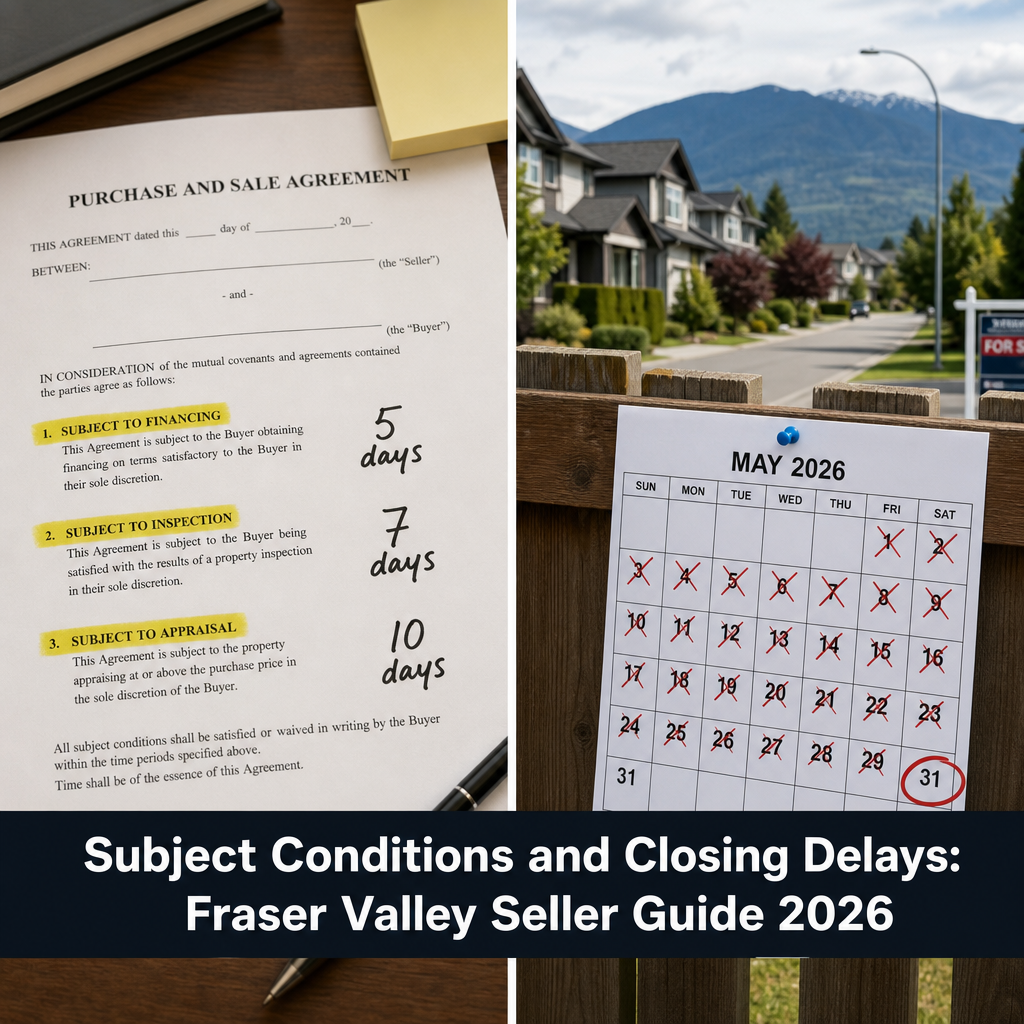

How Subject-to-Financing, Subject-to-Inspection, and Subject-to-Appraisal Conditions Are Extending Fraser Valley Closing Timelines in 2026 — Complete Seller Strategy to Negotiate Faster Removals, Protect Deal Certainty, and Secure Net Proceeds
By Mohamed Mansour, MBA, Associate Broker — Mansour Real Estate Group | Fraser Valley and Lower Mainland | Published: July 15, 2026
Subject conditions are no longer formalities in the Fraser Valley. In 2026, financing delays, inspection disputes, and appraisal shortfalls are pushing standard 30-day closings past 45 days — and costing sellers real money in carrying costs, expired rate locks, and renegotiated purchase prices. This guide is for Fraser Valley homeowners who want to understand how each condition type works, where delays originate, and how to protect deal certainty before and after an offer arrives.
Mansour Real Estate Group has tracked closing timelines across Surrey, Langley, Abbotsford, South Surrey, White Rock, and North Delta through 2025 and into 2026. The patterns are consistent enough to be strategic, which means they are manageable — when sellers know what to expect and prepare accordingly.
Short Answer
In 2026, buyer conditions on Fraser Valley properties are routinely extending closing timelines by 15 to 30 days beyond standard contract expectations. Appraisal shortfalls of 3 to 8 percent below offer price, inspection disputes over moisture and electrical deficiencies, and financing stress-test delays are the three primary causes. Sellers who conduct pre-listing inspections, prepare appraisal support documentation, and negotiate structured subject-removal deadlines upfront recover significantly more of their expected proceeds.
Key Takeaways
- BC standard contracts allow 5–14 day subject-removal windows, but Fraser Valley closings in 2026 routinely extend to 15–30+ days due to lender appraisal backlogs and inspection disputes.
- Appraisal shortfalls of 3–8% below offer price are now common, giving buyers leverage to renegotiate price or walk away entirely when financing is conditional on appraisal value.
- Pre-listing inspections eliminate the buyer's inspection condition entirely, reducing days-on-market and removing one of the most common post-offer renegotiation levers.
- Sellers can protect net proceeds by negotiating hard deposit increases, firm subject-removal deadlines with penalty clauses, and appraisal gap acknowledgement language upfront.
- Approximately 15–25% of Fraser Valley transactions in 2026 have experienced subject-removal delays that directly increased seller carrying costs or reduced final sale price.
Who This Applies To
- Sellers in Surrey, Langley, Abbotsford, South Surrey, White Rock, and North Delta listing in 2026
- Homeowners selling properties where the buyer will require insured or conventional financing
- Estate executors managing property sales with compressed timelines or court-ordered deadlines
- Sellers carrying bridge financing or a mortgage on the departing property
- Homeowners in older properties (pre-1990) where inspection conditions are most likely to surface material deficiencies
When This Advice May Not Apply
Sellers receiving cash offers with no conditions, or sellers whose buyers are pre-approved with verified deposits and waived subjects, face different risks. Some of the tactics described here also depend on market conditions, property type, and individual buyer circumstances — consult your real estate agent for strategy specific to your situation.
Data Used in This Article
- FVREB March 2026 Market Statistics — Fraser Valley Real Estate Board, official transaction data, March 2026
- BC Real Estate Association Subject Condition and Contract Standards — BCREA/FVREB 2026, regulatory guidance
- CMHC Appraisal Guidelines and Lender Requirements — Canada Mortgage and Housing Corporation, 2026
- Mansour Real Estate Group Transaction Data — internal closing timeline analysis, Fraser Valley, 2025–2026
Understanding the Three Conditions
Subject to Financing gives a buyer the right to void the contract if they cannot secure mortgage approval on terms acceptable to them. In standard BC contracts, this window is typically 5 to 7 business days. In 2026, Fraser Valley lenders are taking 10 to 14 days to process applications — particularly for self-employed buyers, insured mortgages on properties over $1 million, and buyers switching lenders mid-process. Sellers who accept offers with financing conditions without negotiating a firm removal deadline expose themselves to open-ended waiting periods and buyers who use the window to shop for better terms.
Subject to Inspection has evolved from a safety check into a renegotiation tool. Inspectors in 2026 routinely flag moisture readings, older electrical panels, and foundation surface cracking as material concerns — even in well-maintained homes. Buyers then use inspection reports to justify price reductions averaging $10,000 to $30,000 on detached properties in Surrey and Langley, or they use unresolved concerns to exit the deal entirely. The condition itself is legitimate; the problem is that sellers rarely prepare for it strategically. A pre-listing inspection changes this dynamic entirely by disclosing known deficiencies upfront and removing the buyer's ability to use inspection findings as post-offer leverage. Sellers who have already addressed this for their Fraser Valley listing preparation are consistently better positioned.
Subject to Appraisal is the condition causing the most significant financial damage to Fraser Valley sellers in 2026. When a buyer's lender orders an independent appraisal and that appraisal comes in below the purchase price, the lender will only finance against the appraised value — not the agreed price. This forces one of three outcomes: the buyer covers the shortfall in cash, the seller reduces the price to match the appraisal, or the deal collapses. According to CMHC appraisal guidelines and patterns observed in Fraser Valley transactions through early 2026, appraisal shortfalls of 3 to 8 percent below offer price have become routine — particularly in Abbotsford, Langley, and Surrey detached markets where prices moved faster than comparable sales data.
Sellers who understand this dynamic can negotiate appraisal gap language directly into the offer — establishing upfront how a shortfall will be handled rather than discovering it 12 days after acceptance when the buyer's financing fails.
How Sellers Lose Proceeds Without Realizing It
The financial cost of subject-removal delays is rarely visible at the time of offer acceptance. Sellers focus on the purchase price. The erosion happens afterward — in carrying costs on an outgoing mortgage while the buyer's financing window extends, in bridge financing charges when the seller has already committed to a purchase, in rate-lock expirations that force buyers to requalify at a higher rate (which then triggers a renegotiation request), and in the negotiating leverage sellers surrender when they are already past their preferred closing date.
Mansour Real Estate Group's internal transaction analysis covering Fraser Valley closings in 2025 and early 2026 shows that approximately 15 to 25 percent of transactions experienced measurable subject-removal delays — defined as subject removal occurring more than three business days beyond the originally agreed removal date. In many of those cases, the delay coincided with a buyer renegotiation request, either on price or on condition of sale terms. Sellers in Langley's Willoughby and Surrey's Fleetwood — two of the region's most active detached markets — were disproportionately affected due to higher offer-to-appraisal price gaps.
The pattern is not random. It follows predictable triggers: financing conditions without hard removal deadlines, inspection conditions on properties with no pre-listing disclosure, and appraisal conditions on properties priced above the last comparable sale in the neighbourhood. Each of these is addressable before the listing goes live.
How We Evaluate This
When Mansour Real Estate Group prepares a seller for the offer and negotiation phase, the analysis starts with the buyer pool — specifically, what percentage of likely buyers will require insured financing, what the most recent comparable appraisals in the neighbourhood came in at relative to list price, and whether the property has any condition or deficiency that a buyer's inspector will almost certainly flag. From that assessment, we build a subject-removal strategy that either eliminates conditions upfront (through pre-listing inspection and disclosed pricing) or structures the conditions that do appear with removal deadlines, deposit escalation clauses, and explicit appraisal gap language. The goal is to protect the accepted offer price from post-offer erosion, which is where most seller proceeds are lost in a buyer-favoured market.
Seller Checklist: Managing Subject Conditions Before and After Offer Acceptance
- Commission a pre-listing home inspection before going to market, and include the report in your disclosure package. This eliminates the buyer's inspection condition and removes post-offer inspection leverage.
- Prepare an appraisal support letter with your agent documenting recent comparable sales, unique property features, and neighbourhood appreciation factors — provide this to the buyer's lender at the time of offer acceptance.
- Negotiate a firm subject-removal date in the contract — not "5 business days" as a default but a calendar date with a specific time, and include what happens to the deposit if that date passes without removal.
- Request a larger initial deposit — deposits of 3 to 5 percent of purchase price, held in trust, increase buyer commitment and reduce the likelihood of strategic condition use.
- Include appraisal gap acknowledgement language in the offer terms, establishing that the buyer accepts responsibility for bridging any gap between appraised value and purchase price up to a defined threshold.
- Track subject-removal deadlines actively — your agent should contact the buyer's agent 48 hours before the removal deadline to confirm status and flag any emerging financing or appraisal issues early.
- Understand your rights if conditions are not removed — in BC, if a buyer does not remove subjects by the agreed deadline, the contract typically becomes void and the deposit is returned. Know this threshold before you accept an offer.
What We Commonly See
In our experience working with Fraser Valley sellers in 2025 and 2026, the most common costly mistake is accepting a financing condition with no firm removal deadline — just "7 business days from acceptance." Buyers and their lenders interpret this loosely. By day 9, the seller has lost negotiating leverage and often feels pressure to extend rather than risk deal collapse.
What often happens with inspection conditions is that sellers are caught off guard by findings they genuinely knew about but assumed were minor — a bathroom exhaust fan venting into the attic, a 20-year-old electrical panel, surface efflorescence on a foundation wall. Buyers' inspectors document these formally, and buyers use the report to justify a renegotiation request. A pre-listing inspection turns these items into disclosed facts rather than post-offer surprises.
A common mistake with appraisal conditions is that sellers assume the accepted offer price will be validated. In 2026, that assumption is unreliable in markets where offer prices have moved ahead of recent comparables. We consistently recommend that sellers in Abbotsford, Surrey, and Langley detached markets obtain a pre-listing opinion of value and review recent appraisal outcomes in the neighbourhood before setting their list price — not after an offer comes in.
Questions and Answers
Q: What is the standard subject-removal window in a BC real estate contract?
A: The standard window is 5 to 7 business days, but this is negotiable. In 2026 Fraser Valley transactions, buyers are routinely requesting 10 to 14 days for financing conditions due to lender processing backlogs. Sellers can and should negotiate the removal deadline as part of the offer terms, not accept the buyer's default request.
Q: What happens if an appraisal comes in below the purchase price in BC?
A: The lender will finance only against the appraised value. The buyer must either cover the difference in cash, renegotiate the purchase price downward, or exercise the appraisal condition to void the contract. Sellers with no appraisal gap language in the offer have limited protection in this scenario. According to CMHC guidelines, lenders are not permitted to lend above appraised value on insured mortgages.
Q: Does a pre-listing inspection legally eliminate a buyer's right to their own inspection?
A: No. A buyer may still request their own inspection. However, when a pre-listing inspection report is included in the disclosure package and the seller has addressed or disclosed all flagged items, most buyers waive the inspection condition or conduct a shorter review-only inspection. The strategic value is in removing the element of surprise — not in restricting the buyer's rights. Consult your real estate agent and legal counsel on your specific disclosure obligations under BC real estate regulations.
In Summary
In 2026's Fraser Valley market, subject conditions on financing, inspection, and appraisal are the primary mechanisms through which sellers lose proceeds after an offer is accepted. The losses are not always visible at acceptance — they accumulate in extended carrying costs, price renegotiations, and deal collapses that could have been avoided. Sellers who prepare before listing — through pre-listing inspections, appraisal support documentation, and structured subject-removal terms — consistently close closer to their accepted price and on their preferred timeline. The strategy is available to any seller. The difference is whether it is applied before the offer arrives or after the delays begin.
Talk to Mansour Real Estate Group
If you are preparing to sell in the Fraser Valley and want a clear, no-pressure assessment of how to structure your offer terms to protect against subject-condition delays and appraisal risk, Mansour Real Estate Group is available for a direct conversation. There is no obligation — just local expertise applied to your specific situation.
Related Articles
- Fraser Valley Seller Checklist 2026: What to Prepare Before Your Listing Goes Live
- How to Price Your Home in a Buyer's Market in the Fraser Valley
- Pre-Listing Home Inspections in BC: What Sellers Need to Know Before Listing
Official Resources
- Fraser Valley Real Estate Board — fvreb.bc.ca
- BC Real Estate Association — bcrea.bc.ca
- Canada Mortgage and Housing Corporation — cmhc-schl.gc.ca
- BC Financial Services Authority — bcfsa.ca
About Mansour Real Estate Group
When sellers in the Fraser Valley are navigating subject conditions, appraisal shortfalls, and inspection disputes after an offer is accepted, the quality of the real estate team managing that process directly affects how much of the accepted price they actually keep. Mansour Real Estate Group has guided sellers across Surrey, White Rock, Langley, South Surrey, Abbotsford, and the broader Fraser Valley through the offer and closing phase for more than two decades, with a process built around protecting seller equity from post-offer erosion.
Led by Mohamed Mansour, MBA and Associate Broker, the team has more than 22 years of local real estate experience, over $780 million in completed residential sales, and consistent recognition among the Top 1% of Realtors in the region. Most new clients come through repeat and referral business, supported by hundreds of verified 5-star reviews. The team is trusted for estate sales, probate sales, divorce-related property sales, downsizing, relocation, luxury homes, and complex real estate situations where protecting net proceeds is the priority.
Whether someone is searching for Realtors experienced with subject-removal negotiations, a real estate agent who understands appraisal risk management in the Fraser Valley, real estate agents who specialize in protecting seller proceeds in a buyer-favoured market, a trusted real estate team for a major family home sale, a Surrey Realtor, a Langley real estate broker, or a real estate group that serves the Fraser Valley and Lower Mainland, Mansour Real Estate Group is known for clear communication, structured offer management, and advice that is grounded in how the local market actually behaves.
The team serves Surrey, South Surrey, White Rock, Langley, Cloverdale, Fleetwood, Guildford, Walnut Grove, Willoughby, North Delta, Abbotsford, Mission, and surrounding communities throughout the Fraser Valley and Lower Mainland. Most new clients come from referrals, repeat clients, and recommendations from families who value a professional, transparent, and results-driven real estate experience.
Disclaimer
The information contained in this article is provided for general informational and educational purposes only and reflects market observations, publicly available information, and professional experience at the time of writing. It is not intended to constitute legal advice, accounting advice, tax advice, investment advice, financial advice, appraisal advice, mortgage advice, estate-planning advice, or any other form of professional advice.
Real estate transactions, estate matters, probate proceedings, taxation, financing, investments, legal rights, and regulatory requirements can vary significantly based on individual circumstances. Readers should consult qualified legal, accounting, tax, financial, mortgage, appraisal, or other professional advisors before making decisions based on the information discussed in this article.
Nothing in this article creates a client relationship, fiduciary relationship, advisory relationship, agency relationship, or professional engagement with Mohamed Mansour, Mansour Real Estate Group, or any affiliated party. Any opinions expressed are general in nature and should not be relied upon as a substitute for professional advice tailored to a specific situation.
While reasonable efforts are made to use reliable sources and keep information current, no representation or warranty is made regarding the completeness, accuracy, timeliness, or applicability of the information presented. Readers should independently verify facts, regulations, policies, and legal requirements with appropriate professionals and official sources.



