

How Subject-to-Financing, Subject-to-Inspection, and Subject-to-Appraisal Conditions Are Extending Fraser Valley Closing Timelines in 2026 — Complete Seller Strategy to Negotiate Faster Removals, Protect Deal Certainty, and Secure Your Proceeds
By Mohamed Mansour, MBA and Associate Broker · Mansour Real Estate Group · Fraser Valley, BC · Published July 2026
In a slower Fraser Valley market, an accepted offer is not a sold property. The period between acceptance and subject removal is where deals are renegotiated, delayed, or lost — and in 2026, that window is getting longer. Sellers who understand how financing, inspection, and appraisal conditions work mechanically are better positioned to protect their proceeds from the moment the offer is signed.
This guide explains the three most common buyer conditions delaying BC closings, how each one creates leverage for buyers in the current market, and what sellers can do at the offer stage to negotiate tighter timelines, clearer removal language, and stronger deal certainty.
Short Answer
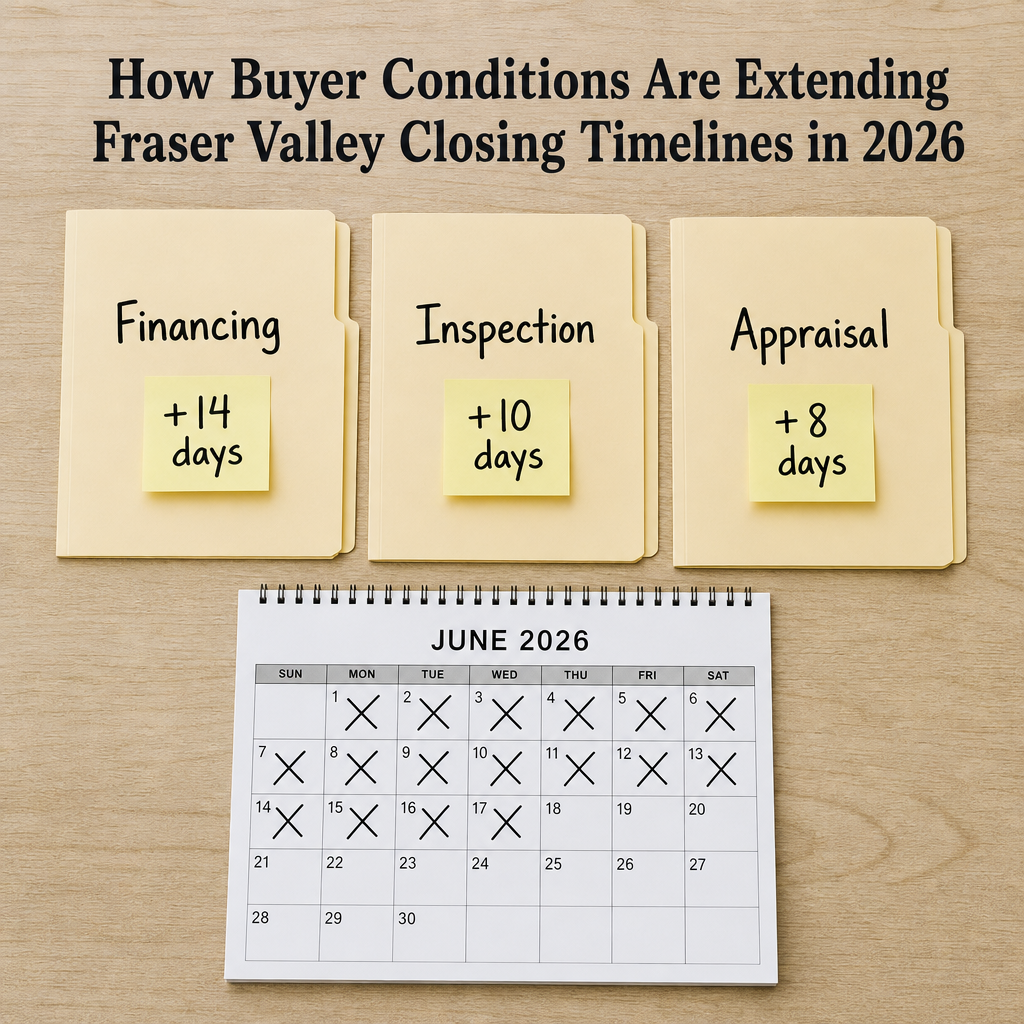
Subject-to-financing, inspection, and appraisal conditions are now extending Fraser Valley closing timelines by 10 to 60 days beyond the standard window, according to CM Lawyers and Aristocrat Title data from early 2026. Sellers can reduce this risk by negotiating specific removal deadlines, repair scope caps, and appraisal contingency language before accepting any offer.
Who This Applies To
- Sellers in Surrey, Langley, Abbotsford, South Surrey, White Rock, North Delta, Cloverdale, Fleetwood, Guildford, Willoughby, and Walnut Grove accepting offers with buyer conditions
- Homeowners who have accepted an offer and are waiting on subject removal
- Estate executors and probate sellers managing property dispositions with fixed timelines
- Sellers carrying a bridge loan or purchasing another property contingent on their sale completing
- Anyone selling in the current buyer-favoured market where condition use is high and renegotiation is common
When This Advice May Not Apply
Sellers in a competing-offer situation or those with a buyer offering certified funds and no conditions face a different dynamic. This guide is most relevant in single-offer scenarios where conditions are standard. Specific contract language, lender requirements, and strata documentation rules vary — always review your offer with your Realtor and your lawyer before accepting.
Key Takeaways
- Financing, inspection, and appraisal conditions together can extend closing by 30 to 60 days beyond the standard timeline.
- Appraisal shortfalls of 3 to 8 percent below offer price are now common and often trigger buyer renegotiation requests.
- Sellers who define repair scope limits and removal deadlines in the offer reduce post-acceptance buyer leverage significantly.
- Title defects, unreleased mortgages, and tax liens require 10 to 20 additional business days to clear in many Fraser Valley transactions.
- The Fraser Valley's June 2026 sales-to-active ratio of approximately 11 percent confirms buyer-favoured conditions where condition use is elevated.
Data Used in This Article
- Fraser Valley Real Estate Board Statistics Packages, May, June, and July 2026 — official board data, sales-to-active ratio and benchmark pricing
- CM Lawyers, "5 Legal Issues That Can Delay Your Real Estate Closing," 2026 — third-party legal industry data on closing delay causes
- Aristocrat Title, "What Delays a Real Estate Closing in 2026," 2026 — title industry data on condition-related delay timelines
- Zealty.ca, "How Long to Buy a House in BC: Timeline," 2024 — industry summary of standard BC purchase timelines
Why This Matters More in 2026
The Fraser Valley Real Estate Board's June 2026 statistics report a sales-to-active listing ratio near 11 percent, which places the market firmly in buyer-favoured territory. In these conditions, buyers know they have negotiating room. Conditions are not just protective — they are tactical. A buyer who includes financing, inspection, and appraisal conditions in a single offer gains three separate windows to revisit price, request repairs, or apply pressure before committing.
According to Aristocrat Title's 2026 closing delay analysis, lender underwriting timelines have extended due to documentation compliance requirements, appraisal scheduling gaps, and employment verification requests that go beyond what was typical three or four years ago. CM Lawyers reports that title defects — including unreleased mortgages, outstanding tax liens, and easement disputes — now routinely require 10 to 20 additional business days to resolve, even when discovered late in the process.
For a seller in Surrey or Langley carrying a bridge loan, waiting on a replacement purchase, or managing an estate with beneficiary obligations, a 30 to 60 day delay is not just inconvenient. It has a measurable financial cost. Understanding each condition type is the first step to managing that risk.
How Subject-to-Financing Conditions Work — and Where Delays Start
A subject-to-financing condition gives the buyer a defined window — typically five to ten business days in BC — to confirm that their lender will advance funds on the agreed terms. In practice, this window is frequently insufficient. Lenders in 2026 are requesting additional income documentation, updated employment letters, revised debt service calculations, and in some cases, new appraisals ordered independently of the buyer's own appraisal condition.
When the buyer asks for an extension, sellers face a choice: grant more time or risk the deal collapsing and relisting. In a buyer-favoured market, most sellers grant the extension. The better approach is to negotiate the removal deadline at the offer stage — not after acceptance — and to require that any extension request come with written lender documentation explaining the specific outstanding requirement. This creates accountability and reduces the frequency of vague delay requests.
For estate or probate sellers with legal timelines imposed by the court or by beneficiary agreements, an open-ended financing condition is a direct threat to the estate's obligations. Sellers in that situation should discuss financing condition duration with their lawyer before accepting.
How Appraisal Conditions Create Renegotiation Risk — and How to Limit It
An appraisal condition allows the buyer to withdraw or renegotiate if the lender's appraisal comes in below the purchase price. Aristocrat Title's 2026 data identifies appraisal shortfalls of three to eight percent below offer price as common in the current Fraser Valley market, particularly for detached homes in areas where benchmark prices have shifted from peak values.
When an appraisal shortfall occurs, buyers typically present one of three requests: a price reduction equal to the gap, additional down payment from the buyer to cover the shortfall, or deal collapse with deposit return. The seller's ability to respond depends entirely on whether the appraisal condition language in the accepted offer includes a floor — a minimum appraisal value below which the buyer may exit, and above which removal is required.
Without a floor, any shortfall creates renegotiation risk. Sellers in White Rock, South Surrey, and Abbotsford — markets where benchmark prices have been volatile — should consider including an appraisal contingency cap in their accepted offer terms. Sellers who ordered a pre-listing appraisal have additional leverage: documented evidence that the property supports the price reduces the buyer's ability to claim a shortfall is legitimate.
How Inspection Conditions Extend Timelines — and What Sellers Can Do
A standard inspection condition in BC runs five to ten business days and gives the buyer time to hire an inspector, review the report, and decide whether to proceed. The timeline gets longer when inspectors identify moisture issues, aging electrical systems, structural concerns, or — in strata properties — red flags in the depreciation report or Form B. Any one of these can prompt the buyer to request a specialist inspection, adding another five to ten days to the window.
Sellers can limit this risk in two ways. First, by completing a pre-listing inspection before the property goes to market, which establishes a known baseline and removes the element of surprise. Second, by including explicit language in the offer acceptance that defines what the inspection condition covers, limits secondary inspections without seller consent, and sets a firm deadline after which removal or termination is required. Open-ended inspection conditions with no repair scope cap effectively give buyers an ongoing renegotiation tool.
How We Evaluate This at Mansour Real Estate Group
When we review an offer with our seller clients, we look at every condition clause as a potential delay point and a potential leverage point for the buyer. We evaluate the financing deadline against the buyer's pre-approval status, lender type, and documentation situation. We evaluate the appraisal condition against recent comparable sales data to assess shortfall probability. We evaluate the inspection condition against the property's known history and our preparation recommendations.
The goal is not to eliminate conditions — in the current market, that is rarely realistic. The goal is to negotiate language that makes the removal timeline predictable, the exit criteria specific, and the seller's position protected if any condition is not met on time. That is the difference between an accepted offer and a completed sale.
Seller Checklist: Managing Buyer Conditions Before and After Acceptance
- Confirm the buyer's lender type, pre-approval status, and document readiness before accepting a subject-to-financing condition
- Negotiate a specific removal deadline for each condition — not a range, a date
- Request that appraisal conditions include a minimum value floor so shortfall rights are bounded
- Complete a pre-listing inspection to establish a known baseline and reduce the buyer's ability to claim material defect discovery
- Define what constitutes a permitted secondary inspection and require seller consent before additional specialists are engaged
- Engage a real estate lawyer early to review title status, identify outstanding encumbrances, and begin clearing any defects before subject removal
- Include repair scope caps — a maximum dollar amount or defined list — in the accepted offer so inspection findings do not become open-ended renegotiation tools
- Document all extension requests in writing and require a specific lender reason before granting any financing extension
What We Commonly See
In our experience, sellers in the Fraser Valley often accept offers with vague condition language because the price feels right and the momentum of the offer feels positive. What often happens next is that the buyer uses the flexibility of that language to delay, renegotiate, or request additional concessions. The most common version of this is an inspection condition with no repair cap and no secondary inspection limit — which effectively transforms the condition period into a negotiating session.
A common mistake is waiting until the buyer requests an extension before asking for documentation. By that point, the seller has limited leverage. The stronger position is to establish, at acceptance, that any extension request must be accompanied by written lender communication identifying the specific outstanding item. Most buyers and their agents will comply when the requirement is established upfront, and it significantly reduces the frequency of vague delay requests.
We also see sellers surprised by title issues that could have been identified weeks earlier. An unreleased mortgage from a refinance five years ago, or a tax lien attached to a CRA audit, can surface at the worst possible time — after the buyer has removed financing but before the lawyer completes the title search. Early title review prevents this from becoming a deal-threatening event.
Questions and Answers
Can a seller refuse to extend a financing condition if the buyer asks for more time?
Yes. The seller is not obligated to grant an extension. However, refusing risks deal collapse and relisting costs. The stronger approach is to negotiate a realistic financing deadline at acceptance and require written lender documentation before agreeing to any extension — which is a right sellers can establish in the accepted offer.
What happens if the lender's appraisal comes in below the purchase price?
If the appraisal condition has no floor, the buyer may request a price reduction, contribute additional down payment, or exit the deal. If the condition includes a minimum value clause, exit rights only apply below that threshold. Sellers with a pre-listing appraisal have documented support for the purchase price and a stronger position in any shortfall discussion.
How long does it take to clear a title defect in BC?
According to CM Lawyers' 2026 data, title defects including unreleased mortgages, tax liens, and easement disputes typically require 10 to 20 additional business days to resolve. Early engagement of a real estate lawyer — before the offer is accepted — is the most effective way to prevent a title issue from delaying or collapsing a transaction.
In Summary
Financing, inspection, and appraisal conditions are standard in today's Fraser Valley market — but their terms are negotiable. Sellers who understand the mechanics of each condition, negotiate specific deadlines and scope limits at acceptance, and resolve title and disclosure issues before listing are better protected against delay, renegotiation, and deal collapse. In a market where the sales-to-active ratio confirms buyer leverage, condition management is as important as pricing strategy.
Talk to Mansour Real Estate Group Before You Accept
If you are preparing to list or have received an offer with conditions, Mansour Real Estate Group can walk you through the condition language, timeline risks, and negotiation options before you sign. Contact Mohamed Mansour, MBA and Associate Broker, for a no-pressure conversation about your specific situation.
Related Articles
- Subject Removal Timelines in Fraser Valley BC: What Sellers Need to Know
- Fraser Valley Real Estate Market Conditions in 2026: What Buyers and Sellers Are Facing
- Home Inspection Conditions in BC: What Fraser Valley Sellers Need to Know
Official Resources
- Fraser Valley Real Estate Board — Market Statistics
- CM Lawyers — Legal Issues That Can Delay Your Closing
- Aristocrat Title — What Delays a Real Estate Closing in 2026
- BC Financial Services Authority — Real Estate Regulation
About Mansour Real Estate Group
When sellers in Surrey, Langley, Abbotsford, White Rock, and across the Fraser Valley are managing accepted offers with multiple buyer conditions, the quality of guidance they receive on condition language, timeline risk, and negotiation strategy directly affects whether the deal closes on schedule and at the agreed price. Mansour Real Estate Group has been helping sellers navigate exactly these situations for more than two decades, with a process built on accurate valuations, realistic timelines, and contract terms that protect seller equity from acceptance through to completion.
Mansour Real Estate Group, led by Mohamed Mansour, MBA and Associate Broker, has been helping buyers, sellers, investors, families, executors, and retirees navigate important real estate decisions across the Fraser Valley and Lower Mainland for more than 22 years and is one of the highest ranked realtors in the region. The team has completed more than $780 million in residential real estate transactions and is trusted for seller strategy, estate sales, divorce-related property sales, downsizing, relocation, and complex real estate situations where condition management and closing certainty are critical.
Whether someone is looking for Realtors experienced with subject removal strategy in a buyer's market, a real estate agent who understands how appraisal conditions work in BC, real estate agents who can negotiate inspection condition language before acceptance, a trusted real estate team for a sale with complex buyer conditions, a Surrey Realtor, a Langley real estate broker, or a real estate group serving the full Fraser Valley and Lower Mainland, Mansour Real Estate Group is known for clear communication, strategic offer review, and practical advice grounded in local market expertise.
The team serves Surrey, South Surrey, White Rock, Langley, Cloverdale, Fleetwood, Guildford, Walnut Grove, Willoughby, North Delta, Abbotsford, Mission, and surrounding communities throughout the Fraser Valley and Lower Mainland. Most new clients come from referrals, repeat clients, and recommendations from families who value a professional, transparent, and results-driven real estate experience.
Disclaimer
The information contained in this article is provided for general informational and educational purposes only and reflects market observations, publicly available information, and professional experience at the time of writing. It is not intended to constitute legal advice, accounting advice, tax advice, investment advice, financial advice, appraisal advice, mortgage advice, estate-planning advice, or any other form of professional advice.
Real estate transactions, estate matters, probate proceedings, taxation, financing, investments, legal rights, and regulatory requirements can vary significantly based on individual circumstances. Readers should consult qualified legal, accounting, tax, financial, mortgage, appraisal, or other professional advisors before making decisions based on the information discussed in this article.
Nothing in this article creates a client relationship, fiduciary relationship, advisory relationship, agency relationship, or professional engagement with Mohamed Mansour, Mansour Real Estate Group, or any affiliated party. Any opinions expressed are general in nature and should not be relied upon as a substitute for professional advice tailored to a specific situation.
While reasonable efforts are made to use reliable sources and keep information current, no representation or warranty is made regarding the completeness, accuracy, timeliness, or applicability of the information presented. Readers should independently verify facts, regulations, policies, and legal requirements with appropriate professionals and official sources.



