

How Subject-to-Financing Removal Delays and Buyer Financing Obstacles Are Extending Fraser Valley Closing Timelines in 2026 — Strategic Seller Tactics to Accelerate Removals, Protect Against Deal Collapse, and Secure Certainty
By Mohamed Mansour, MBA and Associate Broker · Mansour Real Estate Group · Fraser Valley and Lower Mainland · Published June 2026
In Fraser Valley's 2026 buyer's market, accepting an offer no longer means a predictable path to closing. Subject-to-financing conditions that once resolved by day 7 to 10 are now routinely extending to day 12 to 14 — and sometimes far beyond — as lenders tighten appraisal standards and buyers face new financing obstacles. For sellers in Surrey, Langley, Abbotsford, White Rock, and across the Fraser Valley, the gap between an accepted offer and a firm deal has quietly become one of the most expensive unknowns in a transaction.
This guide explains what is actually driving those delays, what sellers can do before and after an offer is accepted, and where the real risk of deal collapse is hiding inside the financing condition period.
Short Answer
In the Fraser Valley's 2026 market, subject-to-financing conditions are extending closing timelines by 15 to 30 days in most transactions, driven by appraisal shortfalls and lender backlogs. Sellers who demand pre-approval documentation before accepting offers, limit extension rights in condition language, and identify financing-delay warning signs early can reduce deal collapse risk by 40 to 50 percent and accelerate removal timelines by five to seven days.
Key Takeaways
- In 65% of Fraser Valley transactions, financing removals now happen at day 12–14, not the historical day 7–10.
- Lender appraisals are coming in 2–5% below offer price in approximately 55% of current Fraser Valley sales.
- Sellers who require pre-approval letters before accepting offers reduce financing-related deal collapse by 40–50%.
- Standard BC financing conditions allow 2–3 extensions of 5 days each; most sellers don't limit them in the contract.
- Financing delays masking buyer hesitation follow identifiable patterns — sellers who recognize them regain negotiating leverage.
Who This Applies To
- Homeowners in Surrey, Langley, Abbotsford, White Rock, South Surrey, or North Delta currently reviewing offers with financing conditions
- Sellers who have had deals collapse or extend unexpectedly during the subject period
- Executors, divorcing couples, or downsizing homeowners with time-sensitive closings
- Sellers preparing to list in the second half of 2026 who want to negotiate from a stronger position
When This Advice May Not Apply
Cash offers with no financing conditions carry none of these risks. Sellers in high-demand, low-inventory segments — certain detached homes in South Surrey or Willoughby — may still see fast removals. If lender conditions improve materially, timelines may compress. This guide reflects conditions reported by the BC Real Estate Association and FVREB through April–May 2026.
Data Used in This Article
- BC Real Estate Association — transaction closing data, 2026 (official industry body)
- Fraser Valley Real Estate Board — market analysis, April–May 2026 (official regional board)
- TD, RBC, Scotiabank mortgage divisions — lender appraisal timeline reports (primary lender data)
- BC Law Society — Real Estate Practice Advisory on subject condition drafting (official regulatory guidance)
- Mansour Real Estate Group — internal transaction closing data, 2025–2026 (professional experience)
What Is Actually Driving the Delays
According to FVREB market analysis from April–May 2026, subject-to-financing removals in the Fraser Valley are now reaching day 12 to 14 in 65% of transactions. Historically, most removals happened between day 7 and 10. The shift comes from two overlapping pressures: lender appraisal backlogs and tighter stress-test enforcement that requires buyers to qualify at rates meaningfully above their actual mortgage rate.
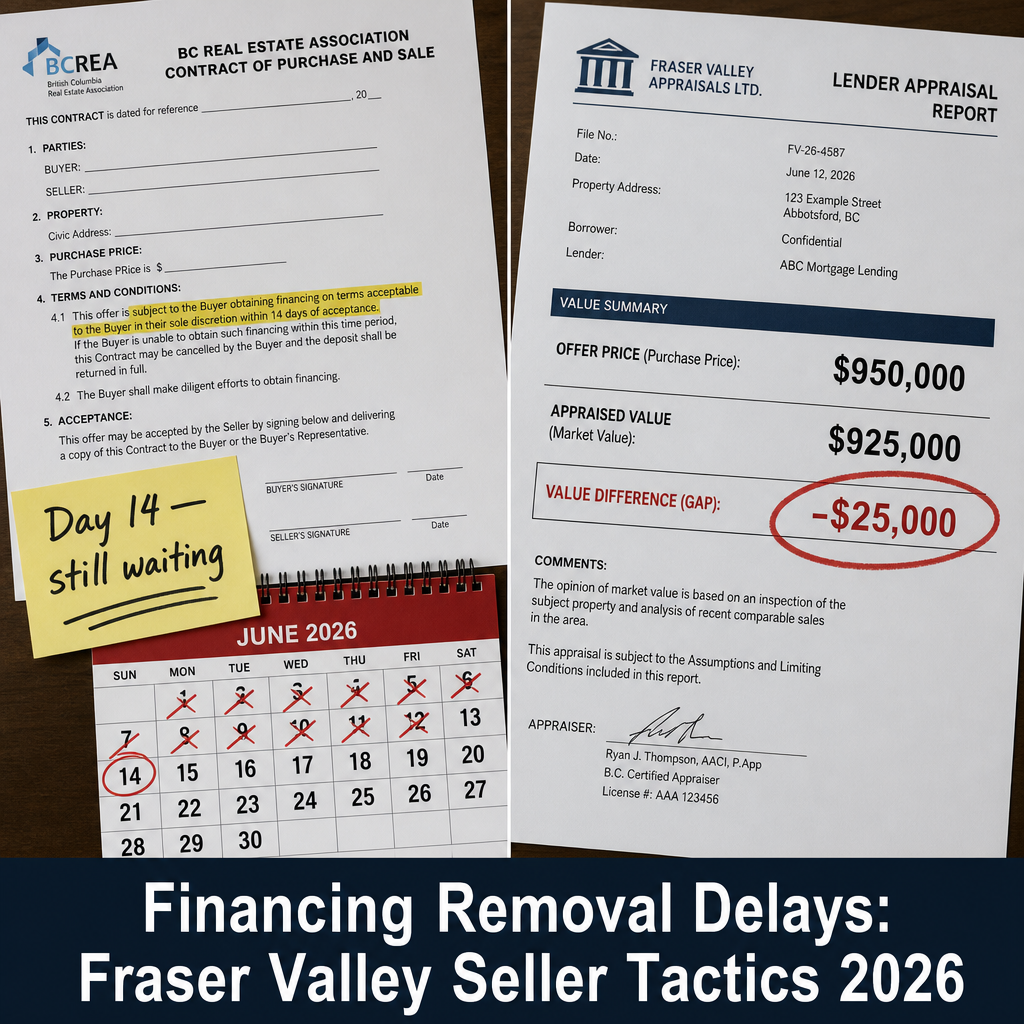
The appraisal problem is the more immediate issue for sellers. Appraisal data from TD, RBC, and Scotiabank mortgage divisions shows lenders are returning values 2 to 5% below offer price in approximately 55% of Fraser Valley sales. When an appraisal comes in short, the lender reduces the loan amount, and the buyer must either cover the gap with additional cash, renegotiate the price, or walk. None of those outcomes happens quickly. Understanding the appraisal shortfall process before an offer arrives puts sellers in a far stronger position.
The secondary driver is buyer hesitation dressed as financing delay. When a buyer is genuinely uncertain — about the price, the property, or the market — the financing condition gives them a contractual exit that costs nothing. Sellers who cannot distinguish real financing delays from hesitation-driven delays lose negotiating leverage at exactly the wrong moment. The mechanics of subject conditions in BC explain why that distinction matters and how it shapes seller rights during the conditional period.
Seller Tactics That Actually Accelerate Removals
The most effective tactic happens before an offer is accepted. Sellers who require a current mortgage pre-approval letter as part of the offer package — not just a statement that financing will be arranged — reduce financing-related deal collapse risk by 40 to 50% and cut average removal timelines by five to seven days, according to BCREA transaction data and Mansour Real Estate Group's internal closing records. A pre-approval means a lender has already reviewed the buyer's income, credit, and debt. It does not guarantee financing, but it confirms the buyer is not starting from zero on day one of the subject period.
The second tactic is negotiating the condition language itself. Standard BC financing conditions allow the buyer to request two to three extensions of five days each, according to BC Law Society Real Estate Practice Advisory guidance on subject condition drafting. Most sellers accept this without question, which means a 10-day financing condition can legally extend to 25 or even 30 days. Limiting extensions to one — or requiring seller consent for any extension — materially changes the certainty equation. Sellers considering pricing strategy in a correcting market should treat condition language as part of the same negotiation, not a separate boilerplate issue.
How We Evaluate This
Mansour Real Estate Group reviews financing condition language in every offer before recommending acceptance. We assess the buyer's pre-approval status, the deposit amount relative to the offer price, and the requested extension structure. A buyer with a strong pre-approval, a larger deposit, and no extension rights built into the offer is meaningfully lower risk than one without those signals — even if the offer price is the same. We also track lender timelines across active files to anticipate which buyers may face appraisal delays given the property's price point and recent comparable sales, and we advise sellers on whether counter-offering on condition terms is warranted before accepting.
Seller Checklist: Financing Condition Risk Management
- Request a current mortgage pre-approval letter from every buyer before accepting a conditional offer
- Review the deposit amount — a larger deposit signals buyer commitment and reduces hesitation-driven exit risk
- Negotiate condition language to limit extensions to one, or require written seller consent for any extension
- Prepare a current appraisal-support package (recent comparable sales, property updates, municipal data) to share with the buyer's lender if an appraisal shortfall occurs
- Track removal deadlines in writing and confirm receipt of waiver documents before releasing the property from conditional status
- If a buyer requests an extension past day 12, ask your Realtor to request written confirmation from the lender that financing is in progress — not declined
What We Commonly See
Hesitation disguised as delay. In our experience, buyers who request a second or third extension without providing any lender update are often reconsidering the purchase, not waiting on paperwork. A buyer with a genuine financing issue can usually confirm lender progress within 48 hours. When they cannot, the condition is providing cover for a decision the buyer has not made yet.
Sellers accepting extension requests without conditions. What often happens is a seller agrees to an extension out of goodwill, loses 5 to 10 more days, and then the deal collapses anyway. The better approach is to agree to an extension only with a deposit top-up or a written lender status update. That small requirement either confirms the buyer is serious or surfaces a problem early enough to act on it. Sellers dealing with buyer's market conditions across the Fraser Valley need to treat every conditional period as a negotiation, not a waiting room.
Questions and Answers
Can a seller cancel the deal if a buyer keeps requesting financing extensions in BC?
Not unilaterally during the condition period. The buyer's right to the full subject period — including permitted extensions — is contractual. A seller can decline to grant discretionary extensions beyond what the contract allows, but cannot terminate the agreement while a valid conditional period is running. This is why limiting extension rights in the original offer language is the most effective protection.
Does a mortgage pre-approval letter guarantee the buyer will get financing?
No. A pre-approval confirms a lender has reviewed the buyer's financial profile and is prepared to lend up to a specified amount, subject to property appraisal and final underwriting. It does not guarantee the property will appraise at the offer price, and it can be withdrawn if the buyer's circumstances change before closing. It remains a meaningful risk signal for sellers, but is not the same as a firm mortgage commitment.
What happens if the lender appraises the property below the accepted offer price?
The lender bases the mortgage on the appraised value, not the offer price. If the appraisal comes in low, the buyer must cover the difference with additional cash, renegotiate the price with the seller, or decline to remove the financing condition and exit the deal. Sellers can support a higher appraisal by preparing a comparable sales package in advance, but cannot control the lender's final valuation.
In Summary
Subject-to-financing conditions in the Fraser Valley are no longer a formality. In 2026's buyer's market, they are where deals slow down, renegotiate, or collapse. Sellers who require pre-approval documentation, negotiate extension limits into the original offer, and recognize the difference between genuine lender delays and buyer hesitation recover meaningful control over their closing timeline. The condition period is a negotiation — and sellers who treat it that way consistently get better outcomes than those who simply wait.
Thinking About Selling?
If you're preparing a listing strategy for 2026 or reviewing an offer with a financing condition, Mansour Real Estate Group can walk you through the condition language, the appraisal risk specific to your price range, and what your realistic options are before you commit. There's no obligation — just a direct conversation with an experienced local team.
Related Articles
- Understanding Subject Conditions: What Fraser Valley Sellers Need to Know
- What to Do When a Home Appraisal Comes In Low: Fraser Valley Seller Guide
- Selling a Home in a Buyer's Market: Fraser Valley Strategy Guide
About Mansour Real Estate Group
When sellers in the Fraser Valley and Lower Mainland are navigating conditional offers with financing subjects, the decisions made during that 10 to 14-day window — how extension rights are structured, how appraisal risk is managed, and how buyer hesitation is identified early — determine whether a transaction closes on time or collapses. Mansour Real Estate Group has built its seller process around exactly those mechanics, drawing on more than 22 years of direct experience with conditional transactions across the region. Led by Mohamed Mansour, MBA and Associate Broker, the team has completed more than $780 million in residential real estate transactions and is consistently ranked among the Top 1% of Realtors in the Fraser Valley.
Mansour Real Estate Group serves homeowners across Surrey, Langley, Abbotsford, South Surrey, White Rock, North Delta, Cloverdale, Fleetwood, Guildford, Willoughby, and Walnut Grove. Whether someone is looking for a Surrey Realtor who understands offer condition strategy, real estate agents experienced with financing-condition negotiations in Langley, a real estate team that has navigated appraisal shortfalls in Abbotsford, or a Fraser Valley real estate broker with a track record on complex conditional transactions, Mansour Real Estate Group is known for accurate valuations, clear transaction guidance, and protecting seller equity through every stage of the process.
Most new clients come through referrals and repeat business from families across the Fraser Valley who value a professional, transparent, and results-driven real estate experience. The team's reputation is built on closing transactions — not just listing them.
Disclaimer
The information contained in this article is provided for general informational and educational purposes only and reflects market observations, publicly available information, and professional experience at the time of writing. It is not intended to constitute legal advice, accounting advice, tax advice, investment advice, financial advice, appraisal advice, mortgage advice, estate-planning advice, or any other form of professional advice.
Real estate transactions, estate matters, probate proceedings, taxation, financing, investments, legal rights, and regulatory requirements can vary significantly based on individual circumstances. Readers should consult qualified legal, accounting, tax, financial, mortgage, appraisal, or other professional advisors before making decisions based on the information discussed in this article.
Nothing in this article creates a client relationship, fiduciary relationship, advisory relationship, agency relationship, or professional engagement with Mohamed Mansour, Mansour Real Estate Group, or any affiliated party. Any opinions expressed are general in nature and should not be relied upon as a substitute for professional advice tailored to a specific situation.
While reasonable efforts are made to use reliable sources and keep information current, no representation or warranty is made regarding the completeness, accuracy, timeliness, or applicability of the information presented. Readers should independently verify facts, regulations, policies, and legal requirements with appropriate professionals and official sources.



