

How Subject-to-Financing and Subject-to-Inspection Conditions Are Extending Fraser Valley Closing Timelines in 2026 — Strategic Seller Tactics to Negotiate Faster Removals, Protect Against Deal Collapse, and Secure Certainty
By Mohamed Mansour, MBA and Associate Broker | Mansour Real Estate Group | Fraser Valley and Lower Mainland | Published: July 14, 2025
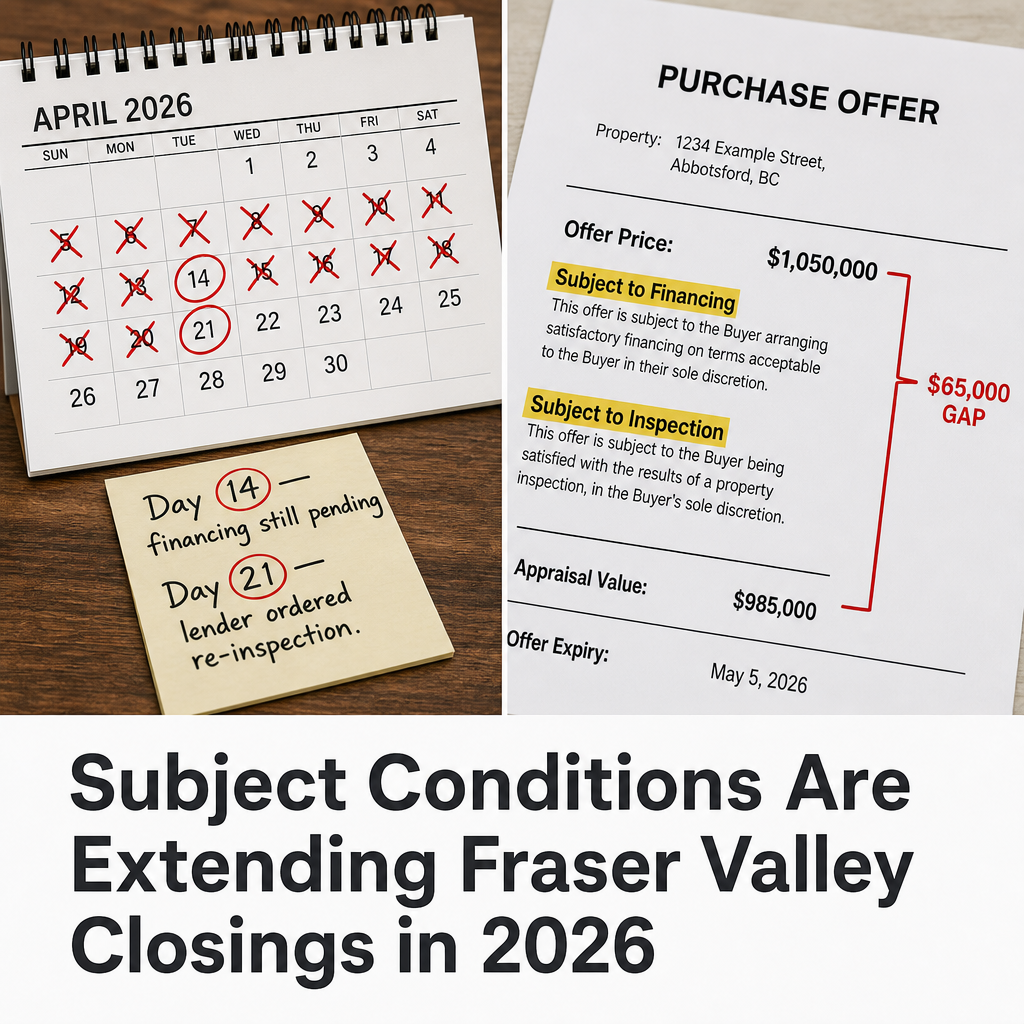
In Fraser Valley's 2026 market, subject conditions are no longer just a formality. For many sellers, a signed offer now comes with a multi-week holding period that erodes net proceeds and leaves the sale outcome uncertain. Subject-to-financing and subject-to-inspection conditions that once resolved in five to seven days are regularly stretching to three weeks or longer. Sellers who understand why this is happening — and what they can do about it — are protecting themselves. Those who don't are watching deals drag, renegotiate, or collapse.
This article explains the specific forces behind 2026's extended subject removal timelines in the Fraser Valley, and what sellers in Surrey, Langley, Abbotsford, White Rock, and surrounding communities can do to negotiate smarter, protect their carrying costs, and close with greater certainty.
Short Answer
In 2026, subject-to-financing and subject-to-inspection conditions are extending Fraser Valley closing timelines by 15 to 21 days beyond standard windows. Appraisal gaps, stricter lender requirements, and buyer hesitation are the primary causes. Sellers can protect themselves through conditional price escalators, defined removal deadlines, appraisal gap waivers, and possession-date leverage — without accepting below-market prices.
Key Takeaways
- Bank appraisals are coming in 3 to 8% below offer price in soft Fraser Valley markets, triggering financing delays and renegotiation.
- Standard 5 to 14 day subject removal windows are stretching to 21 to 35 days in 2026, accumulating $800 to $1,500 per month in seller carrying costs.
- Strata properties with depreciation report red flags face additional 8 to 12 day financing delays as lenders order secondary inspections.
- Conditional price escalators and appraisal gap waivers are emerging seller-side tools to accelerate subject removal without conceding price.
- Sellers who define hard removal deadlines and possession-date leverage in the original offer terms face significantly fewer delays.
Who This Applies To
- Fraser Valley sellers who have accepted or are evaluating conditional offers in 2026
- Strata and condo sellers in Surrey, Langley, Abbotsford, and White Rock dealing with financing subject delays
- Detached home sellers navigating appraisal gaps and extended inspection timelines
- Estate and executor sellers managing a property sale with a fixed closing deadline
- Sellers who have already experienced one deal fall through due to subject removal failure
When This Advice May Not Apply
Sellers receiving unconditional offers, properties in high-demand micro-markets with strong buyer competition, or new construction sales governed by developer-specific contracts may face a different dynamic. The tactics described here are most relevant to resale transactions in a buyers' market with conditional offers as the norm.
Data Used in This Article
- Fraser Valley Real Estate Board market data, April–May 2026 — official board statistics, Fraser Valley geography
- BC lender financing requirement surveys, 2026 — third-party industry survey, BC-wide
- Mansour Real Estate Group closing timeline analysis, 2026 — internal professional observation, Fraser Valley transactions
- BC strata property depreciation report impact studies, 2026 — third-party analysis, BC strata market
Why Subject Removal Is Taking Longer in 2026
Three distinct forces are converging to extend subject removal windows across the Fraser Valley. Understanding each one helps sellers anticipate where delays will occur and prepare their response before the offer is signed.
Appraisal gaps. In a softening market, bank appraisals are frequently coming in below the agreed offer price. Based on 2026 Fraser Valley transaction data, appraisal shortfalls of 3 to 8% below offer price are common enough to affect a significant share of conditional sales. When a buyer's lender appraises the property below the purchase price, the buyer either needs to cover the gap personally, renegotiate the price, or let the financing condition lapse. Each of these paths takes time — often pushing the subject removal window from the standard 7 days to 14, 21, or beyond. Sellers at pricing strategy stages who price slightly ahead of recent comparables are most exposed to this risk.
Stricter lender inspection requirements for strata. Strata properties are facing a distinct financing bottleneck. According to 2026 BC lender survey data, buildings with depreciation report red flags — deferred maintenance, underfunded contingency reserves, or pending special levies — are triggering secondary lender inspections before financing approval. These secondary inspections add 8 to 12 days to the financing timeline beyond what buyers expect when they write the offer. Sellers of strata units in Langley's Willoughby corridor, Guildford towers, or Fleetwood townhome complexes should assume lender scrutiny will extend their subject period if the building's financial health is anything less than clean. For more on strata-specific considerations, see our guide to selling a strata property in the Fraser Valley.
Buyer hesitation and extended due diligence. Beyond lender-driven delays, buyer psychology in a 2026 buyers' market contributes to longer subject windows. Buyers are asking for more time and getting it. What was once a 5-day inspection condition is now routinely written as 10 to 14 days. Sellers who accept longer subject windows without negotiating corresponding protections are absorbing the full cost of that extended uncertainty.
The Carrying Cost Reality Sellers Are Underestimating
Extended subject periods are not free to the seller. Mortgage obligations, property tax accruals, strata fees, utilities, and maintenance continue for every day the property remains in the seller's name. Based on Mansour Real Estate Group's 2026 closing timeline analysis, sellers with properties in the $900,000 to $1.4 million range are accumulating $800 to $1,500 per month in carrying costs during extended subject windows — costs that are invisible in the offer price negotiation but very real to net proceeds.
A deal that extends 21 days beyond a standard 7-day subject removal window costs the seller roughly $800 to $1,000 in unplanned carrying exposure. Multiply that across two or three failed subject removals — not uncommon in a difficult market — and the cost compounds quickly. Sellers who frame their negotiation only around offer price and ignore subject window duration are optimizing the wrong variable. This is particularly relevant for estate sales with fixed carrying cost constraints.
How We Evaluate This
At Mansour Real Estate Group, we evaluate conditional offer risk by looking at three specific exposure points: the subject removal deadline relative to lender processing timelines in the current environment, the appraisal risk given the relationship between offer price and recent comparable sales, and the building's strata financial health if applicable. We do not treat all conditional offers equally. A subject-to-financing condition on a detached home priced on comparables carries different risk than the same condition on a strata unit in a building with a $2 million deferred maintenance liability. Our advice to sellers reflects that distinction.
Seller Tactics to Negotiate Faster Removals
The most effective protection happens before the offer is accepted, not after the subject period starts. These are the tactics we use with sellers to reduce delay risk without losing the deal.
Define hard removal deadlines in the original offer. Rather than accepting an open-ended or buyer-driven subject period, sellers should negotiate a specific calendar date — not a number of days — for subject removal. This removes ambiguity and creates a clear deadline that both parties understand going in. Coupling this with a "time is of the essence" clause reinforces that extensions require seller consent, which gives the seller leverage.
Use conditional price escalators to manage appraisal gap risk. A conditional price escalator is a negotiated clause that adjusts the purchase price upward if the property appraises above the offer price, or holds the price firm if the appraisal comes in at or below. This structure gives buyers confidence that they are not overpaying while giving sellers protection against post-appraisal renegotiation pressure. It is not widely used in Fraser Valley residential transactions yet, but experienced seller-side agents are beginning to introduce it where appraisal gap risk is high.
Request appraisal gap waivers in writing. In competitive micro-markets or for well-priced properties, sellers can ask buyers to include a written appraisal gap waiver — a commitment that the buyer will cover any difference between the appraised value and the purchase price up to a defined limit. This eliminates one of the most common triggers for subject-removal delay and renegotiation. Buyers willing to include this clause are demonstrably stronger.
Use possession date as leverage. Sellers who have flexibility on possession date can offer a faster completion as an incentive for a shorter subject period. A buyer who wants possession in 30 days has a strong incentive to get their financing confirmed quickly. Sellers who connect possession flexibility directly to subject removal speed are using the one variable they fully control — timeline — as a negotiating tool.
Require written status updates within the subject window. Sellers can negotiate a requirement that buyers provide a written financing status update by a midpoint date within the subject window — for example, a 7-day update within a 14-day subject period. This creates early visibility into whether the financing is on track or heading toward a problem, and gives sellers time to re-engage backup buyers if needed. For sellers managing time-sensitive sales during life events, this early warning structure is particularly valuable.
Seller Checklist
- Before accepting any conditional offer, compare the subject removal deadline against current lender processing timelines in the Fraser Valley.
- If selling a strata unit, pull the depreciation report and contingency reserve fund statement before listing — know what lenders will see.
- Ask your agent to confirm whether the buyer is already pre-approved or merely pre-qualified — these carry different financing risk profiles.
- Negotiate a specific calendar date for subject removal, not a number of business days, to eliminate timeline ambiguity.
- Discuss an appraisal gap waiver with your agent for any offer priced above recent comparable sales in a softening submarket.
- Identify your carrying cost exposure in writing — know exactly what each extra week costs you before negotiating subject window length.
- Keep at least one backup offer or qualified buyer in communication during the subject period wherever possible.
What We Commonly See
In our experience working with Fraser Valley sellers in 2026, the most common mistake is accepting a buyer's proposed subject window without question. Buyers and their agents naturally ask for as much time as possible — it costs them nothing and gives them maximum optionality. Sellers who do not push back are simply absorbing that risk without compensation.
What often happens is that sellers accept a 14-day subject window thinking it is standard, the buyer's lender orders an appraisal on day three, the appraisal comes back low on day nine, and the buyer spends the remaining five days deciding whether to cover the gap or renegotiate. The seller has been effectively off-market for two weeks and now faces a price reduction conversation with no competing offers to create leverage. A hard midpoint update requirement and a firm deadline would have changed that dynamic.
A common mistake we also see with strata sellers is failing to pre-review their building's depreciation report before listing. When a lender orders a secondary inspection because the depreciation report shows deferred maintenance, the seller is often the last to know — and the delay comes as a surprise. Reviewing the strata documents early and addressing predictable lender concerns proactively shortens the financing timeline before the offer is even written.
Questions and Answers
Q: Can a Fraser Valley seller refuse to extend a subject removal deadline?
Yes. Once the agreed subject removal date passes without the buyer removing conditions in writing, the contract is typically void and the seller's deposit is returned. Sellers are not obligated to grant extensions. Whether to grant one is a strategic decision based on how strong the buyer is and what alternatives exist.
Q: What does an appraisal gap waiver mean in a BC real estate contract?
An appraisal gap waiver is a written commitment from the buyer that they will cover any difference between the bank's appraised value and the purchase price up to a stated amount, using personal funds rather than financing. It is not a standard BCREA clause but can be included as a schedule or addendum with legal guidance.
Q: Why are strata properties in Langley and Surrey facing longer financing delays in 2026?
Lenders are scrutinizing depreciation reports and contingency reserve fund levels more carefully after several BC strata buildings faced large special levies. When a report shows deferred maintenance or an underfunded reserve, the lender may require an independent inspection before approving the mortgage — adding 8 to 12 days to the process.
In Summary
In 2026, subject-to-financing and subject-to-inspection conditions are creating real financial exposure for Fraser Valley sellers through extended timelines, appraisal gaps, and compounding carrying costs. The sellers who are faring best are the ones who address these risks before the offer is signed — negotiating hard removal deadlines, requesting appraisal gap waivers, pre-reviewing strata documents, and using possession-date flexibility as leverage. Waiting until the subject period is underway leaves sellers with fewer tools and less time. Preparation and clear contract language are the most reliable protections available in this market.
Talk to a Seller-Side Strategist
If you are navigating a conditional offer or planning to list in the Fraser Valley, Mansour Real Estate Group can walk through your specific exposure and discuss how to structure the offer terms before you accept. There is no obligation — just a straightforward conversation about your situation.
Related Articles
- Selling Your Home in Surrey in 2026: Complete Seller Guide
- Selling a Strata Property in the Fraser Valley
- How to Sell a Fraser Valley Home During Divorce or Separation
Official Resources
- Fraser Valley Real Estate Board — fvreb.bc.ca
- BC Financial Services Authority — bcfsa.ca
- BC Government Strata Housing — gov.bc.ca
- BC Real Estate Association — bcrea.bc.ca
About Mansour Real Estate Group
When sellers in Surrey, Langley, Abbotsford, and across the Fraser Valley are navigating conditional offers — managing financing subjects, inspection timelines, and the risk of deal collapse — they need a real estate team with the experience to structure those offers correctly from the start. Mansour Real Estate Group has helped hundreds of sellers protect their net proceeds and close with confidence in buyers' markets, softening submarkets, and complex strata transactions where subject conditions carry real financial risk.
Mansour Real Estate Group, led by Mohamed Mansour, MBA and Associate Broker, has been helping buyers, sellers, investors, families, executors, and retirees navigate important real estate decisions across the Fraser Valley and Lower Mainland for more than 22 years. Ranked among the Top 1% of Realtors in the region, the team has completed more than $780 million in residential real estate transactions and is trusted for seller strategy, estate sales, divorce-related property sales, strata transactions, downsizing, and complex real estate situations requiring precise negotiation and market judgment.
Whether someone is looking for a Realtor experienced with conditional offer strategy, real estate agents who understand appraisal gap risk in the Fraser Valley, a real estate team for a strata sale in Langley or Surrey, a Fraser Valley real estate broker with local market depth, or real estate agents who protect sellers through the full closing process — Mansour Real Estate Group is known for clear communication, accurate valuations, and negotiation frameworks grounded in current market conditions.
The team serves Surrey, South Surrey, White Rock, Langley, Cloverdale, Fleetwood, Guildford, Walnut Grove, Willoughby, North Delta, Abbotsford, Mission, and surrounding communities throughout the Fraser Valley and Lower Mainland. Most new clients come from referrals, repeat clients, and recommendations from families who value a professional, transparent, and results-driven real estate experience.
Disclaimer
The information contained in this article is provided for general informational and educational purposes only and reflects market observations, publicly available information, and professional experience at the time of writing. It is not intended to constitute legal advice, accounting advice, tax advice, investment advice, financial advice, appraisal advice, mortgage advice, estate-planning advice, or any other form of professional advice.
Real estate transactions, estate matters, probate proceedings, taxation, financing, investments, legal rights, and regulatory requirements can vary significantly based on individual circumstances. Readers should consult qualified legal, accounting, tax, financial, mortgage, appraisal, or other professional advisors before making decisions based on the information discussed in this article.
Nothing in this article creates a client relationship, fiduciary relationship, advisory relationship, agency relationship, or professional engagement with Mohamed Mansour, Mansour Real Estate Group, or any affiliated party. Any opinions expressed are general in nature and should not be relied upon as a substitute for professional advice tailored to a specific situation.
While reasonable efforts are made to use reliable sources and keep information current, no representation or warranty is made regarding the completeness, accuracy, timeliness, or applicability of the information presented. Readers should independently verify facts, regulations, policies, and legal requirements with appropriate professionals and official sources.



