
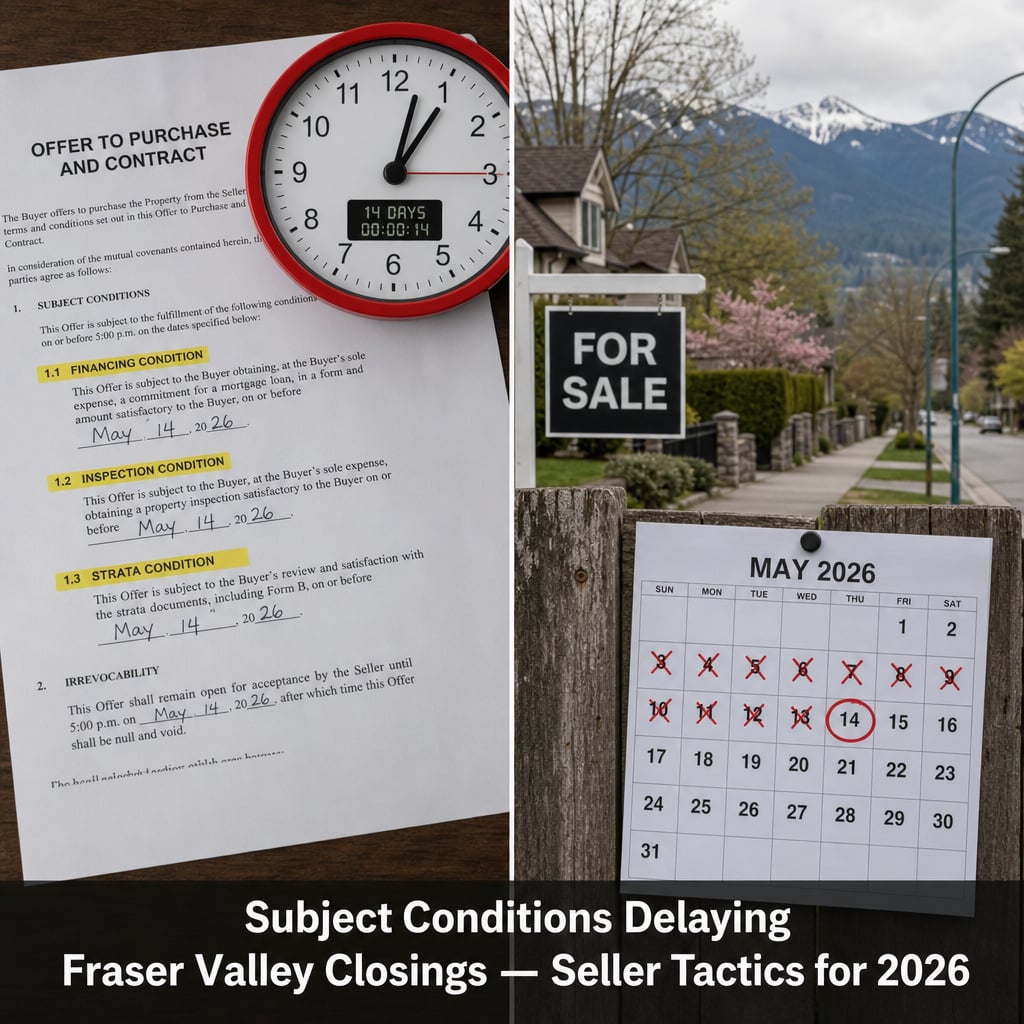

How Subject-to-Financing and Subject-to-Inspection Conditions Are Extending Fraser Valley Closing Timelines in 2026 — Complete Seller Tactics to Negotiate Faster Removals, Protect Against Deal Collapse, and Secure Your Proceeds
By Mohamed Mansour, MBA and Associate Broker, Mansour Real Estate Group | Fraser Valley and Lower Mainland | Published June 30, 2026 | BC Seller Strategy
In the Fraser Valley's current market, an accepted offer is not a completed sale. Between the offer date and the day proceeds land in your account, several conditions — financing, inspection, appraisal, and strata — must be satisfied and removed in writing. In 2026, each of those windows is taking longer than sellers expect, and the delays are costing real money.
This guide is for sellers in Surrey, Langley, Abbotsford, South Surrey, White Rock, and across the Fraser Valley who want to understand how conditional offers work, why removal timelines are stretching, and what tactics protect their position without killing the deal.
Short Answer
In 2026's buyer-favoured Fraser Valley market, subject removal windows that once took 5–7 days are regularly stretching to 3–4 weeks. Financing conditions, inspection findings, appraisal gaps, and strata document reviews are each capable of stalling your closing, triggering renegotiation, or collapsing your deal. Sellers who understand how to structure, limit, and negotiate each condition type keep more of their proceeds and close on schedule.
Key Takeaways
- Subject removal windows in BC are extending to 3–4 weeks in 2026 due to buyer leverage in a market with an 11% sales-to-active ratio.
- Appraisal conditions trigger price renegotiation in an estimated 40–50% of Fraser Valley sales when lender valuations undercut the offer price.
- Strata document conditions — including depreciation report review — are adding 10–14 days to condo and townhome closings across the region.
- Inspection conditions on pre-2010 homes in Abbotsford, Mission, and similar markets stretch to 2–3 weeks when defects trigger renegotiation.
- Sellers who define condition language precisely in the offer — limiting scope, setting hard deadlines, and requiring written notice — reduce renegotiation risk significantly.
Who This Applies To
- Homeowners listing detached, semi-detached, or townhome properties in Surrey, Langley, Abbotsford, or South Surrey
- Condo sellers dealing with strata documentation requirements and depreciation report timelines
- Estate executors or divorcing homeowners who need a predictable, time-bounded closing process
- Sellers of pre-2010 homes where inspection conditions are statistically more likely to trigger renegotiation
- Any seller who has accepted a conditional offer and is now managing the removal period
When This Advice May Not Apply
Sellers in high-demand neighbourhoods receiving competing offers may face very different dynamics. Sellers of newer builds or recently renovated properties may see shorter inspection timelines. Always review your specific offer language with your Realtor and, where legal questions arise, with a BC real estate lawyer.
Data Used in This Article
- Fraser Valley Real Estate Board (FVREB) — Q1–Q2 2026 market statistics, sales-to-active listings ratio
- BCFSA conveyancing practice guidelines — conditional offer and subject removal standards
- Mansour Real Estate Group transactional data — subject removal timelines and condition-related delays across Fraser Valley sales, 2025–2026 (internal, professional interpretation)
- BC Strata Property Act — strata document disclosure requirements
Why Subject Conditions Are Taking Longer in 2026
The Fraser Valley's sales-to-active listings ratio sat near 11% through Q1 and Q2 of 2026, according to FVREB market data. That figure places the market firmly in buyer's territory. When buyers have options and sellers are competing for a smaller pool of qualified purchasers, conditional periods shift from administrative formalities into negotiation extensions.
Buyers in this environment use conditional periods for three purposes: to satisfy their lender's requirements, to investigate the property, and sometimes to reconsider the price. When conditions are broadly written — a common outcome when sellers accept an offer without scrutinizing the language — buyers have room to delay, request extensions, and use findings as leverage. The seller, meanwhile, is off the market and accumulating carrying costs.
Understanding how each condition type behaves, and what sellers can do about it before and after offer acceptance, is the practical difference between a clean closing and a three-week negotiation that ends in a price reduction or a collapsed deal.
The Four Condition Types Sellers Must Understand
Subject to Financing. Financing conditions exist because buyers need lender approval to complete the purchase. In 2026, stress-test qualification requirements remain in place under federal mortgage rules, meaning buyers are qualified at a rate higher than their actual contract rate. This makes financing approval less certain than it was in low-rate environments, and lenders are applying more scrutiny to property valuations alongside buyer income qualification.
A standard financing condition gives the buyer 5–7 business days to secure approval. In the current market, buyers or their lenders are commonly requesting 10–14 days — and some are requesting extensions beyond that when documents are slow or lenders require additional information. Sellers who agree to open-ended financing conditions without a hard deadline create the largest risk category.
Subject to Inspection. Home inspection conditions on Fraser Valley properties — particularly pre-2010 homes in Abbotsford, Mission, and Cloverdale — are generating extended timelines when inspectors identify deferred maintenance, aging mechanical systems, or moisture-related concerns. According to data from Mansour Real Estate Group's transaction history in these markets, inspection contingency rates on pre-2010 homes exceed 70%, and when significant findings emerge, buyers are using a 5–10 day renegotiation window that extends the overall removal timeline to 2–3 weeks.
The condition language matters enormously here. "Subject to buyer's satisfaction with the results of a home inspection" is functionally unlimited — a buyer can claim dissatisfaction for any reason. "Subject to the inspection revealing no material latent defects" is bounded — the standard is objective, and minor findings cannot trigger an indefinite hold.
Subject to Appraisal. Appraisal conditions are increasingly present in 2026 as lenders order independent valuations before approving financing on purchases above certain thresholds. When a lender's appraiser values the property below the offer price — which is happening in an estimated 40–50% of Fraser Valley transactions where appraisal conditions apply, based on professional observation — the buyer faces a financing gap. That gap becomes a negotiation: either the buyer covers the shortfall, the seller reduces the price, or the deal collapses.
Sellers who have priced strategically, using comparable sales that their Realtor can defend to an appraiser, reduce this risk. Those who have accepted an inflated offer price relative to recent sales — sometimes in the hope that an optimistic buyer will absorb an appraisal gap — face the highest exposure to midstream renegotiation.
Subject to Strata Documents (Form B and Related). For condos and townhomes, buyers are entitled to review the Form B information certificate, strata minutes, financial statements, and depreciation report before waiving conditions. Since the BC Government introduced mandatory depreciation report requirements (with a July 1, 2027 compliance deadline for most stratas), buyers are scrutinizing depreciation reports carefully — and some are requesting extensions when reports flag significant upcoming expenditures. This process adds 10–14 days to condo and townhome closings in the Fraser Valley on average, based on Mansour Real Estate Group's transactional data.
How We Evaluate This
At Mansour Real Estate Group, we evaluate conditional offers on three dimensions: the specificity of condition language, the reasonableness of the removal timeline relative to current market conditions, and the risk profile of the buyer based on how the offer is structured.
A conditional offer with a financially qualified buyer, a bounded inspection clause, and a 7-day financing window is structurably different from an offer with open-ended condition language and a 14-day removal period on each clause stacked sequentially. We help sellers read those differences before counter-signing, not after the conditional period has started running.
Seller Tactics Checklist
- Define condition scope precisely in the offer. Require bounded inspection language (material latent defects, not "buyer satisfaction") before counter-signing.
- Set hard removal deadlines on each condition. Financing: 7 business days. Inspection: 5–7 business days. Strata: 10 business days. Require simultaneous removal, not sequential.
- Request proof of mortgage pre-approval with the offer. Buyers with lender pre-approval letters present lower financing condition risk than unqualified buyers.
- Pre-assemble strata documents before listing. For condo and townhome sellers, having the Form B, minutes, and depreciation report ready at offer time reduces strata condition timelines by 5–7 days.
- Price accurately relative to recent comparables. Offers accepted above defensible comparable sales are the leading cause of appraisal-gap renegotiation. Accurate pricing eliminates this risk category entirely.
- Include a time-is-of-the-essence clause. This standard BC real estate clause establishes that all deadlines are firm and removes ambiguity when a buyer requests an extension.
- Require written removal notice. Condition removal must be confirmed in writing. Verbal confirmation from a buyer's agent is not binding in BC.
- Evaluate extension requests carefully. If a buyer requests a financing extension, ask your Realtor to find out why. A lender delay is different from a buyer reconsidering. Know the difference before agreeing.
What We Commonly See
Sellers accepting broad condition language to secure the offer. In our experience working with Fraser Valley sellers, the most common tactical error is counter-signing an offer with satisfaction-based inspection language because the price looks good. When the inspection returns findings, the buyer uses the open-ended clause to request a price reduction or extended removal period — and the seller has no contractual basis to push back.
Strata sellers not having documents ready. What often happens is that a condo seller accepts an offer, the buyer's agent requests the Form B and strata documents, and the strata management company takes 5–10 business days to produce them. The removal window starts running, but the buyer cannot reasonably review documents they haven't received. The result is an automatic extension — not because the buyer asked for one, but because the seller was not prepared.
Sellers treating all extension requests the same way. A common mistake is automatically agreeing to extension requests without understanding their source. A buyer whose lender needs one more business day to complete an appraisal review is in a fundamentally different position than a buyer who is reconsidering the purchase price. Sellers who ask their Realtor to investigate the real reason for an extension request are in a far better position to respond appropriately — whether that means granting 48 hours or formally notifying the buyer of a removal deadline.
Questions Sellers Ask About Subject Conditions in BC
Can a seller keep marketing the property while conditions are outstanding?
In most cases, the accepted offer removes the property from active marketing. However, sellers can negotiate a "seller's right to accept other offers" clause — sometimes called a 72-hour clause — which allows the seller to accept a second offer and give the original buyer a limited window to waive conditions. This clause must be agreed upon before the offer is signed, not after a condition removal problem has already emerged.
What happens if a buyer removes conditions late without written notice?
In BC, subject condition removal must be in writing to be binding. If a buyer verbally communicates removal but fails to deliver written notice by the contractual deadline, the seller is entitled to treat the offer as collapsed — though this carries legal complexity. Any situation involving a missed condition removal deadline should be reviewed immediately with a BC real estate lawyer before any action is taken.
Is an appraisal condition the same as a financing condition?
Not always. A financing condition protects the buyer if their lender refuses to approve the mortgage. An appraisal condition specifically protects the buyer if the lender's property valuation comes in below the offer price — which affects how much the lender will loan against the property. Some offers contain both, which can create two separate grounds for renegotiation or condition removal failure. Sellers should understand which conditions are present and what each one covers before counter-signing.
In Summary
Subject conditions are a normal part of BC real estate transactions, but in 2026's buyer-favoured Fraser Valley market, they are functioning as extended negotiation windows rather than brief administrative steps. Sellers who understand how financing, inspection, appraisal, and strata conditions work — and who use precise language, bounded timelines, and preparation to limit condition exposure — complete cleaner sales, avoid midstream price reductions, and protect the proceeds they worked to build. An accepted offer is the beginning of the closing process, not the end of the negotiation.
Ready to Talk Through Your Offer?
If you have received a conditional offer or are preparing to list in Surrey, Langley, Abbotsford, or elsewhere in the Fraser Valley, Mansour Real Estate Group can walk through the condition structure with you — what it means, what to watch for, and how to protect your position through the removal period. No pressure, just a clear second opinion from a team that has worked through these situations many times.
Related Articles
- Fraser Valley Real Estate in 2026 — What Sellers Need to Know Before Listing
- How to Price Your Home Accurately in a Buyer's Market — Fraser Valley Seller Strategy
- What Condo Sellers Need to Prepare Before Listing — Strata Documents and Form B in BC
About Mansour Real Estate Group
When sellers in Surrey, Langley, Abbotsford, and across the Fraser Valley are navigating conditional offers, subject removal timelines, and the real risk of deal collapse, they need a real estate team with the transactional depth to read an offer's structure before it becomes a problem. Mansour Real Estate Group works with sellers who are managing this exact situation — accepted offers with financing, inspection, appraisal, and strata conditions that need to be properly bounded, monitored, and negotiated through to a clean closing.
Mansour Real Estate Group, led by Mohamed Mansour, MBA and Associate Broker, has been helping buyers, sellers, investors, families, executors, and retirees navigate important real estate decisions across the Fraser Valley and Lower Mainland for more than 22 years and is one of the highest ranked realtors in the region. The team has completed more than $780 million in residential real estate transactions and is trusted for seller strategy, estate sales, divorce-related property sales, downsizing, relocation, and complex transactions where condition management and timeline precision matter.
Whether someone is searching for Realtors experienced with conditional offer negotiation, a real estate agent who understands how subject removal timelines work in BC, real estate agents who specialize in protecting seller equity through the closing process, a trusted real estate team for a Fraser Valley home sale, a Surrey Realtor, a Langley real estate broker, or a real estate group that serves the full Fraser Valley and Lower Mainland, Mansour Real Estate Group is known for clear communication, strategic offer review, accurate valuations, and practical advice grounded in current local market conditions.
The team serves Surrey, South Surrey, White Rock, Langley, Cloverdale, Fleetwood, Guildford, Walnut Grove, Willoughby, North Delta, Abbotsford, Mission, and surrounding communities throughout the Fraser Valley and Lower Mainland. Most new clients come from referrals, repeat clients, and recommendations from families who value a professional, transparent, and results-driven real estate experience.
Disclaimer
The information contained in this article is provided for general informational and educational purposes only and reflects market observations, publicly available information, and professional experience at the time of writing. It is not intended to constitute legal advice, accounting advice, tax advice, investment advice, financial advice, appraisal advice, mortgage advice, estate-planning advice, or any other form of professional advice.
Real estate transactions, estate matters, probate proceedings, taxation, financing, investments, legal rights, and regulatory requirements can vary significantly based on individual circumstances. Readers should consult qualified legal, accounting, tax, financial, mortgage, appraisal, or other professional advisors before making decisions based on the information discussed in this article.
Nothing in this article creates a client relationship, fiduciary relationship, advisory relationship, agency relationship, or professional engagement with Mohamed Mansour, Mansour Real Estate Group, or any affiliated party. Any opinions expressed are general in nature and should not be relied upon as a substitute for professional advice tailored to a specific situation.
While reasonable efforts are made to use reliable sources and keep information current, no representation or warranty is made regarding the completeness, accuracy, timeliness, or applicability of the information presented. Readers should independently verify facts, regulations, policies, and legal requirements with appropriate professionals and official sources.



