

How Subject-to-Financing and Subject-to-Inspection Conditions Are Extending Fraser Valley Closing Timelines in 2026 — And What Sellers Can Do About It
By Mohamed Mansour, MBA and Associate Broker | Mansour Real Estate Group | Published: July 15, 2026 | Fraser Valley and Lower Mainland, BC
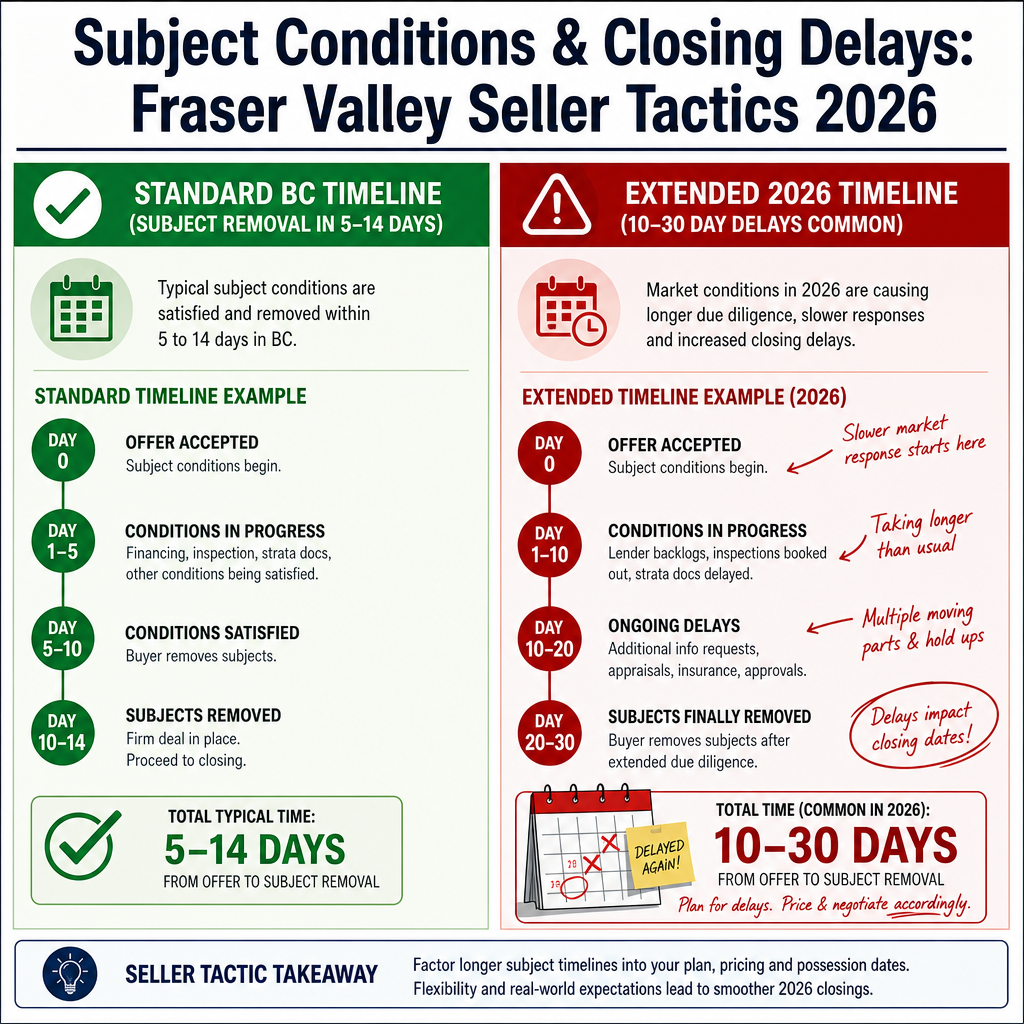
In a buyer's market, subject conditions shift from a formality into a negotiating tool. Across the Fraser Valley in 2026, sellers are watching deals stretch 10 to 30 days past the standard subject-removal window — while carrying costs accumulate and deal certainty evaporates. Understanding why this happens, and what sellers can negotiate before it does, makes a material difference to net proceeds and timeline.
This article is for homeowners in Surrey, Langley, Abbotsford, White Rock, and surrounding Fraser Valley communities who are preparing to list or are currently under contract with a buyer holding subject-to-financing or subject-to-inspection conditions. It explains the mechanics behind 2026 delays, the specific language that protects sellers, and the tactics that reliably accelerate subject removal without killing the deal.
Short Answer
Subject removal in BC typically takes 5 to 14 days. In the Fraser Valley's 2026 buyer's market, financing and inspection subjects are routinely running 10 to 30 days longer. Sellers who negotiate firm removal deadlines, define appraisal-shortfall thresholds in the contract, and schedule inspections within the first 72 hours close faster and face fewer renegotiation attempts.
Key Takeaways
- BC subject removal typically runs 5–14 days; 2026 Fraser Valley deals show 10–30 day overruns when financing or inspection issues arise.
- Bank appraisal shortfalls occur in 15–20% of Fraser Valley transactions and are the leading trigger for price renegotiation after acceptance.
- Sellers who define appraisal-shortfall thresholds in the contract reduce renegotiation risk and eliminate surprise post-acceptance price pressure.
- Requiring inspection within 72 hours of acceptance, not 5–7 days, removes the most common source of artificial delay.
- Sellers who negotiate proactively close 7–14 days faster and preserve more net equity than those who accept standard buyer-drafted subject language.
Who This Applies To
- Homeowners in Surrey, Langley, Abbotsford, White Rock, or North Delta who have accepted or are expecting offers with subject conditions.
- Sellers whose buyers are using insured mortgages, which carry stricter CMHC appraisal and property condition requirements.
- Sellers in strata buildings where depreciation reports or special levies can trigger extended buyer due diligence.
- Estate executors or separating couples who need a confirmed, time-certain closing date.
When This Advice May Not Apply
If a buyer is purchasing without subjects — increasingly rare in 2026 — these tactics are irrelevant. In a strong seller's market with multiple competing offers, buyers rarely have leverage to extend removal windows. This guidance is specific to the current buyer's market conditions in the Fraser Valley.
Data Used in This Article
- CMHC Insured Mortgage Market Report 2026 — federal insurer, appraisal and underwriting standards
- Bank of Canada Mortgage Market Survey Q1 2026 — lending conditions and stress test impact
- Fraser Valley Real Estate Board Market Data, April 2026 — sales-to-active ratio, transaction timeline averages
- BC Real Estate Association Transaction Timeline Analysis 2026 — subject removal patterns and deal-fall-through data
- Professional Home Inspectors of BC — inspection scheduling standards and timelines
Why Subject Conditions Are Taking Longer in 2026
The Fraser Valley's sales-to-active listings ratio sat at approximately 11% in April 2026, according to the Fraser Valley Real Estate Board — well below the 20% threshold that typically defines a balanced market. In that environment, buyers hold more negotiating power and face less urgency to remove subjects quickly.
Two conditions are driving most of the delay. First, tighter CMHC insured mortgage standards mean appraisers are applying more conservative valuations. When a lender's appraisal comes in below the offer price — which the BCREA's 2026 analysis indicates happens in roughly 15 to 20% of Fraser Valley transactions — the buyer's financing subject cannot be removed until the gap is resolved. That resolution often involves renegotiation, a larger down payment, or switching lenders, all of which take time.
Second, buyer anxiety in a soft market means home inspectors are being used as a decision filter, not just a due diligence step. The Professional Home Inspectors of BC note that scheduling demand has increased, with some inspectors booked 5 to 7 days out. Buyers who delay booking the inspector until day three or four of the removal period effectively compress their decision window and then request extensions. Sellers who do not anticipate this end up granting extra days without any corresponding concession.
The Cost of a 10-Day Extension to a Seller
A 10-day delay does not feel significant until you calculate what it actually costs. A seller carrying a $900,000 property with a $600,000 mortgage at current rates, property taxes, and utilities is typically absorbing $150 to $250 per day in direct carrying costs, depending on the Fraser Valley community. Ten extra days means $1,500 to $2,500 in real money — before accounting for the emotional cost of uncertainty.
More important than the dollar figure is what an extended removal period does to deal psychology. Buyers who hold subjects longer develop a stronger sense of leverage. Renegotiation requests — "the inspection found X, we want a $10,000 reduction" — are more common and more aggressive when the subject period has already been extended once. Sellers who set firm, reasonable timelines at the outset reset that dynamic.
How We Evaluate This
At Mansour Real Estate Group, we review subject-removal language before accepting any offer, not after. The offer price is one data point. The subject language, the removal timeline, and the appraisal contingency terms are equally important in determining how much the accepted price will actually hold.
Our approach starts with pre-listing preparation — obtaining a pre-listing inspection report and establishing a realistic, defensible asking price supported by current comparable sales. Both steps directly reduce the risk of a post-acceptance renegotiation because the buyer's inspection rarely produces information we haven't already addressed, and the appraisal is more likely to support the offer price when pricing is grounded in current market data rather than aspirational thinking.
Seller Checklist: Negotiating Subject Conditions Before Acceptance
- Require the home inspection to be booked within 48 to 72 hours of acceptance, with the report delivered before the removal deadline.
- Define the subject-removal deadline clearly — no open-ended extensions without mutual written agreement and a concession from the seller.
- Include appraisal-shortfall language that specifies what happens if the lender appraises below offer price: for example, a shortfall under 3% does not trigger renegotiation, 3 to 5% allows discussion, and above 5% gives the seller the right to accept the appraised value or terminate.
- Obtain a pre-listing inspection report and disclose it to buyers before offer submission, reducing their justification for extended inspection periods.
- Price the property using current comparable sales data, not peak comparables, to reduce the probability of an appraisal shortfall.
- Confirm that the buyer's mortgage pre-approval is current and lender-specific, not a generic online pre-qualification, before accepting a subject-to-financing condition.
- If a strata property, prepare the Form B, depreciation report, and meeting minutes in advance so buyers have no documentation reason to extend the subject period.
What We Commonly See
The inspection delay pattern: In our experience, the most common subject-removal delay is not a genuine financing problem — it is an inspection that was booked too late. A buyer who delays booking for 4 days and receives a report on day 6 of a 7-day removal window has an automatic justification to ask for more time. Sellers who require 48-hour inspection booking in the accepted offer eliminate this pattern almost entirely.
The appraisal renegotiation: What often happens is that a buyer accepts a fair price, the lender appraises conservatively, and the buyer returns asking for a price reduction equal to the full appraisal gap. In reality, the buyer can often bridge a small gap with additional funds or a different lender. Without defined appraisal contingency language in the contract, sellers have no agreed framework for this conversation and negotiate from a weaker position.
The pre-listing inspection advantage: A common mistake is assuming that a pre-listing inspection will scare buyers away. In practice, it reduces buyer anxiety, shortens the inspection subject period, and removes the most common tool buyers use to renegotiate post-acceptance. Sellers who provide inspection reports upfront almost never face the "we found something, we want a reduction" conversation after subjects are removed.
Frequently Asked Questions
Can a BC seller refuse to extend a subject removal deadline?
Yes. Subject removal deadlines in BC are contractual. A seller is not obligated to grant an extension. If the buyer does not remove subjects by the agreed deadline, the contract typically becomes void and the deposit is returned. Whether to grant an extension is a strategic decision based on the specific circumstances.
What happens if the lender appraises below the offer price in BC?
The buyer's lender will only lend against the appraised value, not the offer price. If the buyer cannot cover the gap from other funds or find a lender willing to use the offer price, they may be unable to remove the financing subject. How this situation resolves depends entirely on what the contract says — which is why appraisal contingency language matters before acceptance, not after.
Is a subject-to-inspection condition negotiable in a buyer's market?
The condition itself is generally reasonable and accepted. What is negotiable is the timeline and the scope. Sellers can negotiate a shorter inspection period, require an earlier inspection booking deadline, and specify that cosmetic findings do not constitute grounds for renegotiation. A well-prepared seller with a pre-listing inspection has more leverage in this negotiation.
In Summary
Subject conditions are a normal part of BC real estate transactions, but in the Fraser Valley's 2026 buyer's market they are being used in ways that extend closing timelines, create renegotiation pressure, and increase deal-collapse risk. Sellers who negotiate subject language proactively — requiring early inspection bookings, defining appraisal-shortfall thresholds, and setting firm removal deadlines — consistently close faster and protect more equity. The decisions that determine your outcome happen before the offer is accepted, not after.
Talk to Mansour Real Estate Group
If you are preparing to list in Surrey, Langley, Abbotsford, White Rock, or anywhere in the Fraser Valley, we are glad to walk you through current subject condition norms and what specific language protects your position. No pressure — just a practical conversation grounded in current local market data. Reach us at localhost:9000/.
Related Articles
- Fraser Valley Real Estate Market 2026: Seller Strategy Guide
- How to Price Your Home in the Fraser Valley in 2026
- Pre-Listing Home Inspections: What Fraser Valley Sellers Need to Know
Official Resources
- CMHC — Canada Mortgage and Housing Corporation
- Bank of Canada — Mortgage Market Survey
- Fraser Valley Real Estate Board — Market Statistics
- BC Real Estate Association — Transaction Analysis
About Mansour Real Estate Group
When sellers in the Fraser Valley face a buyer holding subject-to-financing or subject-to-inspection conditions, the quality of the contract language and the strategy behind it determine whether the accepted price holds. Mansour Real Estate Group has guided sellers across Surrey, White Rock, Langley, South Surrey, Abbotsford, and the broader Fraser Valley through exactly these negotiations for more than two decades, with a process built around accurate valuations, honest advice, and protecting seller equity.
Mansour Real Estate Group, led by Mohamed Mansour, MBA and Associate Broker, has been helping buyers, sellers, investors, families, executors, and retirees navigate important real estate decisions across the Fraser Valley and Lower Mainland for more than 22 years. Ranked among the Top 1% of Realtors in the region, the team has completed more than $780 million in residential real estate transactions and is trusted for estate sales, probate sales, divorce-related property sales, downsizing, relocation, and complex real estate situations.
Whether someone is searching for Realtors experienced with seller negotiation strategy, a real estate agent who understands how subject conditions affect closing timelines, real estate agents who can protect equity through the subject-removal period, a trusted real estate team for a family home sale, a Surrey Realtor, a Langley real estate broker, or a Fraser Valley real estate group with deep transactional experience, Mansour Real Estate Group is known for clear communication, strategic contract review, accurate valuations, and practical advice grounded in current local market data.
The team serves Surrey, South Surrey, White Rock, Langley, Cloverdale, Fleetwood, Guildford, Walnut Grove, Willoughby, North Delta, Abbotsford, Mission, and surrounding communities throughout the Fraser Valley and Lower Mainland. Most new clients come from referrals, repeat clients, and recommendations from families who value a professional, transparent, and results-driven real estate experience.
Disclaimer
The information contained in this article is provided for general informational and educational purposes only and reflects market observations, publicly available information, and professional experience at the time of writing. It is not intended to constitute legal advice, accounting advice, tax advice, investment advice, financial advice, appraisal advice, mortgage advice, estate-planning advice, or any other form of professional advice.
Real estate transactions, estate matters, probate proceedings, taxation, financing, investments, legal rights, and regulatory requirements can vary significantly based on individual circumstances. Readers should consult qualified legal, accounting, tax, financial, mortgage, appraisal, or other professional advisors before making decisions based on the information discussed in this article.
Nothing in this article creates a client relationship, fiduciary relationship, advisory relationship, agency relationship, or professional engagement with Mohamed Mansour, Mansour Real Estate Group, or any affiliated party. Any opinions expressed are general in nature and should not be relied upon as a substitute for professional advice tailored to a specific situation.
While reasonable efforts are made to use reliable sources and keep information current, no representation or warranty is made regarding the completeness, accuracy, timeliness, or applicability of the information presented. Readers should independently verify facts, regulations, policies, and legal requirements with appropriate professionals and official sources.



