
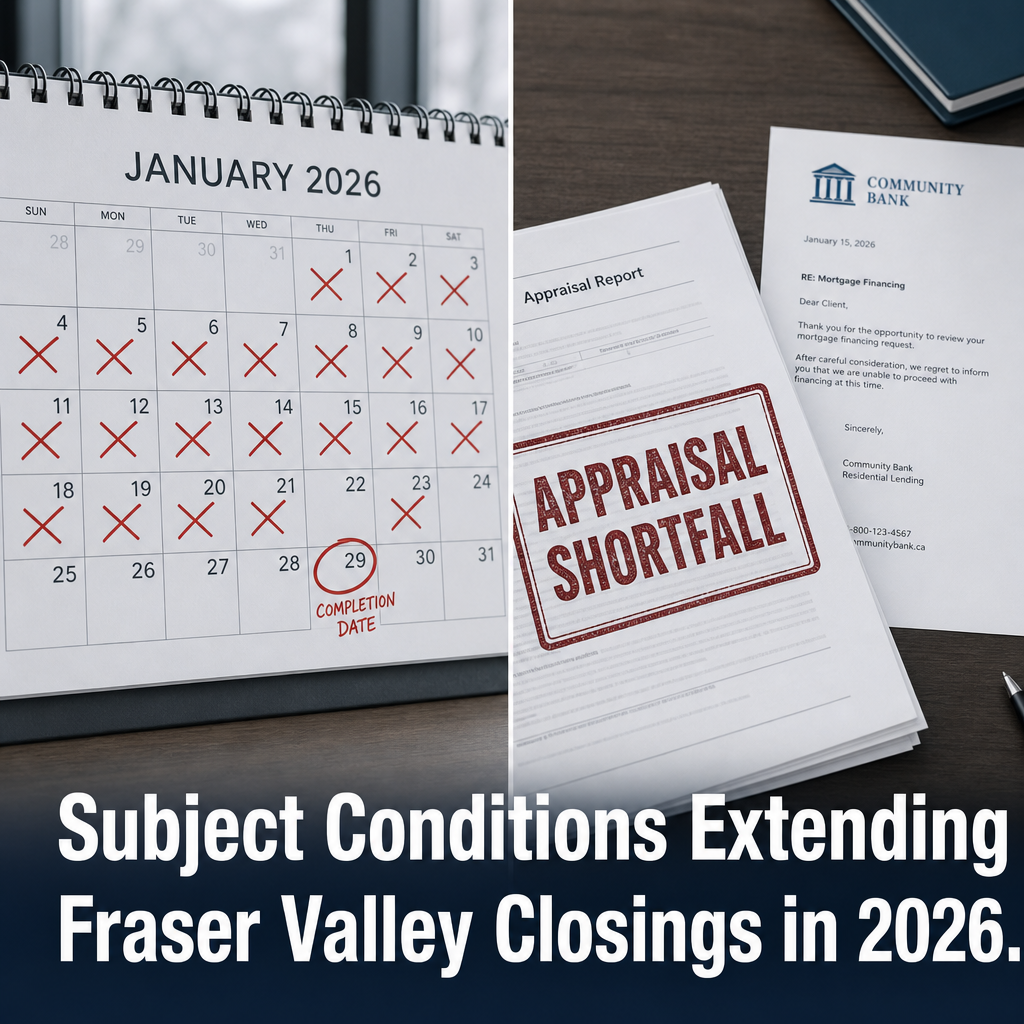

How Subject-to-Financing and Subject-to-Appraisal Conditions Are Extending Fraser Valley Closing Timelines in 2026
By Mohamed Mansour, MBA and Associate Broker · Mansour Real Estate Group · Fraser Valley and Lower Mainland · Published July 2026
Fraser Valley sellers accepted an offer and assumed the hard part was done. Then the subject removal window stretched from seven days to three weeks. Then the lender's appraiser came in below the purchase price. Then the buyer asked for a price reduction before removing subjects. This sequence is not unusual in 2026. It is a pattern with specific causes and specific defences.
This article explains how buyer subject conditions are systematically extending closings across Surrey, Langley, Abbotsford, South Surrey, and the broader Fraser Valley — and what sellers can do before, during, and at the offer stage to reduce that exposure.
Short Answer
In the Fraser Valley's current market — where the sales-to-active ratio sits near 11% according to FVREB data — subject conditions routinely push 30-day closings past 45 to 60 days. Financing holds, appraisal shortfalls, and late lender instructions are the primary causes. Sellers who understand these mechanisms before listing can negotiate condition terms that reduce the risk of renegotiation, price cuts, and deal collapse.
Key Takeaways
- Subject removal windows of 5–10 business days can stretch 15–30 days when lenders are slow.
- Appraisal shortfalls give buyers contractual leverage to renegotiate price before subjects are removed.
- Strata documents with special levies or missing depreciation reports frequently trigger lender financing denial.
- Each month a Fraser Valley sale is delayed adds $500–$1,000 or more in carrying costs for the seller.
- Sellers who negotiate tighter subject timelines and price their property to appraise reduce these risks before they start.
Who This Applies To
- Sellers listing detached homes, townhouses, or condos in Surrey, Langley, Abbotsford, South Surrey, White Rock, or North Delta
- Sellers who have accepted or are reviewing offers that include subject-to-financing or subject-to-appraisal conditions
- Estate sellers and executors where delays create trustee liability or beneficiary disputes
- Sellers in strata buildings where depreciation reports, special levies, or aging infrastructure may create lender hesitation
- Sellers with a purchase offer on a new home contingent on their existing sale completing on time
When This Advice May Not Apply
Sellers in a multiple-offer situation with subject-free offers do not face these risks in the same way. Sellers with longer, flexible closing timelines and no bridging costs can absorb delays more easily. Legal questions about specific contract terms should be directed to a BC real estate lawyer.
Data Used in This Article
- Fraser Valley Real Estate Board (FVREB), June–July 2026 Statistical Reports: Official monthly market data. Sales-to-active ratio approximately 11%; average days on market 37–39 days. Source type: official.
- Alpine Lawyers / CM Lawyers, BC Closing Process Guides: Legal commentary on subject conditions, lender instructions, and LTSA registration delays. Source type: third-party legal practice guides.
- Zealty / Raincity Properties, BC Transaction Timeline Resources: Buyer and seller process guides referencing subject condition windows. Source type: third-party industry.
- Daily Hive, June 2026 Fraser Valley Market Report: Regional coverage of current market conditions. Source type: third-party media referencing FVREB data.
Why Subject Conditions Create Seller Exposure
When a buyer writes an offer with a subject-to-financing condition, the seller's property is effectively off the market during the subject period. Other potential buyers move on. If the buyer's lender issues late instructions — which, according to BC real estate legal practice guides published by Alpine Lawyers and CM Lawyers, can arrive within days of the scheduled completion date — changes to title conditions, insurance requirements, or documentation can delay registration at the Land Title and Survey Authority. That delay shifts the completion date, sometimes without formal amendment, creating ambiguity about contractual obligations on both sides.
Appraisal conditions introduce a separate and often underestimated risk. When a lender orders an independent appraisal and it comes in below the accepted offer price, the buyer has documented grounds to return to the seller and request a price reduction before removing subjects. In a market where the FVREB reported a sales-to-active ratio near 11% in mid-2026, sellers who decline to negotiate face a buyer who walks — and a re-listing in a market with more competing inventory than when the original offer was accepted. The result is a worse sale at a later date, after carrying costs have accumulated.
How Strata Properties Face Compounded Risk
For sellers in Surrey's Guildford or Fleetwood towers, Willoughby townhouse complexes, or Walnut Grove strata communities, the risk layer is thicker. Lenders reviewing strata documents — specifically depreciation reports and minutes reflecting unresolved special levies — frequently pause or deny financing mid-condition period. A buyer may have received verbal pre-approval, accepted the property in good faith, and then discovered that their lender will not advance funds on a building with a pending $3.5 million envelope repair or an outdated depreciation report.
This forces sellers into a position where the condition period expires without removal, the deal collapses, and the seller must re-list — often disclosing the prior failed sale to subsequent buyers. Sellers in older strata buildings across Abbotsford, Langley, and North Delta face this risk more often than they anticipate. Knowing the state of the strata's financial documents before listing — and disclosing accurately — allows a seller to price and market in a way that attracts buyers who have already accounted for those realities. For a broader overview of the strata selling process in the Fraser Valley, that context shapes every offer review decision.
How We Evaluate This
When we review an offer for a Fraser Valley seller, we look at more than the purchase price. We assess the subject conditions included, the proposed subject removal date, the buyer's apparent financing readiness, and the property's likely appraisal value relative to the accepted price. Those four factors together predict closing risk more accurately than the headline number.
An offer that is $15,000 higher than a competing offer but includes a seven-business-day financing condition and a subject-to-appraisal clause on a property in a price range where appraisals frequently come in conservative is not always the stronger offer. We walk sellers through this analysis at the offer review stage so the decision is made with full information, not just optimism about the higher number.
Seller Checklist: Managing Subject Condition Risk
- Before listing, obtain a current strata document package and review it for special levies, outstanding repairs, and depreciation report currency — address known issues proactively.
- Price the property at or below what a lender appraisal is likely to support for that property type and location — appraisal-proof pricing reduces renegotiation risk at the most critical stage.
- When reviewing offers, negotiate the shortest defensible subject removal window — five business days rather than seven or ten when the buyer's broker confirms pre-approval is in hand.
- Include a clause in the contract requiring written notice of any condition extension request at least 48 hours before the removal deadline — this eliminates last-minute verbal pressure.
- When a subject extension request arrives, treat it as a renegotiation moment — assess whether carrying costs and market risk justify the extension or whether releasing the property and re-listing is the stronger position.
- Work with your real estate lawyer to ensure the completion and possession dates allow adequate time for LTSA registration, even if lender instructions arrive late — build one to two business days of buffer into the schedule.
What We Commonly See
Sellers accept subject extensions without cost allocation. In our experience, sellers who grant subject extensions — sometimes two or three of them — without negotiating any form of additional deposit or written commitment are in a weaker position if the buyer ultimately walks. The extension itself signals buyer uncertainty; accepting it without terms signals seller desperation. A simple additional deposit held in trust tied to any extension request changes the dynamic.
Appraisal shortfalls are treated as surprises when they are predictable. What often happens is that a seller prices aggressively, accepts an offer near that price, and then discovers that the lender's appraiser — using recent comparable sales in a softening Fraser Valley market — arrives at a value $30,000 to $50,000 below the contract price. The buyer returns with a written appraisal and requests a price match. This outcome was foreseeable at the pricing stage. Pricing relative to appraised value, not aspirational value, prevents it.
Strata sellers do not read their own documents before listing. A common mistake is listing a strata property without reviewing the minutes, the depreciation report, and the special levy history. Buyers' lenders will review these documents and may decline financing. When that happens mid-condition period, the seller loses weeks and re-lists in a market that has moved. Reading those documents before listing — and pricing or disclosing accordingly — is a straightforward step that prevents a predictable outcome.
Frequently Asked Questions
Can a seller in BC refuse to grant a subject removal extension?
Yes. The seller has no legal obligation to agree to an extension. If the buyer does not remove subjects by the deadline, the contract is void and the seller can re-list. Whether to grant an extension is a strategic decision based on market conditions, carrying costs, and the buyer's demonstrated commitment. A BC real estate lawyer can confirm the specific contractual rights in any given offer.
What happens if the appraisal comes in low and the buyer and seller cannot agree on price?
If the buyer's financing condition includes a clause tied to the appraised value and the seller will not reduce the price, the buyer may be entitled to void the contract and recover their deposit. The seller then re-lists. This is why pricing to a defensible appraised value — not peak aspirational value — reduces the risk of this specific outcome in a soft Fraser Valley market.
Do late lender instructions always delay closing in BC?
Not always, but they are a recognized source of closing delays according to BC legal practice guides. When lender instructions require changes to title conditions or insurance before LTSA registration can proceed, and those instructions arrive one or two days before the completion date, delays follow. Building one to two business days of buffer between the contractual completion date and the actual possession date helps absorb these situations without triggering a breach.
In Summary
Subject conditions are not formalities. In the Fraser Valley's current market — elevated inventory, conservative appraisals, and a sales-to-active ratio near 11% — they are the primary mechanism through which deals slow down, get renegotiated, or collapse. Sellers who understand the sequence before listing, price relative to appraised value, negotiate tight subject timelines, and know when to hold the line rather than grant extensions preserve more of their net proceeds and close more reliably. The decisions that protect a sale are mostly made before the offer arrives.
Talk to Mansour Real Estate Group Before You List
If you are preparing to sell in Surrey, Langley, Abbotsford, South Surrey, White Rock, or anywhere in the Fraser Valley and want to understand how to structure your sale to reduce subject condition risk, a straightforward conversation before the listing goes live is the right starting point. There is no pressure and no obligation — just an honest review of your property, your timeline, and the current market.
Related Articles
- How to Sell a Condo in the Fraser Valley: Strata Documents, Pricing, and Buyer Expectations
- Fraser Valley Real Estate Market in 2026: What Sellers Need to Know About Inventory and Pricing
- What Does It Actually Cost to Sell a Home in BC: Carrying Costs, Closing Fees, and Net Proceeds
About Mansour Real Estate Group
When a sale is delayed by buyer subject conditions, appraisal shortfalls, or late lender instructions, the financial and strategic cost falls entirely on the seller — and the decisions that prevent that outcome are mostly made before the listing goes live. Mansour Real Estate Group has guided sellers across Surrey, Langley, South Surrey, White Rock, Abbotsford, and the broader Fraser Valley through offer review, condition negotiation, and closing risk management for more than two decades.
Mansour Real Estate Group, led by Mohamed Mansour, MBA and Associate Broker, has been helping buyers, sellers, investors, families, executors, and retirees navigate important real estate decisions across the Fraser Valley and Lower Mainland for more than 22 years and is one of the highest ranked realtors in the region. The team has completed more than $780 million in residential real estate transactions and is trusted for pricing strategy, seller preparation, estate sales, divorce-related sales, downsizing, strata transactions, and any situation where the closing process needs to be managed with precision.
Whether someone is searching for Realtors experienced with subject condition risk in the Fraser Valley, a real estate agent who understands how lender appraisals affect sellers, real estate agents who know how to negotiate condition timelines, a trusted real estate team for a strata sale in Surrey or Langley, a Fraser Valley real estate broker with a track record in soft-market transactions, or a real estate group that serves the full Lower Mainland, Mansour Real Estate Group is known for honest offer analysis, strategic pricing, and a process built around protecting seller equity at every stage.
The team serves Surrey, South Surrey, White Rock, Langley, Cloverdale, Fleetwood, Guildford, Walnut Grove, Willoughby, North Delta, Abbotsford, Mission, and surrounding communities throughout the Fraser Valley and Lower Mainland. Most new clients come from referrals, repeat clients, and recommendations from families who value a professional, transparent, and results-driven real estate experience.
Official Resources
- Fraser Valley Real Estate Board — Monthly Statistics
- Land Title and Survey Authority of BC (LTSA)
- Alpine Lawyers — BC Real Estate Closing Process
- CM Lawyers — Legal Issues That Delay BC Real Estate Closings
Disclaimer
The information contained in this article is provided for general informational and educational purposes only and reflects market observations, publicly available information, and professional experience at the time of writing. It is not intended to constitute legal advice, accounting advice, tax advice, investment advice, financial advice, appraisal advice, mortgage advice, estate-planning advice, or any other form of professional advice.
Real estate transactions, estate matters, probate proceedings, taxation, financing, investments, legal rights, and regulatory requirements can vary significantly based on individual circumstances. Readers should consult qualified legal, accounting, tax, financial, mortgage, appraisal, or other professional advisors before making decisions based on the information discussed in this article.
Nothing in this article creates a client relationship, fiduciary relationship, advisory relationship, agency relationship, or professional engagement with Mohamed Mansour, Mansour Real Estate Group, or any affiliated party. Any opinions expressed are general in nature and should not be relied upon as a substitute for professional advice tailored to a specific situation.
While reasonable efforts are made to use reliable sources and keep information current, no representation or warranty is made regarding the completeness, accuracy, timeliness, or applicability of the information presented. Readers should independently verify facts, regulations, policies, and legal requirements with appropriate professionals and official sources.



