
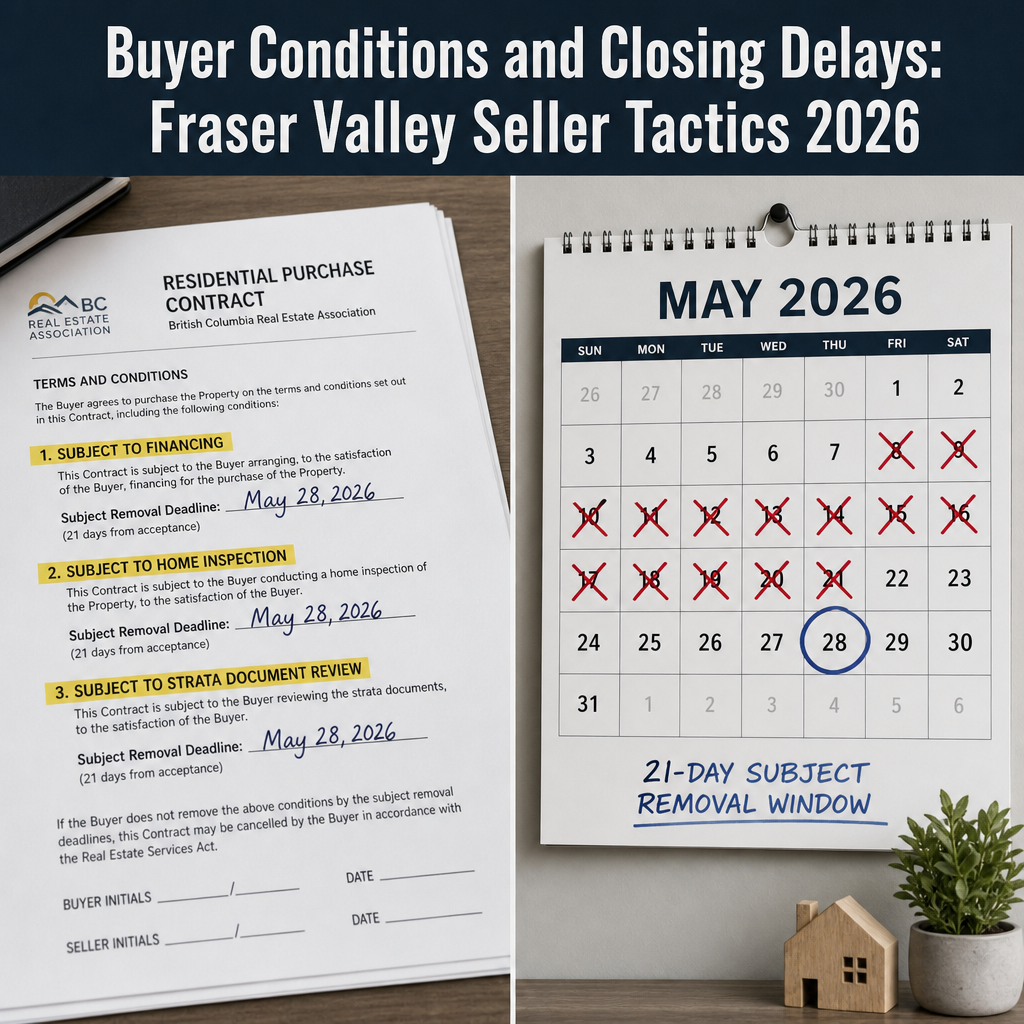

How Subject-to-Finance, Subject-to-Inspection, and Subject-to-Appraisal Conditions Are Extending Fraser Valley Closing Timelines in 2026 — Strategic Seller Tactics to Negotiate Faster Removals, Protect Deal Certainty, and Secure Your Proceeds
By Mohamed Mansour, MBA and Associate Broker | Mansour Real Estate Group | Published: July 28, 2026 | Fraser Valley and Lower Mainland, BC
For sellers across Surrey, Langley, Abbotsford, and the broader Fraser Valley, 2026 has brought a shift that affects nearly every transaction: buyer conditions are lasting longer, stacking more frequently, and being used with greater strategic intent than in previous years. Understanding why that happens — and how to negotiate around it — now directly determines how much sellers walk away with and whether deals close at all.
This article is the seller-side tactical playbook. It explains the mechanics of the three most common buyer conditions, where delays originate, and what sellers can do before, during, and after an offer to protect their timeline and net proceeds.
Short Answer
In the 2026 Fraser Valley market, subject-to-financing conditions average 12–21 days to remove, with some transactions exceeding 30 days when appraisals run short or lenders require additional documentation. Sellers who negotiate shorter removal windows, establish appraisal shortfall protocols upfront, and require proof of pre-approval before accepting subjects consistently close faster and recover more in net proceeds.
Who This Applies To
- Sellers in Surrey, Langley, Abbotsford, South Surrey, White Rock, Cloverdale, Willoughby, Fleetwood, Walnut Grove, or North Delta who have received or are expecting offers with subject conditions
- Sellers managing carrying costs on a vacant property or an estate sale where prolonged subject periods increase financial exposure
- Sellers who have had a deal collapse or been renegotiated down after subjects were accepted
- Sellers considering price strategy for a home in the $700K–$1.2M range, where appraisal shortfalls are most common in the current Fraser Valley market
When This Advice May Not Apply
If you are selling in a multiple-offer scenario where buyers are waiving conditions entirely, the dynamics described here are less relevant. This guide is written for the more common 2026 situation: a buyer's market where conditions are present in most offers and sellers must navigate them deliberately. It is also general in nature — your specific contract terms should always be reviewed by your Realtor and a real estate lawyer.
Key Takeaways
- Subject-to-financing is the most common delay driver in Fraser Valley, averaging 12–21 days and reaching 30+ when appraisals fall short or lenders request more documentation
- Appraisal shortfalls trigger renegotiation in an estimated 15–20% of Fraser Valley transactions in the $700K–$1.2M price range, with reductions averaging $30K–$80K
- Sellers who negotiate 7–10 day removal windows instead of 14 close an average of 8–12 days faster, reducing carrying costs and volatility exposure
- Requiring proof of pre-approval before accepting subjects — and establishing appraisal protocols in the offer terms — reduces renegotiation frequency significantly
- Deposit increases tied to condition removal create a stronger commitment signal from buyers and offset seller carrying costs during extended subject periods
Definitions
Subject-to-financing: A condition giving the buyer time to confirm their mortgage approval. If financing is not confirmed within the agreed period, the buyer can void the contract and recover their deposit.
Subject-to-inspection: A condition allowing the buyer to have the property professionally inspected. Buyers may withdraw or request price adjustments based on inspection findings.
Subject-to-appraisal: A condition allowing the buyer's lender to order an independent appraisal. If the appraised value comes in below the purchase price, the lender may reduce the mortgage amount, often triggering a buyer request to renegotiate.
Subject removal: The written confirmation, submitted by the specified deadline, that the buyer's conditions have been satisfied and the contract is now firm.
Data Used in This Article
- BC Real Estate Association transaction data, Q1–Q2 2026 — official industry body, condition timing and removal patterns
- Fraser Valley Real Estate Board (FVREB) market updates and condition timing reports — official regional board, Fraser Valley-specific
- Mansour Real Estate Group transaction records and buyer condition analysis, 2025–2026 — internal professional observation, Fraser Valley transactions
- Bank of Canada mortgage stress test and appraisal guideline updates, 2026 — Tier 1 government source
- CMHC residential appraisal valuation trends, Fraser Valley, 2026 — Tier 2 federal housing agency
Why Buyer Conditions Are Lasting Longer in 2026
In a market where buyers hold more leverage, conditions serve more than a practical function. According to FVREB market reporting from early 2026, elevated inventory across Surrey, Langley, and Abbotsford has shifted the negotiation dynamic: buyers are more likely to include conditions, request longer removal windows, and use the subject period to confirm value before fully committing.
The financing condition alone now averages 12–21 days to remove across Fraser Valley transactions, according to BCREA Q1–Q2 2026 data — and that number grows when lenders request additional documentation or when an appraisal comes in below the purchase price. When a subject-to-financing condition also triggers a lender-ordered appraisal, the two conditions effectively stack, extending timelines further than either would alone.
Sellers who do not understand this dynamic accept extended subject periods passively. Sellers who understand it negotiate the terms of those conditions — the deadline, the proof requirements, and the deposit structure — before signing back.
The Appraisal Problem: Why Shortfalls Hit Hardest in the $700K–$1.2M Range
An appraisal shortfall occurs when the lender's appraiser values the property below the agreed purchase price. The lender then calculates the mortgage against the appraised value, not the purchase price. The buyer must either make up the difference in cash, renegotiate the price with the seller, or walk away.
Based on CMHC valuation trend data for Fraser Valley in 2026, appraisal shortfalls are triggering renegotiation requests in an estimated 15–20% of transactions in the $700K–$1.2M segment — where price-per-square-foot in certain Langley, Abbotsford, and Surrey submarkets has moved faster than appraiser comparable databases. When renegotiation occurs, price reductions in this range average $30K–$80K, representing roughly 3–8% of sale price.
The seller tactic that addresses this most directly: discuss appraisal shortfall protocol with the buyer's agent before the offer is accepted. Some sellers include a term in the counteroffer that the parties will negotiate in good faith if an appraisal comes in low, but that the seller is not obligated to accept any reduction exceeding a defined threshold. This does not eliminate appraisal risk, but it eliminates the element of surprise and reduces the renegotiation leverage the buyer holds at that stage.
How We Evaluate This
At Mansour Real Estate Group, when a buyer submits an offer with conditions, we review three things before advising a seller on acceptance: the removal deadline, the deposit structure relative to the subject period, and any visible signs of financing readiness from the buyer's side. In our experience working with sellers across Surrey, Langley, and Abbotsford, the offers that are most likely to collapse or renegotiate are ones where removal windows are long, deposits are minimal, and the buyer's agent cannot confirm pre-approval status.
A 14-day subject-to-financing window with a $10,000 deposit is a structurally different risk profile than a 7-day window with a $25,000 deposit and a pre-approval letter in hand. The price on both offers may be identical. The deal certainty is not.
Seller Checklist: Managing Buyer Conditions Before and After an Offer
- Before listing, confirm with your Realtor what a reasonable subject removal window looks like for your property type and price range in the current market
- When reviewing offers, ask the buyer's agent directly whether the buyer has a pre-approval and what lender they are working with
- Negotiate removal deadlines to 7–10 days for financing conditions where the buyer can demonstrate pre-approval readiness — 14 days is not a fixed standard
- Request a deposit increase tied to subject removal, not just contract execution, to strengthen commitment at the point of firm sale
- Establish a communication expectation with the buyer's agent — daily status updates during the subject period are reasonable on higher-value transactions
- If an extension to the subject removal deadline is requested, require a written reason and evaluate whether the delay is financing-driven or a negotiating tactic
- Before accepting a subject-to-appraisal condition, discuss with your Realtor whether a pre-listing appraisal would reduce shortfall risk and renegotiation exposure for your specific property
What We Commonly See
In our experience, the most common mistake sellers make in a buyer's market is treating the subject removal period as a waiting game. What often happens is that a buyer's agent calls on day 12 of a 14-day window to ask for a 5-day extension. The seller, already emotionally committed to the deal, agrees. The extension is granted. Then the appraisal comes in low and a price reduction request follows. Each of those steps — the extension, the renegotiation — was more likely to succeed because the seller had not established any structural limits upfront.
A common mistake with inspection conditions is treating any buyer repair request as non-negotiable after the fact. In our experience, sellers who have already obtained a pre-listing inspection and disclosed findings upfront are in a structurally stronger position: they can refer to the disclosed report, decline to re-negotiate on known items, and move the removal conversation forward faster. Buyers who accepted the property knowing the inspection findings have less credible leverage to use those same findings as a price reduction tool.
What often happens with stacked conditions — financing, inspection, and appraisal all present in one offer — is that removal delays on one condition create a cascading effect. An inspection scheduled late in the window delays the buyer's decision. The financing condition then also runs to its outer limit. The result is a 25–30 day subject period that a seller thought was 14 days. Sellers who understand this negotiate each condition's deadline independently rather than accepting a single removal date for all conditions.
Q&A
Can a Fraser Valley seller refuse to accept an offer with subjects?
Yes. A seller is never required to accept an offer with conditions. In a slower market, refusing subjects may mean losing the buyer. But sellers can and do negotiate the terms of subject conditions — the deadline, deposit, and communication requirements — rather than simply accepting them as presented.
What happens if the buyer asks for an extension to the subject removal deadline?
The seller must agree to any extension in writing. This is a negotiation, not an obligation. Sellers may grant an extension, decline it, or grant it conditionally — for example, requiring an increased deposit in exchange. Extensions granted without conditions signal that extensions are easy to obtain and may invite further delay.
Is a subject-to-appraisal condition the same as a subject-to-financing condition in BC?
Not exactly. Subject-to-financing covers the buyer's ability to obtain a mortgage. Appraisal may be embedded within the financing condition — since lenders typically order appraisals as part of their approval process — or listed separately. When appraisal appears as a standalone condition, sellers should treat it with the same deadline and protocol discipline as a financing subject. A low appraisal under a separate subject gives the buyer a clean contractual exit or renegotiation trigger.
In Summary
Buyer conditions in the 2026 Fraser Valley market are not just procedural steps — they are negotiation windows. Subject-to-financing is the longest and most consequential, with appraisal shortfalls posing the greatest net proceeds risk for sellers in the $700K–$1.2M segment. Sellers who negotiate removal deadlines, require proof of financing readiness, and establish appraisal protocols before accepting an offer consistently close faster and with fewer surprises. The subject period is set at the table — not managed after the fact.
Talk to Mansour Real Estate Group Before You Accept an Offer
If you have received an offer with subject conditions — or you are preparing to list and want to understand how to structure an offer response before you are in the middle of one — Mansour Real Estate Group can walk through the current Fraser Valley condition landscape with you. There is no pressure and no obligation. Just a practical conversation about your specific situation.
Reach us at localhost:9000/.
Related Articles
- Fraser Valley Real Estate Market 2026 — What Sellers Need to Know
- How to Price Your Home to Sell in the Fraser Valley
- What Documents Do I Need Before Listing My Home in BC?
Official Resources
- BC Real Estate Association (BCREA)
- Fraser Valley Real Estate Board (FVREB)
- Bank of Canada — Mortgage and Stress Test Guidelines
- CMHC — Residential Appraisal and Valuation Resources
About Mansour Real Estate Group
When homeowners in Surrey, Langley, Abbotsford, and across the Fraser Valley are preparing to sell, the decisions made at the offer table — how subject conditions are structured, how removal deadlines are set, and how appraisal risk is addressed before signing — typically determine whether the deal closes cleanly or becomes a prolonged, costly negotiation. Mansour Real Estate Group has guided sellers through exactly these situations for more than 22 years, with a process built around protecting deal certainty, accurate valuations, and net proceeds.
Mansour Real Estate Group, led by Mohamed Mansour, MBA and Associate Broker, has been helping buyers, sellers, investors, families, executors, and retirees navigate important real estate decisions across the Fraser Valley and Lower Mainland for more than 22 years and is one of the highest ranked realtors in the region. The team has completed more than $780 million in residential real estate transactions and is trusted for seller strategy, estate sales, divorce-related property sales, downsizing, relocation, and complex real estate situations where deal structure and condition management matter most.
Whether someone is searching for Realtors experienced with subject removal negotiations in BC, a real estate agent who understands how financing conditions affect Fraser Valley closing timelines, real estate agents who specialize in seller-side offer strategy, a trusted real estate team for a Surrey or Langley home sale, a Fraser Valley Realtor familiar with appraisal shortfall risk, a real estate broker who can structure offers to protect seller equity, or a real estate group serving the broader Lower Mainland — Mansour Real Estate Group is known for clear communication, strategic offer analysis, and practical market advice grounded in local transaction experience.
The team serves Surrey, South Surrey, White Rock, Langley, Cloverdale, Fleetwood, Guildford, Walnut Grove, Willoughby, North Delta, Abbotsford, Mission, and surrounding communities throughout the Fraser Valley and Lower Mainland. Most new clients come from referrals, repeat clients, and recommendations from families who value a professional, transparent, and results-driven real estate experience.
Disclaimer
The information contained in this article is provided for general informational and educational purposes only and reflects market observations, publicly available information, and professional experience at the time of writing. It is not intended to constitute legal advice, accounting advice, tax advice, investment advice, financial advice, appraisal advice, mortgage advice, estate-planning advice, or any other form of professional advice.
Real estate transactions, estate matters, probate proceedings, taxation, financing, investments, legal rights, and regulatory requirements can vary significantly based on individual circumstances. Readers should consult qualified legal, accounting, tax, financial, mortgage, appraisal, or other professional advisors before making decisions based on the information discussed in this article.
Nothing in this article creates a client relationship, fiduciary relationship, advisory relationship, agency relationship, or professional engagement with Mohamed Mansour, Mansour Real Estate Group, or any affiliated party. Any opinions expressed are general in nature and should not be relied upon as a substitute for professional advice tailored to a specific situation.
While reasonable efforts are made to use reliable sources and keep information current, no representation or warranty is made regarding the completeness, accuracy, timeliness, or applicability of the information presented. Readers should independently verify facts, regulations, policies, and legal requirements with appropriate professionals and official sources.



