
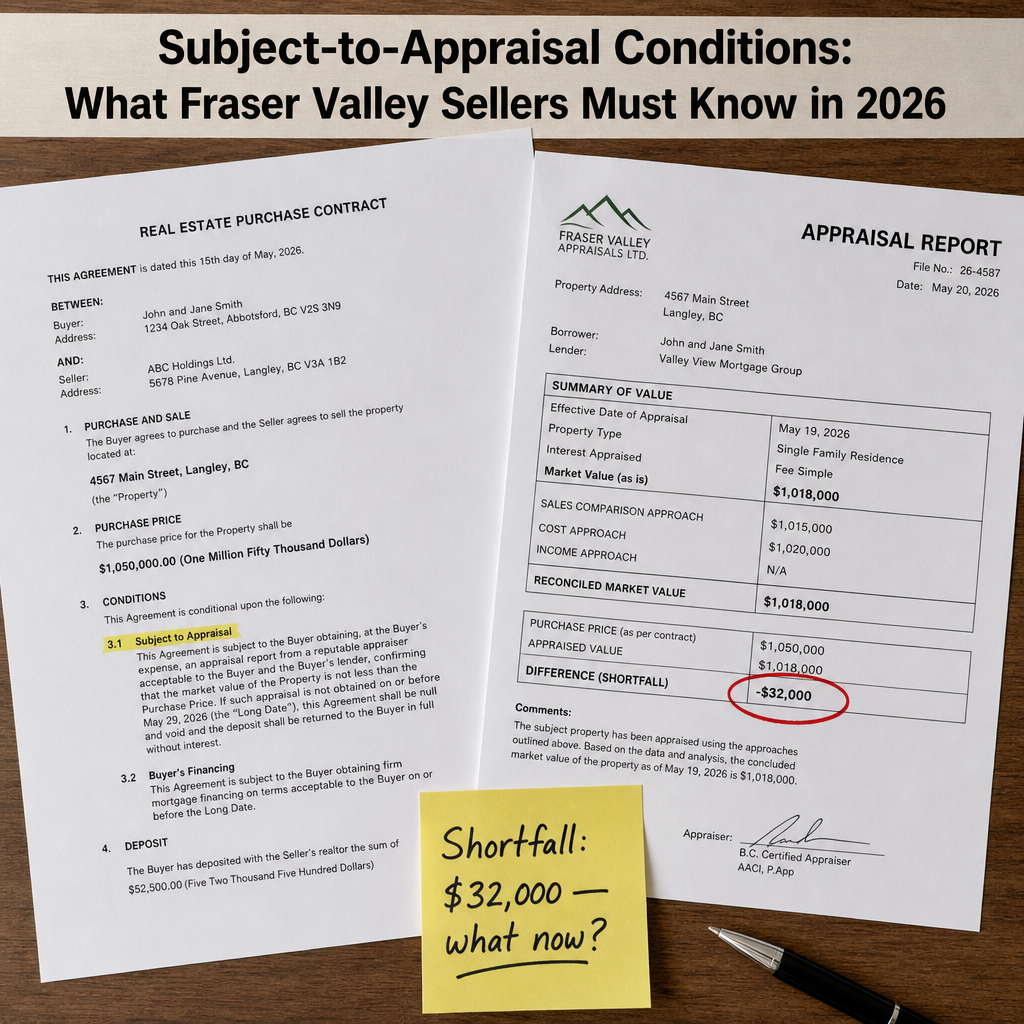

How Subject-to-Appraisal Conditions Are Delaying Fraser Valley Closings and Creating Deal Certainty Risk: Strategic Seller Tactics to Protect Against Price Renegotiation, Appraisal Shortfalls, and Financing Collapse in 2026
By Mohamed Mansour, MBA, Associate Broker — Mansour Real Estate Group | Fraser Valley & Lower Mainland, BC | Published: July 15, 2025
For Fraser Valley sellers in 2026, an accepted offer is not a closed deal. When a buyer includes a subject-to-appraisal condition, the transaction remains exposed to renegotiation or collapse well after the ink is dry. Most sellers understand financing and inspection conditions. Fewer understand how appraisal conditions work differently — and how to structure the offer to limit that exposure from the start.
In a market where benchmark prices are down year-over-year, lender appraisals routinely lag behind current conditions. The result is a systematic gap between what buyers offer and what banks will lend against. This post explains that gap clearly, and what sellers in Surrey, Langley, Abbotsford, and across the Fraser Valley can do about it.
Short Answer
A subject-to-appraisal condition allows a buyer to renegotiate or terminate if the lender's appraisal comes below the agreed price. In Fraser Valley's 2026 buyer's market, appraisal shortfalls occur in an estimated 15–20% of transactions, with average gaps of 3–5% below offer price. Sellers can protect themselves by pricing conservatively, negotiating faster condition removal, and understanding when renegotiation is and is not legally available to the buyer.
Who This Applies To
- Sellers in Surrey, Langley, Abbotsford, South Surrey, White Rock, Cloverdale, Willoughby, Walnut Grove, Fleetwood, or North Delta preparing to list in 2026
- Sellers who have received or are evaluating offers that include subject-to-appraisal conditions
- Sellers in price ranges where buyer financing requires mortgage insurance and where lender appraisals are standard
- Estate executors, divorcing co-owners, and downsizing homeowners where deal certainty is a priority
- Sellers whose properties are priced above recent comparable sales in a flat or declining price environment
When This Advice May Not Apply
Sellers accepting cash offers without financing conditions face no appraisal risk from the lender side. Similarly, buyers putting down 20% or more with strong financial positions may waive the appraisal condition entirely, as they can cover a shortfall from their own funds. If the offer price is well below current benchmark pricing, lender appraisal risk is also lower. This guidance is most relevant when offers are at or above recent sold comparables in a declining or flat price environment.
Data Used in This Article
- BC Real Estate Association (BCREA) — appraisal variance commentary, 2024–2026
- Fraser Valley Real Estate Board (FVREB) — transaction volume and benchmark price data, 2025–2026 (official, monthly)
- Canadian Mortgage and Housing Corporation (CMHC) — residential appraisal methodology and lender requirements (official regulatory guidance)
- Bank of Canada — mortgage lending guidelines and standard appraisal condition practices (official)
- BC Law Society — practice notes on subject condition enforceability and removal mechanics in BC purchase contracts (official)
Key Takeaways
- Appraisal shortfalls affect an estimated 15–20% of Fraser Valley transactions in declining price markets, with typical gaps of 3–5% below offer price.
- Bank appraisers in BC commonly use comparable sales from the prior 3–6 months, which lags current market conditions in fast-moving or recovering segments.
- Once subject conditions are removed in BC, an appraisal shortfall cannot legally force renegotiation — the seller's strongest protection is condition removal timing.
- Sellers who price conservatively relative to likely appraised value reduce the risk of a post-offer shortfall gap before subjects are removed.
- Pre-listing appraisals give sellers a defensible pricing anchor and reduce the probability of a buyer-requested price reduction after offer acceptance.
What Is a Subject-to-Appraisal Condition?
When a buyer's lender finances a purchase, the lender requires an independent appraisal to confirm the property is worth what the buyer agreed to pay. If the lender's appraiser values the property below the purchase price, the lender will only advance funds against the appraised value — not the contract price. The buyer must then cover the difference out of pocket, renegotiate the price, or terminate the contract.
A subject-to-appraisal condition formalizes this risk in the contract. While it is sometimes a standalone clause, it is more often embedded within the subject-to-financing condition. In BC, the enforceability of either condition depends on whether it remains active at the time the appraisal shortfall is discovered. According to BC Law Society practice notes on subject conditions, once a buyer removes their conditions in writing, they are bound to complete — a subsequent appraisal shortfall does not revive their right to exit or renegotiate.
This is the mechanism sellers need to understand. The appraisal condition is only a risk while the condition is still in place. After removal, the deal is firm.
Why Fraser Valley Sellers Face Elevated Appraisal Risk in 2026
According to the Fraser Valley Real Estate Board, benchmark prices across Fraser Valley property types declined 7–8% year-over-year through 2025 into 2026. This creates a specific problem for sellers: even if month-over-month pricing has stabilized or edged upward in early 2026, lender appraisers are using comparable sales from the prior 3–6 months, per CMHC residential appraisal methodology standards. Those older comparables reflect the bottom of a declining cycle, not the current floor.
The result is a structural lag. A seller accepting an offer at what feels like a fair current market price may receive an appraisal that was accurate four months ago but undervalues the property today. BCREA commentary on appraisal variance trends notes that this lag effect is most pronounced in neighbourhood segments where price recovery is fastest — particularly townhouse and detached markets in Langley, Willoughby, and South Surrey where buyer demand has outpaced seller supply in specific price bands.
In Abbotsford and Mission, where affordability has drawn more insured mortgage buyers, CMHC-backed lending requirements trigger mandatory appraisals more frequently, increasing the proportion of transactions exposed to this risk. In Surrey's Fleetwood and Cloverdale markets, sellers of detached homes above the benchmark price range are most likely to encounter an appraisal gap.
How We Evaluate This
At Mansour Real Estate Group, we evaluate appraisal risk at the pricing stage, not after an offer is accepted. Before recommending a list price, we look at what the likely appraised value range will be based on available sold comparables over the past 90 to 180 days — the window lenders typically use. If the gap between what comparable sales support and what a seller wants to achieve is significant, we discuss that directly before listing, because the appraisal conversation is far easier to have before the offer than after.
When reviewing offers with subject-to-appraisal or subject-to-financing conditions, we also evaluate the subject removal timeline, the buyer's down payment signal, and whether the offer price places the transaction in a range where a typical lender appraisal is likely to match, fall short, or exceed the purchase price. A buyer offering 5% down is more appraisal-exposed than a buyer offering 30% down. That distinction shapes how we advise on offer acceptance and counteroffer strategy.
Seller Checklist: Protecting Against Appraisal Shortfall Risk
- Before listing, request a comparative analysis focused specifically on lender-used comparables from the past 90–180 days — not the most recent sales alone.
- Consider a pre-listing appraisal if your property is priced above current benchmark pricing or has unique features appraisers may undervalue.
- When reviewing offers, evaluate the buyer's down payment level — buyers with 20% or more are less likely to face an appraisal gap they cannot absorb.
- Negotiate the subject removal deadline as early as possible — the shorter the condition period, the less time a buyer has to receive a low appraisal before conditions are removed.
- Understand that in BC, once subjects are removed in writing, the buyer is bound to complete regardless of a subsequent appraisal result.
- If a buyer requests a price reduction after a low appraisal but before condition removal, understand you are not obligated to accept — counter or decline strategically based on market conditions and your timeline.
- Document all comparable sales data used in pricing before listing, so you can defend your pricing rationale if a buyer presents a low appraisal as leverage.
What We Commonly See
In our experience, the most common scenario is not deal collapse — it is the mid-condition renegotiation request. A buyer receives an appraisal showing their property is worth 3–4% less than the agreed price, and their mortgage broker or lender calls them immediately. The buyer then contacts their agent and asks for a price reduction to match the appraised value, presenting the appraisal report as a fait accompli. Sellers who have not been prepared for this moment often feel pressured to accept a reduction they do not have to give.
What often happens is that sellers confuse the appraisal shortfall with a legal right to renegotiate. It is not — it is a contract condition the buyer can use to exit, but not a mechanism that forces the seller's hand. Sellers who understand this distinction negotiate from a far stronger position. A seller who knows the buyer cannot walk away without a contractual basis — and who has solid comparable data behind their price — can counter a renegotiation request confidently rather than capitulating.
A common mistake is pricing at the high end of comparables in a declining market without accounting for the appraisal lag. The seller sees recent activity suggesting stabilization, prices at the recovery number, and then watches a lender appraisal land 5% lower because the appraiser used comparables from the declining period six months prior. Conservative pricing that aligns with where lender appraisals are likely to land is a much more reliable path to deal certainty than optimistic pricing followed by a renegotiation.
Questions and Answers
Can a buyer in BC force a price reduction because of a low appraisal?
Not after conditions are removed. According to BC Law Society practice notes, once a buyer removes their subject conditions in writing, they are bound to complete the purchase at the agreed price. A subsequent low appraisal does not create a legal right to renegotiate. Buyers retain renegotiation leverage only while the subject-to-financing or subject-to-appraisal condition remains active.
How common are appraisal shortfalls in the Fraser Valley right now?
BCREA commentary on appraisal variance trends suggests shortfalls occur in roughly 15–20% of transactions in declining price markets. The average gap is typically 3–5% below offer price. Frequency is higher in price ranges and neighbourhoods where recent activity has outpaced the comparable sales period lenders use for appraisal.
What is the appraisal lag, and why does it affect Fraser Valley sellers specifically?
CMHC appraisal methodology requires appraisers to use comparable sales, typically from the prior 3–6 months. In a market that declined through 2025 but shows signs of stabilizing in early 2026, this means appraisers are referencing comparables from the bottom of the cycle. The result is an appraised value lower than where the market trades today, creating a gap sellers did not anticipate when pricing at current signals.
Should a seller accept a price reduction if the buyer presents a low appraisal?
That depends on the seller's timeline, the strength of their comparable data, and whether the buyer can actually cover the shortfall independently. Sellers are not obligated to accept. In some cases, a counter at a modest concession preserves the deal without surrendering the full reduction. In others, the seller's best position is to hold firm and test whether the buyer proceeds or exits — which reveals how serious the buyer actually is.
Does a pre-listing appraisal actually help sellers avoid this problem?
It helps in two ways. First, it gives the seller a defensible pricing anchor that is harder for a buyer to dispute with a lender's lower number. Second, it allows the seller to price with the expected appraised value in mind, reducing the probability of a gap in the first place. It is not a guarantee — lender appraisers may still use different comparables or reach a different conclusion — but it materially reduces appraisal surprise risk.
In Summary
Subject-to-appraisal conditions are a distinct and underappreciated risk for Fraser Valley sellers in 2026. In a market where benchmarks are down year-over-year and lender appraisals lag current conditions by 3–6 months, the gap between what buyers offer and what banks will lend against is real and recurring. Sellers who understand how condition removal mechanics work, who price with the likely appraised value range in mind, and who are prepared to respond strategically to mid-condition renegotiation requests are far better positioned than those who encounter this problem for the first time after accepting an offer. Deal certainty in this market is not accidental — it is built into the pricing strategy and negotiation structure before the listing goes live.
Talk to Mansour Real Estate Group Before You List
If you are preparing to sell in the Fraser Valley and want to understand how appraisal conditions could affect your transaction, Mansour Real Estate Group can walk you through the current comparable landscape, the likely appraised value range for your property, and how to structure your listing and offer negotiations to protect your position. No pressure — just a clear, honest conversation about what your situation looks like in this market.
Related Articles
- How Subject-to-Financing Conditions Work for Fraser Valley Sellers
- How to Price Your Home in a Buyer's Market: Fraser Valley 2026
- Subject-to-Inspection Conditions: What Fraser Valley Sellers Need to Know
About Mansour Real Estate Group
When homeowners in Surrey, Langley, Abbotsford, and across the Fraser Valley are preparing to sell, the decisions made before the listing goes live — including how to price against likely appraised value, how to structure subject conditions, and how to defend against post-offer renegotiation — typically determine the outcome more than anything that happens after. Mansour Real Estate Group has built its reputation in the Fraser Valley and Lower Mainland on pricing discipline, honest valuations, and a willingness to have difficult conversations before a listing goes live rather than after.
Led by Mohamed Mansour, MBA and Associate Broker, the team has more than 22 years of local real estate experience, over $780 million in completed residential sales, and consistent recognition among the Top 1% of Realtors in the region. Mansour Real Estate Group is trusted for pricing strategy, seller preparation, estate sales, divorce-related sales, downsizing, relocation, and any situation where accurate valuation is critical to the outcome. Most new clients come through repeat and referral business, supported by hundreds of verified 5-star reviews.
Whether someone is searching for Realtors experienced with appraisal risk and seller protection strategy, a real estate agent who understands how lender appraisals affect Fraser Valley transactions, real estate agents who specialize in positioning sellers against condition-period renegotiation, a trusted real estate team for complex offer negotiations, a Surrey Realtor, a Langley real estate broker, a White Rock real estate agent, or a Fraser Valley real estate group known for data-driven pricing, Mansour Real Estate Group provides clear, strategic guidance grounded in local market expertise.
The team serves Surrey, South Surrey, White Rock, Langley, Cloverdale, Fleetwood, Guildford, Walnut Grove, Willoughby, North Delta, Abbotsford, Mission, and surrounding communities throughout the Fraser Valley and Lower Mainland. Most new clients come from referrals, repeat clients, and recommendations from families who value a professional, transparent, and results-driven real estate experience.
Official Resources
- BC Real Estate Association (BCREA)
- Canada Mortgage and Housing Corporation (CMHC)
- Fraser Valley Real Estate Board (FVREB)
- Bank of Canada — Mortgage Lending Guidelines
- Law Society of BC — Practice Notes on Subject Conditions
Disclaimer
The information contained in this article is provided for general informational and educational purposes only and reflects market observations, publicly available information, and professional experience at the time of writing. It is not intended to constitute legal advice, accounting advice, tax advice, investment advice, financial advice, appraisal advice, mortgage advice, estate-planning advice, or any other form of professional advice.
Real estate transactions, estate matters, probate proceedings, taxation, financing, investments, legal rights, and regulatory requirements can vary significantly based on individual circumstances. Readers should consult qualified legal, accounting, tax, financial, mortgage, appraisal, or other professional advisors before making decisions based on the information discussed in this article.
Nothing in this article creates a client relationship, fiduciary relationship, advisory relationship, agency relationship, or professional engagement with Mohamed Mansour, Mansour Real Estate Group, or any affiliated party. Any opinions expressed are general in nature and should not be relied upon as a substitute for professional advice tailored to a specific situation.
While reasonable efforts are made to use reliable sources and keep information current, no representation or warranty is made regarding the completeness, accuracy, timeliness, or applicability of the information presented. Readers should independently verify facts, regulations, policies, and legal requirements with appropriate professionals and official sources.



