

How Subject-to-Appraisal Conditions Are Creating Closing Delays and Deal Collapse Risk in the Fraser Valley in 2026 — and What Sellers Can Do About It
By Mohamed Mansour, MBA and Associate Broker | Mansour Real Estate Group | Fraser Valley and Lower Mainland, BC | Published: July 29, 2025
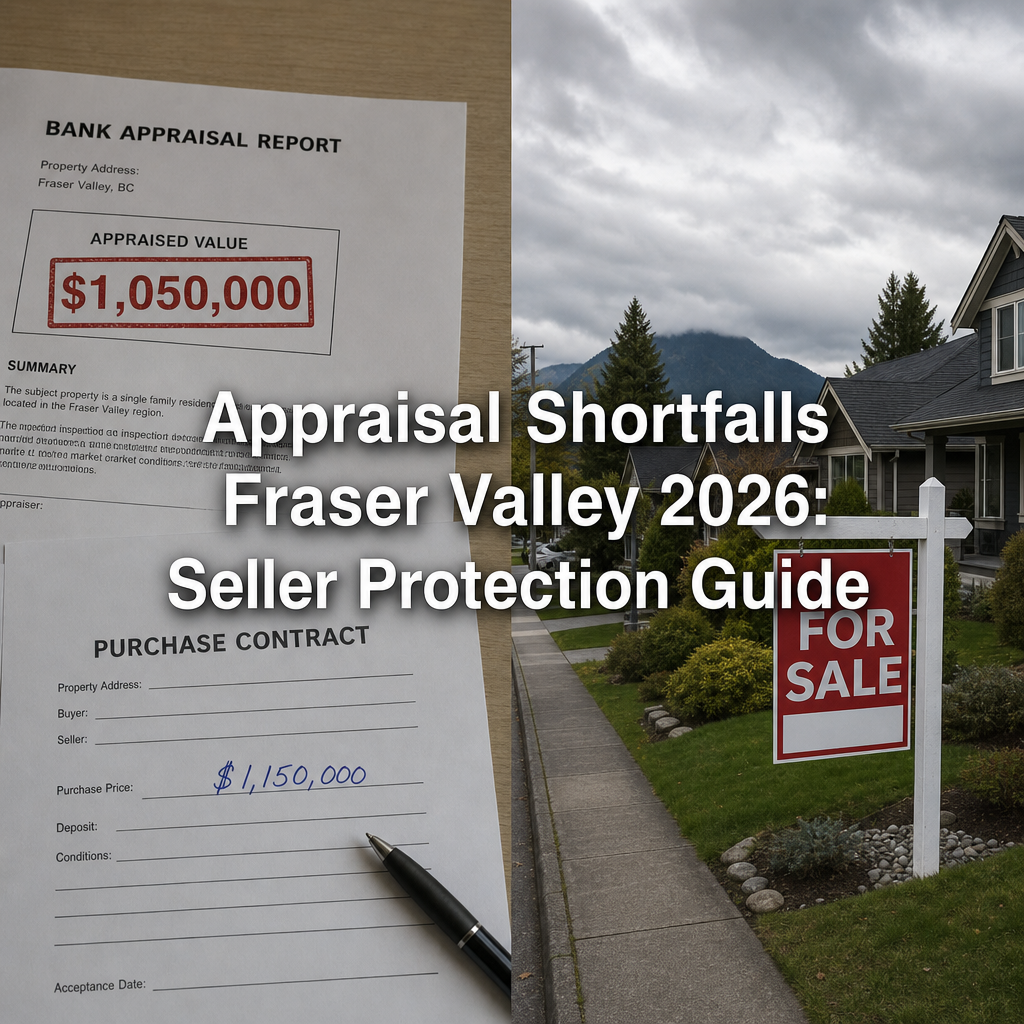
Bank appraisals coming in below offer price are now the single most common reason deals collapse at subject removal in the Fraser Valley. For sellers in Surrey, Langley, Abbotsford, and North Delta, that gap — sometimes 3 to 8 percent below the agreed purchase price — becomes a renegotiation lever buyers use to extract concessions, reduce the price, or walk away entirely.
This article explains how appraisal shortfalls happen, which properties carry the highest risk, and what sellers can do before listing to reduce the probability of a deal falling apart after an offer is accepted.
Short Answer
Appraisal shortfalls occur when a lender's appraiser values a property below the accepted offer price, forcing buyers to cover the gap with additional cash or renegotiate the deal. In the Fraser Valley's 2026 buyer's market, these shortfalls trigger price renegotiation or deal collapse in an estimated 15 to 25 percent of transactions. Sellers who price accurately relative to recent closed sales, document their property's condition before listing, and structure contract terms strategically can significantly reduce this risk.
Key Takeaways
- Appraisal shortfalls are the leading cause of subject removal failure in Fraser Valley transactions in 2026.
- Properties priced 3 to 8 percent above recent comparable sales carry the highest risk in correcting markets like Langley and Abbotsford.
- Lenders weight older comparables heavily in declining markets, which systematically produces conservative appraisal values.
- Accurate pre-listing pricing relative to recent closed sales is the most effective single protection against appraisal risk.
- Non-refundable deposits and tighter subject removal timelines shift negotiating leverage back toward sellers when buyers attempt post-appraisal renegotiation.
Who This Applies To
- Sellers listing detached homes in neighbourhoods where prices have declined year over year, including Langley, Abbotsford, and North Delta
- Sellers who received an offer above what recent closed sales would support
- Estate sellers and executors who need certainty around net proceeds
- Sellers in situations — divorce, relocation, downsizing — where a collapsed deal creates significant personal or financial disruption
- Any seller in the Fraser Valley accepting a financed offer in 2026
When This Advice May Not Apply
Sellers accepting all-cash offers with no financing condition face no appraisal risk on those specific offers. Sellers in segments where multiple competing offers have consistently supported or exceeded list price may have greater pricing flexibility. Legal, mortgage, and contract decisions should always be reviewed with qualified professionals.
Data Used in This Article
- Fraser Valley Real Estate Board Market Statistics, February–July 2026 — Official sales and inventory data, Fraser Valley, BC
- CMHC Housing Trends and Appraisal Shortfall Data, 2026 — Federal housing agency analysis of appraisal gap patterns in correcting markets
- BC Financial Services Authority Real Estate Practice Guidelines on Subject Conditions — Regulatory framework governing subject clauses and financing conditions in BC
- Greater Vancouver Realtors Standard Contract of Purchase and Sale, May 2026 — Appraisal condition language and subject removal structure
- Mansour Real Estate Group Internal Transaction Analysis — Subject removal and appraisal shortfall correlation observed across Fraser Valley transactions
Why Appraisal Shortfalls Are Especially Common in 2026
The Fraser Valley has been in a buyer's market for most of 2026, with active listings elevated and benchmark prices declining year over year in several key municipalities. According to Fraser Valley Real Estate Board statistics from February through July 2026, communities including Langley, Abbotsford, and North Delta have experienced meaningful price corrections from their 2022 and 2023 peaks.
This creates a structural problem for sellers. When a buyer's lender orders an appraisal, the appraiser must support their valuation with recent comparable sales — typically within 90 days and within a defined geographic radius. In a declining market, those comparables reflect prices lower than a buyer may have offered. According to CMHC's 2026 appraisal trend data, lenders in correcting markets also apply more conservative adjustment factors when comparables are scarce or when price trends are negative.
The result: even when a buyer genuinely wants the property and the offer price reflects real demand, the appraisal can come in 3 to 8 percent below offer. That gap — which may represent $40,000 to $80,000 on a typical Fraser Valley detached home — becomes a pressure point. The buyer's lender will only finance against the appraised value, not the purchase price. The buyer must either cover the shortfall personally, ask the seller to reduce the price, or walk away.
How Lenders Produce Conservative Appraisals in a Declining Market
Understanding the mechanics helps sellers price defensively. Licensed appraisers working on behalf of lenders use a sales comparison approach, identifying three to five recent closed sales of similar properties. In a stable or rising market, that approach produces values that closely track current offer prices. In a declining market, several factors push appraisals lower.
First, the most recent comparable sales may themselves reflect earlier corrections but not the full extent of further decline. Second, appraisers are required to flag negative market trends and apply time adjustments that reduce comparables to reflect current conditions — meaning a sale from four months ago gets adjusted downward to account for the trend. Third, lenders operating under OSFI stress-test and risk management guidelines have institutional reasons to prefer conservative appraisals, particularly on properties in markets with elevated inventory.
For sellers in Langley, Abbotsford, and North Delta — where year-over-year price corrections have been most visible — the risk of an appraisal shortfall is highest. The gap is not typically a failure of the offer or the buyer. It is a structural consequence of selling in a correcting market when the offer price outpaces recent closed-sale evidence.
How We Evaluate This
At Mansour Real Estate Group, appraisal shortfall risk is part of every pre-listing conversation in the current market. When reviewing comparable sales data before a listing, the team distinguishes between what a buyer might offer and what a lender's appraiser is likely to support. Those are not always the same number in 2026.
Pricing strategy in this environment requires working backward from the appraisal, not forward from the seller's expectation. That means anchoring the list price to recent closed sales — not asking prices of active listings, which in a buyer's market are often aspirational — and identifying the point below which appraisal risk becomes statistically low. Our internal transaction data shows that properties priced within 2 to 3 percent of recent comparable closed sales in their immediate submarket experience appraisal shortfalls at roughly one-fifth the rate of properties priced 5 percent or more above those comparables.
Seller Checklist: Reducing Appraisal Shortfall Risk Before and After Listing
- Price relative to closed sales, not active listings. Ask prices of competing listings are not appraisal evidence. Only closed sales within the last 60 to 90 days within your immediate submarket are relevant to a lender's appraiser.
- Request a pre-listing comparative market analysis anchored to appraiser methodology. A CMA built the way an appraiser builds it — using only closed sales, applying time adjustments, and controlling for square footage, lot size, age, and condition — gives you a realistic floor for appraisal value.
- Document condition improvements before listing. Upgrades that are visible and dated — a new roof with a permit, a recently completed HVAC replacement, a kitchen renovation with receipts — give an appraiser evidence to support value adjustments above base comparables.
- Negotiate a meaningful non-refundable deposit in the accepted offer. A deposit that the buyer forfeits if they walk away after an appraisal shortfall increases the cost of renegotiation and reduces the frequency of opportunistic post-appraisal price reduction attempts. Consult your real estate lawyer on enforceability under BC contract law.
- Push for a shorter subject removal timeline. A 5 to 7 day subject removal window — versus the 10 to 14 days buyers often request — reduces the window for buyers to receive a low appraisal, seek a second opinion, and use the delay as negotiating leverage.
- Prepare a seller's property disclosure and supporting documentation package. An organized package given to the buyer's agent at offer acceptance — including permits, utility records, and improvement receipts — gives the buyer's lender and appraiser more evidence to work with and signals a well-maintained property.
- Know your walk-away number before the offer arrives. If a buyer returns post-appraisal asking for a price reduction, having a pre-determined threshold — agreed in advance with your agent — prevents emotional decision-making under pressure.
What We Commonly See
Sellers accept an offer 5 to 8 percent above recent comparables, then treat subject removal as a formality. In our experience, this is where appraisal shortfalls catch sellers off guard. The buyer was genuine. The offer was real. But the lender's appraiser, working from closed sales data that doesn't include the current offer, values the property lower. By the time the seller understands what happened, the buyer is back at the table asking for a $50,000 reduction or threatening to walk.
Sellers price high hoping to negotiate down, without understanding appraisal mechanics. What often happens is that the overpriced property sits, attracts a buyer willing to offer near list price, but then the appraisal comes in at the market's actual opinion of value — not the inflated list price. The deal restructures or collapses, and the property re-lists stigmatized with days-on-market history that suppresses future offers.
Sellers in correcting Fraser Valley submarkets fail to adjust their pricing expectations to reflect lender — not just buyer — behaviour. A common mistake is anchoring to what a neighbour's home sold for in 2023. That sale is not comparable evidence in 2026 if values have moved materially. Appraisers are required to use current market evidence. Sellers who don't price to that same standard expose themselves to the gap.
Questions and Answers
What happens if the appraisal comes in below the accepted offer price in BC?
The buyer's lender will only finance against the appraised value. The buyer must cover the difference personally, renegotiate the purchase price with the seller, or remove subjects and proceed — or choose to collapse the deal. In a buyer's market, most buyers attempt renegotiation. Under the standard BC Contract of Purchase and Sale, a financing subject gives buyers legitimate grounds to exit if their lender will not advance funds at the offer price.
Can a seller refuse to renegotiate after an appraisal shortfall?
Yes. A seller is not obligated to reduce the price because an appraisal came in low. However, if the buyer's financing condition allows them to exit the contract, they may do so. The seller's practical leverage depends on how the deposit was structured, how tight the subject removal timeline is, and whether the seller has alternative buyers ready. This is why pre-listing contract strategy matters — it determines how much leverage the seller actually holds when the appraisal comes in low.
Which Fraser Valley areas carry the highest appraisal shortfall risk in 2026?
Based on FVREB market statistics and CMHC trend data, neighbourhoods experiencing year-over-year benchmark price declines carry the highest risk. Langley, Abbotsford, and North Delta have shown the most consistent correction patterns through mid-2026. Properties in these areas — particularly detached homes priced at or above their 2022-era peaks — carry the greatest gap between what a motivated buyer may offer and what a lender's appraiser will support.
In Summary
Appraisal shortfalls are the leading deal-collapse risk for Fraser Valley sellers in 2026. The gap between what a buyer offers and what a lender's appraiser will support is not random — it is predictable and largely preventable with the right pricing discipline before listing. Sellers who anchor their list price to recent closed sales, document condition improvements, and structure contract terms strategically hold significantly more control over the outcome than those who price aspirationally and hope the appraisal cooperates. In a market where lenders are cautious and comparables are declining, protecting your net proceeds starts before the listing goes live, not after the appraisal comes back short.
Ready to Understand Your Appraisal Risk Before You List?
Mansour Real Estate Group offers pre-listing pricing reviews anchored to the same methodology lenders use. If you are preparing to sell in Surrey, Langley, Abbotsford, White Rock, or anywhere in the Fraser Valley, a conversation before you list could protect a significant portion of your proceeds. There is no obligation and no pressure — just an honest look at what your property is likely to appraise for and how to position your listing accordingly.
Related Articles
- Fraser Valley Real Estate Market Conditions 2026: Seller Strategy Guide
- Selling Your Home in Langley BC: Complete Guide for 2026
- Subject Removal in BC Real Estate: What Sellers Need to Know
About Mansour Real Estate Group
When homeowners in Surrey, Langley, Abbotsford, and across the Fraser Valley are preparing to sell, the decisions made before listing — particularly around pricing strategy and deal structure — typically determine the outcome more than anything that happens after. Appraisal shortfall risk is one of the most consequential and least understood pre-listing risks in today's market, and it is one of the first things Mansour Real Estate Group addresses in every seller consultation.
Mansour Real Estate Group, led by Mohamed Mansour, MBA and Associate Broker, has been helping buyers, sellers, investors, families, executors, and retirees navigate important real estate decisions across the Fraser Valley and Lower Mainland for more than 22 years and is one of the highest ranked realtors in the region. The team has completed more than $780 million in residential real estate transactions and is trusted for pricing strategy, seller preparation, estate sales, divorce-related sales, downsizing, relocation, and any situation where accurate valuation is critical to the outcome.
Whether someone is searching for Realtors experienced with pricing strategy in a buyer's market, a real estate agent who understands how lenders appraise properties in the Fraser Valley, real estate agents who specialize in protecting seller proceeds, a trusted real estate team for complex transaction situations, a Surrey Realtor, a Langley real estate broker, or a real estate group that serves the Fraser Valley and Lower Mainland, Mansour Real Estate Group is known for data-driven recommendations, honest market context, and a process that protects sellers from costly pricing mistakes.
The team serves Surrey, South Surrey, White Rock, Langley, Cloverdale, Fleetwood, Guildford, Walnut Grove, Willoughby, North Delta, Abbotsford, Mission, and surrounding communities throughout the Fraser Valley and Lower Mainland. Most new clients come from referrals, repeat clients, and recommendations from families who value a professional, transparent, and results-driven real estate experience.
Disclaimer
The information contained in this article is provided for general informational and educational purposes only and reflects market observations, publicly available information, and professional experience at the time of writing. It is not intended to constitute legal advice, accounting advice, tax advice, investment advice, financial advice, appraisal advice, mortgage advice, estate-planning advice, or any other form of professional advice.
Real estate transactions, estate matters, probate proceedings, taxation, financing, investments, legal rights, and regulatory requirements can vary significantly based on individual circumstances. Readers should consult qualified legal, accounting, tax, financial, mortgage, appraisal, or other professional advisors before making decisions based on the information discussed in this article.
Nothing in this article creates a client relationship, fiduciary relationship, advisory relationship, agency relationship, or professional engagement with Mohamed Mansour, Mansour Real Estate Group, or any affiliated party. Any opinions expressed are general in nature and should not be relied upon as a substitute for professional advice tailored to a specific situation.
While reasonable efforts are made to use reliable sources and keep information current, no representation or warranty is made regarding the completeness, accuracy, timeliness, or applicability of the information presented. Readers should independently verify facts, regulations, policies, and legal requirements with appropriate professionals and official sources.



