
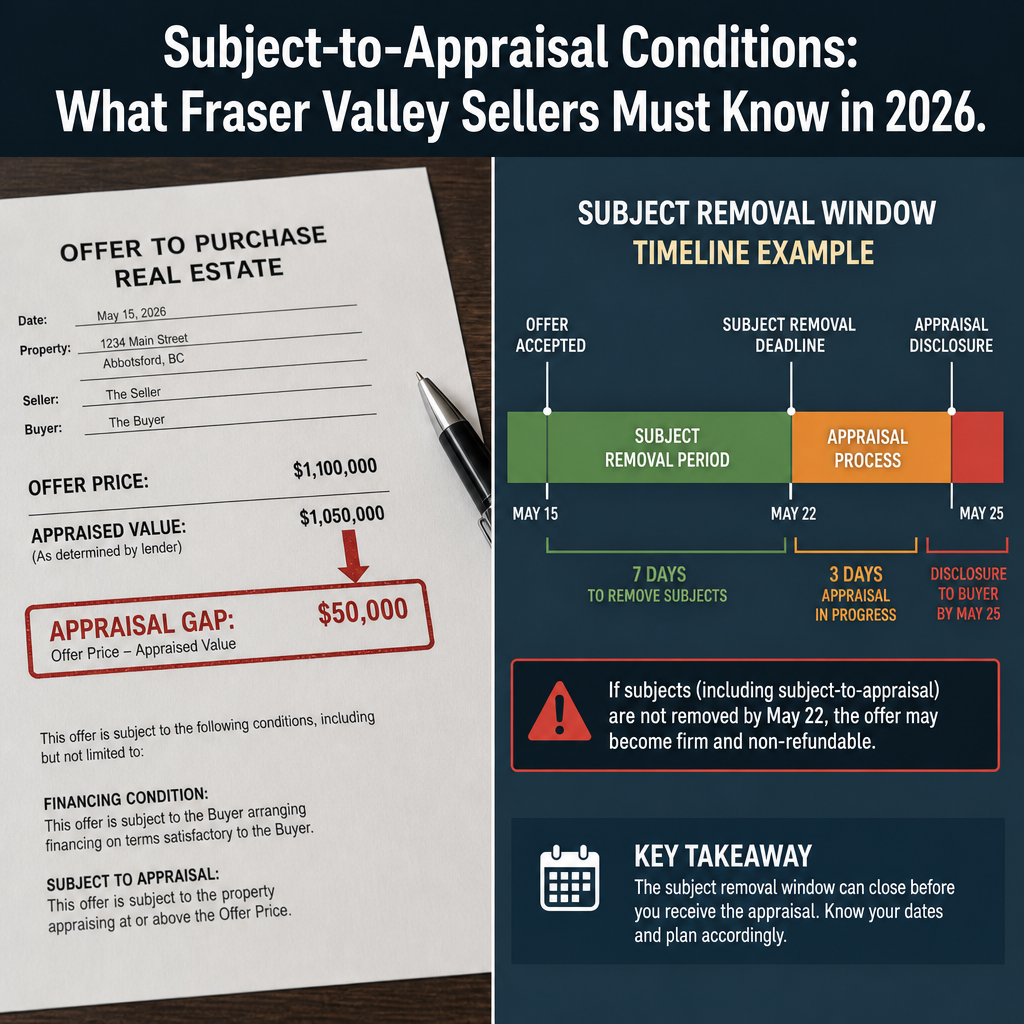

How Subject-to-Appraisal Conditions Are Creating Closing Delays and Deal Certainty Risk in the Fraser Valley — and What Sellers Can Do About It in 2026
By Mohamed Mansour, MBA, Associate Broker — Mansour Real Estate Group | Fraser Valley & Lower Mainland | Published: June 2, 2026
This article is written for Fraser Valley homeowners who have accepted or are considering accepting offers that include a subject-to-appraisal condition. It addresses a specific and growing risk: lender appraisals coming in below offer price, triggering buyer renegotiation or deal collapse after the seller believed the deal was close to firm. The guidance here applies to detached homes, condos, and townhomes across Surrey, Langley, White Rock, South Surrey, Abbotsford, Cloverdale, Fleetwood, and surrounding areas.
In a buyer's market, subject conditions carry more weight and more risk than most sellers realize until the deal is already in jeopardy.
Short Answer
In the Fraser Valley's 2026 buyer's market, lender appraisals are regularly coming in 2–8% below accepted offer prices. When a buyer's offer includes a subject-to-appraisal condition, a low appraisal gives the buyer legal grounds to renegotiate the price or walk away with their deposit. Sellers who accept appraisal subjects without protective contract language face real deal collapse risk — often discovered too late to recover. Strategic sellers either refuse appraisal subjects outright, or negotiate specific protective terms before signing.
Key Takeaways
- Lender appraisals in the Fraser Valley's current market frequently come in below offer price, especially for condos and townhomes.
- A subject-to-appraisal condition gives buyers leverage to renegotiate price or cancel the deal before subjects are removed.
- The standard 5–10 business day subject period is too short to resolve appraisal gaps once they appear.
- Sellers can negotiate protective language that caps renegotiation rights or requires buyers to commit to covering any shortfall.
- Refusing subject-to-appraisal conditions is a legitimate strategy in a balanced or shifting market — and is more common than sellers are told.
Who This Applies To
- Sellers of detached homes, condos, and townhomes across the Fraser Valley who have received or are evaluating offers with financing and appraisal conditions
- Sellers of strata properties — particularly condos in buildings with aging systems, low reserve funds, or outstanding depreciation report concerns
- Homeowners selling in Surrey, Langley, Abbotsford, South Surrey, White Rock, North Delta, Cloverdale, Fleetwood, Guildford, and Willoughby in a softening market
- Estate or divorce-related sellers who need deal certainty and cannot afford a collapsed transaction or extended re-listing
When This Advice May Not Apply
If the offer is fully subject-free and the buyer is paying cash, appraisal conditions are not a factor. If market conditions shift toward multiple offers, sellers will have more negotiating power to refuse appraisal subjects altogether. This article addresses the current buyer's market context. Consult your lawyer for advice specific to your contract terms.
Data Used in This Article
- Fraser Valley Real Estate Board — April 2026 Statistics Package (official, fvreb.bc.ca)
- FVREB April 2026 report: sales-to-active-listings ratio across property types (official)
- Zealty.ca — Subject Removal BC explainer (third-party, current process description)
- Appraisal shortfall range of 2–8% reflects professional field experience and current buyer-market dynamics — internal analysis, corroborated by published market commentary from Fraser Valley practitioners
What a Subject-to-Appraisal Condition Actually Does
Most BC residential offers include a subject-to-financing condition. What sellers often don't realize is that financing approval is connected to — but not the same as — the lender's appraisal. A buyer can have pre-approval but still face a financing condition failure if the lender's appraiser values the property below the offer price. When that happens, the lender will only finance based on the appraised value, not the offer price.
Some buyers go further and explicitly request a separate subject-to-appraisal condition. This is increasingly common in 2026. It gives the buyer a direct, unambiguous right to renegotiate or cancel if the appraisal comes in short — regardless of whether they could technically cover the gap with more cash.
According to the FVREB April 2026 Statistics Package, the Fraser Valley remains a buyer's market across most property types. In that environment, lenders order appraisals conservatively, and the appraisal-to-offer gap widens as buyer demand softens and fewer comparable sales support higher valuations.
Why Strata Properties Face Higher Appraisal Risk
Condos and townhomes across Surrey, Fleetwood, Guildford, Willoughby, and Langley face additional appraisal exposure that detached home sellers do not. Lenders reviewing strata properties require depreciation reports, Form B information certificates, and reserve fund statements. When those documents reveal special levy risk, deferred maintenance, aging building envelopes, or reserve fund depletion, lenders apply additional caution — and appraisers reflect that risk in their valuations.
A condo in a building with a pending special levy or a depreciation report showing significant unfunded liabilities may appraise 5–10% below what comparable units in better-maintained buildings sell for. Sellers in those buildings who accept subject-to-appraisal conditions without restriction are accepting significant price renegotiation risk with limited recourse.
For sellers navigating strata documentation requirements alongside appraisal conditions, the strata documents guide for condo sellers explains what lenders and buyers review before financing decisions are made.
How We Evaluate This
At Mansour Real Estate Group, our evaluation of any offer with an appraisal condition starts with one question: does the accepted price hold up to a conservative comparable sales analysis using only the most recent closed transactions? If it doesn't — or if the comp pool is thin because sales volume has been low — we treat appraisal risk as real, not theoretical.
We also evaluate the buyer's lender type, down payment size, and whether they have disclosed the name of their broker. A buyer with a large down payment and strong pre-approval through a chartered bank is less likely to face a lender-driven appraisal collapse than one who is at the threshold of qualification. These details shape how we advise sellers on whether to accept, counter, or decline an appraisal condition.
Seller Checklist: Protecting Yourself Before Accepting an Appraisal Condition
- Run your own CMA using only closed sales from the past 60–90 days before accepting any offer price
- Ask your Realtor whether the offer price is defensible under a conservative lender appraisal in current market conditions
- If accepting an appraisal subject, negotiate language that caps the buyer's renegotiation right — for example, the buyer must cover any shortfall up to a defined threshold
- Require that the buyer disclose the appraisal result to the seller before subject removal is accepted
- Specify in writing that subject removal cannot occur without a confirmed financing commitment letter from the lender
- For strata properties, obtain current depreciation report and Form B disclosures before listing — buyers and lenders will review them; knowing what lenders will see gives sellers leverage
- Consider refusing subject-to-appraisal as a standalone condition and limiting conditions to standard subject-to-financing only, with appropriate wording
What We Commonly See
Sellers discover the appraisal gap too late. In our experience, sellers often learn about a low appraisal only when the buyer's agent calls to renegotiate — with two or three days left in the subject period. By that point, the seller has no time to re-list, no leverage, and a difficult choice between accepting a lower price or starting over. The time to negotiate protection is before the offer is signed, not after the appraisal has been received.
Subject periods are too short to resolve appraisal disputes. A standard 5–10 business day subject removal window gives buyers time to order an appraisal — but not enough time for the seller to obtain a second appraisal, dispute the first, or negotiate a resolution from a position of strength. What often happens is that sellers, eager to keep the deal together, accept a price reduction under pressure without fully understanding that they had options earlier in the process.
Appraisal conditions are sometimes embedded inside financing conditions. A common mistake is assuming that a subject-to-financing condition is seller-neutral. In practice, if the lender appraises below offer price, the buyer can invoke the financing condition as a reason to cancel — even if they could technically cover the gap themselves. Sellers who don't understand this distinction accept more deal risk than they think they're accepting.
Frequently Asked Questions
Can a seller refuse to accept a subject-to-appraisal condition in BC?
Yes. Sellers are not required to accept any subject condition. In a balanced or stronger market, refusing an appraisal condition is routine. In a buyer's market, sellers may have to weigh the risk of losing the offer against the deal certainty risk the condition creates. This is a strategic negotiation point, not a legal obligation.
What happens if the lender appraises below the offer price and there is no appraisal subject?
If the contract contains only a standard subject-to-financing condition, the buyer can still use a low appraisal to invoke financing failure and cancel the deal — as long as they can show the lender declined to advance the full amount. The seller retains the deposit if the buyer walks away for other reasons, but this is a fact-specific outcome that requires legal review of the contract terms.
How can sellers price their home to minimize appraisal shortfall risk?
Pricing based on recent closed comparable sales — not asking prices or older data — reduces the likelihood of an appraisal gap. When a property is priced in line with what lenders will defensibly support, the appraisal risk shrinks. Sellers who over-price relative to current sales data face the highest appraisal shortfall exposure. For a deeper look at pricing strategy in the current Fraser Valley market, see the home pricing guide for Fraser Valley sellers in 2026.
In Summary
In the Fraser Valley's 2026 buyer's market, subject-to-appraisal conditions are a meaningful seller risk — not a formality. Lender appraisals are coming in below offer prices regularly, and the standard subject removal window gives sellers almost no time to respond. The protection sellers need must be negotiated before the offer is signed: in the contract language, in the conditions, and in the disclosure requirements attached to subject removal. Sellers of strata properties face compounded exposure when building financials trigger lender caution. The sellers most at risk are those who don't know they're at risk until the buyer's agent calls with a price reduction request.
Thinking About Your Next Steps?
If you have received an offer that includes an appraisal condition, or if you want to understand how to structure your listing and offer review process to reduce deal certainty risk, Mansour Real Estate Group is available for a straightforward conversation. There is no obligation — just honest, local guidance grounded in the current Fraser Valley market.
Related Articles
- How to Price Your Home to Sell in the Fraser Valley in 2026
- Subject Removal in BC Real Estate: What Sellers Need to Know
- Strata Documents BC: What Condo Sellers Need to Prepare Before Listing
Official Resources
- Fraser Valley Real Estate Board — April 2026 Statistics Package
- BC Financial Services Authority — Real Estate Regulation
- BC Government — Strata Housing Information
- Zealty.ca — Subject Removal in BC Real Estate
About Mansour Real Estate Group
When sellers accept an offer that includes an appraisal condition, the price on the contract is not yet the final price — and in the Fraser Valley's current market, that gap can cost sellers tens of thousands of dollars if the right contract protections aren't in place before signing. Mansour Real Estate Group has built its practice around exactly these situations: accurate pre-listing valuations, disciplined offer review, and the negotiating framework that protects sellers from conditions that sound routine but carry real financial risk.
Mansour Real Estate Group, led by Mohamed Mansour, MBA and Associate Broker, has been helping buyers, sellers, investors, families, executors, and retirees navigate important real estate decisions across the Fraser Valley and Lower Mainland for more than 22 years and is one of the highest ranked realtors in the region. The team has completed more than $780 million in residential real estate transactions and is trusted for seller strategy, pricing accuracy, estate sales, divorce-related sales, downsizing, and any transaction where deal certainty and valuation discipline matter most.
Whether someone is looking for Realtors experienced with appraisal risk and offer negotiation in the Fraser Valley, a real estate agent who understands how lender appraisals affect deal certainty, real estate agents who specialize in seller-side protection in a buyer's market, a real estate team known for structuring offers carefully, a Surrey Realtor, a Langley real estate broker, or a Fraser Valley real estate group with a track record in complex transactions, Mansour Real Estate Group is known for clear advice, accurate valuations, and a process that keeps sellers informed at every stage.
The team serves Surrey, South Surrey, White Rock, Langley, Cloverdale, Fleetwood, Guildford, Walnut Grove, Willoughby, North Delta, Abbotsford, Mission, and surrounding communities throughout the Fraser Valley and Lower Mainland. Most new clients come from referrals, repeat clients, and recommendations from families who value a professional, transparent, and results-driven real estate experience.
Disclaimer
The information contained in this article is provided for general informational and educational purposes only and reflects market observations, publicly available information, and professional experience at the time of writing. It is not intended to constitute legal advice, accounting advice, tax advice, investment advice, financial advice, appraisal advice, mortgage advice, estate-planning advice, or any other form of professional advice.
Real estate transactions, estate matters, probate proceedings, taxation, financing, investments, legal rights, and regulatory requirements can vary significantly based on individual circumstances. Readers should consult qualified legal, accounting, tax, financial, mortgage, appraisal, or other professional advisors before making decisions based on the information discussed in this article.
Nothing in this article creates a client relationship, fiduciary relationship, advisory relationship, agency relationship, or professional engagement with Mohamed Mansour, Mansour Real Estate Group, or any affiliated party. Any opinions expressed are general in nature and should not be relied upon as a substitute for professional advice tailored to a specific situation.
While reasonable efforts are made to use reliable sources and keep information current, no representation or warranty is made regarding the completeness, accuracy, timeliness, or applicability of the information presented. Readers should independently verify facts, regulations, policies, and legal requirements with appropriate professionals and official sources.



